Queen of Analog

I am a huge proponent of index cards.  I have been tracking my submissions to journals and contests on alphabetized index cards for years.  Some years, there are fewer cards in the box than others (though last year and this year, there are a ton).  I like that I can thumb through them, find what I’m looking for, and move on.  I like their tactile quality, that I can hold them and smell their papery-ness, that I have tangible proof at all times that I am working on publishing.

I keep my pack of cards with me in my purse or bag—I sometimes joke, à la Gollum, that the cards are “My Precious.”  They are precious to me, like a talisman or a charm, and I don’t like to be far from them.  It sounds a little wacky, but then, writers are by definition, wacky folk, so I don’t let my little partiality to (I won’t say “obsession with”) the cards bother me.

The red plastic case that holds them has the space for about 120 3x5s.  Inside, there’s a tab for Sent, Rejected, Accepted.  When I’m feeling like I need a boost, I just look through the cards and tell myself, “JC, you are working it.”  Seeing the Sent and Accepted piles is naturally pleasing (and self-affirming), but I even like the Rejected tab, because after I look for some new journals, I will mine the cards in there for submissions that I can send somewhere else.  And I don’t have to think about what pieces go with what, because the submission groupings have already been created—I’m just reusing the card with new journal title on the top.  Easy peasy.

But this is all by way of saying, that in February, I bit the bullet and got a Duotrope subscription, due in part to a young writer friend who mentioned that he was going to subscribe in order to take his writing more seriously, and that getting a subscription to Duotrope was one way he could feel “professional” about the work.  I thought about that and could see his point.  For myself, I wondered if I could justify the expense; after all, I already subscribed to Allison Joseph’s CRWROPPS list in Yahoo Groups, and got a weekly digest from the New Pages website.  So did I really need a Duotrope subscription?  It turns out, I did.

Now, let me be very clear, that I am in no way shilling for Duotrope—they haven’t promised me a free subscription for next year if I tout all their great qualities or anything.  But I like Duotrope for a number of reasons (and not just for the submission tracker element): I like to see the Response List—it’s quite illuminating about the journal process because people who subscribe are really serious about entering this data.  So you’ll see, for instance, one day, BOAAT will have accepted one person’s work, and there will be 15 rejections, or 32Poems will have accepted one or two pieces, and there’s a ton of rejections.  What it helps to do, in my mind, is to let me see the reality of the journal process—I’m not the only one getting rejections here.  It helps to see that other people’s work also is rejected—not from a “ha ha haha ha” schadenfreude perspective, but more like a “we’re all in this together” perspective.

The other thing about Duotrope that I like is that it is constantly updating when markets are open or closed as well as listing new markets that are available.  Having an academic background (and having worked as a reader on Prairie Schooner back in the day), you kind of have a sense that a lot of journals at university presses take the summer off.  But other journals have different submission cycles, so Duotrope is handy in that they let you know when these cycles are happening.

And finally, Duotrope offers metrics for lots of stuff—because people take a few minutes to record data about their submissions, I have an idea about how long it takes some markets to respond.  I’ll give you an example.  Last May (of 2014!!), I submitted poems to a journal and I just never heard from them–until I queried them in December and said, hey, what’s the deal?  I was told by a very harried editor that this was a Name Brand Journal, and they were Very Busy, and I just needed to wait.  And so I did.  Wait, wait, wait.  I finally got a rejection from them on June 10th—a 384 day wait, according to Duotrope.  The average response time for this market is 155 days; the longest reported was 401 days.  I wouldn’t know that, except that Duotrope offers that data.

Now, it’s probably obvious that I’ve become a fan of Duotrope.  I record my submissions and responses there; I look up new markets (and have had some acceptances directly because I found them on Duotrope)… but I still keep my cards.  Because they’re mine.  Because they’re easy to hold onto and easy to maintain, and I don’t need a computer to check on them.  I can keep My Precious with me at all times, and remind myself when I need to, that I’m doing what I can to get my writing out into the world.

Well, But One Acceptance Is Better than None at All, Right? So Quitcherbitchin.

I recently had the experience where I received an acceptance for two pieces of flash creative non-fiction.  To say I was delighted would be an understatement, particularly because the journal was one in which I’ve discovered many pieces that have moved me in one way or the other since I began reading it.  And I thought, hooray!  My writing will be archived among these paragons of the short form!  I was feeling pretty pleased with myself.

Then the other day, the journal contacted me about the galleys, asking me to look over the work and see if anything were amiss.  But they only sent me the link to one of the pieces they accepted.  So I inquired—what happened to the second piece?  Shouldn’t they have sent me the galley to it?

The CNF editor apologized, but said that clearly Submittable had made an error, and really, they only meant to take Piece A, not Piece A and Piece B.  They hoped I was ok with this, and they hoped Piece A was still available.

I’m not sure if the editor thought I might hold Piece A hostage—like, “You said you were going to publish both, and if you can’t publish both, you can’t publish either, nyah, nyah, nyah.”  I’m not so stupid that I would do that—an acceptance is an acceptance.  But it made me wonder if she had had that experience before, where she or one of the other editors had a Submittable “glitch” which accepted multiple pieces from an author only to have to break it to the author that there must have been some error with Submittable that day, and they only desired to publish one piece.  I could understand an author choosing to say, “To hell with that journal!  If they can’t even be clear about the works they want to publish, maybe I don’t want my work published there.”

I understand about computer errors, and software glitches, and even human mistakes—I get that.  Computers are machinery and bound to fail at some point, and editors have a lot on their plates and don’t always catch things.  But it’s hard, when you’re hungry to start racking up pubs in a different genre than you’re used to publishing in, to have an acceptance snatched away from you like that.  Part of me wishes that they would just have agreed to publish both works, since that’s what they said—and since I withdrew Piece B from all the journals I had sent it to, like a good little simultaneous submitter should do.  But then another part of me thinks I’d rather the work they didn’t want find a home in a journal that loves it for what it is—and not feel constrained to publish it under duress.

I’m trying really hard to see the multiple perspectives here.  I am grateful, of course, that they wanted to take any of my work at all.  That should be enough right?  Mistakes happen, blah blah—at least they wanted one piece—they could have told me the entire acceptance was a mistake.  But I’m stubborn and don’t want to be reasonable about this situation—particularly in light of some other recent (huge) writing rejections that have really demoralized me.  A little part of me feels like this “accidental” acceptance scenario is just too much to take.

I know, I know, this is the publishing biz.  I’m just having a little difficulty being rational while I wallow in my self-pity.

Today’s Zentangle… and a Thought

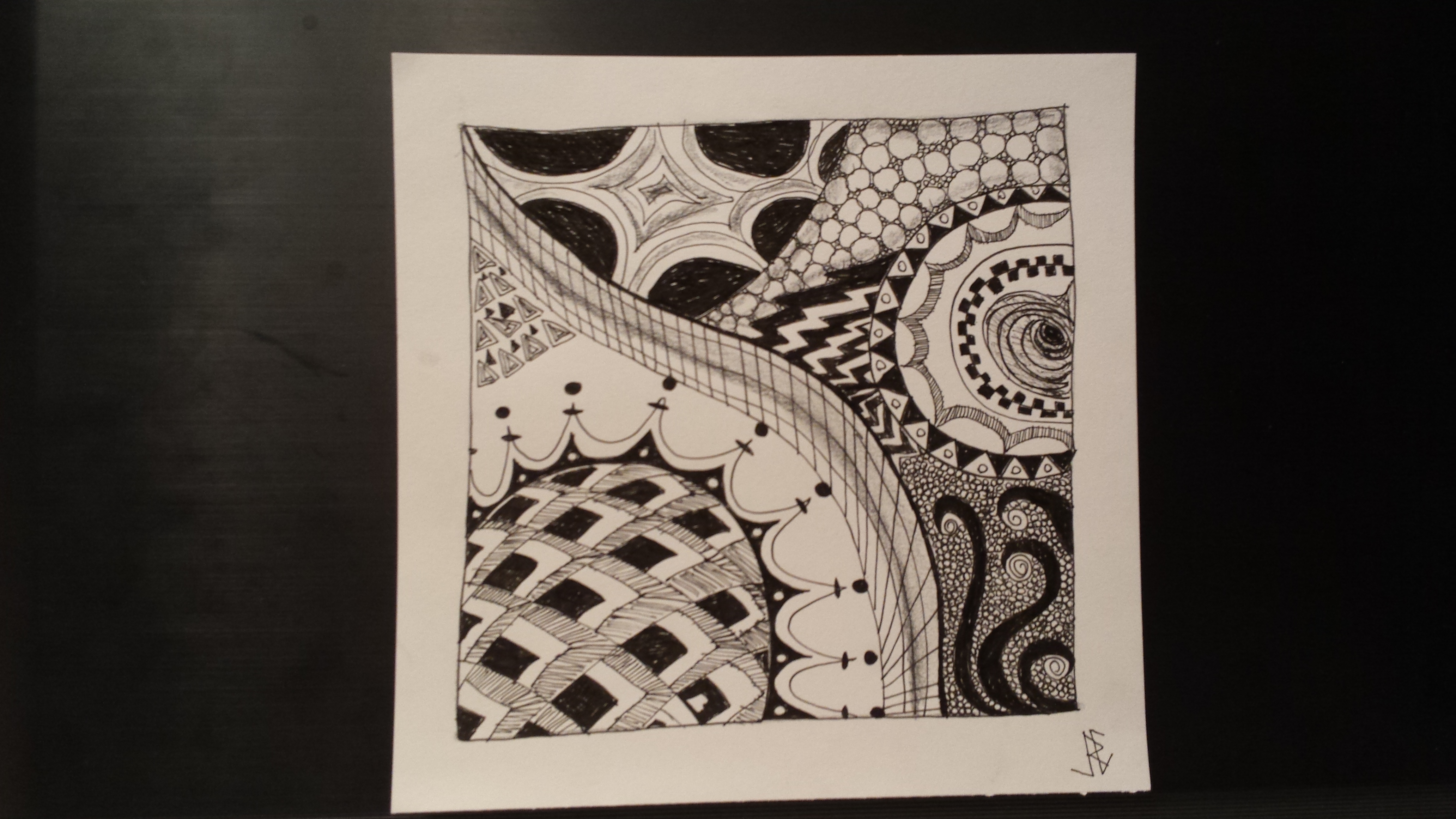
Zentangle 031815

Today I wasted over two good hours of my life that I’ll never get back dealing with people who didn’t want to be dealt with.  I got angsty and upset, and really, that just means they win.  So I came home and did this tangle to de-tangle my brain.  They call Zentangles meditative art, and they work.  If you haven’t tried doing them, you should. (You can get books about them at Amazon.)

Anyone can do them–I feel much calmer than I did earlier.  It doesn’t fix what still needs to be fixed, but I guess some things just happen in their own time.

Sometimes, You Just Need New Eyes

It’s amazing how freeing not writing with your writing-group-as-your-audience-in-mind can be.

My writing group hasn’t been the most productively space lately for me–and for the rest of us, meetings intervene, people are too busy blah blah blah–and I think all of us are struggling with the Zodiac as a writing prompt.  I know it’s killing me–I just can’t think of anything good to say about the constellations or what they stand for.  Bless them, the other three in my group have rallied, and have done some interesting things with the various Signs, but so far, I really haven’t liked what I’ve produced.  (Well, to be fair, I liked my Pisces poem, but the others not so much.)  I’m not sure why I don’t find the Zodiac as inspirational or compelling as it could be–except that (and I’ve mentioned this in previous posts) that I feel like I need something connective to write about–in other words, I need a theme.  The Zodiac could be a good theme, but so far, I’m not moved.

Which brings me back to the first line of this post.  Because I’m not writing with my writing group as my audience, I’m writing some interesting stuff.  Not poems–I think I’m not in a poetic mood lately–but creative nonfiction.  Maybe I’m feeling a little confessional lately–and I feel like I can be that way in nonfiction because I know that the three other people in my writing group are only interested in poetry so they’re not going to be reading these nonfiction pieces.  Somehow I am shy about writing about personal (emotional) things in my poems because they are the first audience who sees what I write–and when I’ve brought them poems about relationships or “my inner self” (gag me, that sounds so pretentious) in the past, I’ve felt like they haven’t responded well.  I may be too invested in pleasing my writing group to be real with them.

But my nonfiction–which so far has an audience of one (me)–is about pleasing me.  I  just completed  a 20 page essay about a previous (and for the most part secret) relationship in my grad school past.  In the class that I’m teaching this semester, about women’s contemporary spiritual memoir, one of the assignments my students have to complete is a spiritual memoir of their own.  And in reading the books with students, wherein these women express their “real” selves, and explore their relationship with their Deities of choice as it impacts on their lives as women, I felt inspired to write a kind of spiritual memoir of my own–one that looks at a relationship about two people whose different religious backgrounds wind up driving them apart.

I know that I need some outside eyes to read it, and to offer me some direction, because I’m aware of some narrative flaws and have concerns about how I represent the religion of one of the characters in the memoir. But those outside eyes, whomever they may belong to, won’t be my writing group. My writing group knows me–or thinks it does–too well, and I need interested but personally uninvested critique.  I’m not sure where I will find a new audience–but there is someone I know, though not well, a writer, whom I’ve approached to give me some insight into how I might develop this essay more fully.  He is going out-of-town, but has agreed to meet with me when he gets back.  And in the interim, I’ll continue to work on it, and shape it.  I think it can be publishable at some future date, and I’m at a point in my life where maybe I’m ok with sharing more of my true self with others.  We’ll see.

I also just wrote another essay, though a shorter one, in which I discuss how my manuscript came to be (the one that I’ve sent to 21 publishers and have so far received 3 rejections for) in relation to a book I’ve just read, Theresa Senato Edwards’ Voices Through Skin, which among other things examines an extremely abusive marriage.  Of course you can never say that the author is definitively the speaker of the poems, but I feel there is certainly an element of autobiography in what Edwards is writing.  In writing my essay, I recognize something about where my manuscript comes from–I really don’t think I had put it together before now, though:  the relationship violence and rape that one of my characters experiences is really a reflection of the relationship violence and rape that I suffered in my own past.  And the way in which the character deals with her sister’s rapist is all about empowerment and justice–the same empowerment and justice that can only come from surviving something horrible.

I’ve never really discussed the abusive relationship I experienced.  I spent years in depression and self-loathing for it; I took cocktails upon cocktails of prescription drugs to dull the pain and more therapy than any three people put together.  Coupled with the depression one endures just from being in grad school, it’s a damn wonder I’m still alive.  I’ve told a few people that I was in this relationship, but always with minimal detail, and it’s not something that you can easily drop into conversation.  In fact, I lost a few friends because they couldn’t understand why I couldn’t just “get over” that relationship.  I’m sure they needed to protect themselves–but I’m also just as sure that they wanted to silence my pain.  Because if I, a reasonably intelligent and educated woman, could fall into a relationship like this, so could they.  And who wants to admit that they are just as vulnerable to being belittled and hit and raped, merely because they are women?

Anyhow in some way, although my book is nothing about me, JC, I think it probably evolved as an imaginative response to the very real horrors of my life.  I’ve written this book years later after that abusive relationship, of course, but you can never escape your past.  Writing this essay where I look at relationship violence and Edwards’ book and my own is really kind of freeing.  At some point in my life, I might write some creative nonfiction about that abusive relationship exclusively.  Or I might not.  Ten-ish years ago is a long time, and sometimes ghosts need to remain ghosts.  But we’ll see.  It helps that if I choose to write about that relationship in detail I don’t have to rely on my writing group for critique or affirmation.  They are just not interested in that kind of writing.

And there are others–out there, somewhere–who are.  And I will find them, and maybe find a new writing group to help me explore the creative non-fiction me as it emerges.

I Also Need a Theme

Since I finished my manuscript, I’ve been literarily adrift about what to write. It would help if I had a theme–I just can’t think of one good enough to sustain my interest.

My writing group’s current theme is the Zodiac, and I can’t tell you how uniteresting the Zodiac becomes when one has to sit down and write a poem based on what sign we’re currently in.  Part of that has to be because in general, I don’t give much thought to the Zodiac.  Maybe the Chinese Zodiac would have been a better topic–at least that’s full of animals, and writing about animals can be a good prompt.  Sure, sure, the general Zodiac has a few animals–Pisces, Aries, Taurus, Leo, maybe a few more I’m not thinking about, but those are much later in the year–well, not Pisces, that’s what we’re in right now.  But what do I have to say about a fish?  I’m not Marianne Moore.

A book of writing prompts could be useful, but I am not often happy with what I produce when I use them.  Not to mention, writing prompts generate many disparate kinds of poems without a central theme… and it’s the theme I am looking for.  After all, I have to find the next focus so I can start on the next book.  I would really prefer it doesn’t take me another four years to write one (like it took me to write this one).

Still, if any of you out there reading this have any suggestions of good writing prompt-y kinds of books, could you leave me a comment?

I Need a Hit

I’m jonesing–yes, jonesing–for an acceptance.  For the last few months, it seems like I was getting an acceptance every other week or so, and it’s been 15 days since my last acceptance (a piece of flash non-fiction).  True, it’s been only 3 days since a rejection, and really, I should be grateful for that, because it means that even if the journal didn’t like what I sent them, at least they read it.  That should count for something, right?

Let’s be honest–the “hit” I want… is for someone to tell me they want to publish my book.  And that it will be a great hit with the publishing world.  That it will get a Pulitzer Prize for Poetry, a National Book Award, Georgia Book of the Year Award, and various other accolades that proves that all the time I spent working on it wasn’t time wasted.  It’s hard waiting to hear back from book contests.  I want to know NOW.

So while I’m waiting more or less reasonably patiently about the book, I feel like every journal I have stuff out at should just agree to publish my work to make my wait more tolerable.  What do you think?  Seems fair, right?  😉

And again, I hope your writing and publishing are going well.  (I know we writers are all in this together.)


Keeping Track

I haven’t been a publishing machine in the months since last I wrote.  That said, I have been writing and sending my work out with the rigor that I should have been applying myself yea these many years.

To wit:

  • Submitted my book manuscript to 18 contests (so far, 3 rejections)
  • Submitted poetry to 14 journals (so far, 7 rejections)
  • Submitted an application to a fellowship
  • Submitted a play to a journal
  • Submitted creative nonfiction to 3 journals (one journal took a story 2 days after I submitted it!)
  • Submitted flash/ fiction to 5 journals

Every time I open up Submittable and I see all my active submissions, I feel a little self-impressed.  Which is not the worst thing.  I need all the encouragement I can get, because the last few rejections have really bummed me out.  (Especially the one I got on Friday which just infuriated me… unfortunately I can’t go into it because there’s no way to be anonymous regarding the journal and say what I REALLY want to say about them.)

What I really need to do is to get some quiet time and try writing something unusual, something hybridy, maybe.  What that would be, I couldn’t say.  Maybe tomorrow…

Anyway, I’m reveling in my dedication.  And I didn’t post this so that I could be all “look at me, look at me,” but just to remind myself that I can make writing a priority, and that it’s good for me.  And, to have a record of it, for when I’m feeling kind of down about my writing successes, or I reach a dry spell.

I hope all of you are having good luck in your writing too.

Why Having Your Mom Read Your Work Is a Bad Idea

So last night, my Mom tells me that she finished reading my manuscript. Here I’m thinking that she’s about to launch into a litany of Mom-like praise.  No.  This is how the conversation went (and apologies for any spoilers… please don’t let that stop you from buying my book when it eventually comes out):

Mom:  I couldn’t believe that ending.  I kept reading and saying Oh, my God!  Oh, my God!

JC:  What do you mean?

Mom:  I had no idea!  I didn’t see it coming! Oh, my God!

JC:  What do you mean, you didn’t see it coming?  She talks about revenge!  She’s plotting!

Mom:  But killing him, for breaking her sister’s heart?

JC:  No, Mom, she kills him because he raped her sister!  That’s why she’s getting revenge!  And he killed her other sister!  He ran her over in his car!

Mom:  He did?  He raped her sister?  I didn’t see that.  And he killed the other sister?  I mean I knew she died…

JC:  Did you read this book?  The rape is not explicit–it happens “off stage,” but he admits it to his friend…

Mom:  I guess I’m just too pedestrian. [Whatever the hell that means.]  Guess I’ll have to read it again and look for the clues.

JC [trying to sound gentle]:  I’m sorry it upset you. [Look for the clues???  How could you miss them?]

Mom:  Of course I’m upset!  She cut him open!  She chopped him up!  I had no idea!  You should have given me a synopsis before I read this book.  It was too graphic!

JC [a little petulantly]:  But you knew she was going to get revenge…

Mom:  Yes, but I thought it was going to be a spell.

JC:  Well, it was a spell.   She poisons him after she does a spell.  And anyway, he was dead before she chopped him up.

Mom:  I just don’t read things like this… I mean you know these things happen, but I don’t read about them!…Before I share it with [a mutual friend] I’m going to have to warn her. She won’t expect it–it will upset her.

JC:  [Good grief.]  Ok, Mom.

I am somewhat bemused by this conversation–it’s kind of funny, but it’s also a little hard to take.  I mean, if you pay attention at all, there are plenty of signs that the main character is just biding her time (à la Hamlet) until she’s ready to exact revenge on the bad guy.  Ok, so maybe the dismemberment was a little over the top, but at the same time, I tried to write it bloodless–that is to say, very matter-of-fact, very much like reporting what was happening (as opposed to poetic editorializing) to demonstrate how clear-headed she was in carrying out her revenge.  Like I could have been gruesomely graphic, but I tried to be restrained. (As an aside, let me say, one of my writing group members thought I should rewrite this section to make it more trance-like, as if she were doing this murder in a dreamlike state.  But that would never have worked, a) because I don’t write in fragments, and b) that is not how this character acts.  She’s completely within her faculties–which I think makes the scene more chilling, because she’s perfectly clear-headed in the process.  She’s not some kind of psycho-killer.  But I digress.)

The point is, of course, that audience matters.  Clearly, some Moms aren’t the audience for books that examine instances of violence.  My Mom despises violence–she runs out of the room, for example, when something scary or possibly bloody is about to happen on the TV.  And while I think that’s an extreme reaction, I suppose, knowing this about her, I should have expected a reaction like this one.  I should have expected it, but I didn’t–so I didn’t think to “warn” her about the murder–although, I also think if she had been reading more carefully, she would have realized what was going to happen.  For heaven’s sakes, that particular part is called “Blood Will Have Blood.”  Like duh, what did you think was going to happen in something that quotes from Macbeth??

Mom was also upset, I think, because there are no repercussions (at least, in this book–and no, that’s an oblique comment promising a sequel, by the way) for the murder.  The character does, in fact, “get away with it.”  And I’m ok with that.  I think my Mom’s sense of justice doesn’t like that she escapes her actions with no downfall, or at least, no real commentary about it.

But I’m not interested in the main character’s punishment–I don’t think she’s unjustified in her actions–and human “justice” is not what this book is about, anyway.  It’s about supernatural justice–not divine justice, make no mistake–she does invoke the Sign of the Goat/ the Dark Mother, after all.  And also, this is not a Greek tragedy.  Apologies to Aristotle, but it’s not hamartia for her to kill him who needs killing.  And anyway, if you kill without your soul, you can kill in “good conscience,” because in fact, no soul equals no conscience to be damaged.

Poor Mom.  She said, “I never knew I’d have a daughter who could write like something like that.”  Oh, if you only knew.

If I Were Virgil Suárez

My poet friends used to joke that if you wanted to get your poetry published, all you had to do was put Cuban-American poet Virgil Suárez’s name on your submission.  For a while, it seemed like no matter what literary journal you picked up, there would at least one poem by him included–and it didn’t matter what the journal was–it could be a nothing-in-particular start-up journal, or it could be the Prairie Schooner.    I also heard–though I can’t substantiate it–that he had this scary complicated system for submitting his works… and gasp, he simultaneously submitted (back when that wasn’t a thing). The point was, he was very good at placing his work.

I don’t know what Virgil Suárez has been doing lately poetry-wise (his last book of poems came out in 2005)–but according to his Florida State University webpage, he’s just published a book called The Soviet Circus Comes to Havana and Other Stories (C & R Press, 2014) ($15.95 on Amazon)–so, at least I’m not competing for space in journals because of him.

But I am competing for space in journals… and losing, based on the two rejections I received today.  One rejection said that they didn’t “love the piece enough” to send it on to the next level of discussion; the other one praised the “ambition” of the work, but then stabbed me in the heart with the criticism that they found my work “too prosy.”  That just struck me as wrong.  My writing tends to be narrative, but it’s in no way “too prosy.”  I know from prosy–after all, I see student creative writing all the time–talk about prosy!  But of course, journal editors are human, and humans are subjective.  I wasn’t overly bothered by the rejections–submitting is a game to me at this point.

Not that I in any way mean that I don’t take the submission process seriously–I do.  I do research on the journals I submit–I generally try to read them before I send them my work.  But I guess as a writer you just get to the point where it’s all just a game–trying to figure out what certain people will like based on what they showcase in their journals.  If I were the Virgil Suárez of the past, that machine of publishing, I might just send my work everywhere, scatter-shot, and hope something sticks.  I might have a hugely complicated Excel file that lists every journal everywhere, and I might cross-list all the poems that I’ve simultaneously submitted–perhaps the same batch of poems for 15 different journals, and have 80 such batches sent out at once.

But that is gamifying the publication process way to much for the likes of me–that’s a little like playing all the numbers in the lottery.  It might work–and maybe if I were that mono-focused, I could do that and be published far and wide in any number of start-ups and well-established journals.  But on the other hand, my very analog system–I put all my submissions on index cards filed alphabetically by journal–seems to work for me.  I can manage that.  I feel good about my process of reading submission calls, reading the journals whose calls interest me, and submitting my work to them.

It may not net me a lot of pubs, but it feels like an accomplishment when I see all my index cards, even the ones that fall under the “Rejected” tab, as today’s two rejections now do.