Dispatch from Edinburgh #2–Return to Mull & Iona

I know I said I was going to write about the Isle of Skye next, but my trip to the Isle of Mull and Iona is on my mind, so I’ll come back to Skye.  (I will always come back to Skye—that place is amazing.)

For this trip, I took a train over to Glasgow to pick up the Rabbie’s tour which was leaving at 9.  But my train was at 6, which meant I left my flat at 5 and walked to Waverly Station at a slow pace to accommodate my dumb foot.  The 6 o’clock train was an “express” which meant it only made 5 stops, as opposed to later trains which would make more like 13 stops and would take up to an hour and a half to get to Glasgow.  The last time I took a regular train to Glasgow we had a 30-minute delay, and I didn’t want to take the chance that might happen again. I made it with no trouble to Glasgow, though, walked to the bus station and, like John Lennon, “[waited] for the van to come.” Fortunately, I got to the bus station before it decided to rain like hell.

When our tour guide arrived, he was great fun from the get-go.  He asked where people were from and did a find job of remembering everyone’s names.  And then he said something which totally surprised me.  He said, “I’m not going to say anything that JC Reilly doesn’t already know.”  I said, “What?”  He added, “She’s been on 50,000 Rabbie’s tours.”  And then of course he continued the joke to say that I had also been to Vegas, and what happened in Vegas, stayed in Vegas.  It got a good laugh from everyone, but I was mystified, because how could he have known that I’d been on so many Rabbie’s tours in the past?  I was determined to figure out this mystery. (Turns out, he looks people’s Rabbie’s records up before a tour and saw I had been on a ton—so he thought he would yank my chain a little.)

We made our first “comfort break” at Luss, which is on Loch Lomond, and it’s a card-only payment to get into the bathroom.  But the card-reader wasn’t working.  So I thought I would use the baby-change/ handicapped bathroom, but as I was about to put in my 50p, the woman who came out gave a scathing review of the bathroom—there was something foul all over the floor (the toilet was leaking).  She said, “It’s grim in there,” which was remarkably subdued for a Scot to describe something, and then she and I had a nice little blether right there in front of the bathroom. She said she thought I was Scottish but then picked up on my accent, and asked me about home.  She wandered off to get someone to clean up, and I decided the smart thing I would do on a full bladder was buy a 2 liter bottle of seltzer water.  Because that makes sense.  But I did eventually use the bathroom and it was fine. And you might ask, why did I share this?  It’s because talking with strangers would wind up being a theme for the weekend.
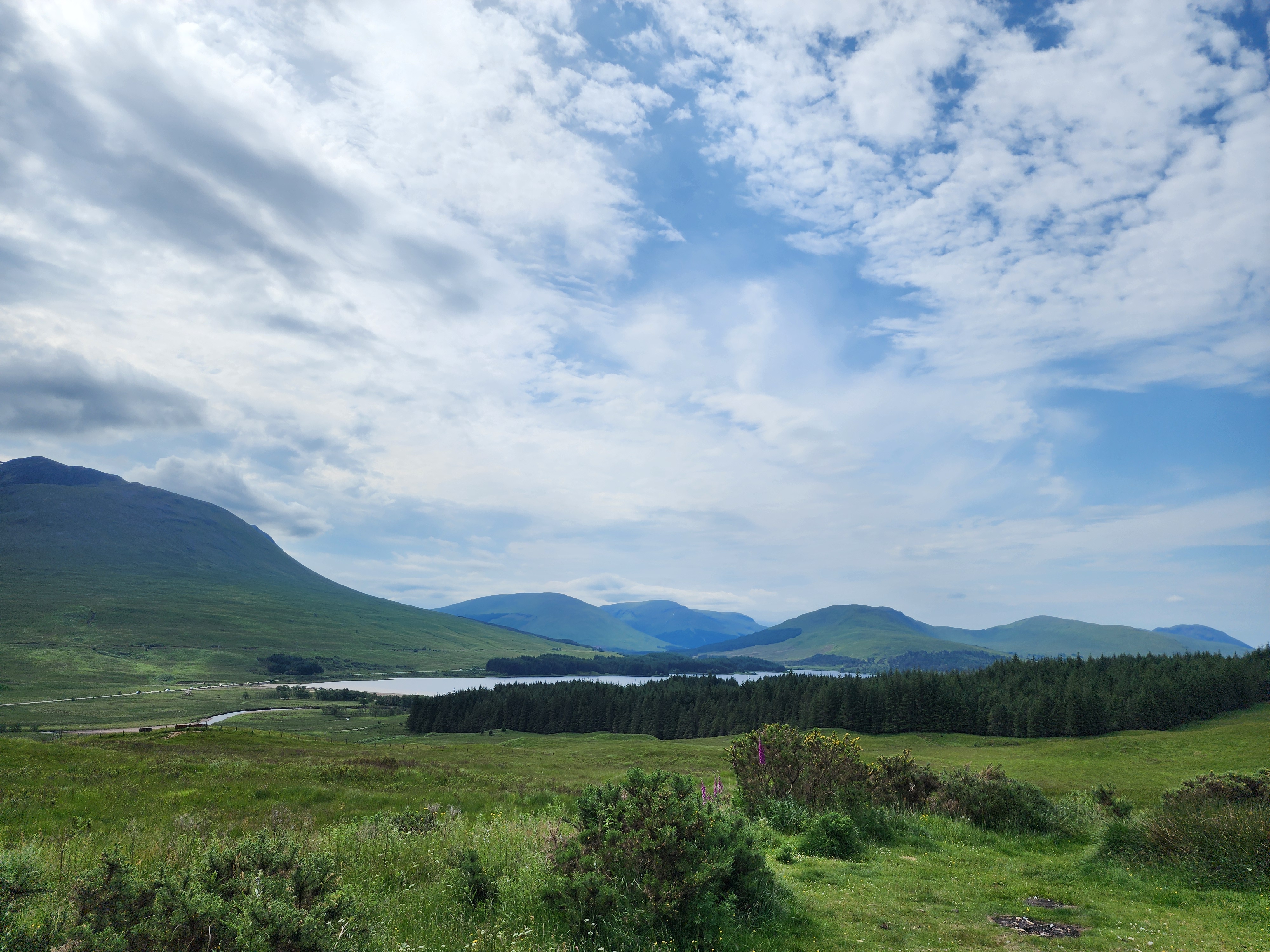
A landscape of a distant loch with mostly blue sky and some mountains

Loch Tulla

I’ve not mentioned this before, but the trip up North to the Highlands has two paths—either you go through Glen Coe (on the A82) or you go through the Cairngorms (on the A9), although it basically makes one big loop.  After Loch Lomond, we drove up to a viewpoint at Loch Tulla, and then through Rannoch Moor, where we stopped to see Etive Mòr.  Besides being the most photographed mountain in Scotland, as I mentioned in the previous blog, Etive Mòr has the distinction of being featured in Skyfall, the 2012 James Bond movie, and our guide, Nick, was very good with the tunage, because he played Adele’s song “Skyfall,” which I’d never heard before (because I live under a rock) and I liked it a lot (though it was a big repetitive)—very appropriately Bond-ish. I didn’t get out of the bus to take another picture, but I did enjoy seeing the mountain again.
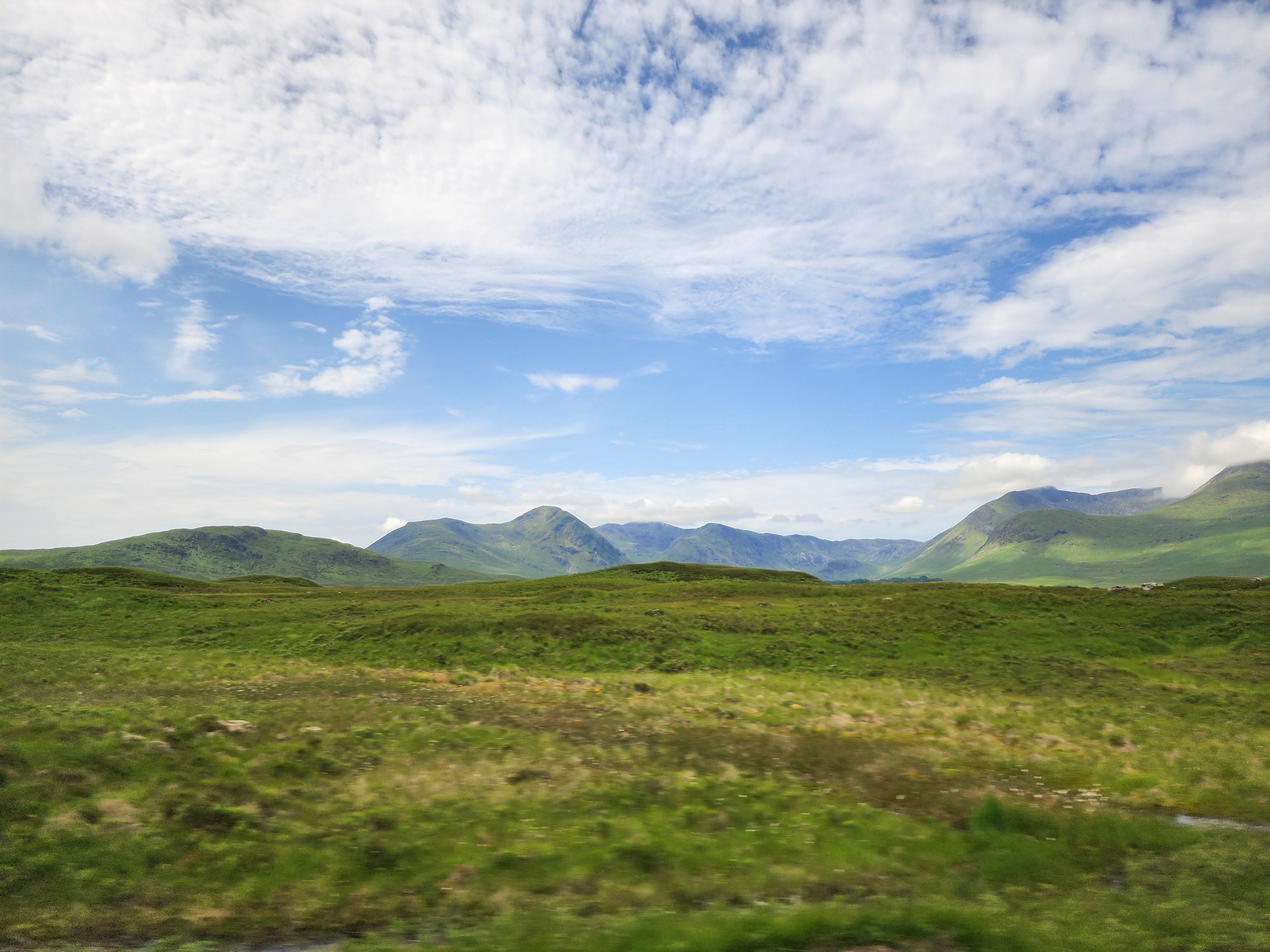
Landscape with mountains in the background and Rannoch Moor in the foreground

Rannoch Moor

Then it was off to Glen Coe to see the Three Sisters.  By this time, the rain had burned off, and the Three Sisters stood in their majestic sunny glory.  What was unusual this time at the mountains was that a man in full kilt played the bagpipes—badly.  Nick, walked past me and said in a low voice, “It’d be guid if he could fookin’ play the bagpipes right.”  I had to smile—Nick was so vehement!  The poor playing did not, however, despoil the beauty of the Three Sisters, and actually, even though the piper wasn’t so great, I thought it was nice that he was out there piping away.  His collection plate was pretty bare—but that didn’t seem to stop him from doing his busking thing.

After I enjoyed (?) a plate of interesting Scottish nachos (fortunately haggis free) at the Glen Coe Visiting Center (sorry for no photo—I couldn’t find my phone, but the chips were like 1/2 inch triangles), we continued on our way, driving on the Ballachulish Bridge over the narrows of the saltwater Loch Linnhe (pron. linny) and Loch Leven, a bridge that I’ve been over before, but I hadn’t heard this story which I’m about to relate.
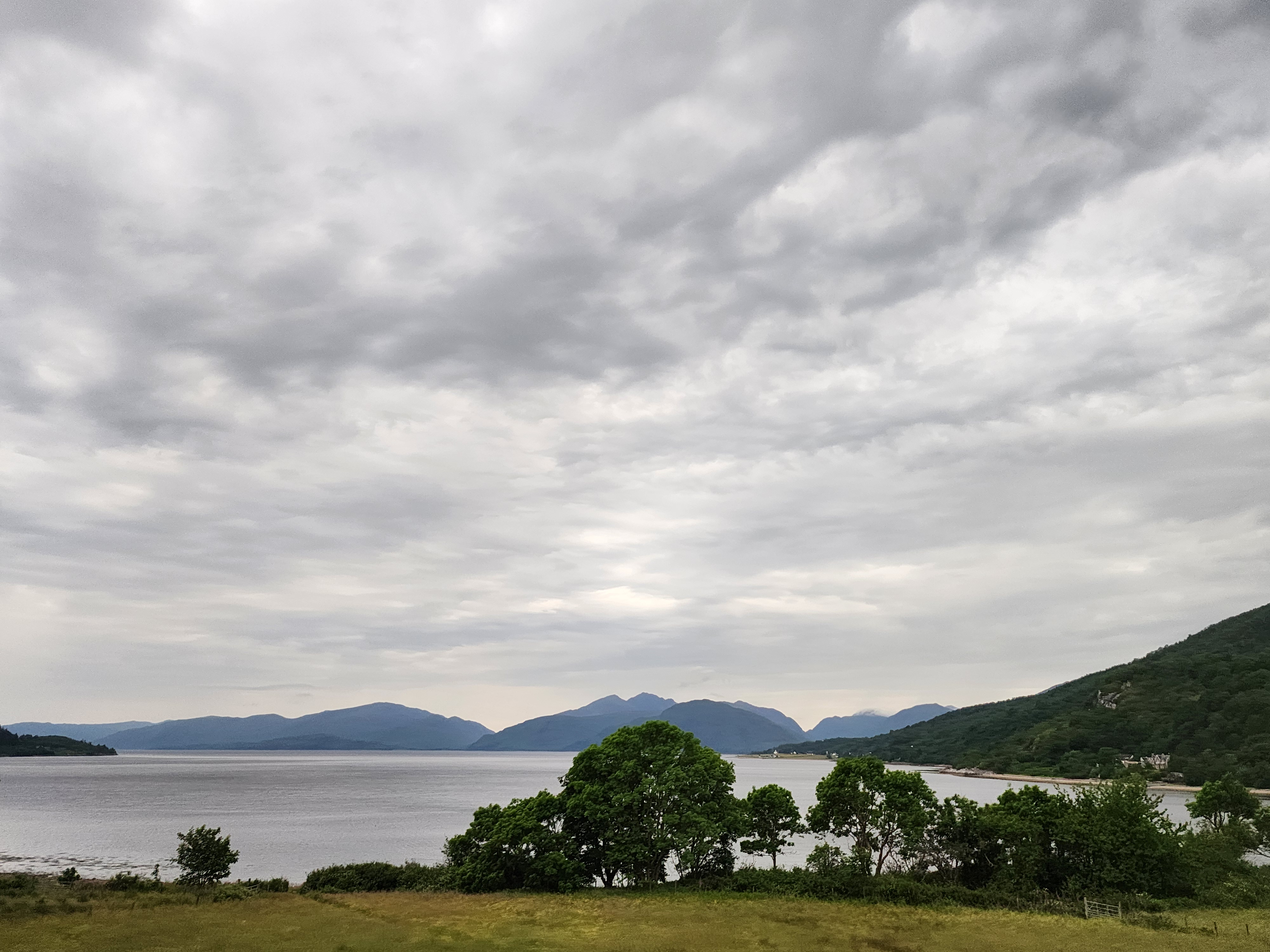
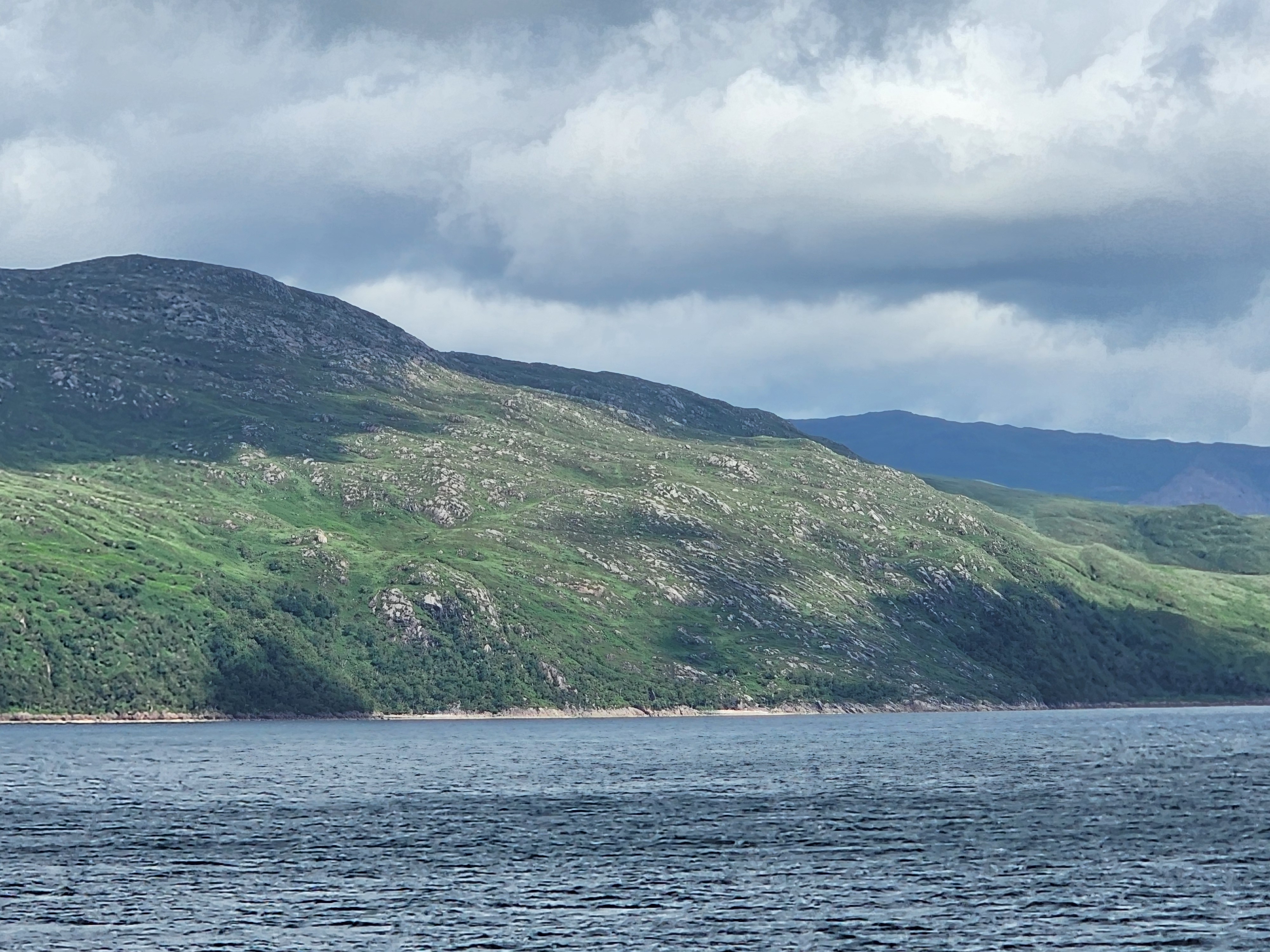
view of Loch Linnhe, with mostly clouds in the background

Loch Linnhe

Apparently, the residents of this area were very superstitious and never wanted a bridge, because it had been predicted that if a bridge was completed over the Loch, danger and heartbreak would befall the town. (Faeries might have been involved.) But with the closing of the Ballachulish ferry, people still needed to cross the water. So when the Cleveland Bridge & Engineering Company talked to the locals, they learned about this superstition, and honored it: when they built the bridge, they left the last bolt off, which meant the bridge was not complete, thus keeping the town safe.

We finally got to the ferry point; first, we took the 3-minute Corran ferry ride, then we drove a bit more to get to the second ferry, this one which dropped us off at Fishnish (?) on Mull. (It might have been the Lochalline-Fishnish ferry, but I’m iffy about the placenames.) Whatever ferry we sailed on, we got the chance to get out of the bus to sit in the lounge on the port side.  It was raining so hard by this point that you could not even see the horizon—it was just a wall of water.  But 20 minutes or so later, we were back on the bus and driving off the ferry to make the 17 mile trip to Tobermory where our accommodations were. Unfortunately, while my B&B was very nice, it was at least a 20-minute walk for a person with good feet down a steep, steep hill (meaning coming back up would be a nightmare) to get to the harbor at Tobermory, so I just decided I would do without dinner because I wasn’t going to be walking.

Another person on the tour staying at the B&B, Victoria, knocked on my door and asked me what my plans for dinner were, and I told her that with my foot, that I was just going to stay in for the night. She offered to get me something but I said thanks anyway, and she toddled off.  But much later I heard a tiny knock on my door, and she had shown up with a sandwich and “crisps” for me.  Her kindness floored me—and she wouldn’t take any money for her gift. I was so touched.  And believe me, it was the best “British Pork and Mature Cheddar” sandwich (minus the pork) I’d ever eaten.  After that, I slept.

At 8:40 the next morning, Nick picked us up and we went around Tobermory and gathered the other tour members. It was drizzly, although the sun peeked through here and there. Normally on this tour, we’d have taken a boat ride to the Isle of Staffa, and I was looking forward to going, because the last time I went, I didn’t feel well (and I neither climbed up the scary steps to get to the top of Staffa to see the puffins, nor did I risk the long but tiny path around the side of Staffa to explore Fingal’s cave). This time I had planned on being brave and trying to walk to the cave (even with the bad foot), but because of the unpredictable weather and choppiness of the sea, the voyage was canceled. Everyone on the tour was disappointed.  But Nick planned for us to visit Duart Castle instead.
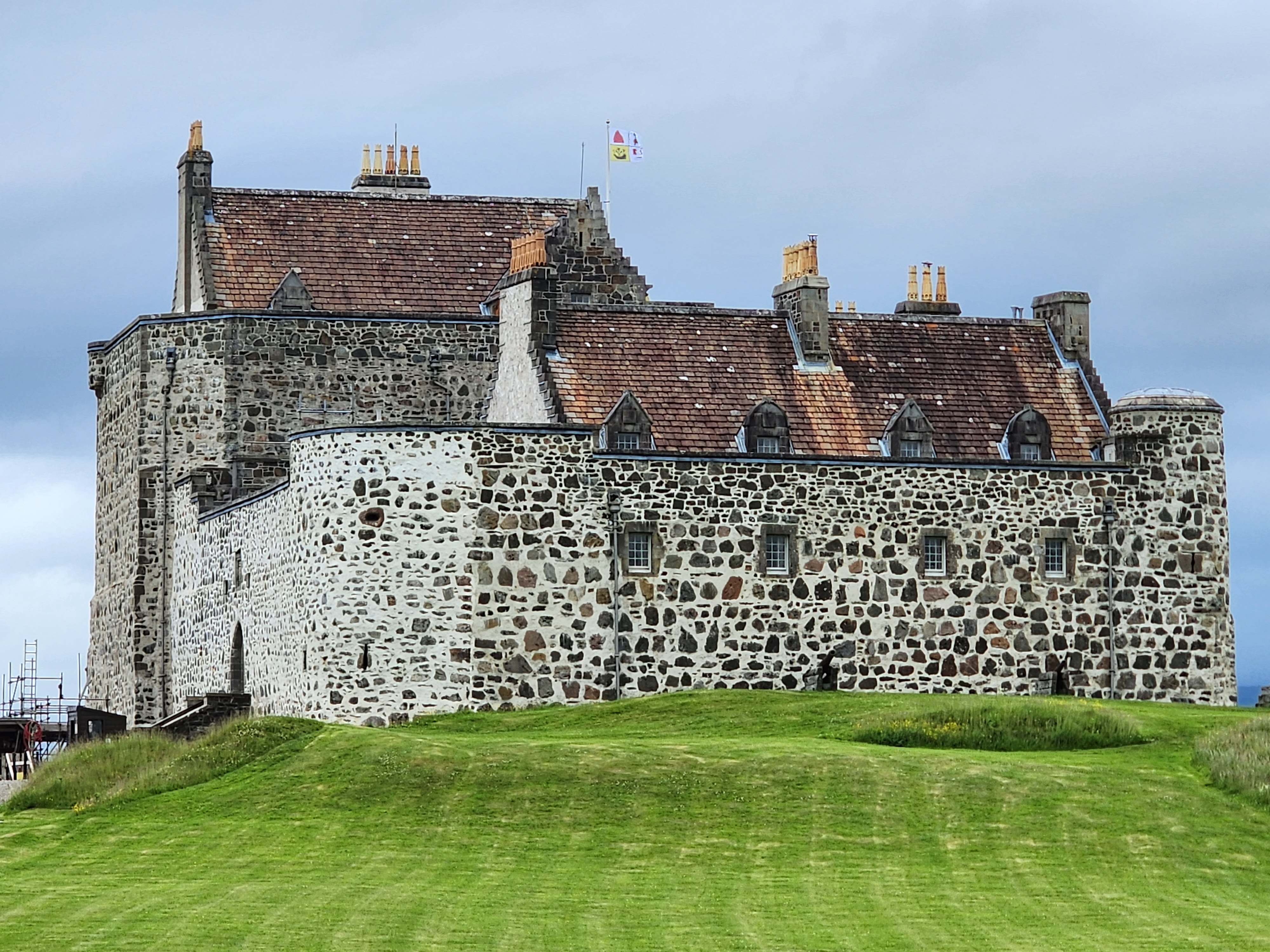
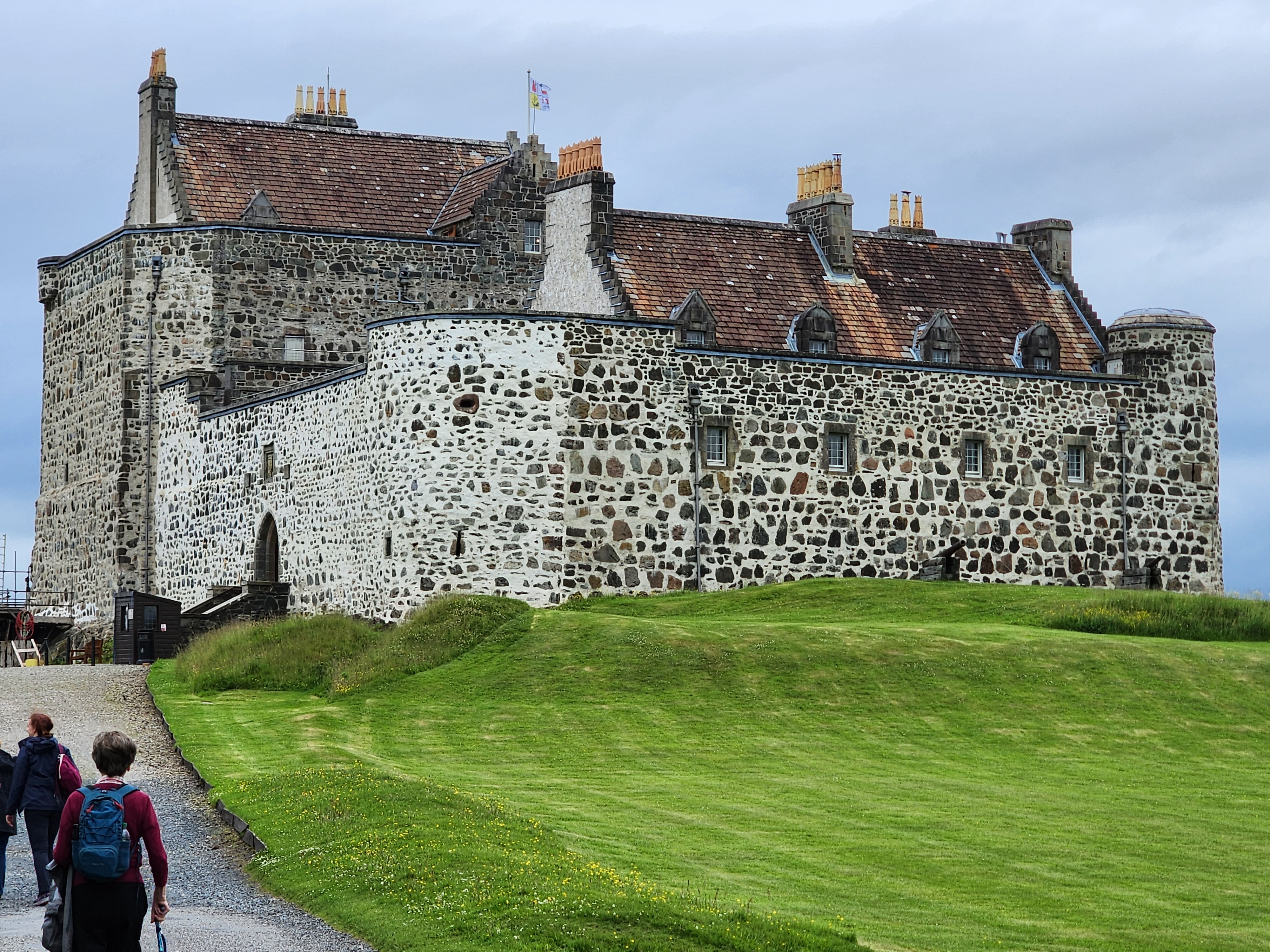
Southern view of Duart castle on a grassy lawn

Duart castle (south view)

Duart is, as castles go, a moderately-sized castle with some white-washed walls. It is the ancestral home of Clan MacLean (pron. Mac-layne) that dates from the 12th century and it sits on the tip of a peninsula that juts out in the Sound of Mull. It was used as a home well into the 20th century.  The first room you enter is a small kitchen with a coal hob, used up until 1960.  It’s hard to believe that a kitchen that small served a castle, and I read on one of the notes on the walls that by the time the food reached the dining room (which was another floor or two up), the food was often cold.  (So you can imagine that water for baths would also have been cold!) Living in a castle, while the dream of every young girl (and old girl like me) could not have been particularly comfortable or cozy. But early castles were built for defense, not luxury, after all.

The ground floor also contains the dungeons and small jail cells that a person could barely sit in. But after you pass through the dark and dinge, you climb up the stairs into the Pantry and Sea Room, which was a later addition to the castle, allowing for a beautiful view of the Sound and Loch Linnhe. I sat there as the castle guide talked about the restorations of Duart Castle and looked north out into the Sound.  At the very far edge you can see Ben Nevis, and somehow the guide was quite pleased that we could see Scotland’s tallest mountain, despite the clouds.
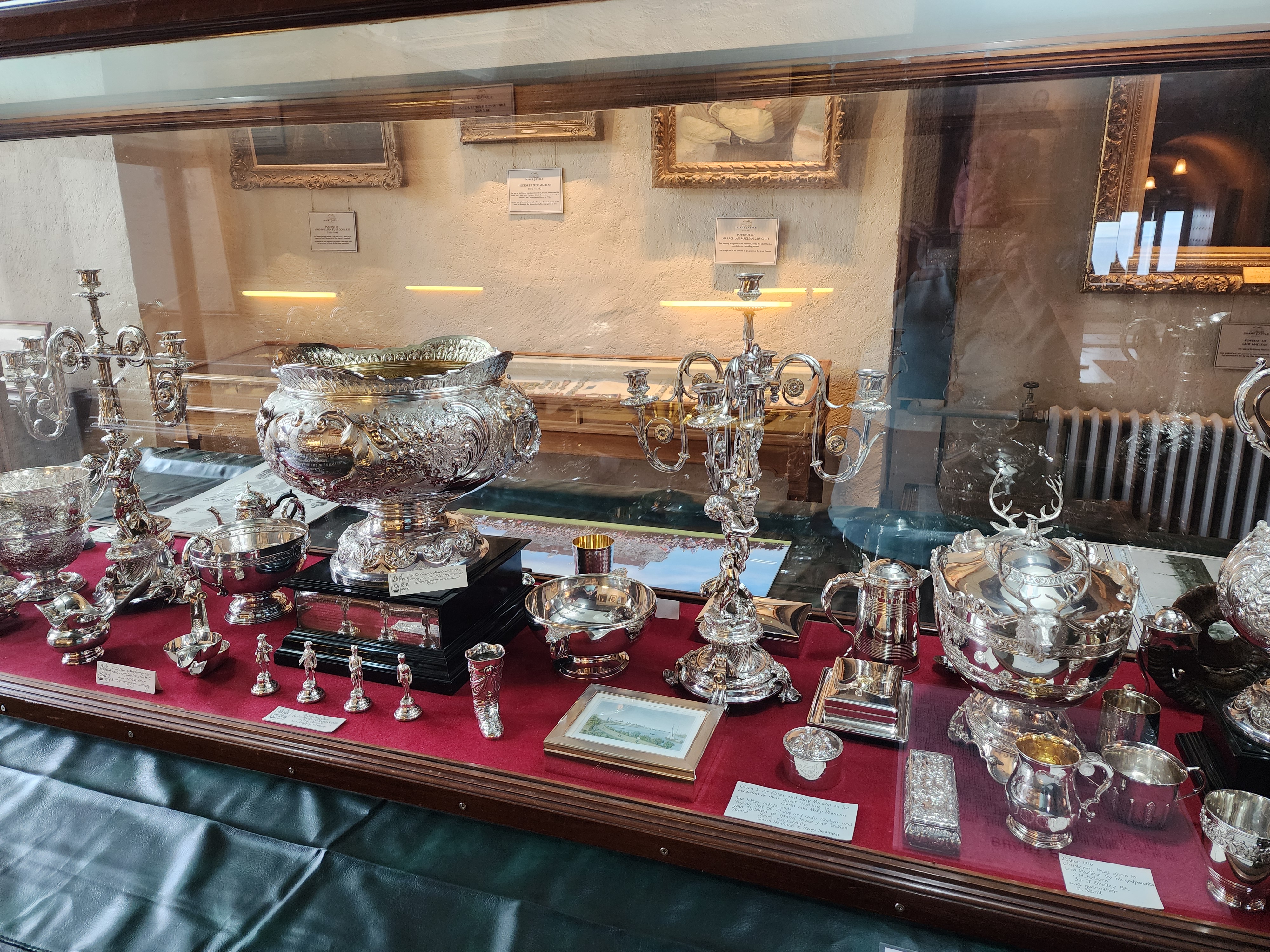
A glass case filled with silver soup tureens and pitchers at Duart Castle

Silver service at Duart Castle

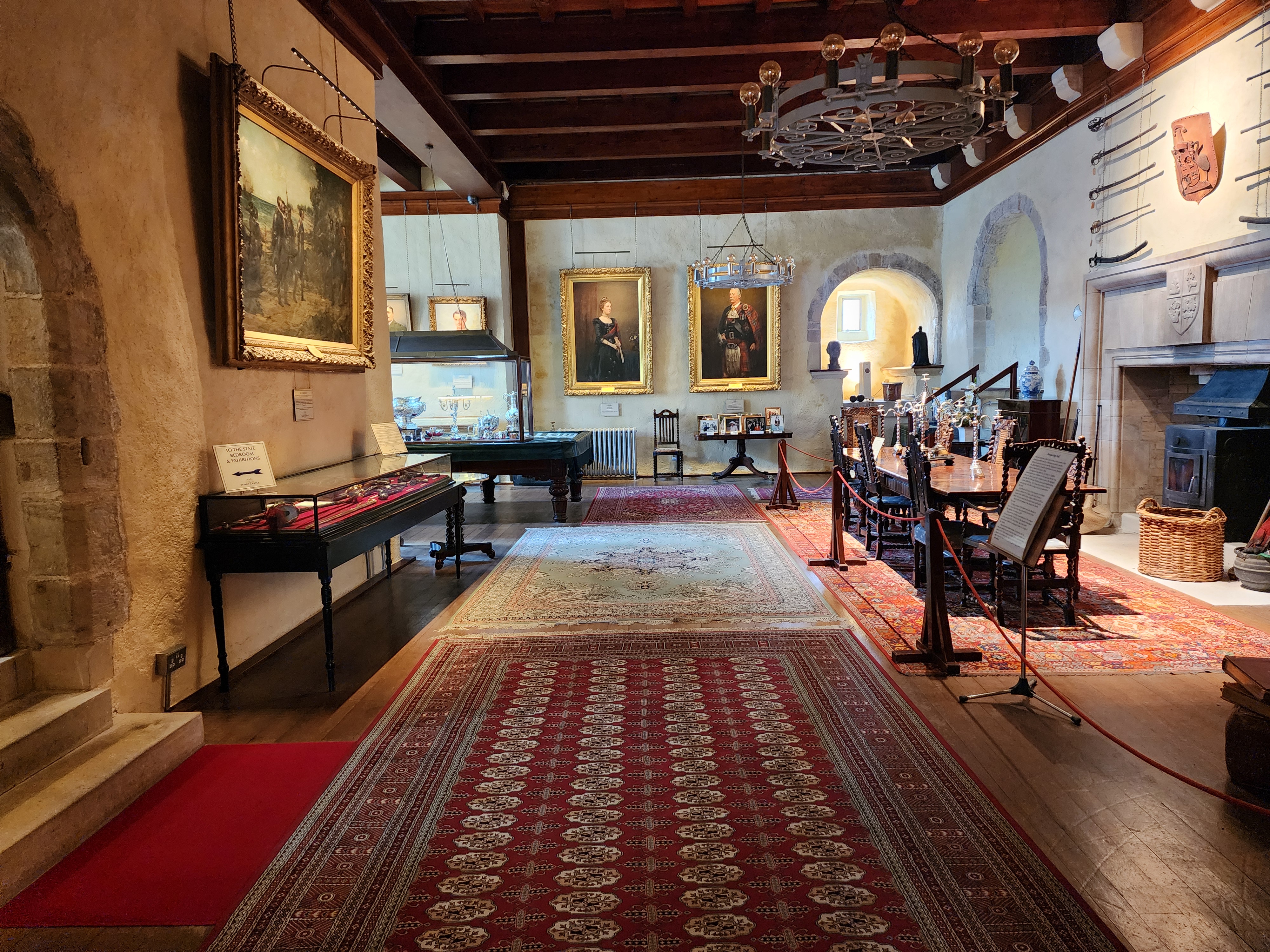
The Sea Room leads into the Great Hall (which included the dining room) which impressed with its antiques and silver, although it was not overly large.  There was a fire going in an iron stove and it smelled woodsy and wonderful, and helped chase the chill from the room.  In cases were jewelry and weapons and on the pool table was a glass case full of silver tureens, pitchers, bowls, and other table settings. But my favorite thing was a large smoky quartz brooch that a person would wear on their cloak.  They offered a replica of it in the gift shop, but it was a little out of my price range, especially because it wasn’t silver.
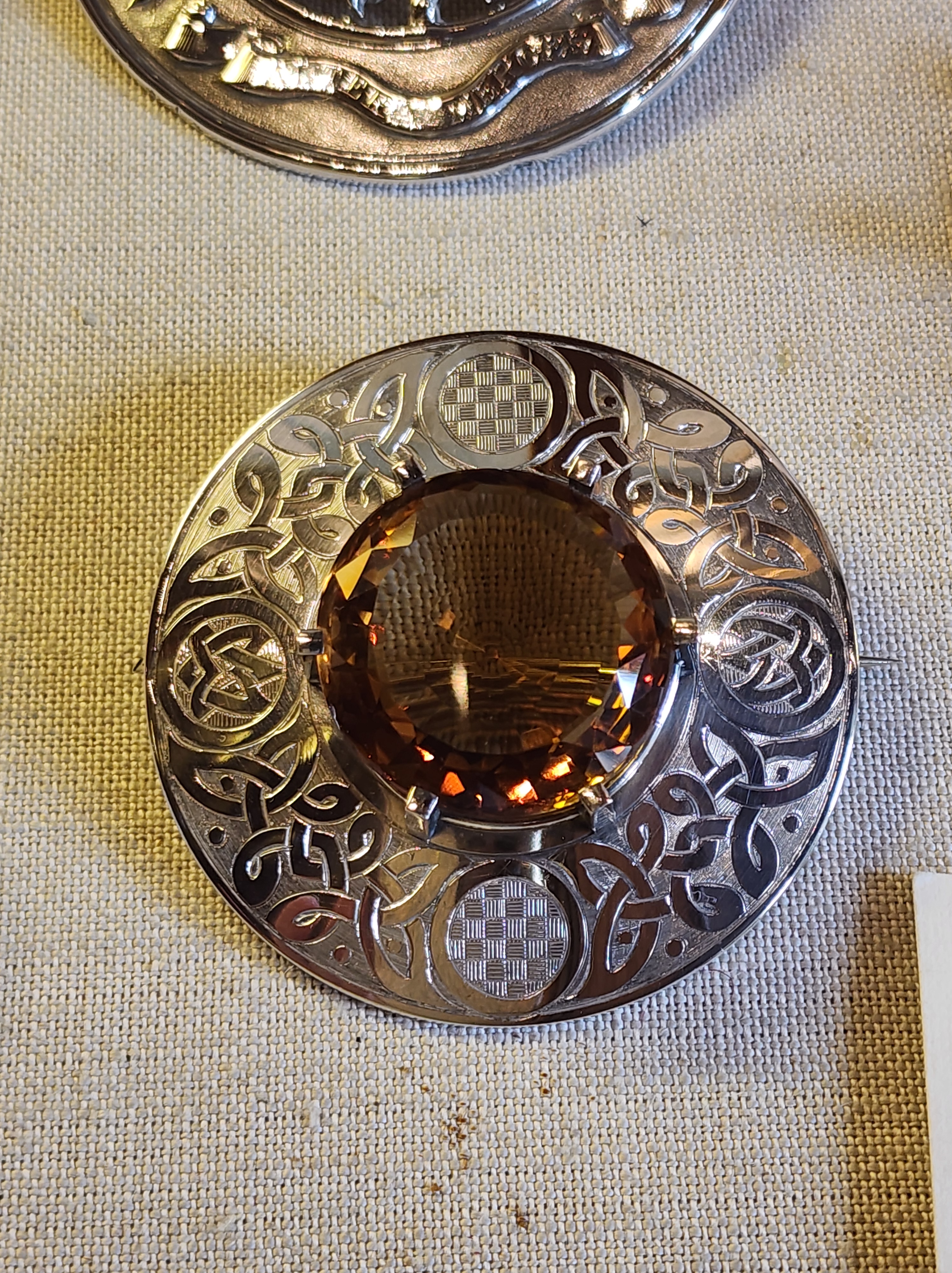
A large silver brooch with a huge smoky quartz jewel

Brooch

Upstairs were the bedrooms/ staterooms for guests, as well as the bathroom that still had the toilet, tub, and sink from the 1912 renovation by Sir Fitzroy, the 26th Chief.  I didn’t go upstairs to see them—I watched a video—because to get there you’d have to climb  a spiral staircase with a hand rope, and I didn’t think I could manage it.  After visiting the Great Hall, I left the castle and went to stand at the battlements and look out over the water for a bit before going into the café for a cheese scone.

And then we were off to Iona.  The CalMac ferry only took about 20 minutes to get there, and because we didn’t have a trip to Staffa in the offing, Nick gave us over 3 hours on the island.  This visit I was determined to see the Abbey—the last time I was there (2023?), we’d only been given an hour for lunch on the island because we needed the rest of the time to get to Staffa, and so I didn’t get a chance to walk there. This time, I was going. It had grown cold and windy though, so the walk to the Abbey was bracing. I found a bench across from the hotel gardens and enjoyed the many dogs that walked by, but eventually after resting my foot, I continued the walk and got to the Abbey itself.
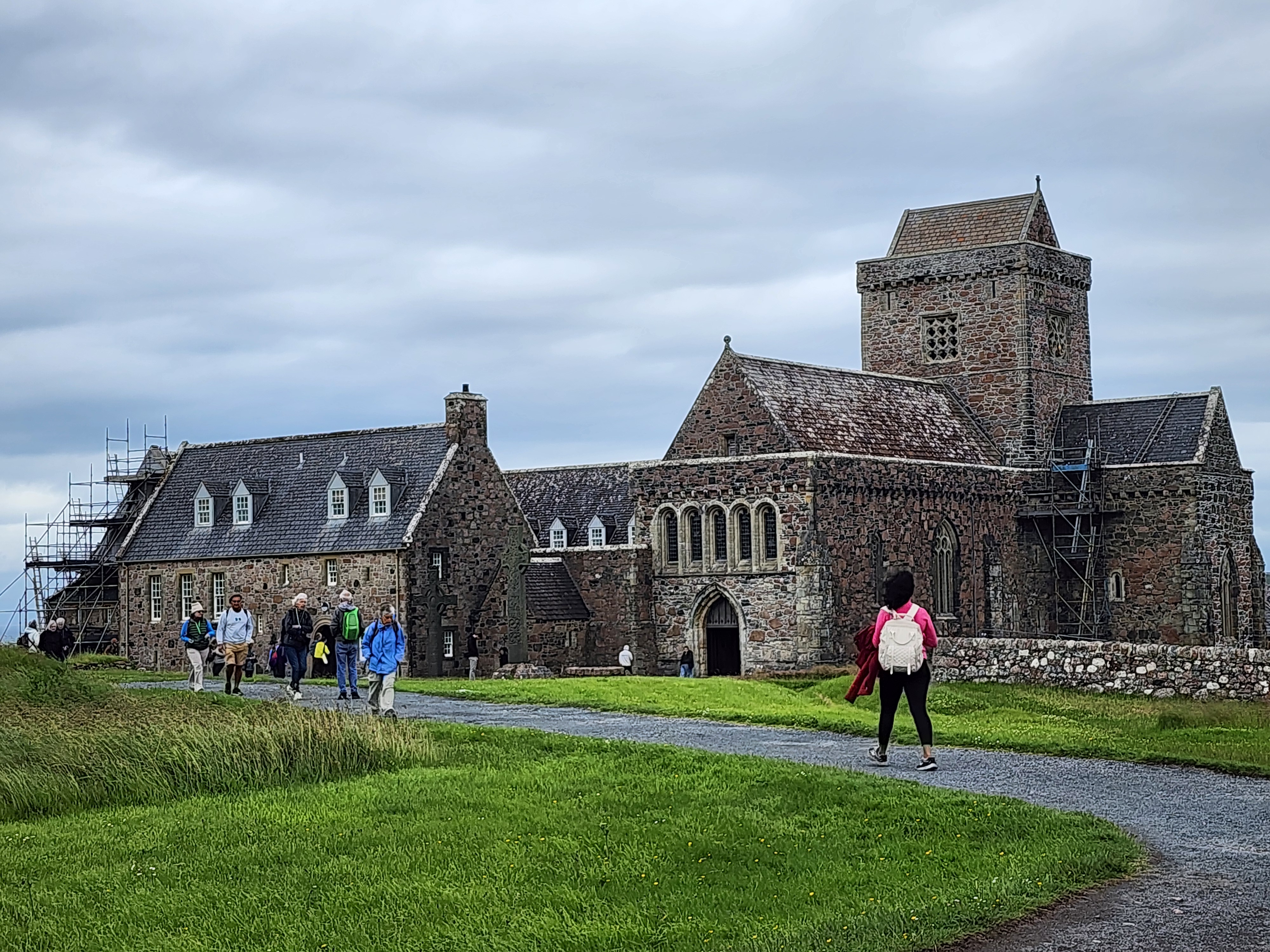
View of Iona Abbey in Scotland

Iona Abbey

Iona Abbey is smallish, but appropriately sized for being the first Christian site in Scotland.  Apparently, how the aristocratic St. Columba chose its spot had to do with his wanting a place from which he could not view Ireland anymore (he had been chased out of that country over a plagiarism dispute around 560). Unfortunately, he chose a site on a dark, dreary day; when the sun came back out, he could see Ireland after all, but he chose not to move his community.  The Abbey dates from around 1200, long after St. Columba’s time.
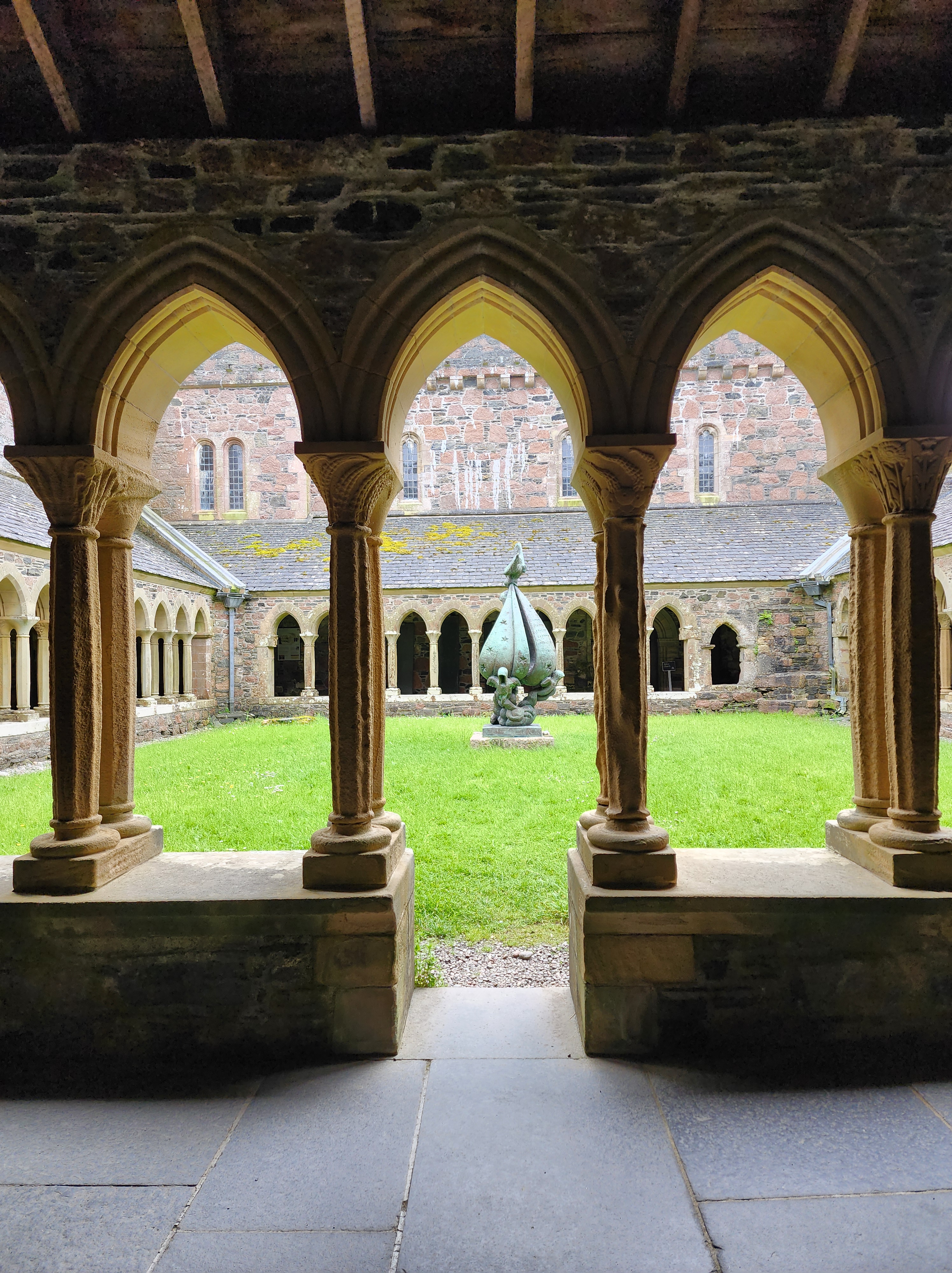
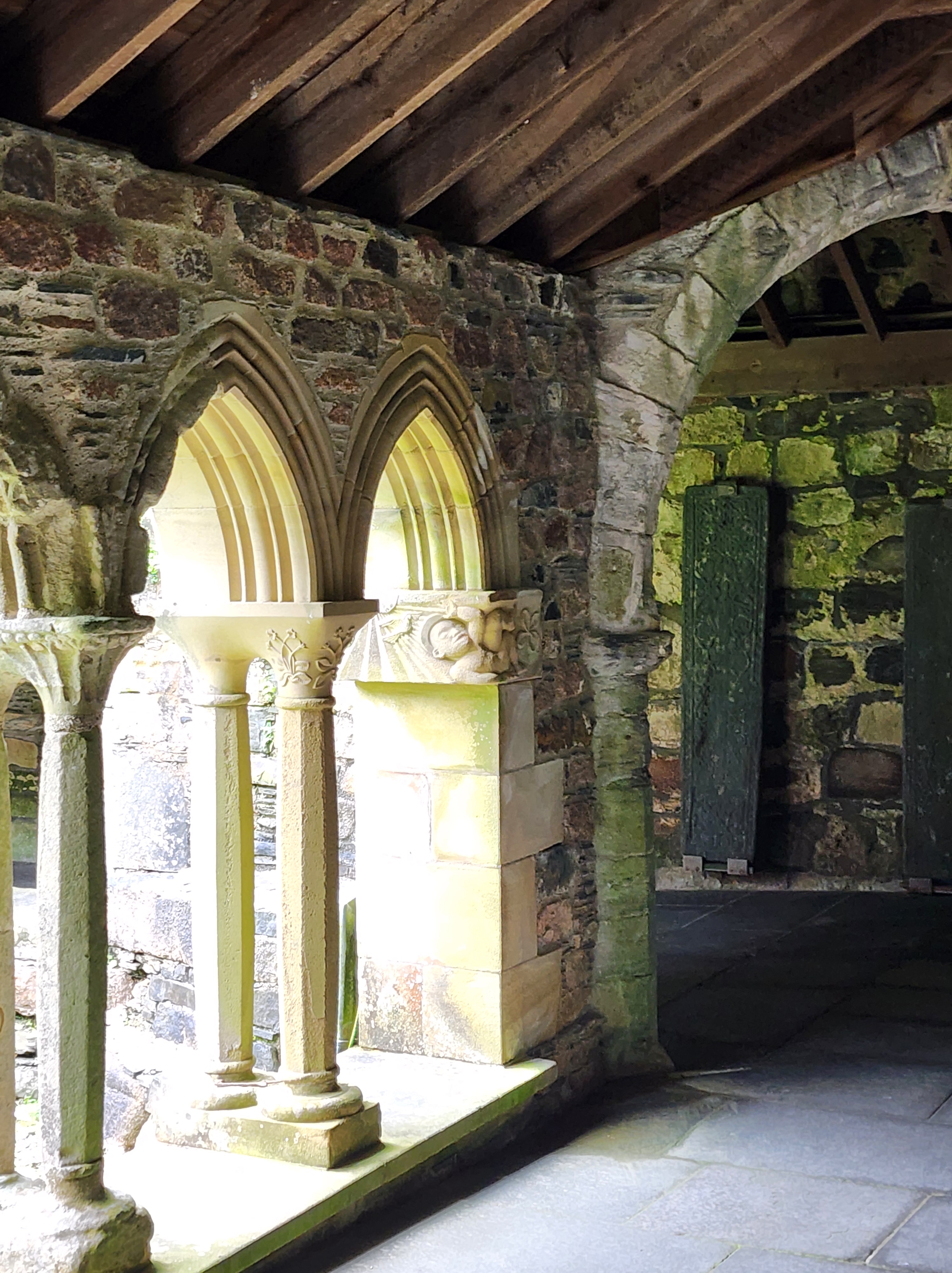
A view of a courtyard with arched entry ways in the foreground

Iona Abbey Cloisters

I walked around the cloister which faced a courtyard with a statue in it.  On the walls were gravestones, but they were mostly unreadable. The cloister connected the monks’ cells with the church and offered a space for prayer and quietude.  The gift shop was an offshoot of the cloister; you almost wouldn’t know it was there except that the door was open.  I poked around inside, and then wandered into the Church and said some prayers for my family, and my kitties, and the world at large.
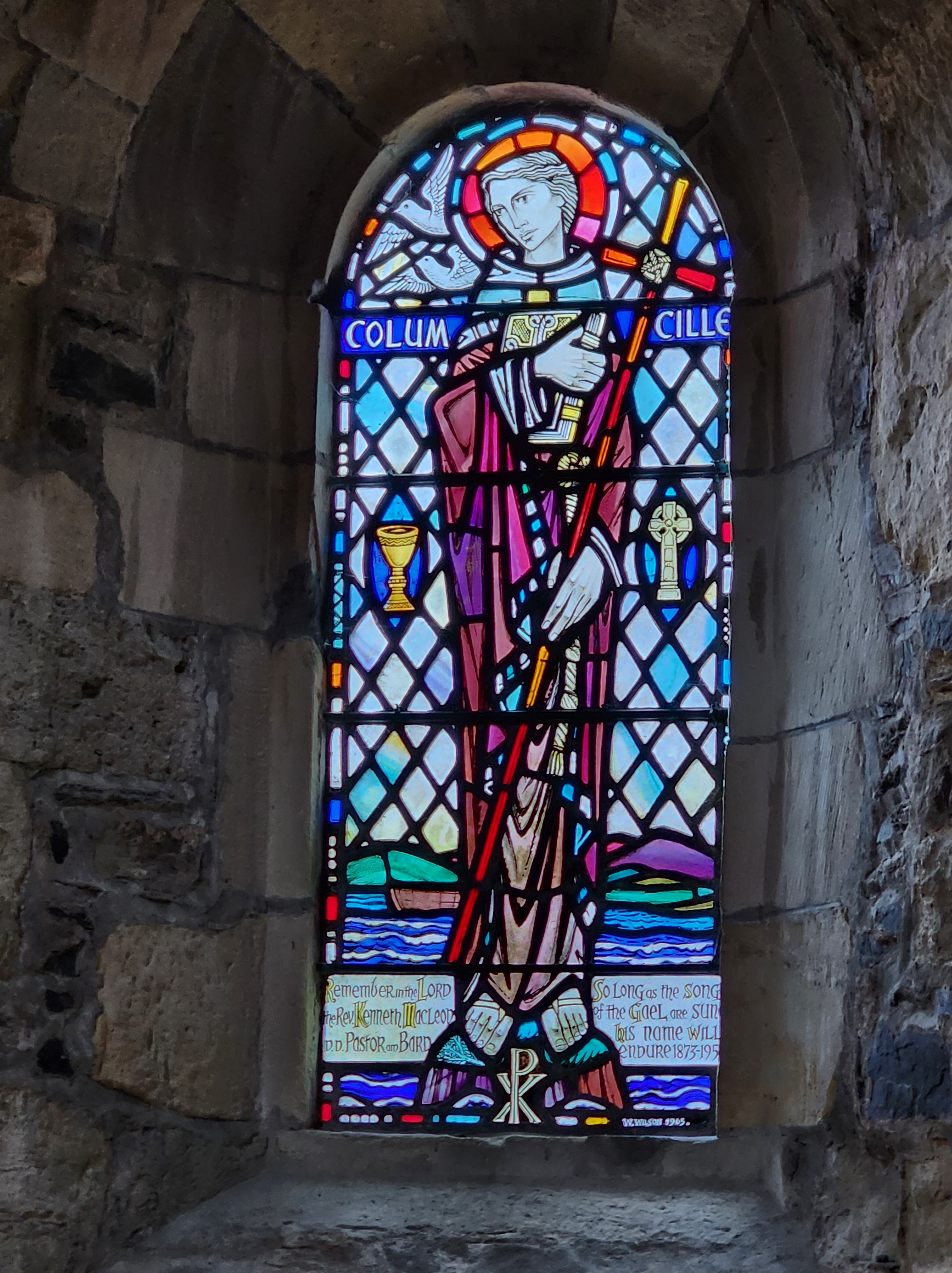
Stained glass window of the Holy Mother

Stained glass window of St. Columba


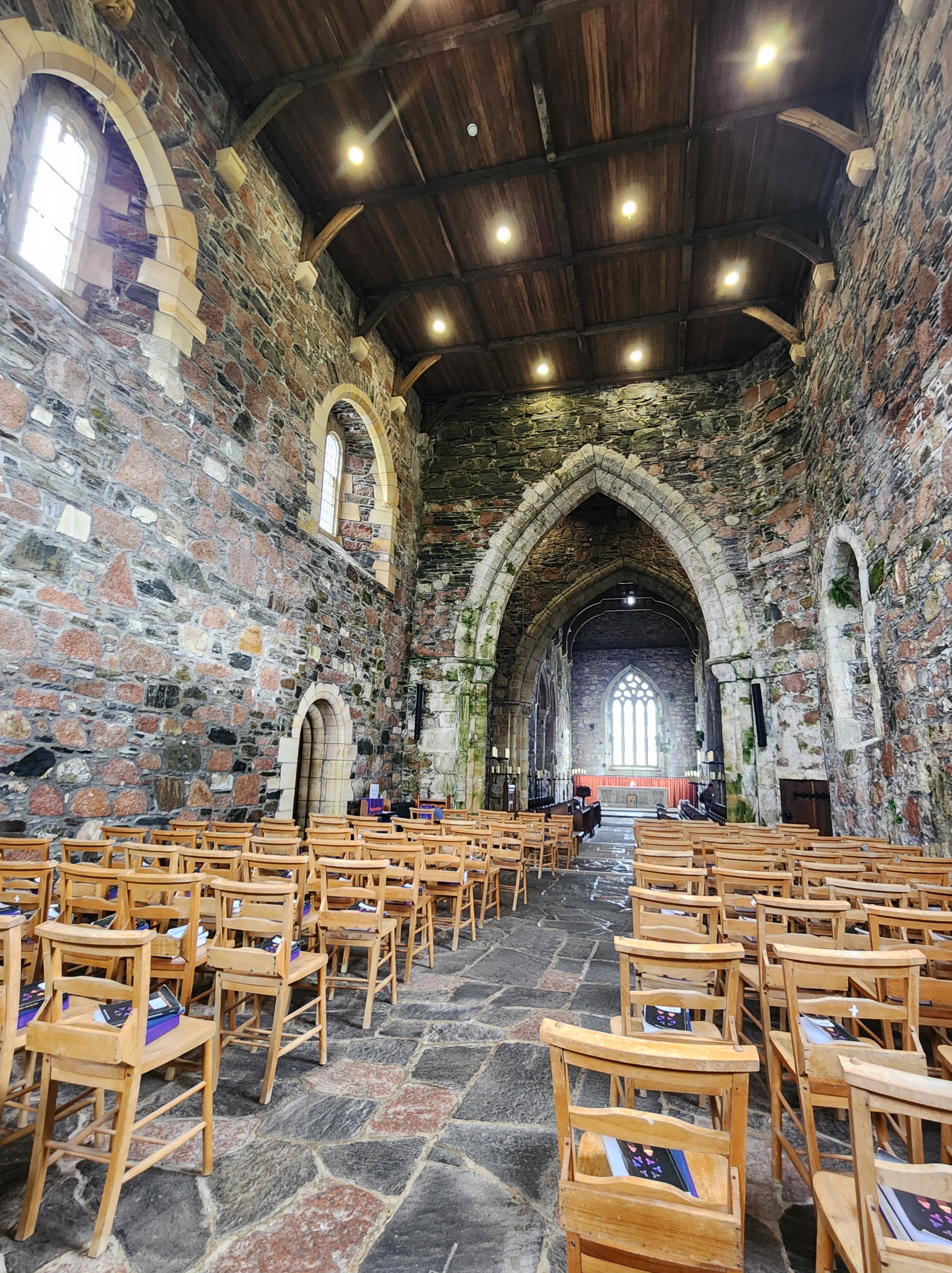
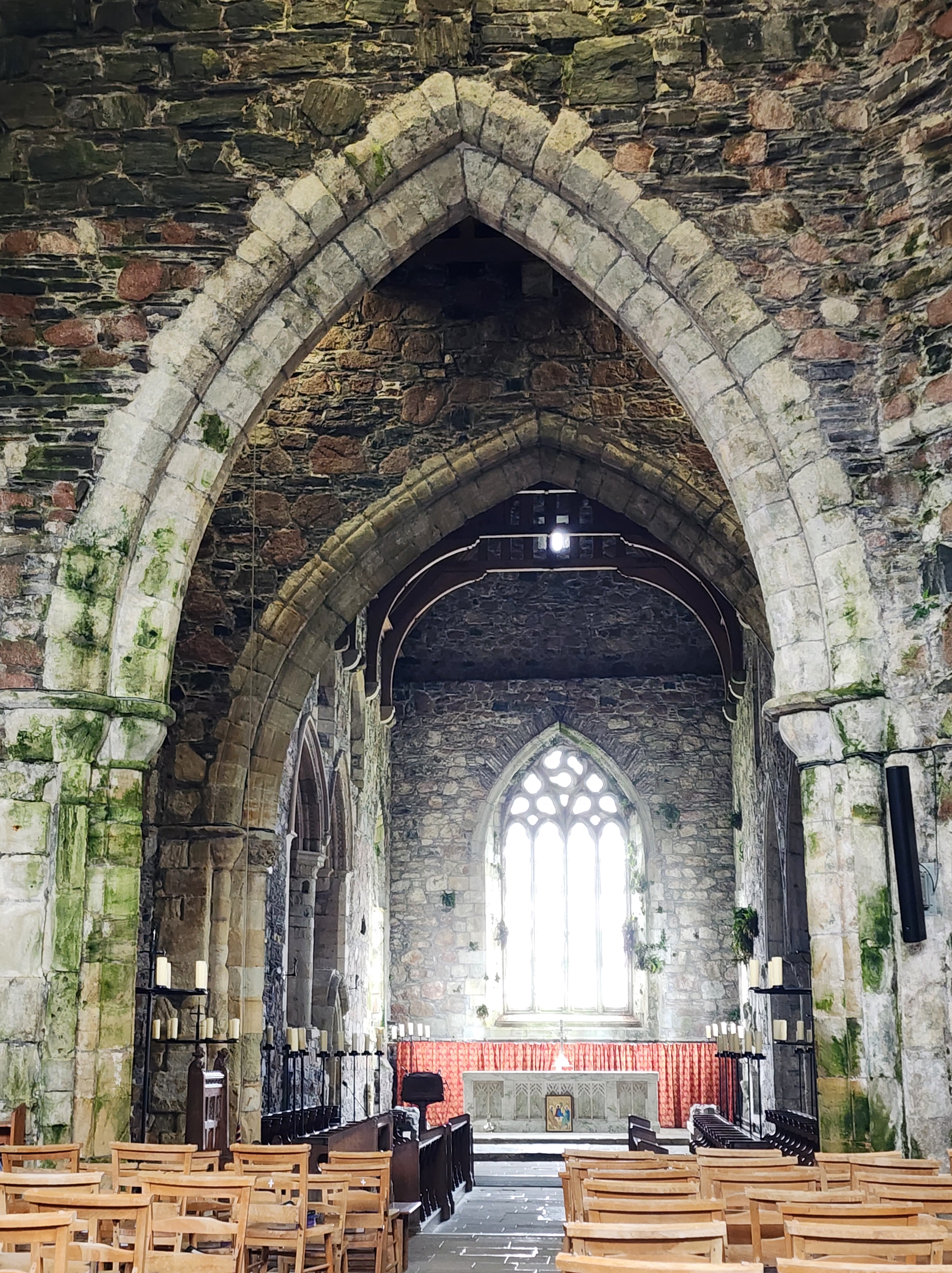
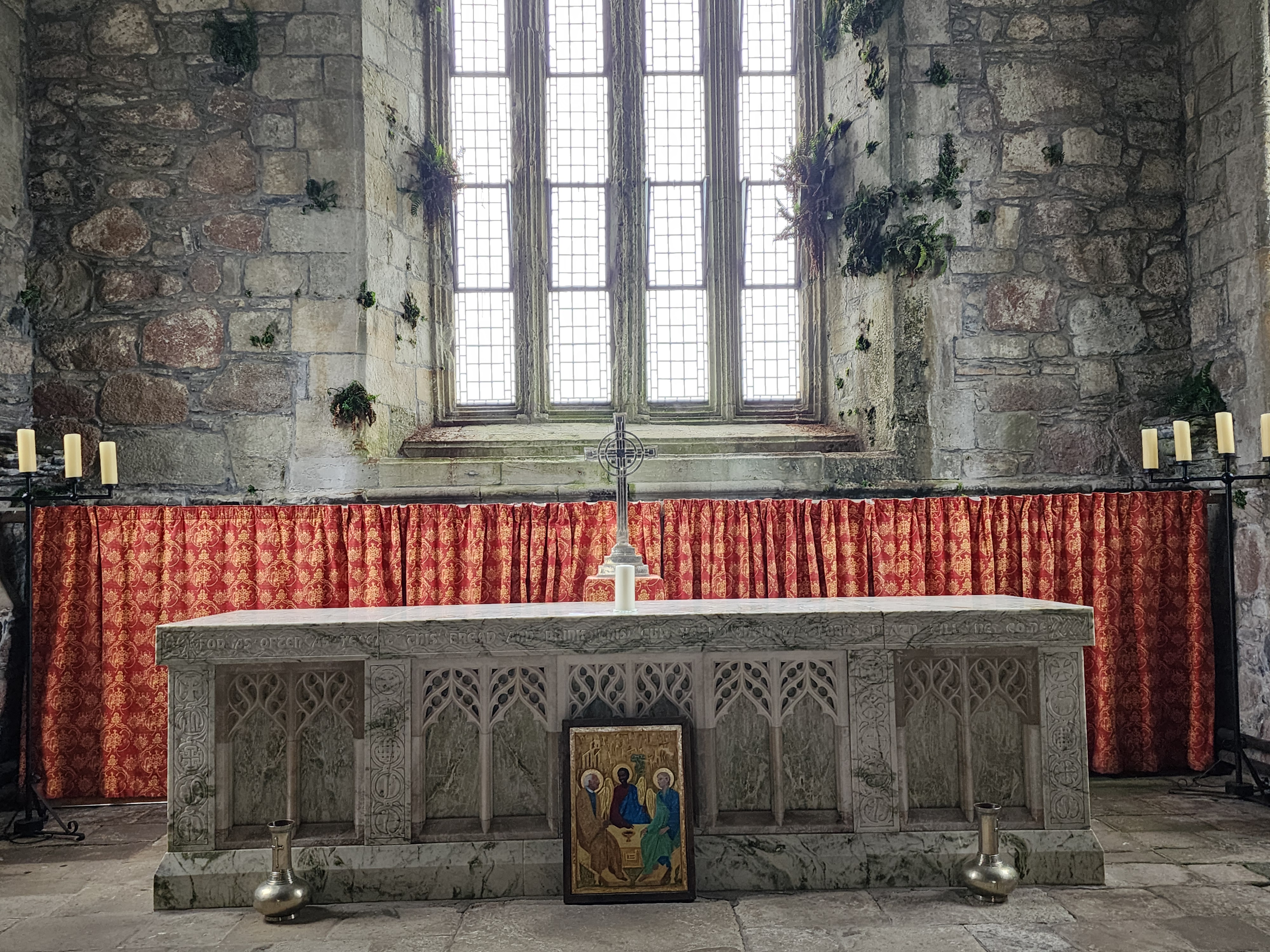
Surprisingly, the cloisters felt holier than the church did to me.  The church offered some beautiful arches and stonework, but not much more in the way of decoration.  And that could be because it’s not a Catholic Church anymore—or because the church had been raided by Vikings and the Protestant Reformation. Or, because, being on a remote island for a small Christian flock, maybe decoration wasn’t a big priority.  Anyway, it’s now the home of the Iona Community, an ecumenical church founded by George MacLeod in 1938, and made up of many religious denominations. This community sounds peaceful and good and believes in social justice matters.  In fact, there was a table full of dishes of ribbons for which you could donate coins for such causes as Black Lives Matter, the environment, AIDS/HIV, and others. (I had bought a little monk bear in the gift shop and gave some spare change for an environmental ribbon, which I pinned to his robe.) As for the altar, it was pretty plain and the stained glass windows  were small, but the church had a good vibe to it.

On the way back to the harbor, I stopped at the Larder to get some lunch and ate my cheese sandwich, crisps, and Coke Zero on a bench in front of the store.  A woman and her husband sat down beside me and we began a very interesting conversation about their visit to Iona. Apparently they are Scottish but have been living mostly in the United States for the last 20 years, although they have a flat that belonged to her mother somewhere in Scotland. Where in the U.S. did they live? I asked, and was surprised when they said, “Oh, Durham, North Carolina.”

So we talked about Durham and about Charlotte and Atlanta too.  I asked what they did with their flat outside of the 6 weeks that they stay there every year—did they AirBnB it?  This got a laugh.  It’s pretty difficult, they told me, to set up AirBnB’s—because of Scottish laws that allow people to stay beyond the time they’ve contracted to stay in a place. In other words, they don’t have to go, even if you want them to.  I thought that was amazing and weird.  But we had a good chat—it felt a little like I was home somehow, especially when we spoke of Charlotte and Atlanta. And it was nice not having to be embarrassed that I was American and to perform my embarrassment like I have been doing every time someone asks me where I’m from.
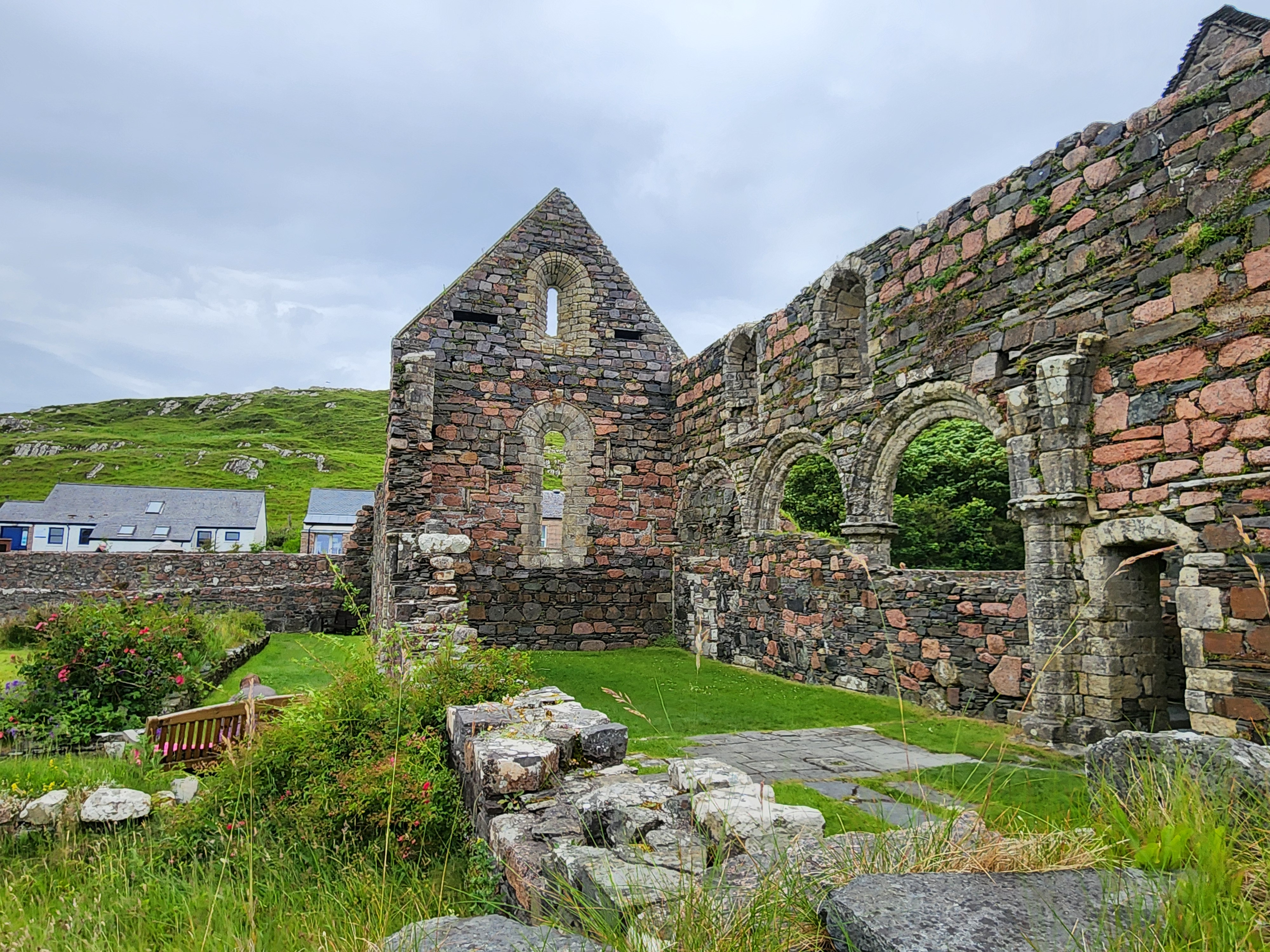
Ruins of the Iona Nunnery; a couple of stone walls and grass

Iona Nunnery

I finished my lunch, and they were going to continue to the Abbey so we said our goodbyes.  I stopped in a craft shop and then a Celtic jewelry store (Aosdàna) where I found delicate, silver handmade earrings.  I loved the jewelry there—although most of it was crazy expensive (several hundred pounds).  And I’ve been wanting to buy myself some jewelry from Scotland for years.  So I splurged and bought a pair of earrings.  They’re so delicate, though, I’m not sure I’ll ever wear them!

After passing through the Nunnery, I returned to the harbor where I found a bench to wait out the time before our ferry would return. And this man comes up to me and says,

“Are you someone important?”

“Me?”

“Yes.  You look very important.  Like you know things.”

“I’m not that important, but I am a published poet.”

“Really?  Have I read anything you’ve written?”

“I doubt it.”

“Oh.”

He seemed truly disappointed that I didn’t turn out to be a VIP—although, I doubt I looked like a VIP, windblown with my raincoat and beanie on.  He said goodbye and turned away, and I thought, I’ve missed an opportunity to brag on myself. And then I remembered, I’m no braggart, and nobody cares about poetry anyway.  So no big deal.  And then, one of the ladies on the tour sat down next to me and offered me the most delicious strawberries I’d ever eaten. So sweet and so red they make the strawberries we get back home look like anemic little ghosts.  And just as suddenly, it started to rain and she hurried off.

But by then the ferry had arrived and we all shuffled back on to Mull. I haven’t had a chance to say that here is true beauty to be found in the Isle of Mull—I know the name is rather dull (ha! dull Mull!), but if it’s possible, Mull is even greener than the Highlands, and the mountains seem steeper and more mysterious.  Driving around Mull, you tend to see a lot of red deer (as well as sheep and cows) just running along the hills; I think Nick said there’s some phenomenal number, maybe 6,000, that live on the island. (We only saw a few, and one of them, sadly, was dead by the side of the road.) But with the rain and dark clouds, the island was moody and bleak and lovely.  I kept thinking how much I would like to live here.

This time, when we drove back into Tobermory, Nick said he’d give us all 30 minutes if we wanted to find something to eat and then he’d drive us to our B&B’s.  This was a godsend, because by then it was raining like hell and there was no way I was going to walk into town from the B&B for dinner.  But since we were there, I went to Hook’d and got a beautiful piece of haddock and chips, and ate that in the B&B and went to bed early.
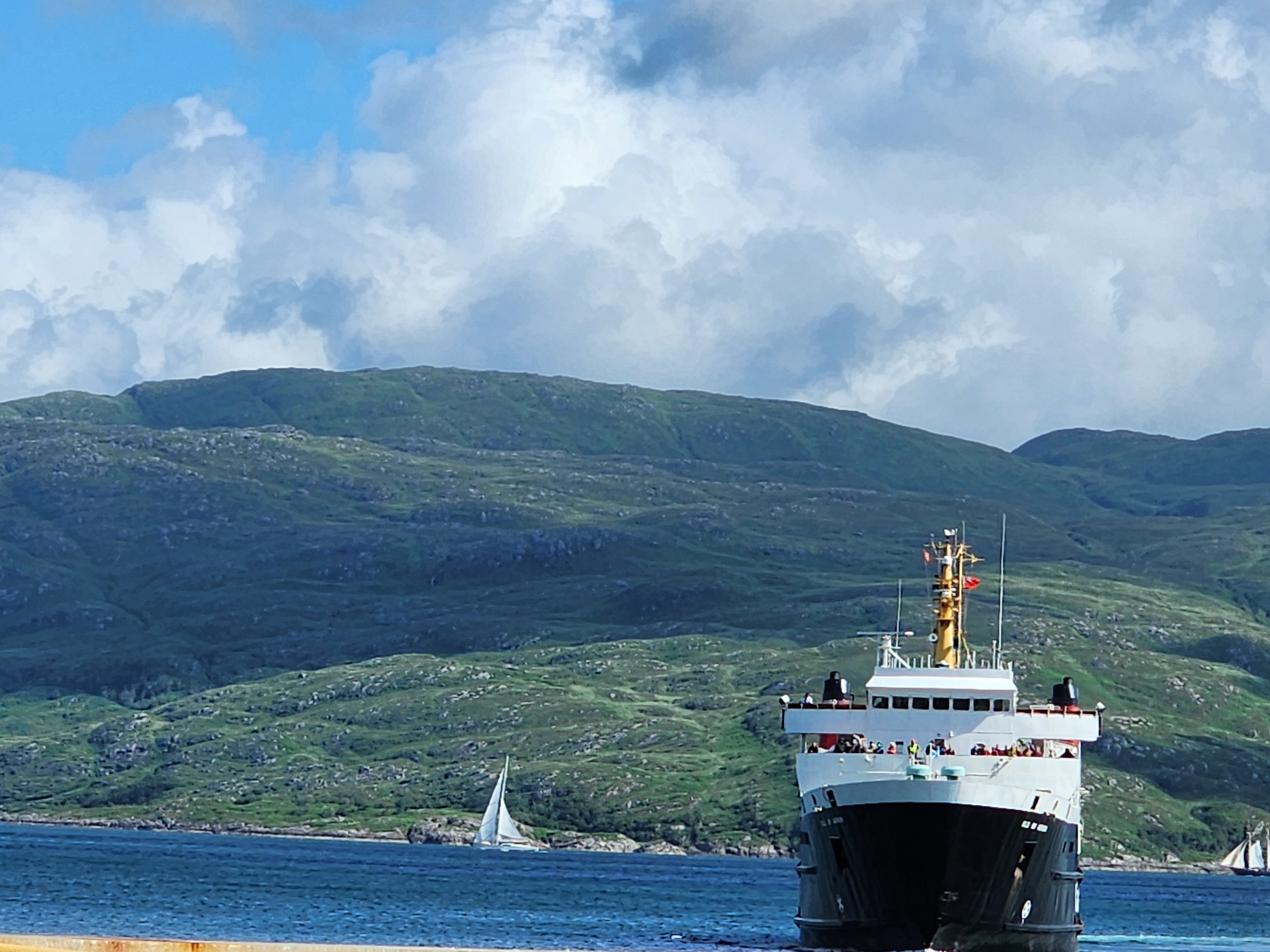
The CalMac ferry to Mull on a backdrop of Mull's mountains

CalMac Ferry to Oban

The next day, we took the ferry from Craignure to Oban.  Right as I left the ferry terminal, I smelled the most delicious garlic buttered seafood at a harbor kiosk but didn’t have enough cash to get some scallops for lunch—a true pity. I suspect everything they were selling came fresh from the sea that morning. I decided to skip touring Oban, even though I wanted to check out the Oban distillery for a dram, because of the dreaded foot.  So I hung out in a Costa coffee shop and read a book until Nick retrieved us.  The ride back to Glasgow seemed long.  We made a few too many stops for my liking, one at the Nether Largie Standing Stones (in Kilmartin), one in Inverary, one in Glen Crowe at the Rest and Be Thankful viewpoint, and one at Loch Lomond again (just a potty break).  I didn’t get back to my flat in Edinburgh till almost 9 p.m. And I pretty much fell into bed after a shower.

I recommend Mull and Iona—and Staffa, if the weather permits—because seeing these places is somehow holy and remarkable.  And if you want a good book that talks about these places, I really recommend Madeleine Bunting’s Love of Country; it’s replete with details about the history of the Hebrides.  And it’s wonderful.
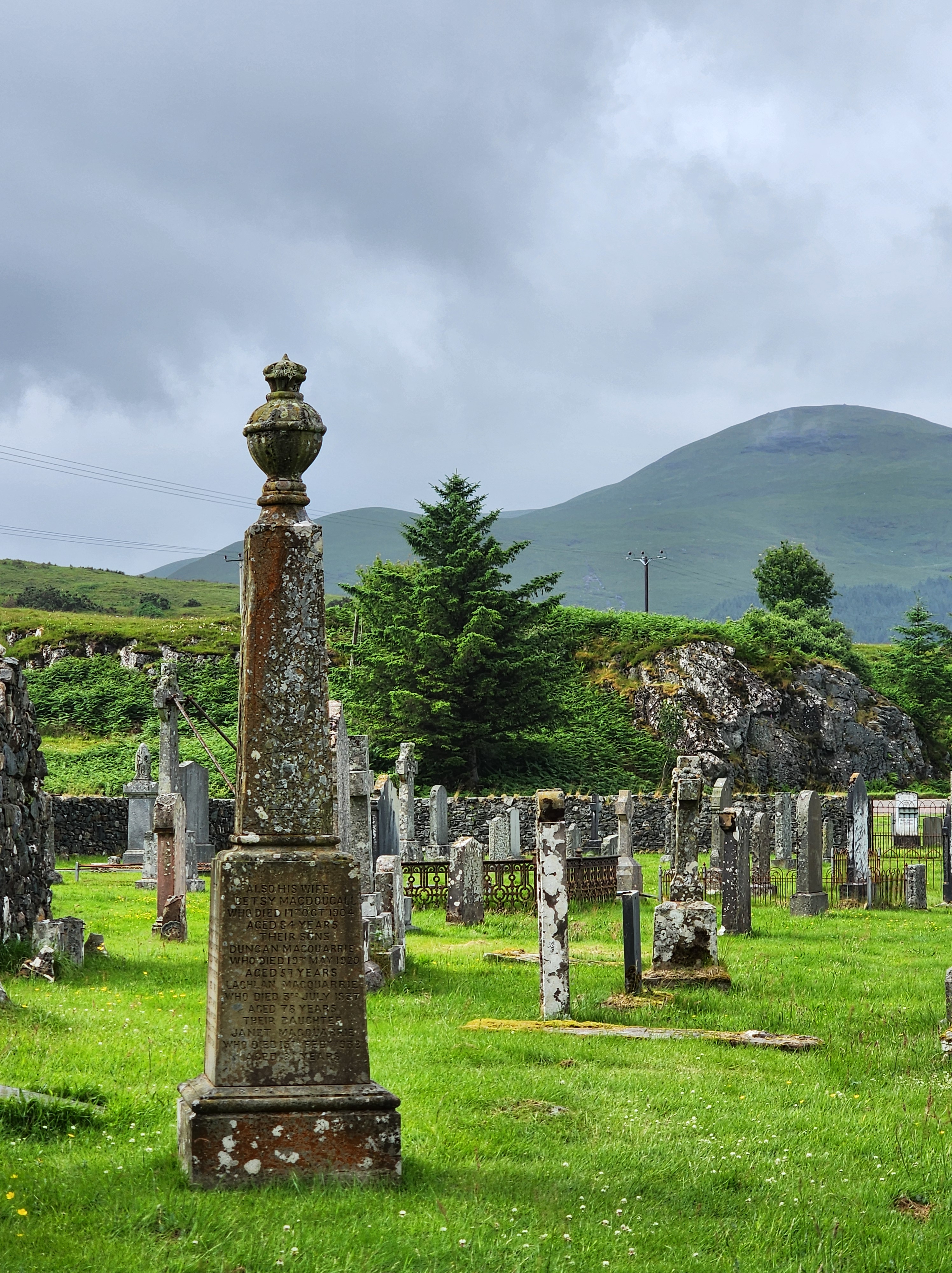
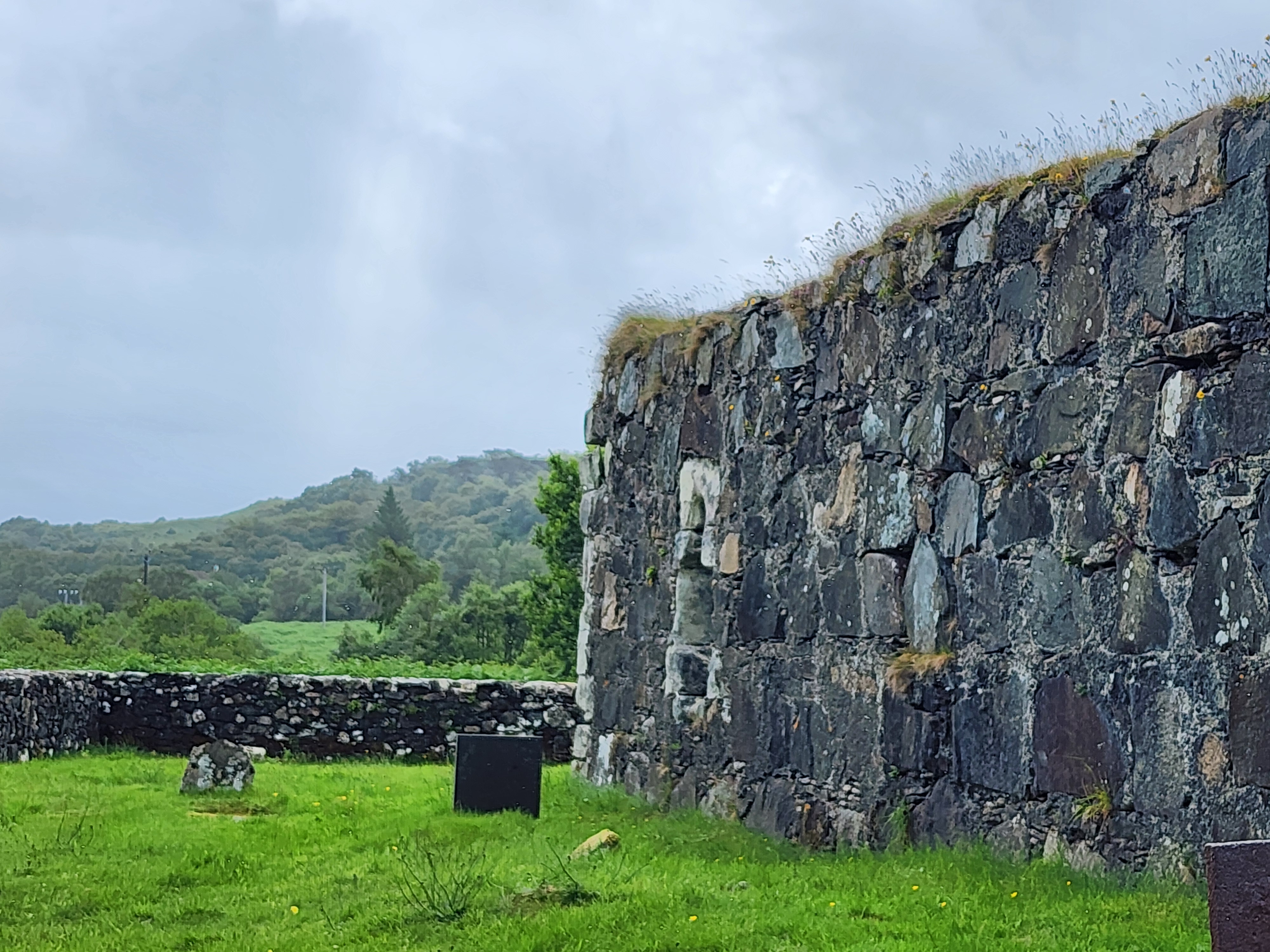
A grave yard at Pennygown

Pennygown graveyard

Old ruins of Pennygown church
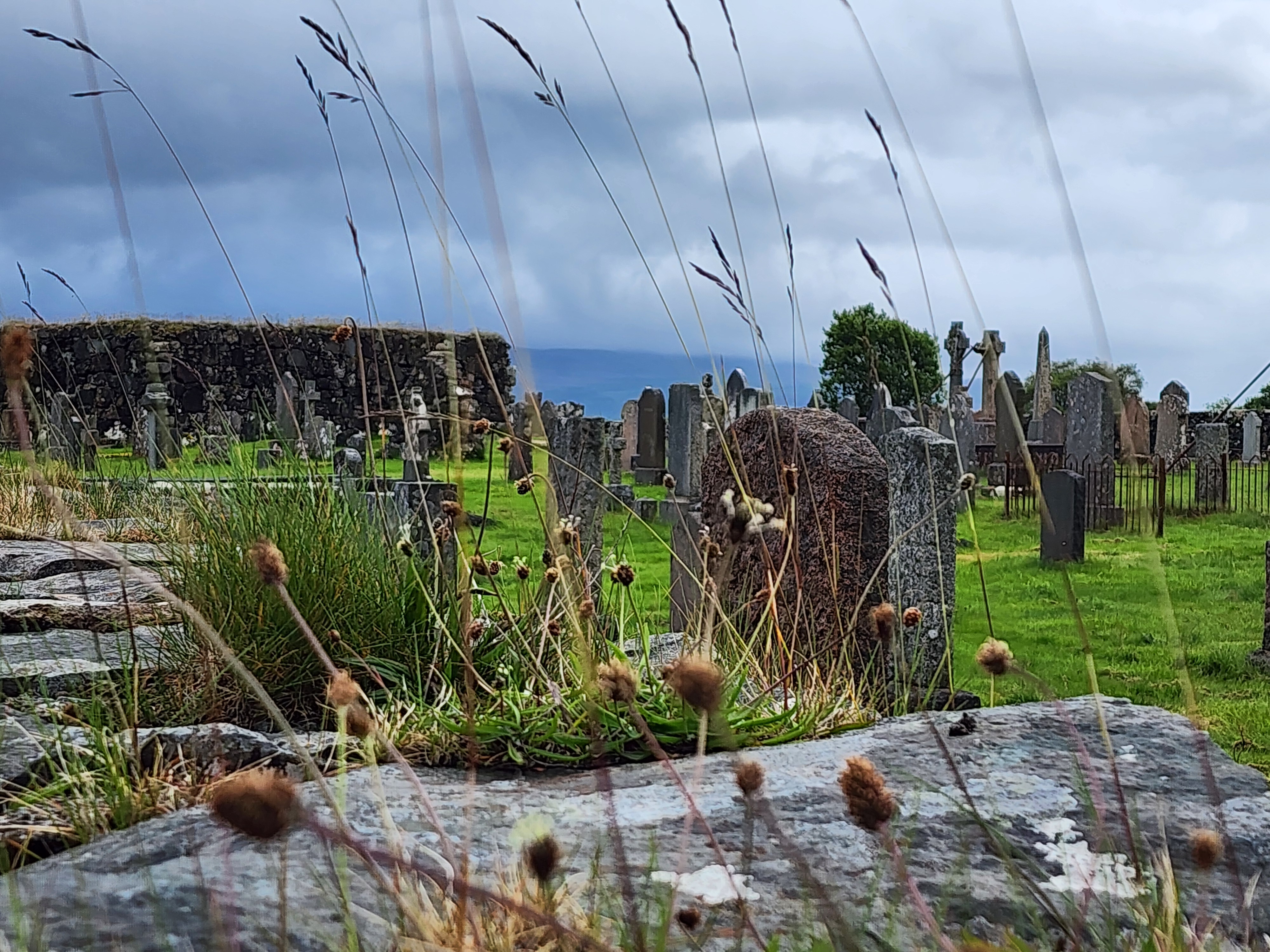
Old ruins of Pennygown church

A picture of Pennygown graveyard through tall grasses

Pennygown graveyard, Mull

Duart Castle from a side view
Duart Castle

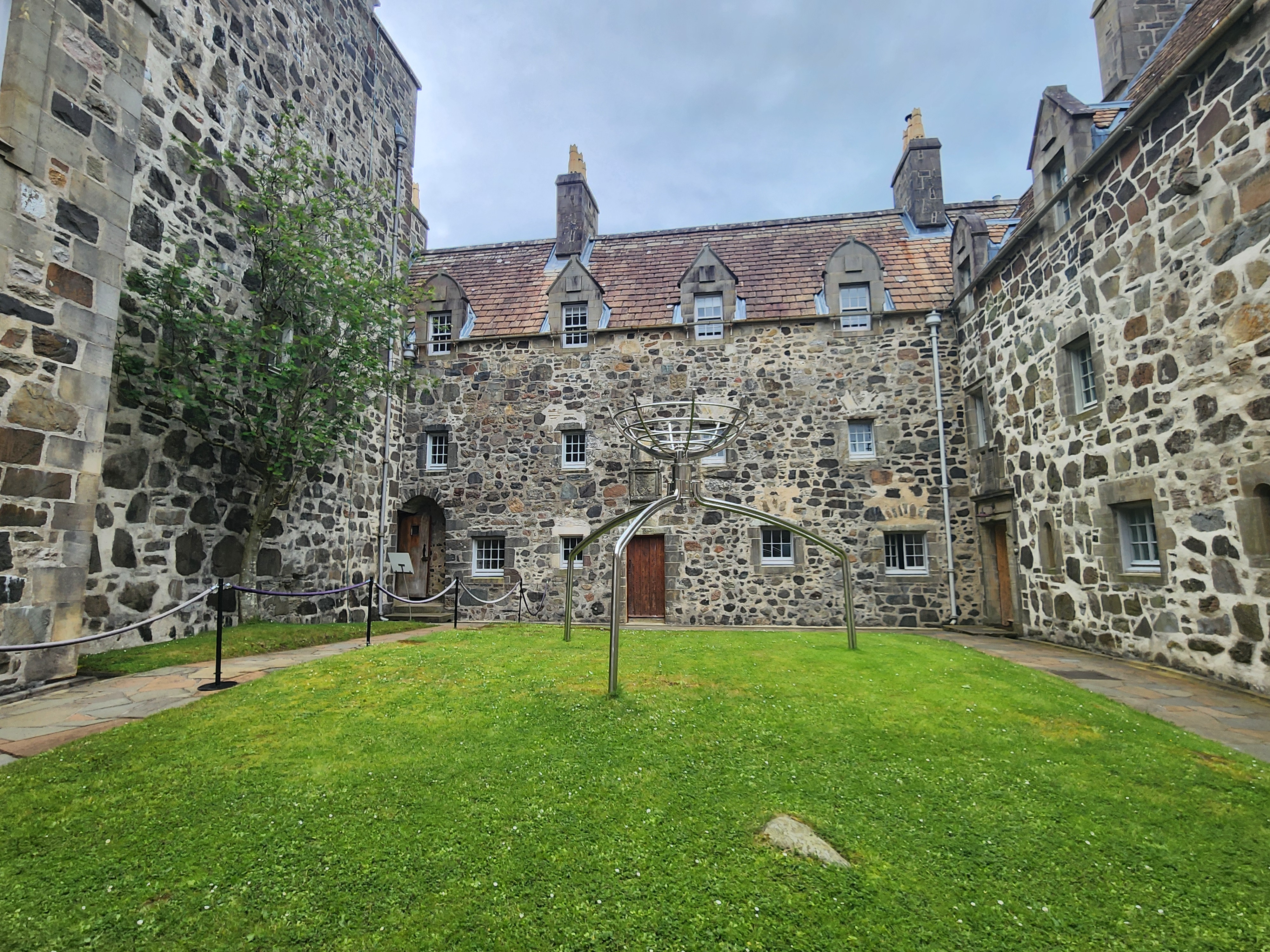
Three walls of Duart castle surround a grassy courtyard.

Inner courtyard of Duart Castle

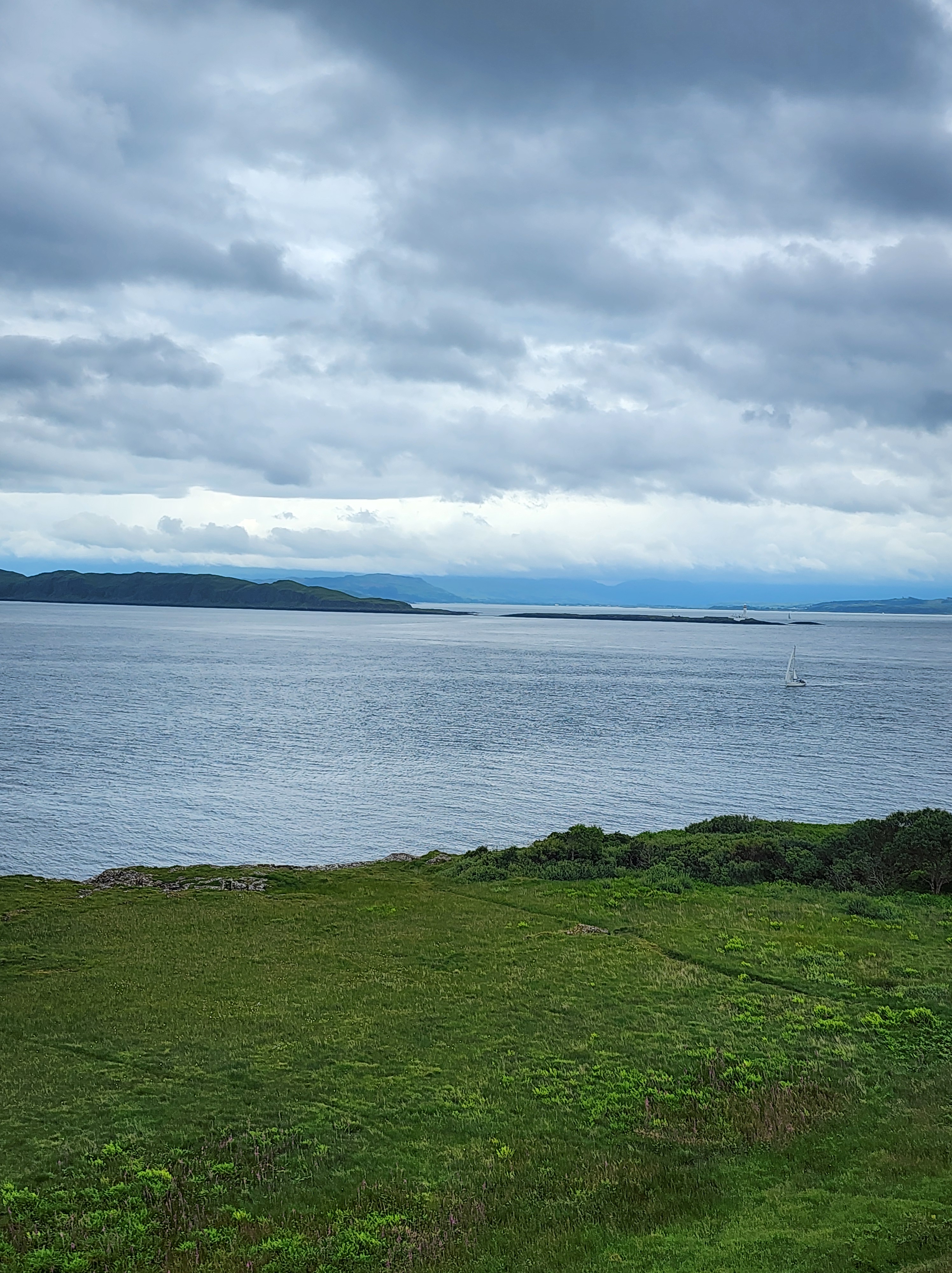
A view of the Sound of Mull, with grass in the foreground and clouds in the back

Sound of Mull (from the Duart battlements)
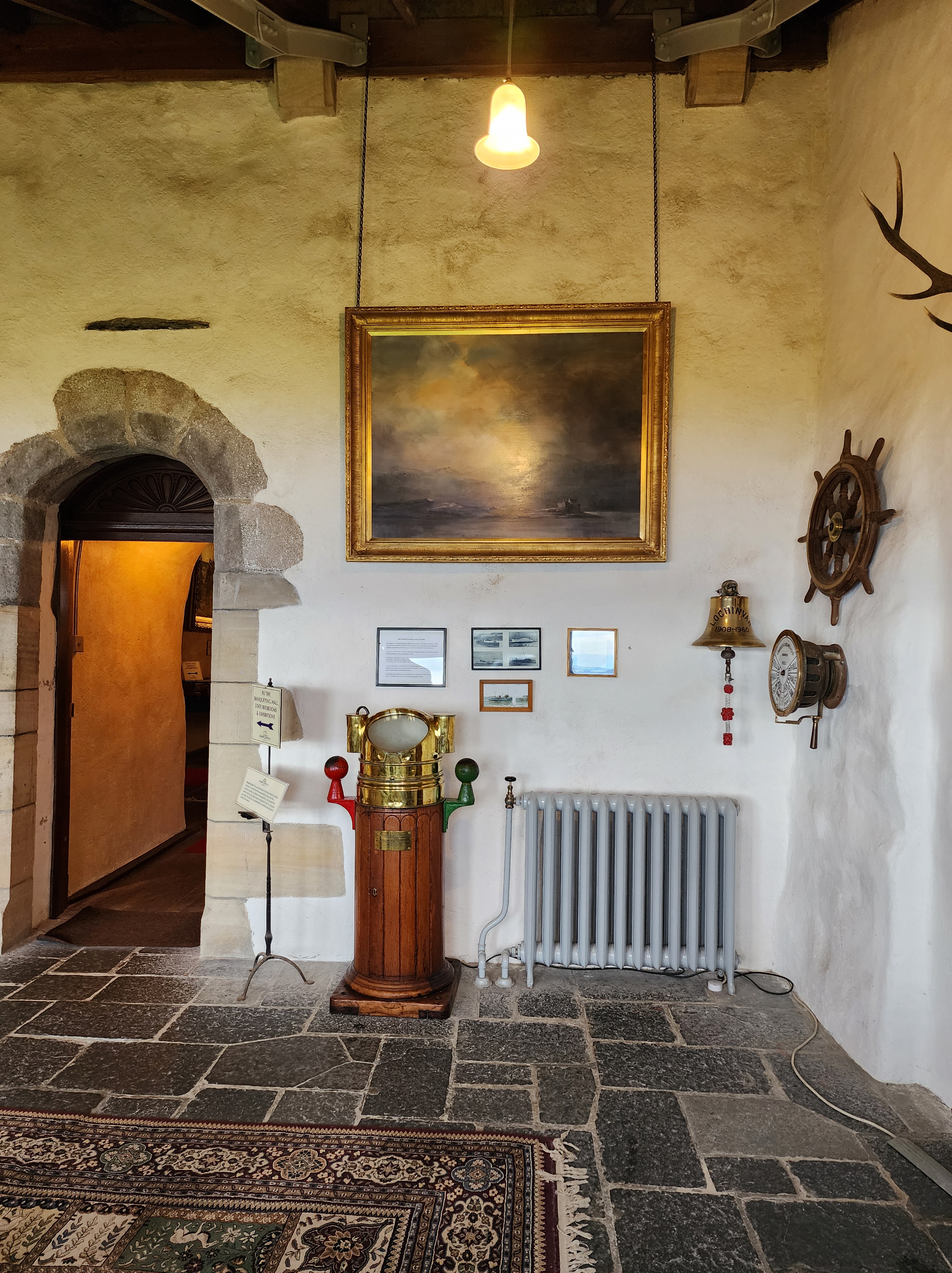
The Sea Room of Duart Castle, showing a large bell, wheel, and binnacle from the RMS Lochinvar ship. To the left is the entrance into the Great Hall.
The Sea Room

A long view of the Great Hall, with antiques and paintings.

View of the Great Hall from the entrance
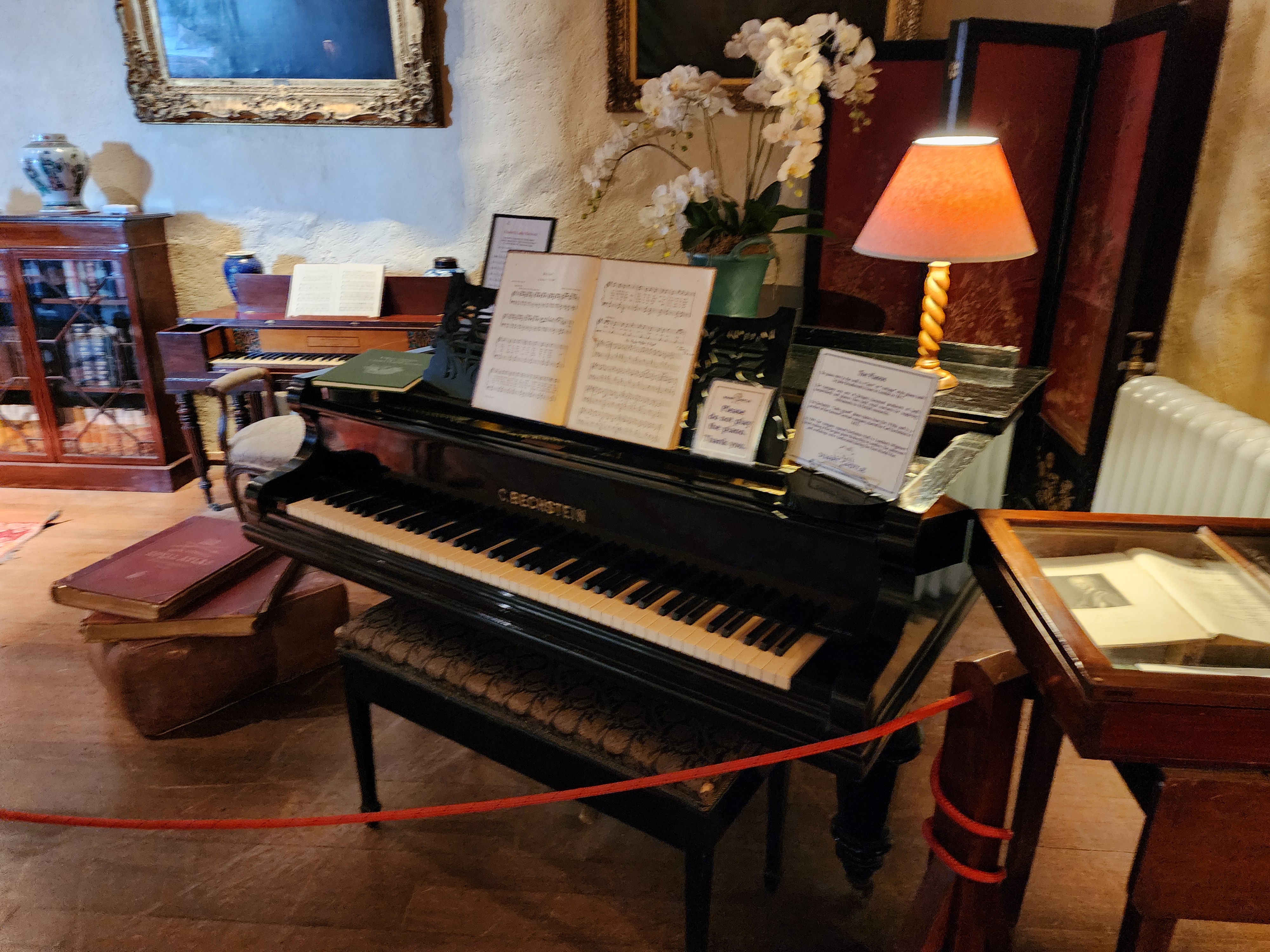
A piano in the Great Hall of Duart Castle, right as you go in

Piano at the entrance of the Great Hall
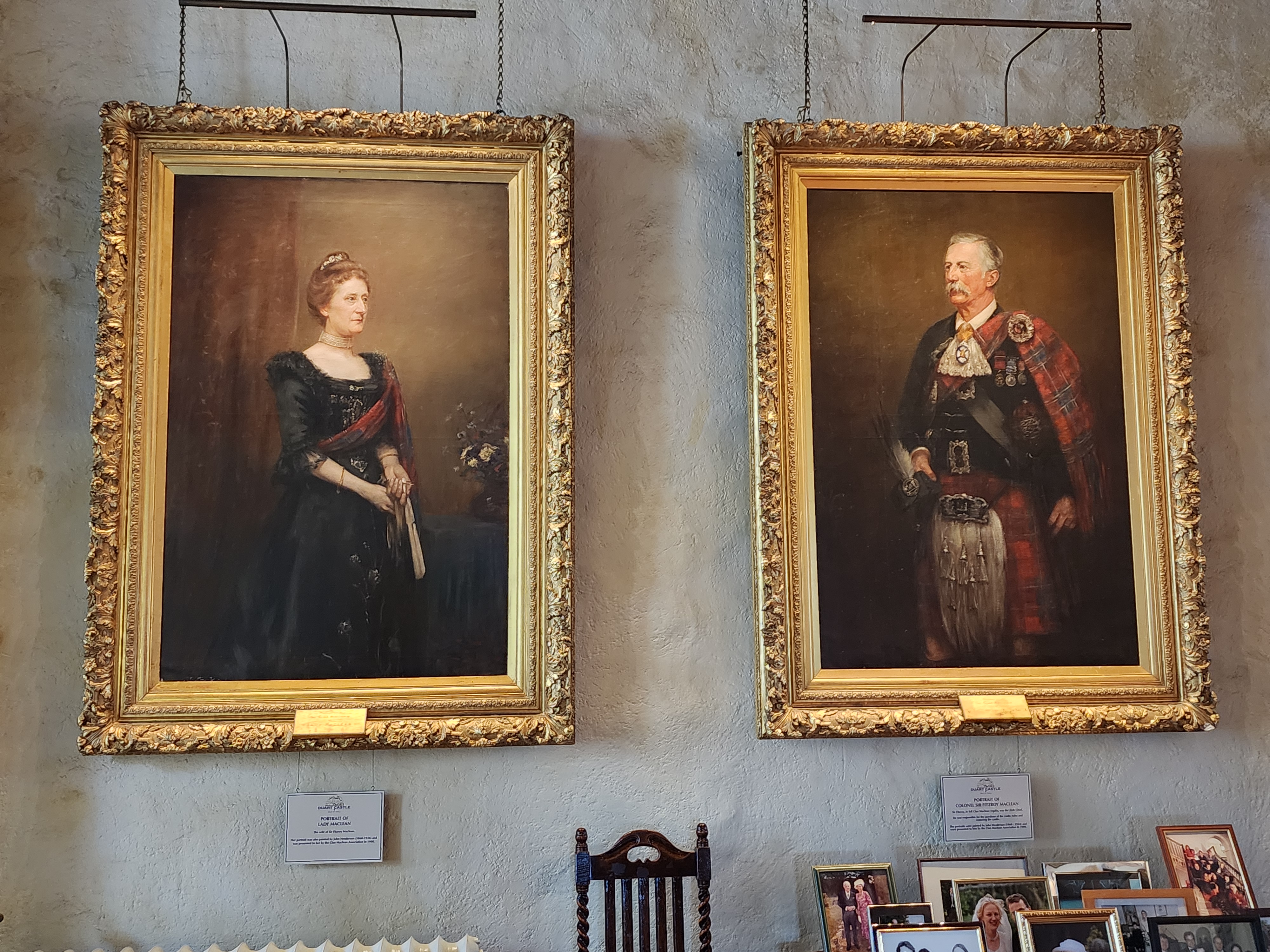
Portraits of Lady MacLean and Col. Fitzroy MacLean
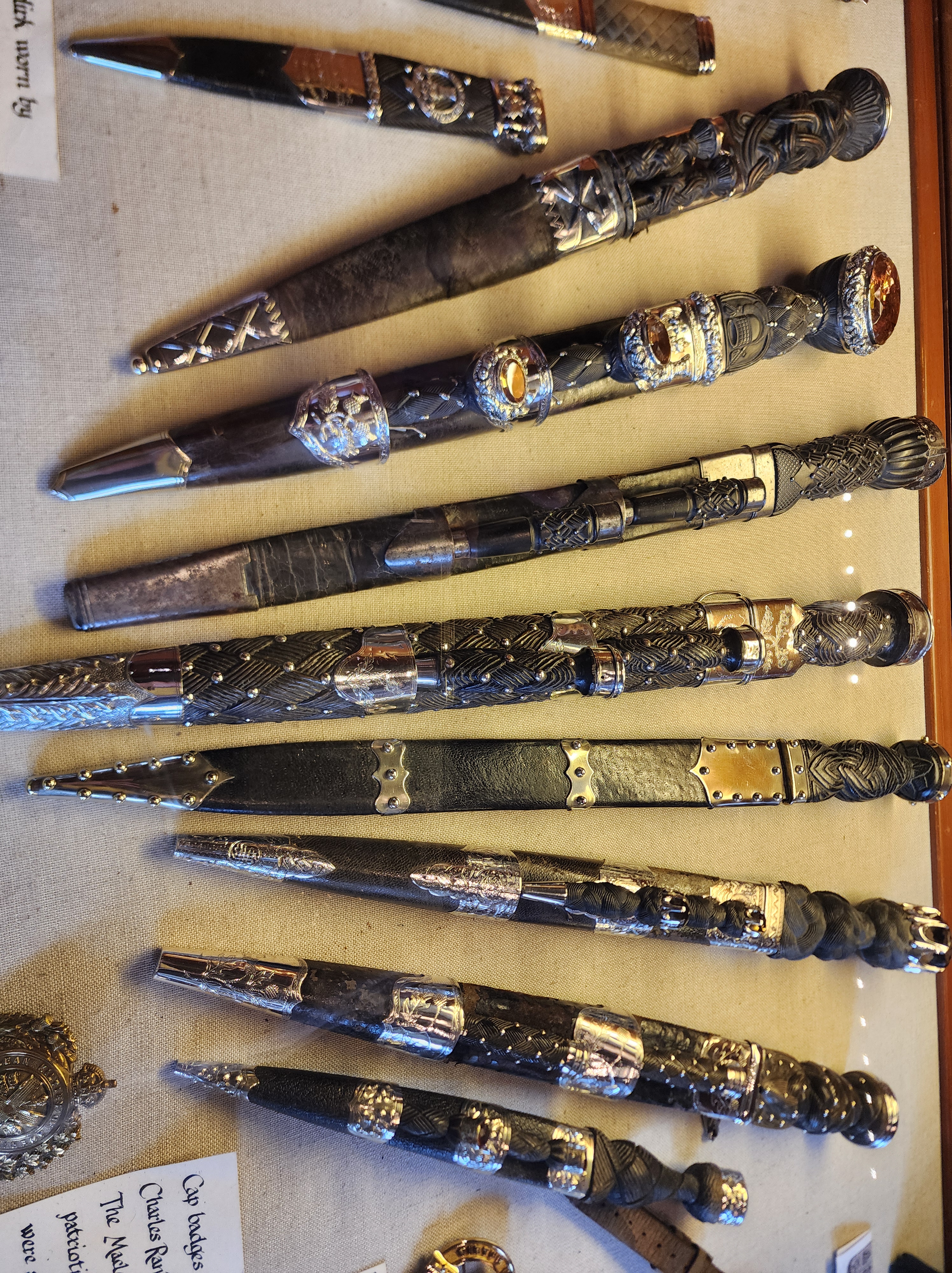
Ten small, fancy daggers in their sheaths in a glass case in Duart Castle

Daggers in the weapons case at Duart Castle
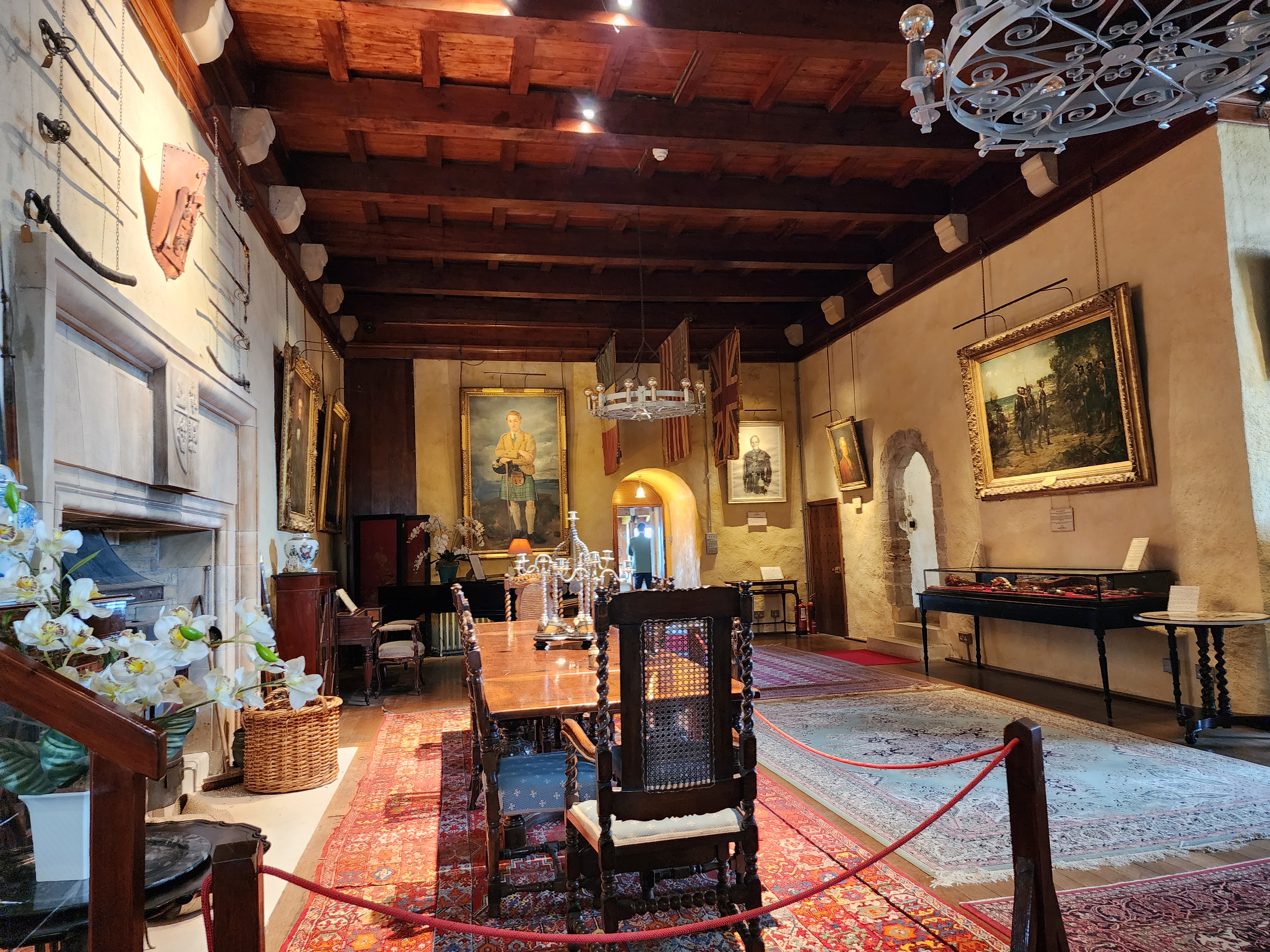
Another view of the Great Hall from the opposite view.  In the foreground is the dining table and a chair.

Great Hall looking north toward the entrance
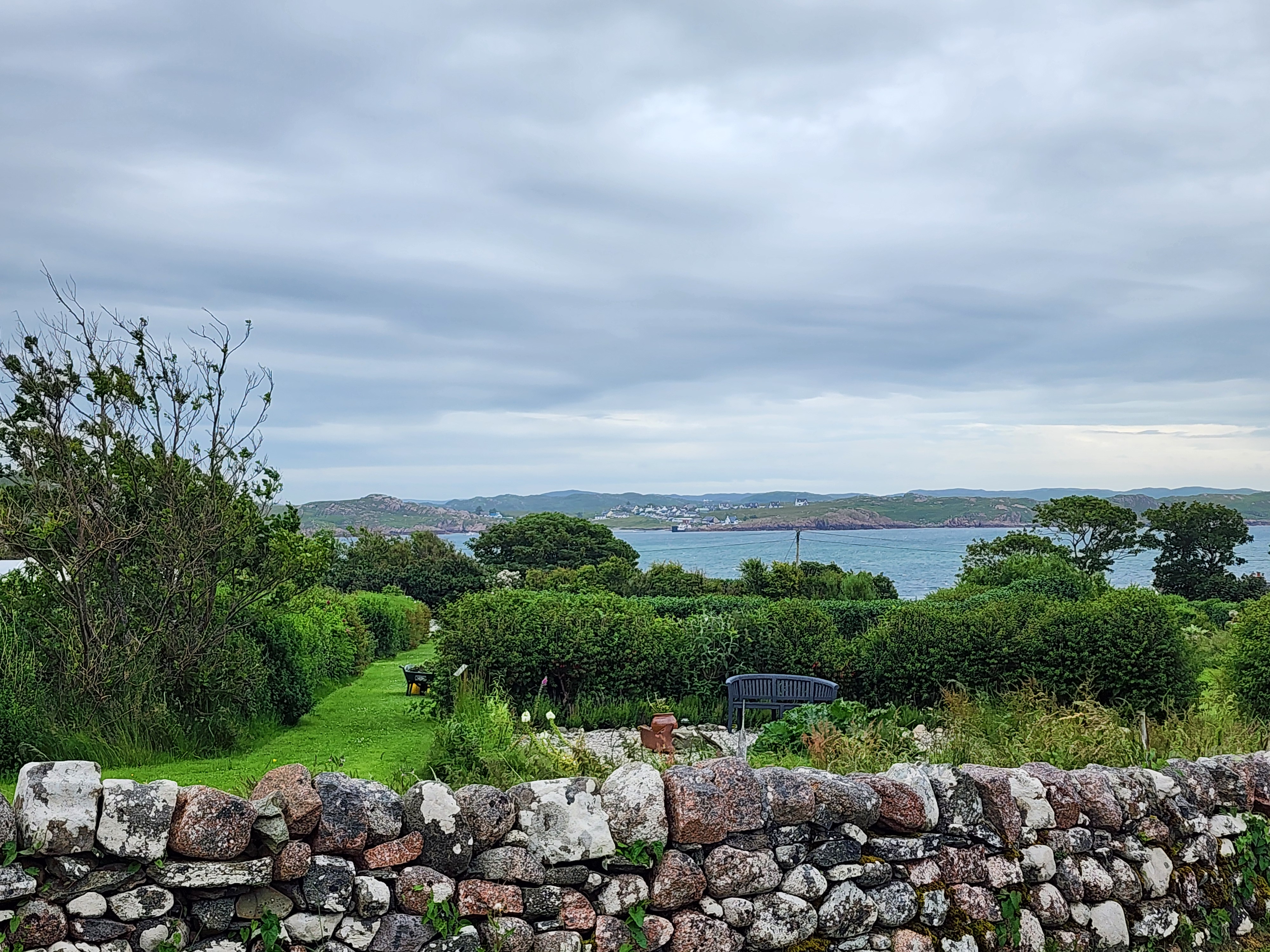
A view of herb gardens with the Sound of Mull in the background

Hotel gardens on Iona

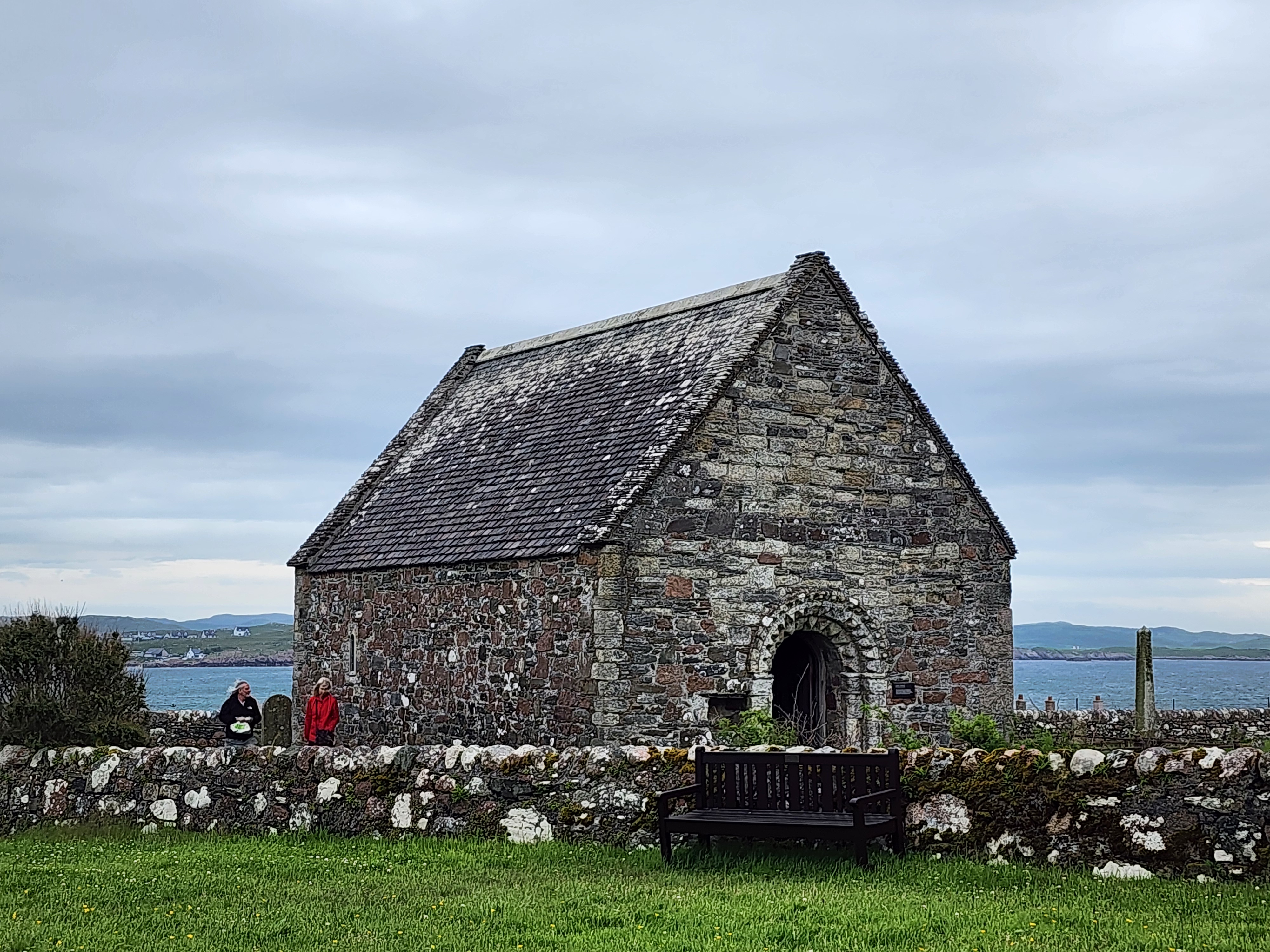
A small chapel with a stone wall in front of it.  This is St. Oran's chapel at Iona Abbey

St. Oran’s Chapel at Iona Abbey

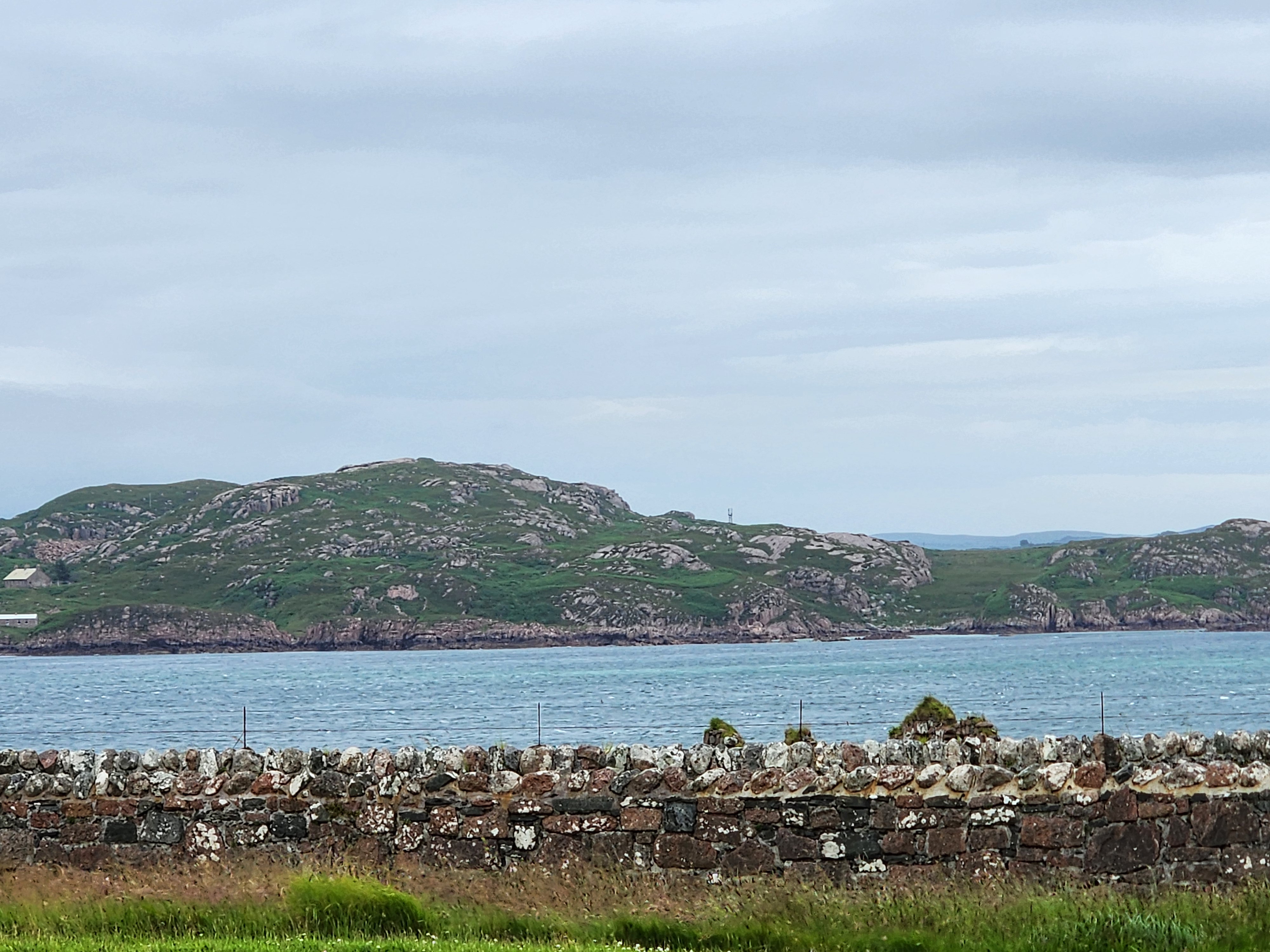
View of the Sound of Mull looking at Mull from Iona
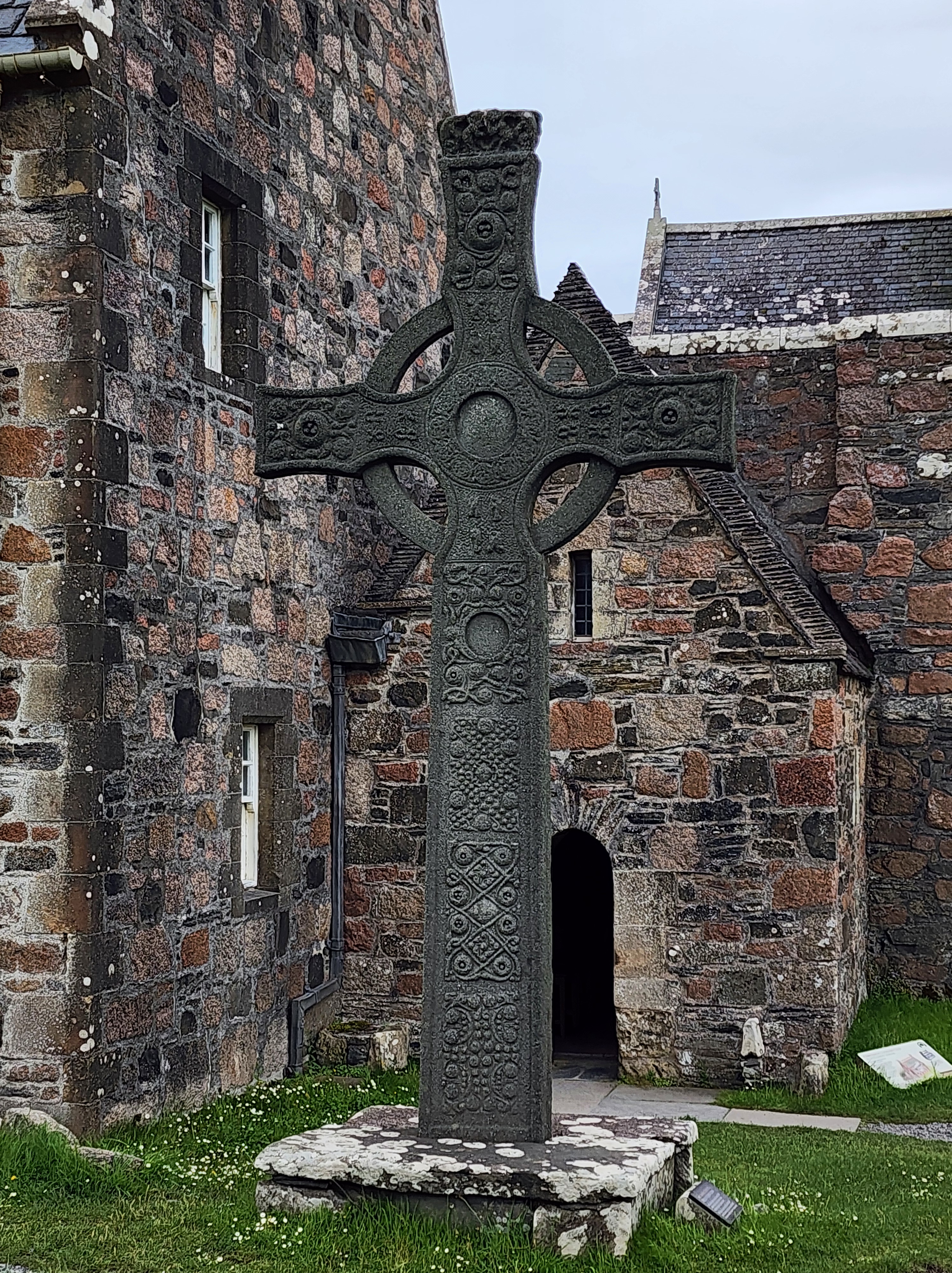
View of the Sound of Mull

A tall Celtic stone cross in front of Iona Abbey.  This is MacLean's Cross.

MacLean’s Cross

A view of the cloisters, with light coming through the arches on the left side of the photo

Another view of the Cloisters at Iona Abbey
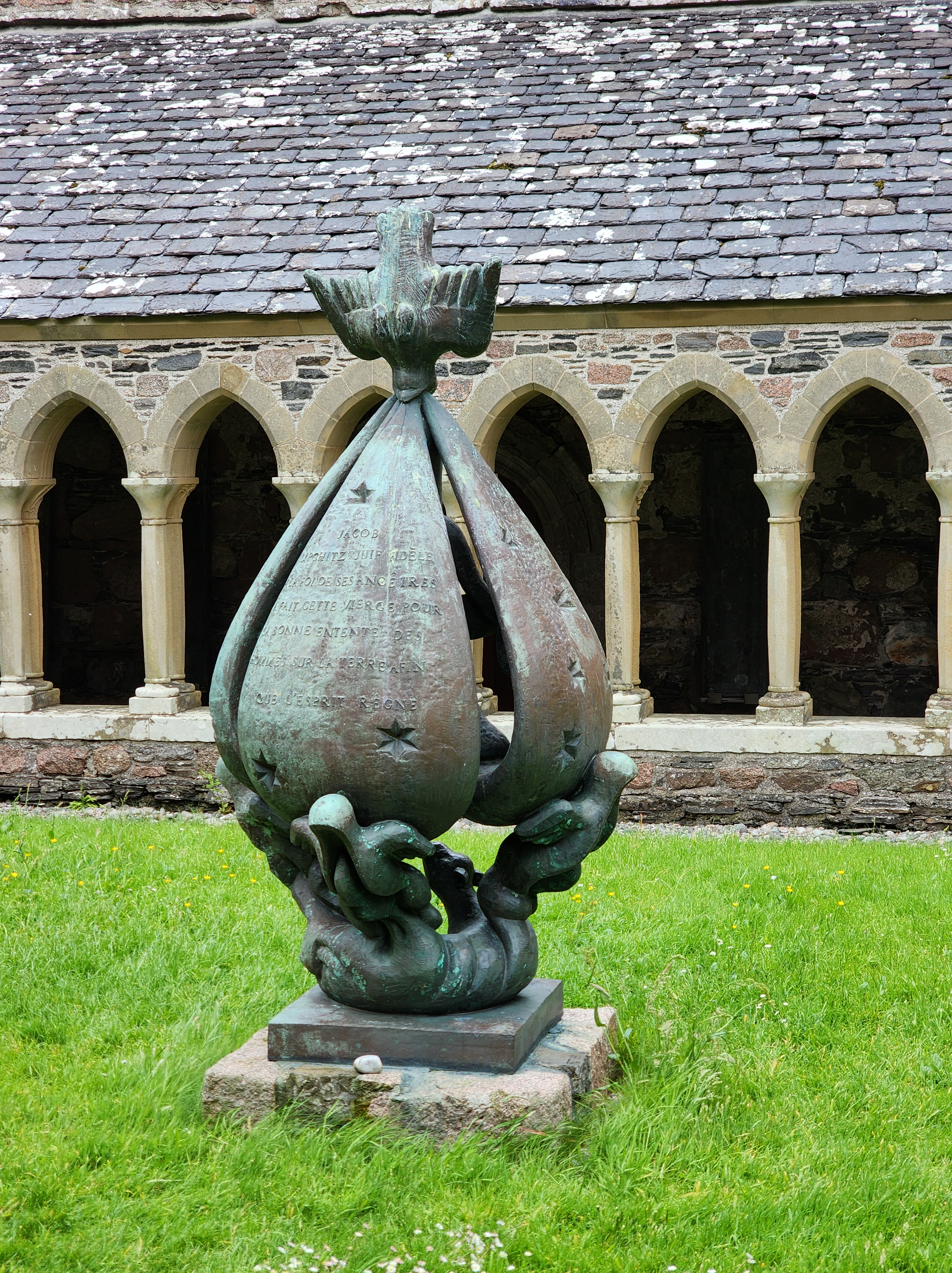
A large statute that looks something like a closed flower with a dove sitting on it.

Cloisters statue

A long view of the inside of the church, featuring wooden chairs in the foreground an a large stone arch in the back.

Inside the Iona Abbey church

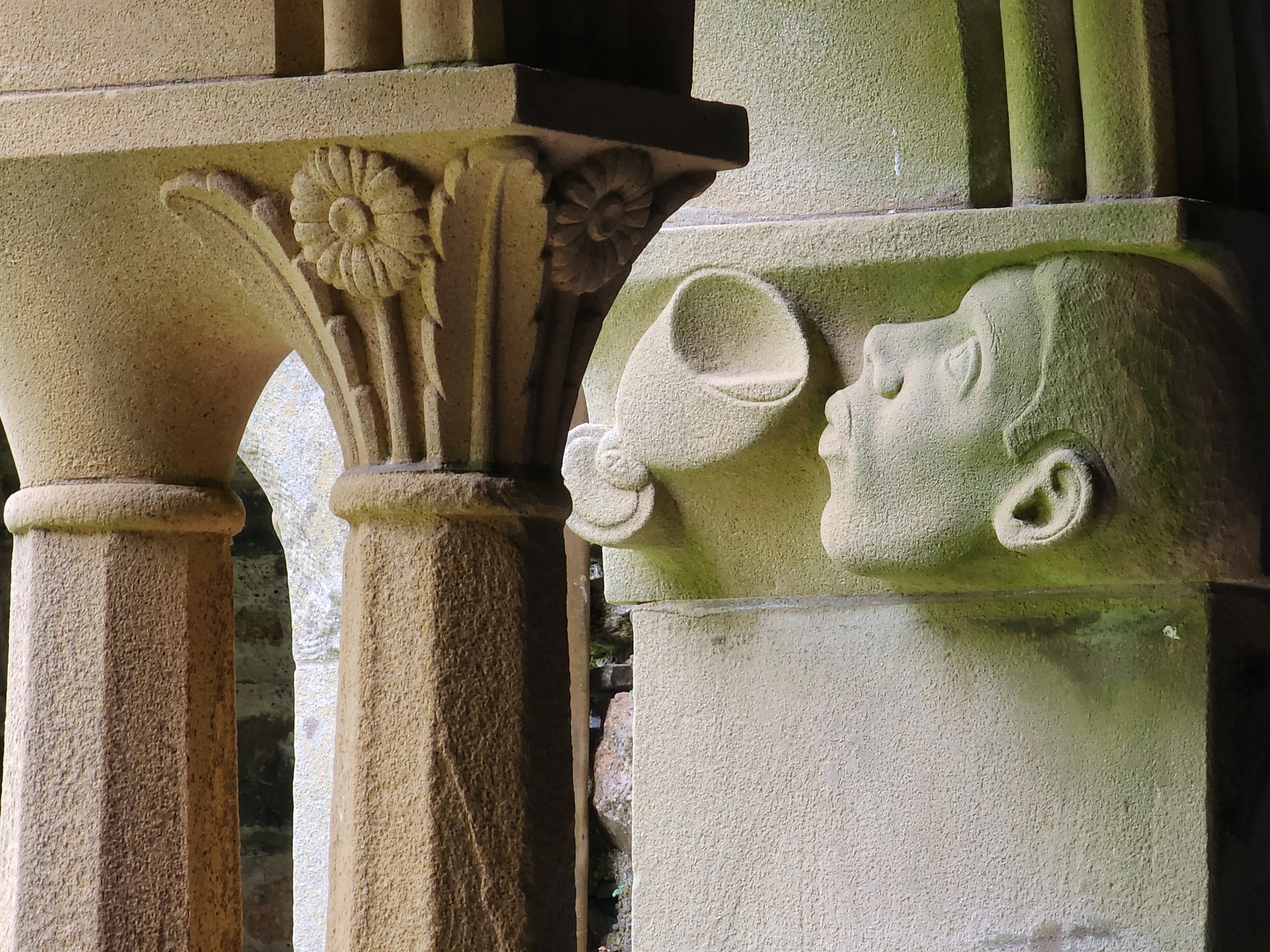
A detail from the cloisters of a man's head about to drink from Jesus's cup.

Detail of the Cloisters

The Iona Abbey great stone arch over the altar space.

The Arch above the altar space

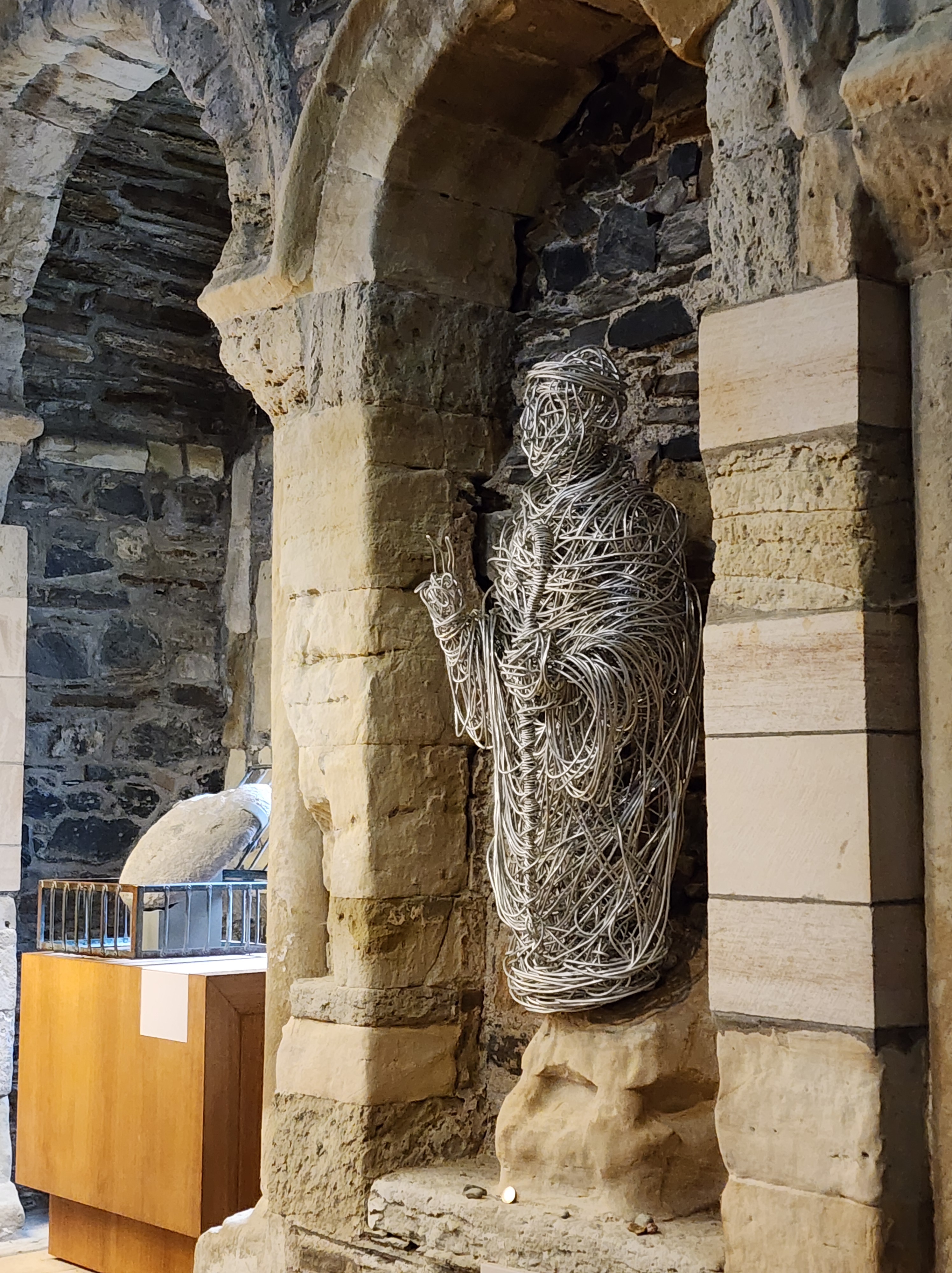
Statue of St. Columba beneath an arch at Iona Abbey

An altar statue at Iona Abbey church

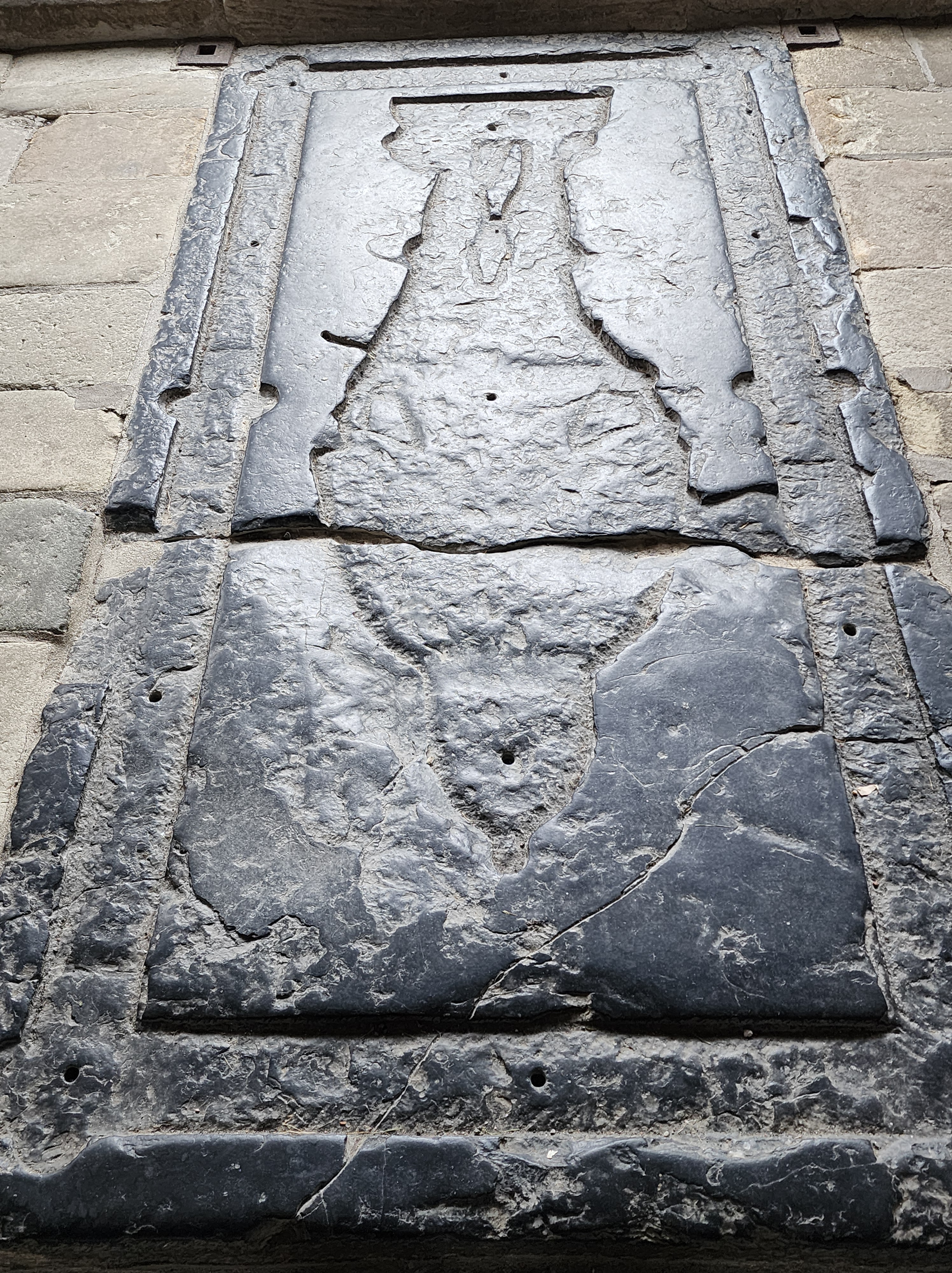
On the floor of the Abbey, a gravestone that may contain the sepulchre of St. Columba

Sepulchre of St. Columba

An altar at Iona Abbey, with ivy growing on the walls

The altar at Iona Abbey

A big house with lush gardens in the foreground.  It is George MacLeod's summer home, near the Abbey

George MacLeod’s summer home, Dunsmeorach, near the Abbey
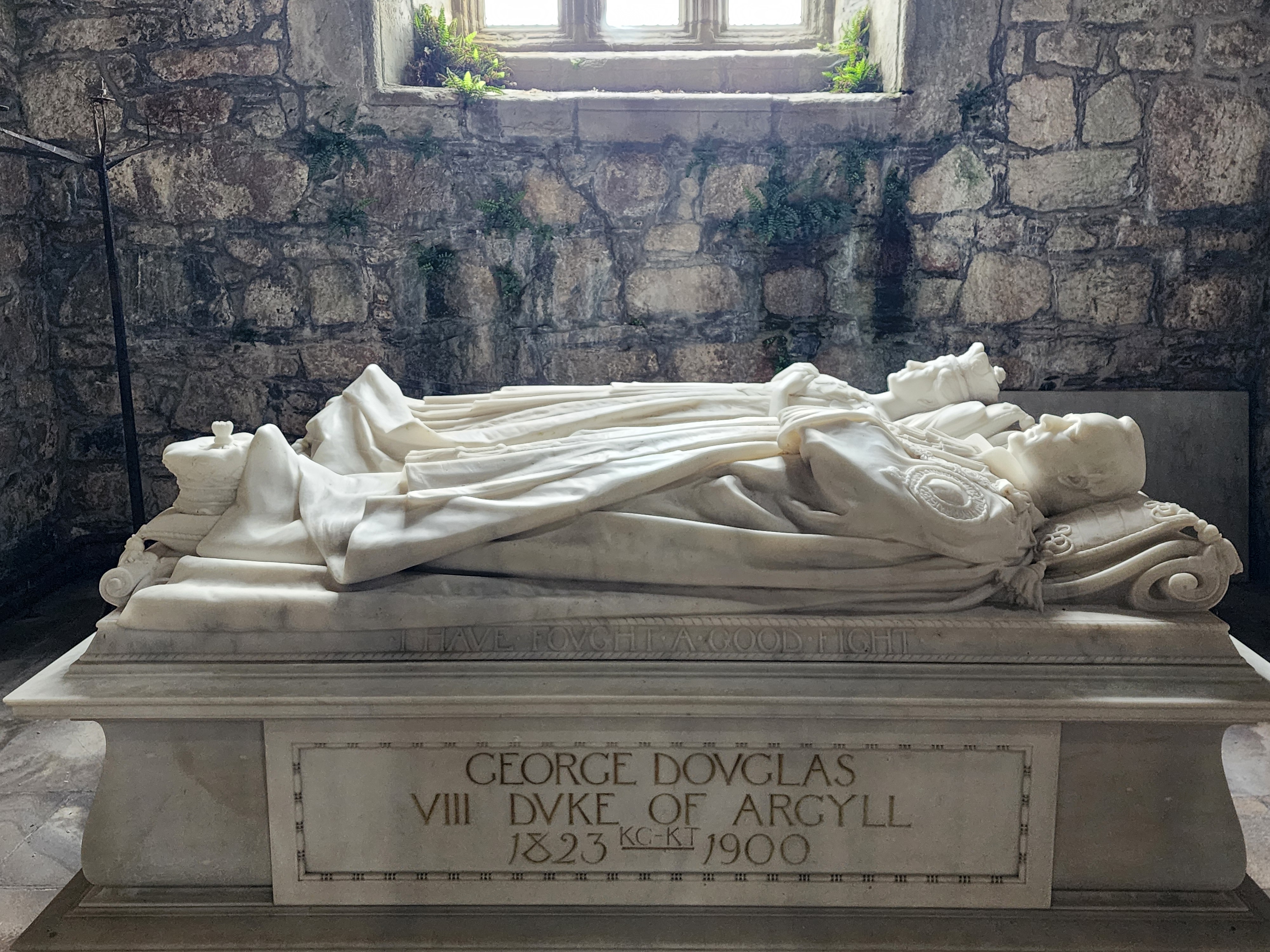
A stone burial crypt of the Duke and Duchess of Argyll

Duke and Duchess of Argyll’s crypt at Iona Abbey
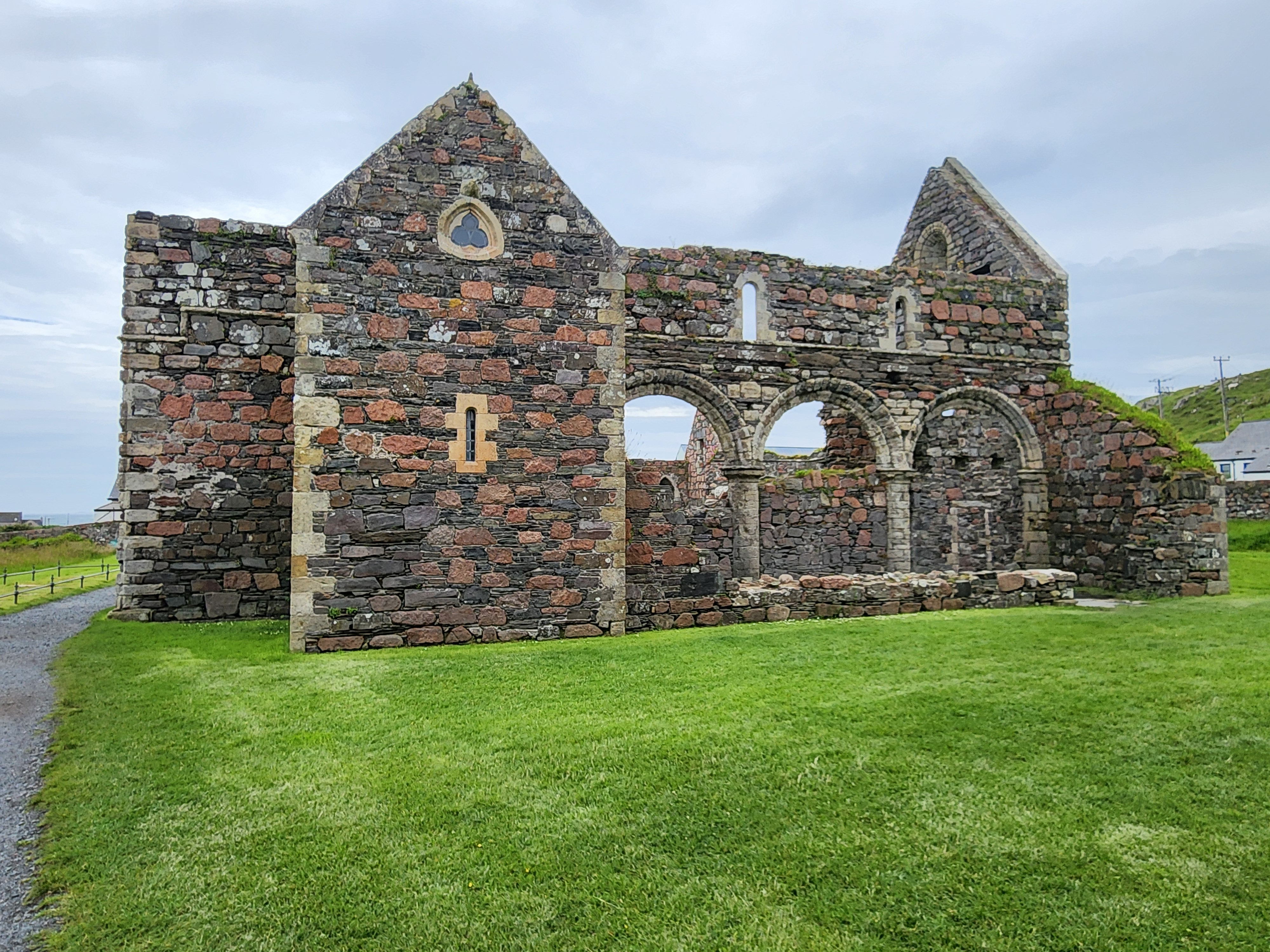
Another view of the ruins of the Iona Nunnery

Iona Nunnery wall

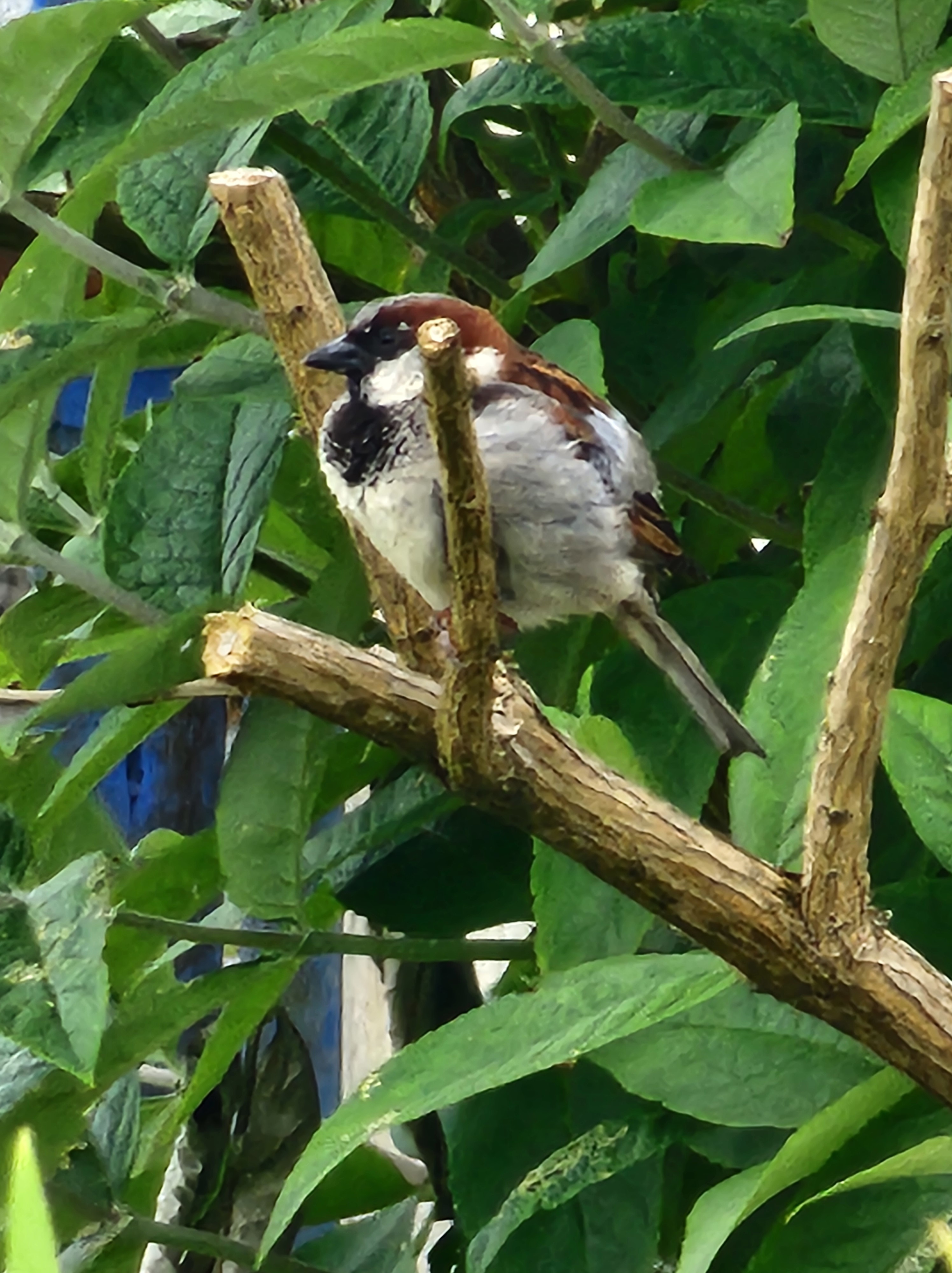
On a leafy background a fat little bird stands on a branch

This chubby guy was singing his heart out in Iona harbor.
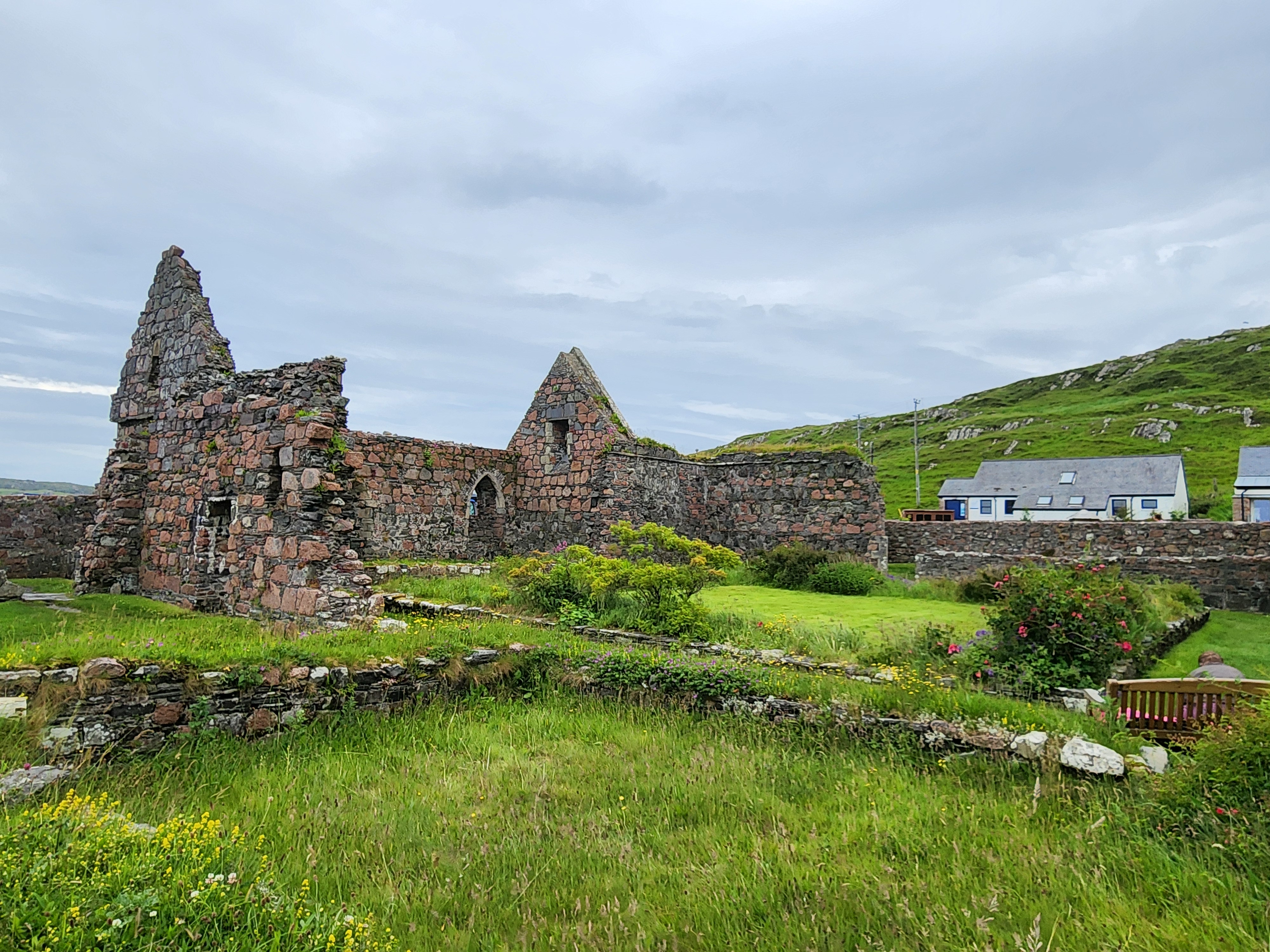
More ruins of the Iona nunnery with mostly grass in the foreground.

Ruins of the Iona nunnery

A sunny mountain view from the Craignure ferry depot
A sunny mountain view from the Craignure ferry depot

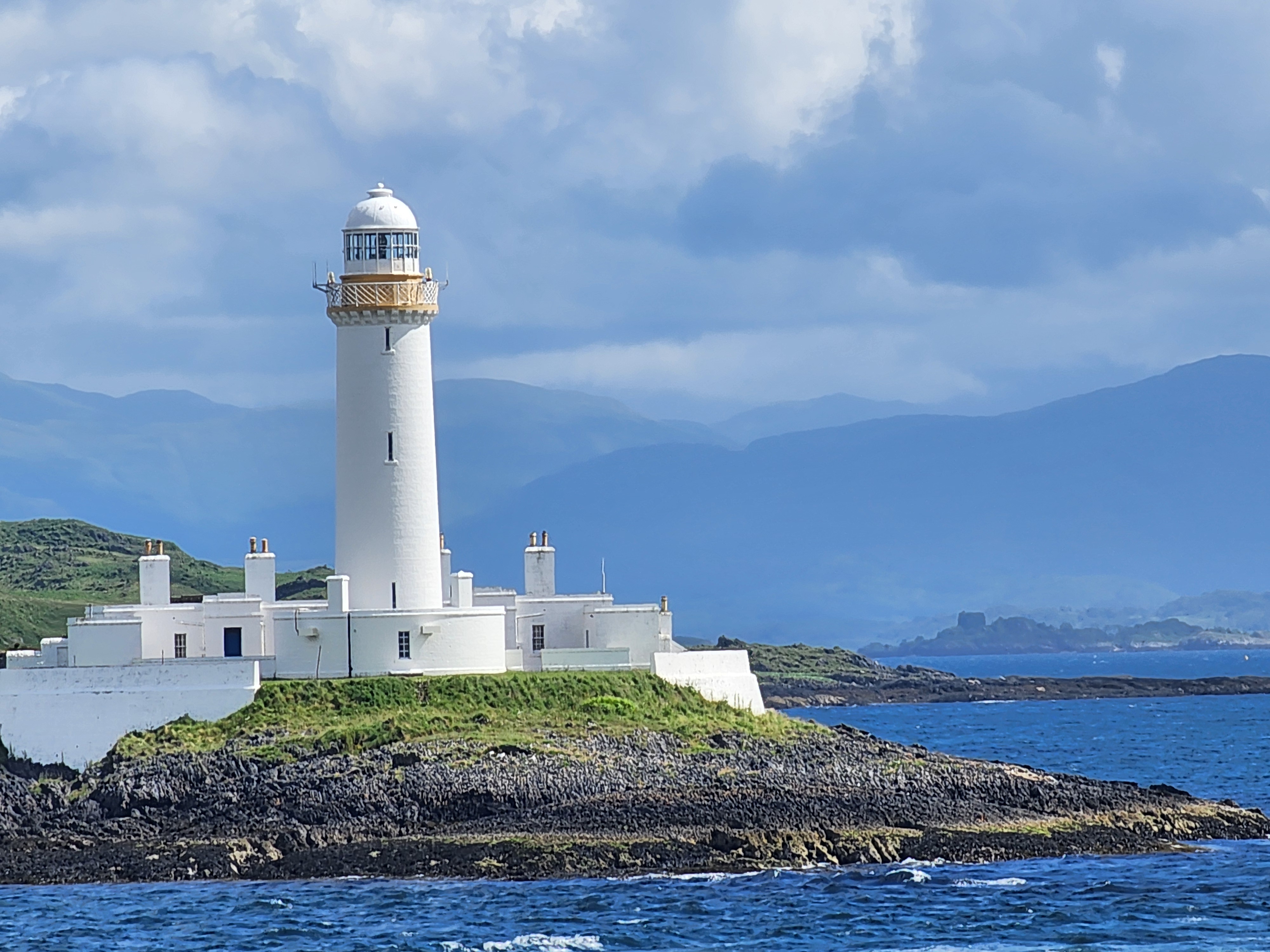
A tall, white lighthouse on the Sound of Mull

Lighthouse on the ferry ride from Craignure to Oban
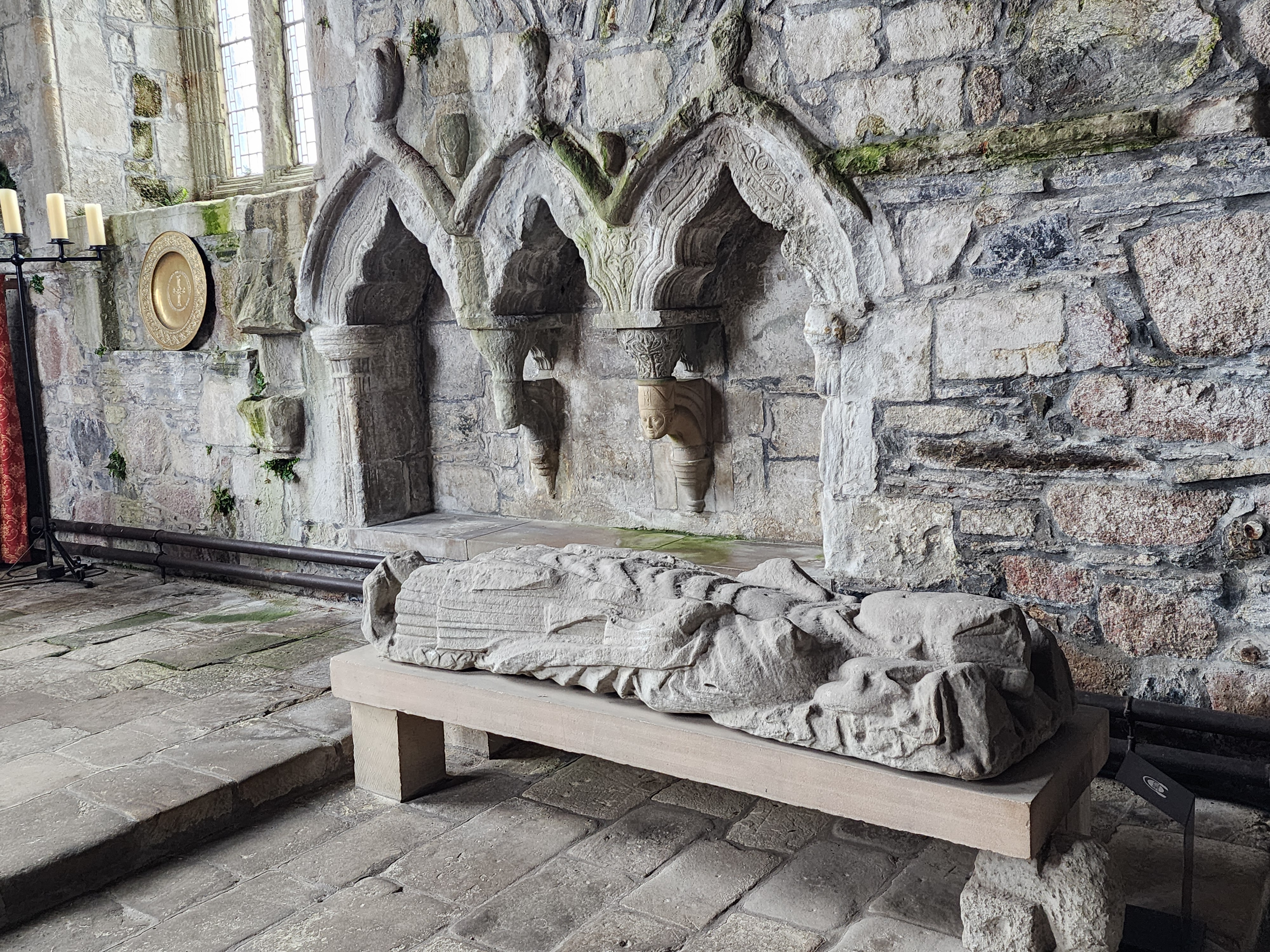
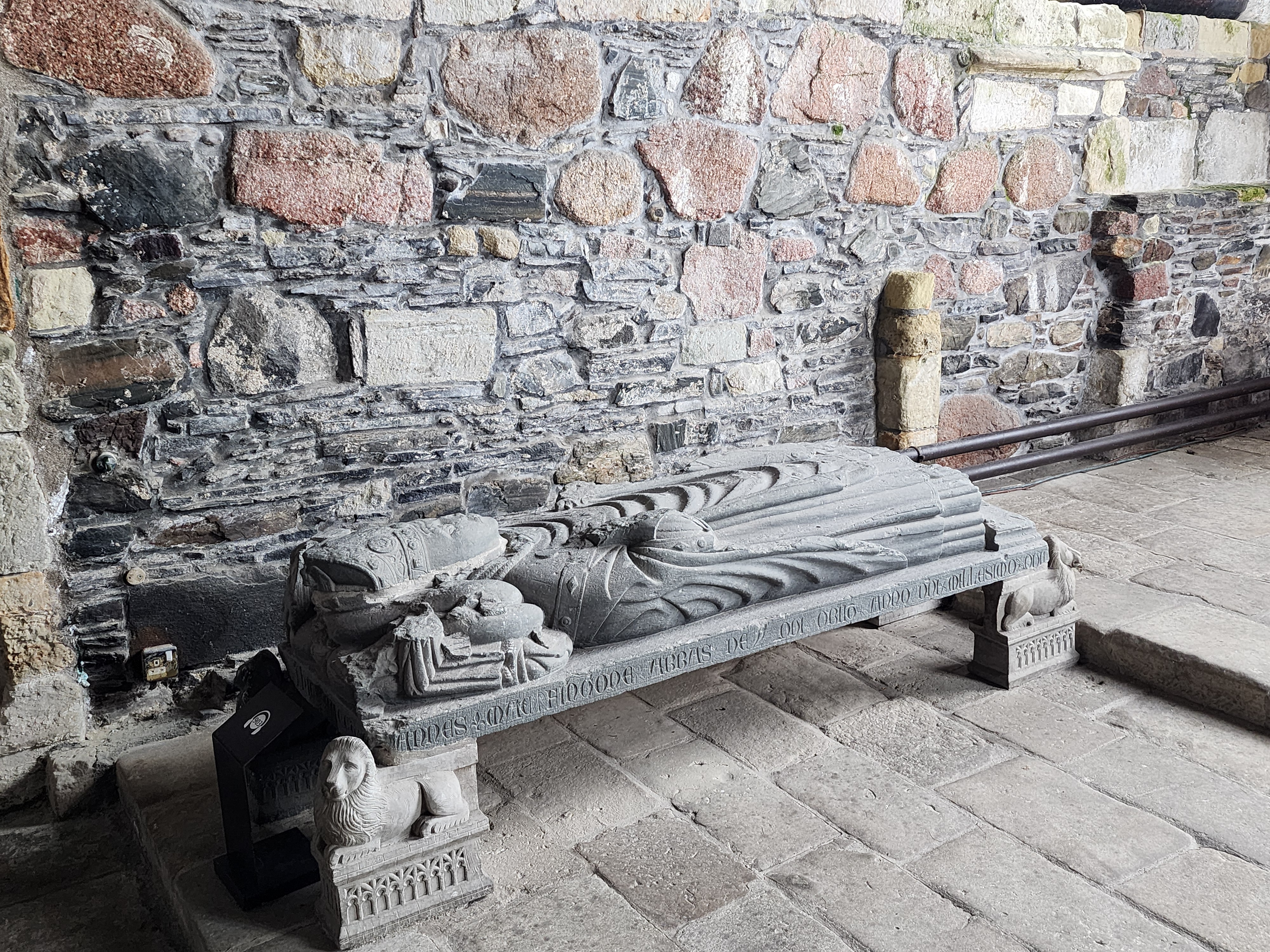
A statue lying down near the altar at the Iona Abbey

A statue near the altar at the Iona Abbey
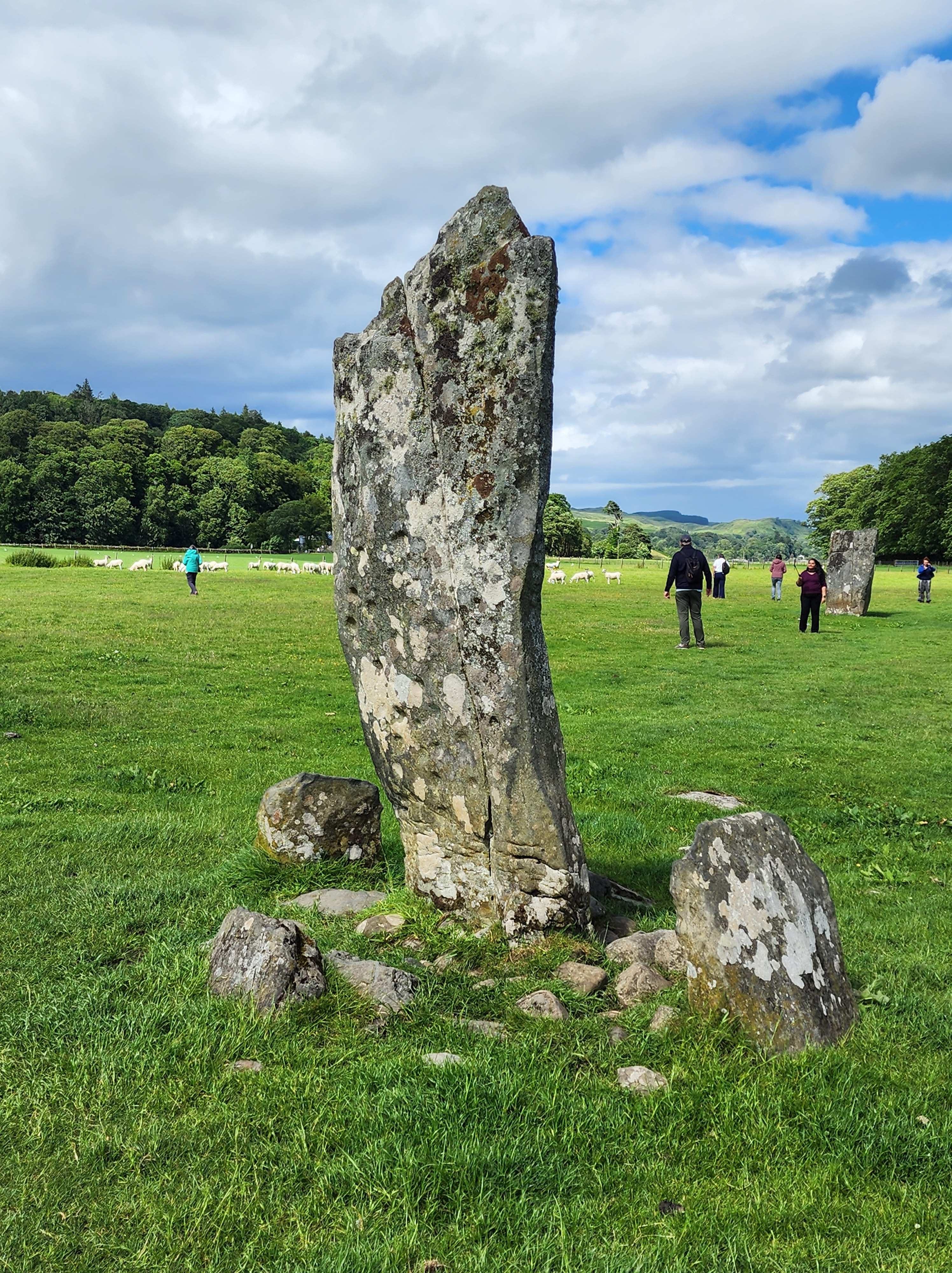
A large standing stone from the Kilmartin cairns

A standing stone at the Nether Largie standing stones
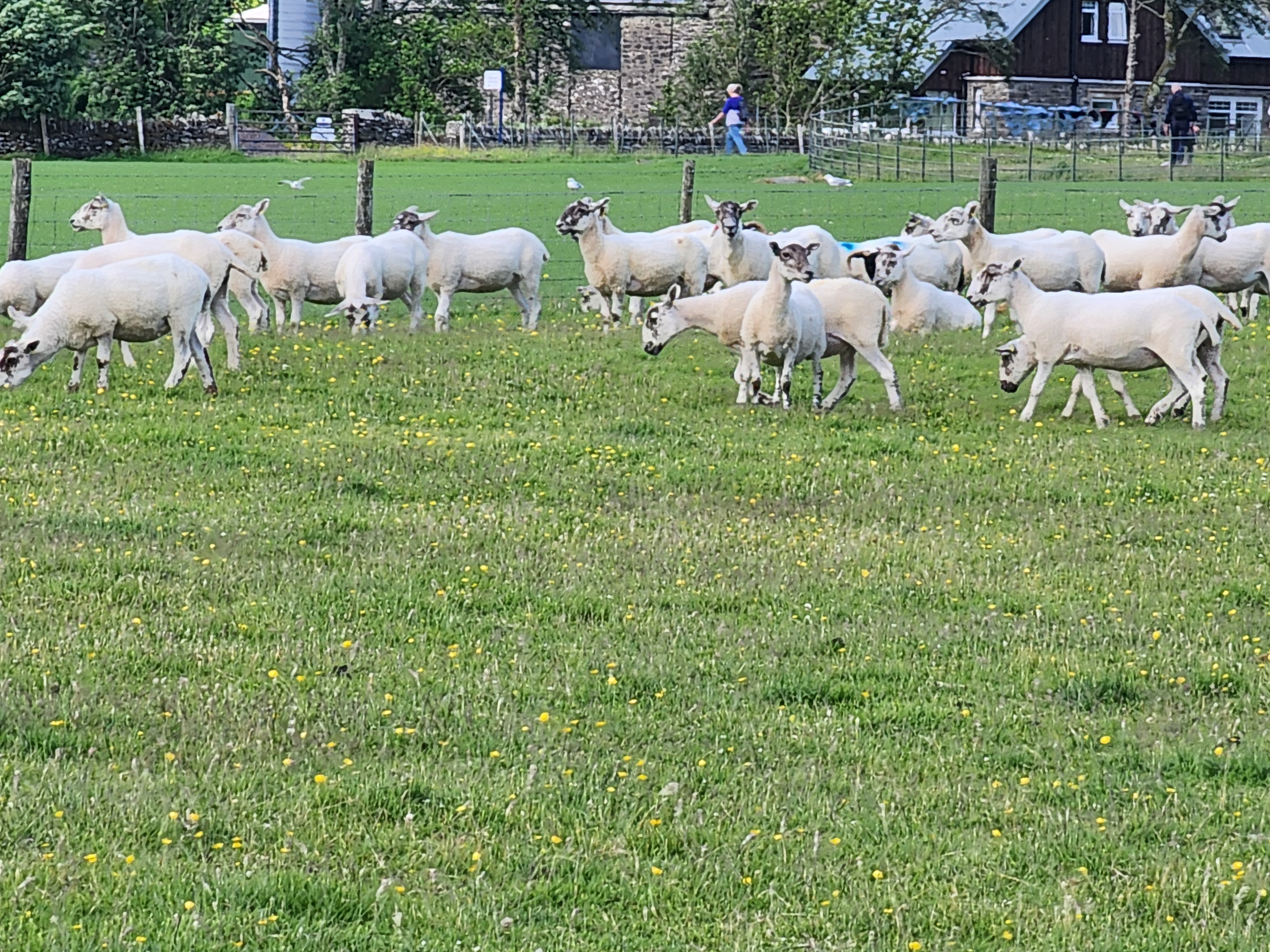
A flock of shee0

Sheepies running free

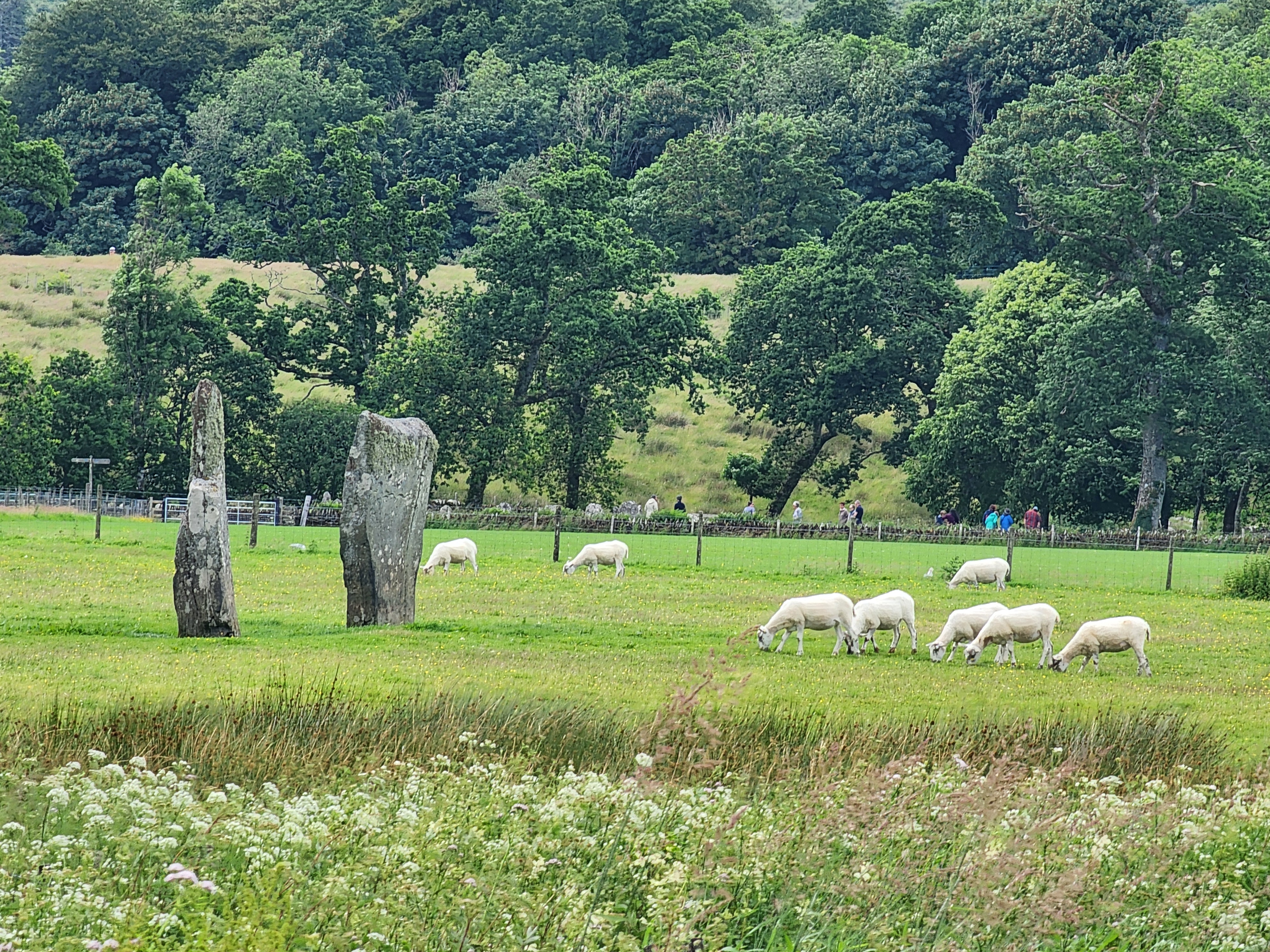
A flock of sheep behind standing stones at Kilmartin cairns

Nether Largie standing stones

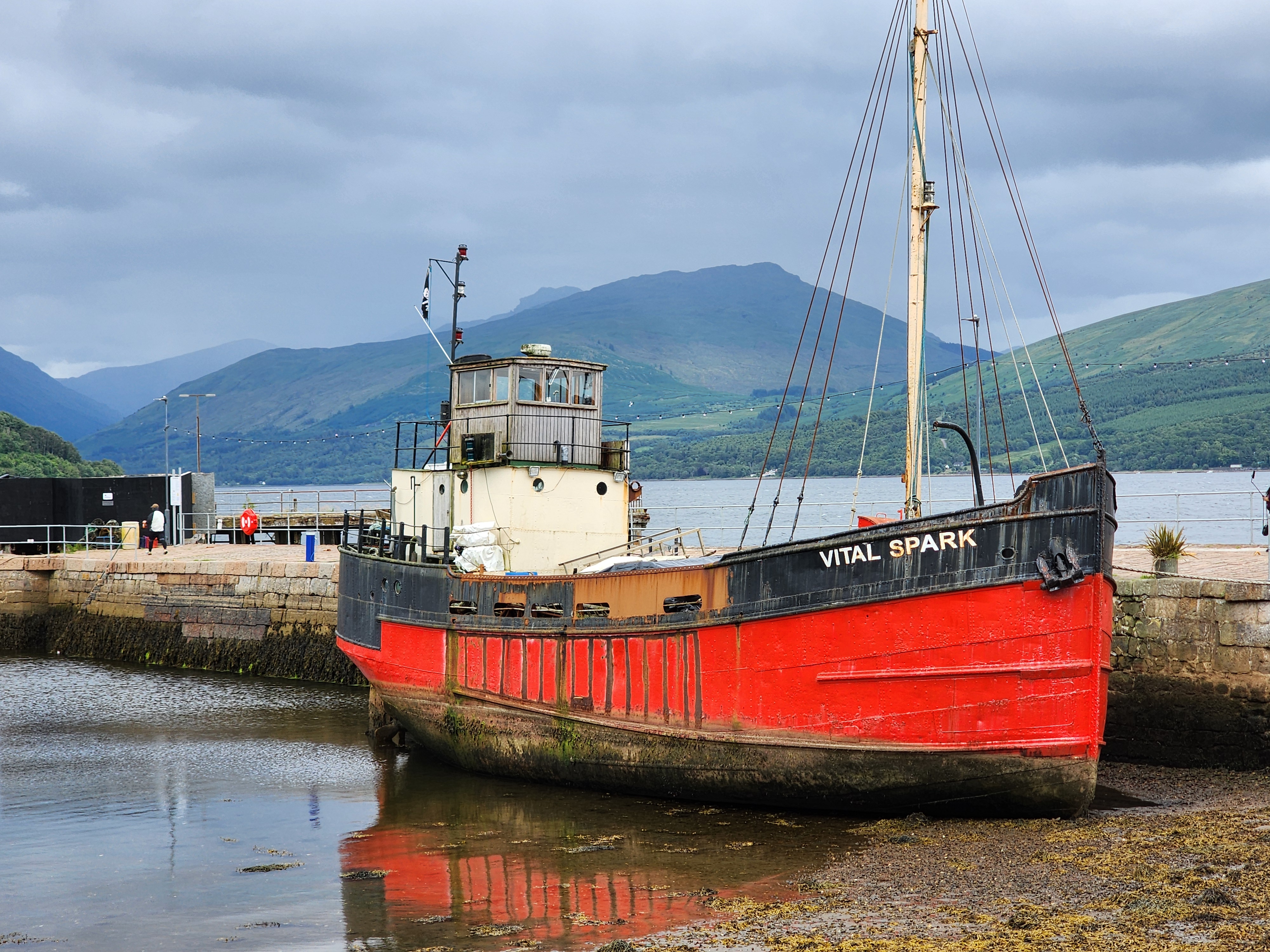
A large fishing trawler docked a Loch Fyne, called The Vital Spark

Fishing trawler at Inverary, on Loch Fyne
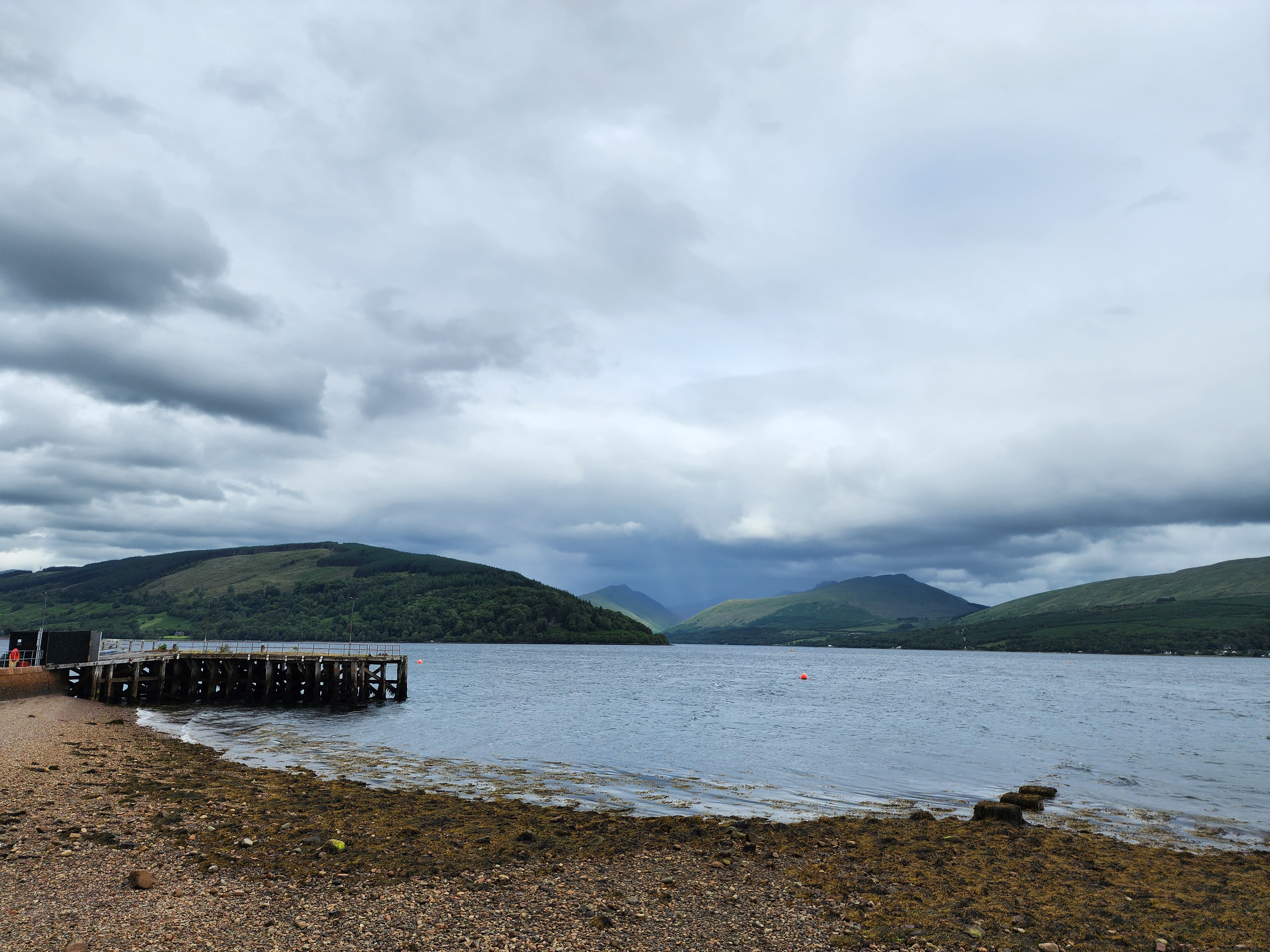
A view of Loch Fyne in the foreground with mountains and sky at the back.

Loch Fyne

Another lying-down statue at the altar at Iona Abbey

Another statue at the altar of Iona Abbey
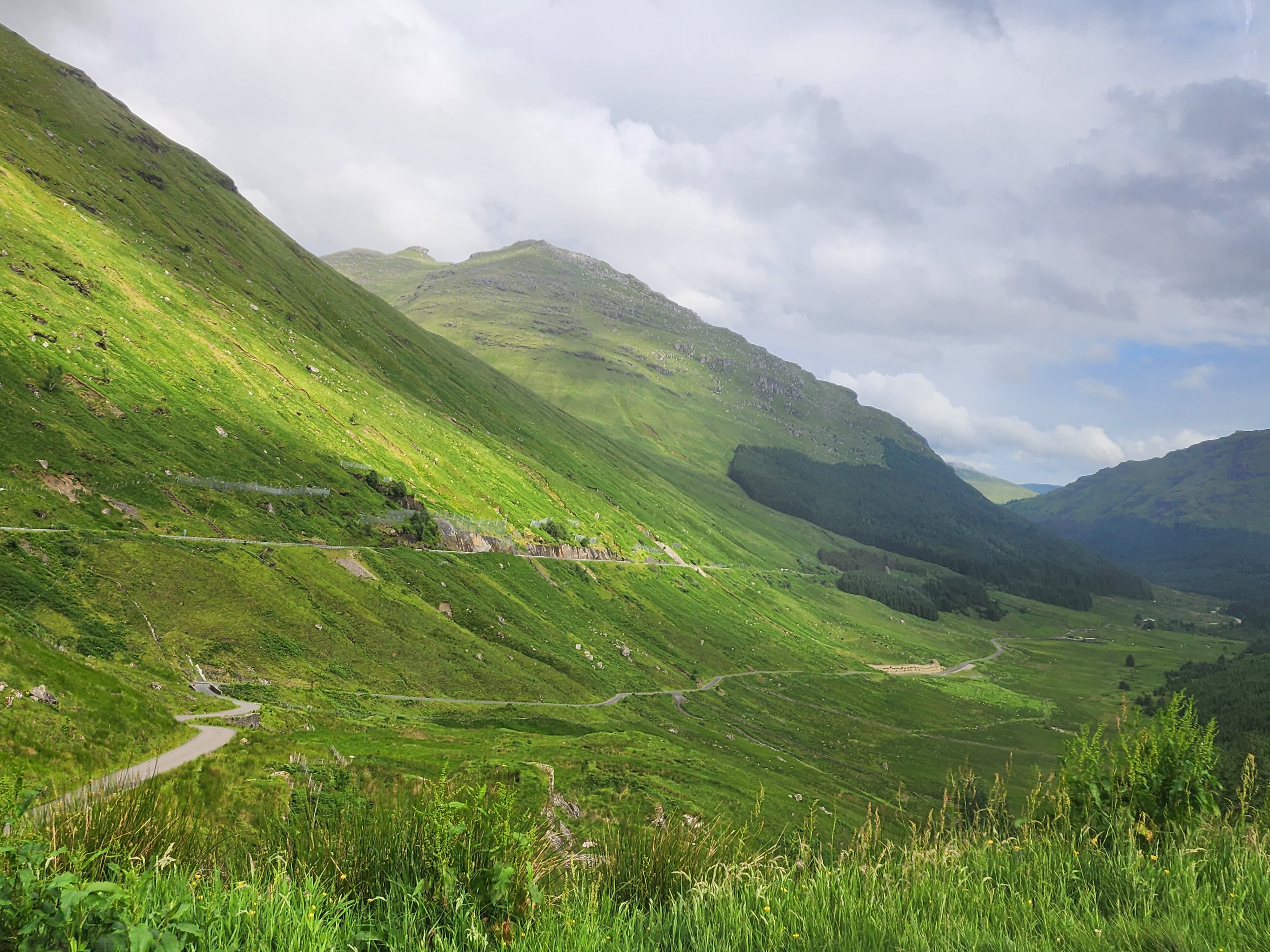
View of Glen Crowe, known as the Rest and Be Thankful viewpoint; basically a big valley with a road in it

View of Glen Crowe, known as the Rest and Be Thankful viewpoint
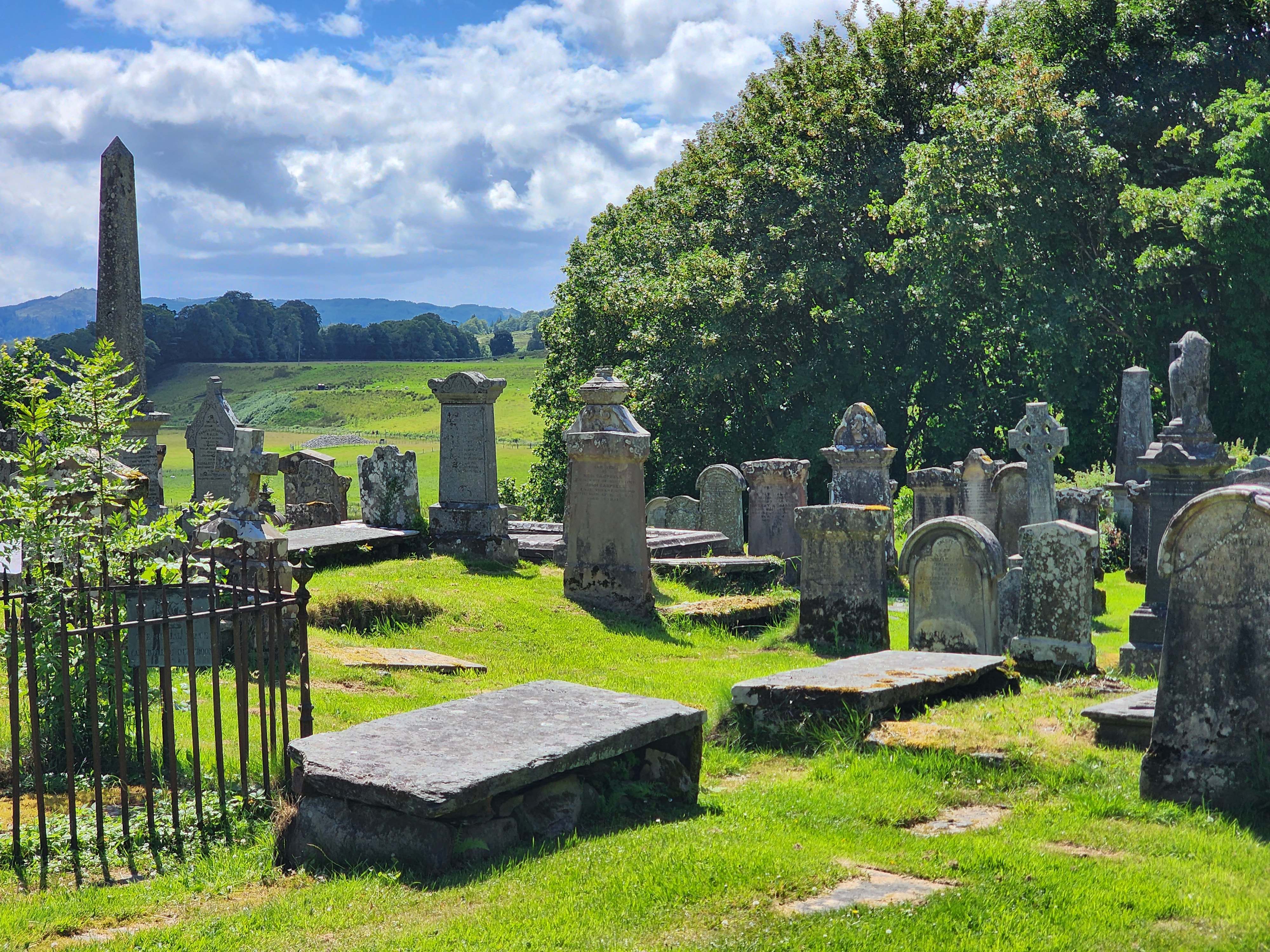
A sunny day in the churchyard at Kilmarten

Churchyard at Kilmartin

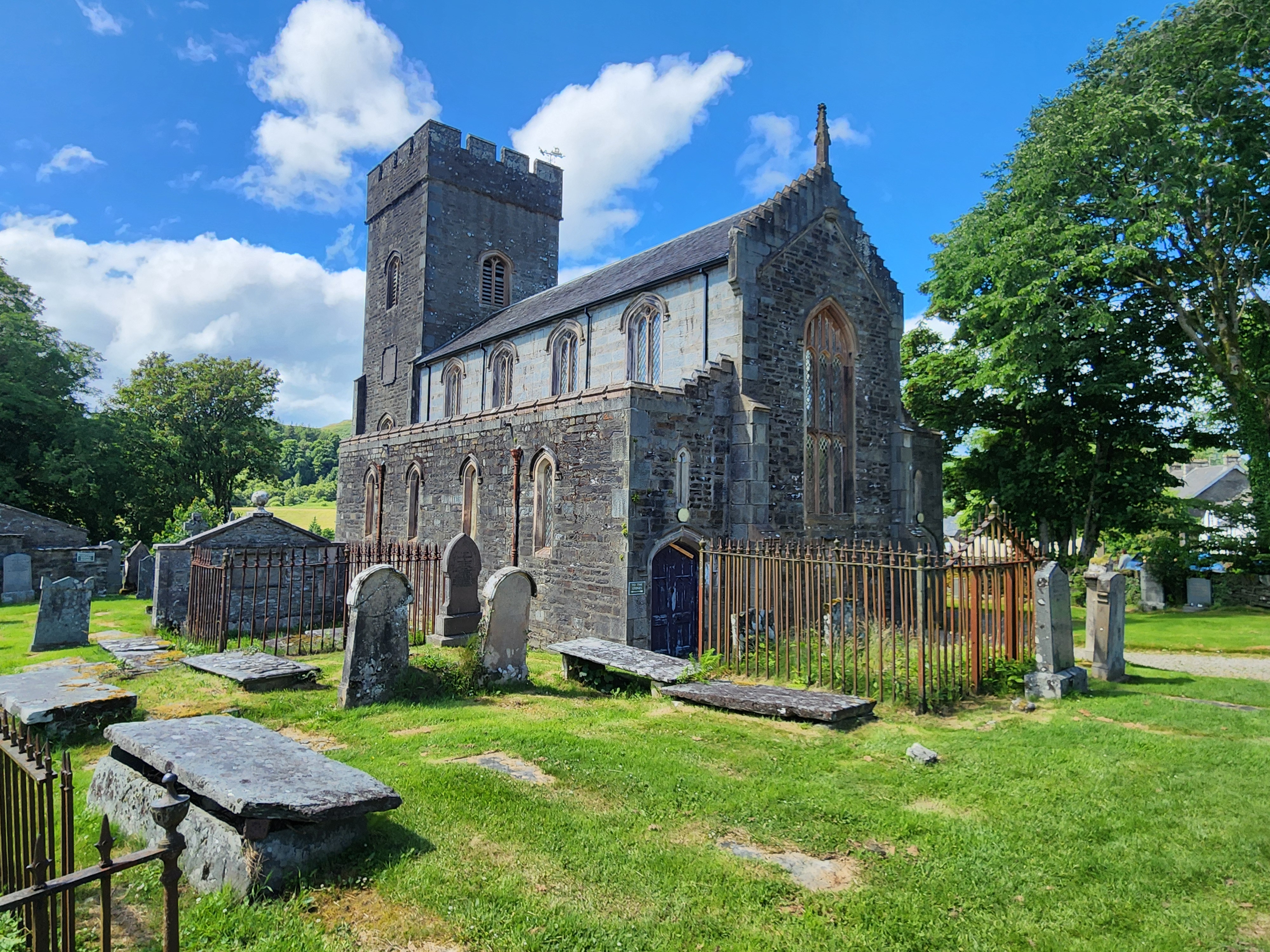
A tall, thin stone church next to some grave stones

Kilmartin Church (for sale)

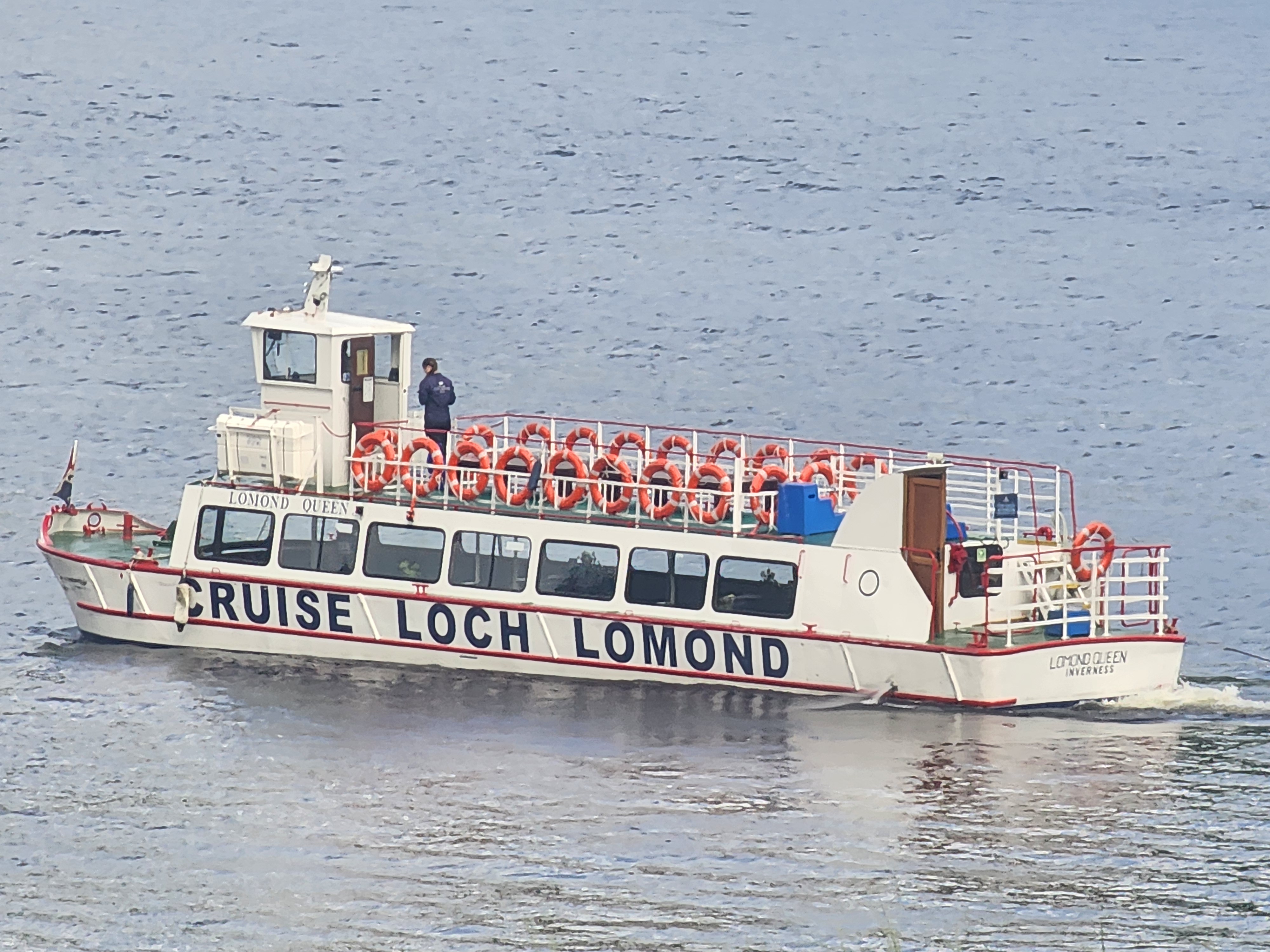
A small cruise ship on Loch Lomond

Last stop of the weekend… not that we went on the cruise
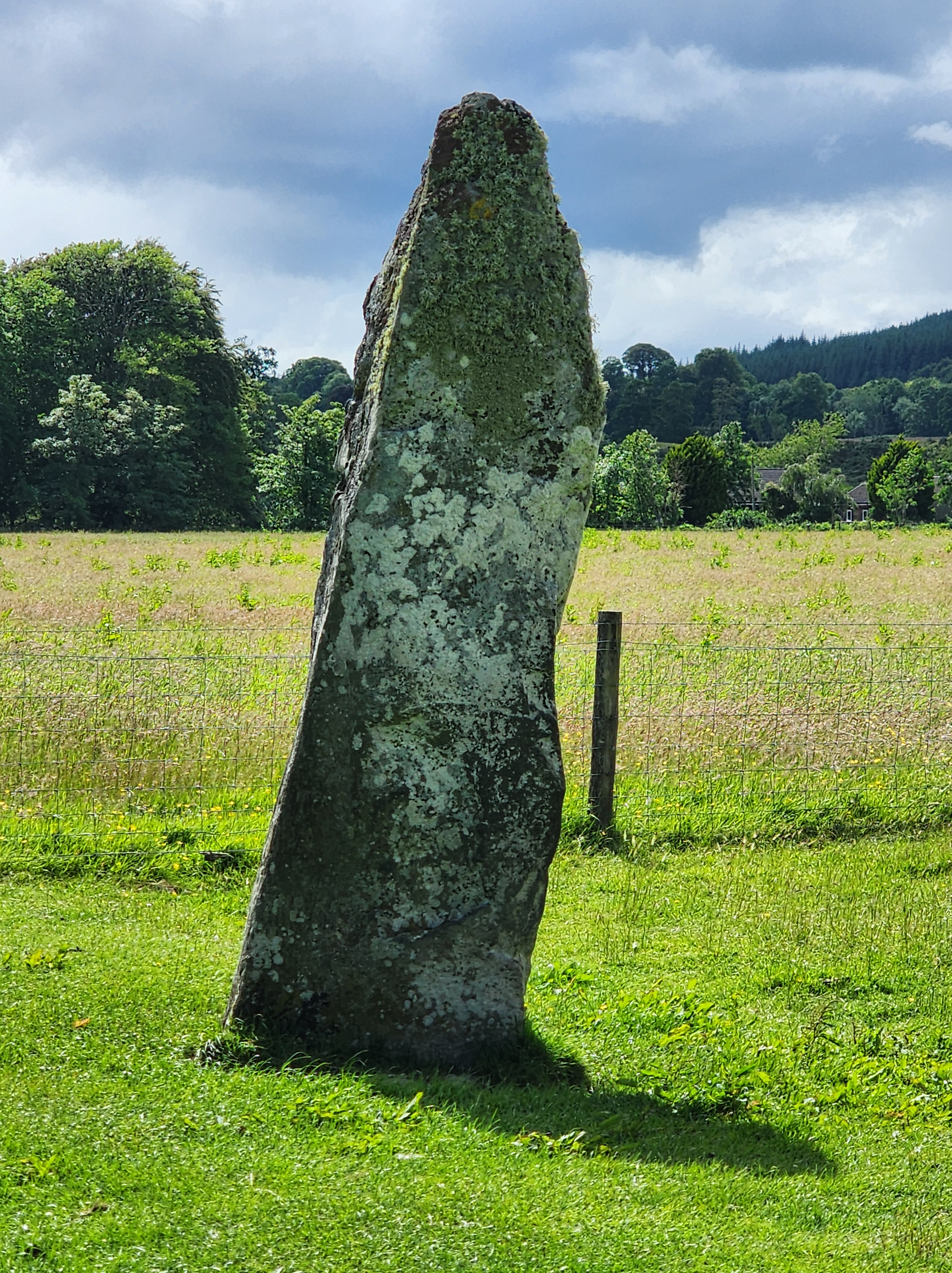
A standing stone

Another Nether Largie standing stone
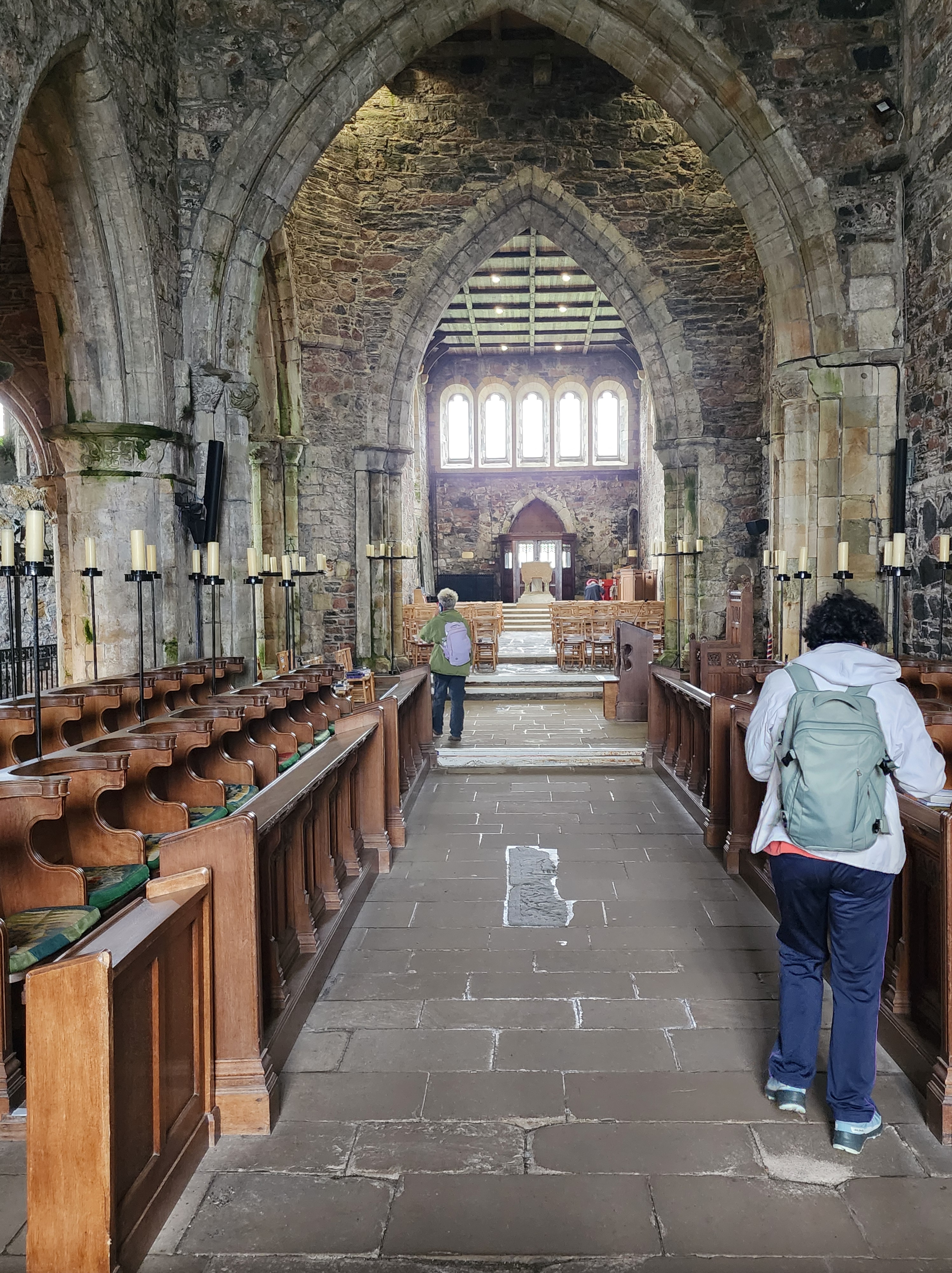
Another view of the inside of the Iona Abbey church, looking towards the altar

Another view of the altar

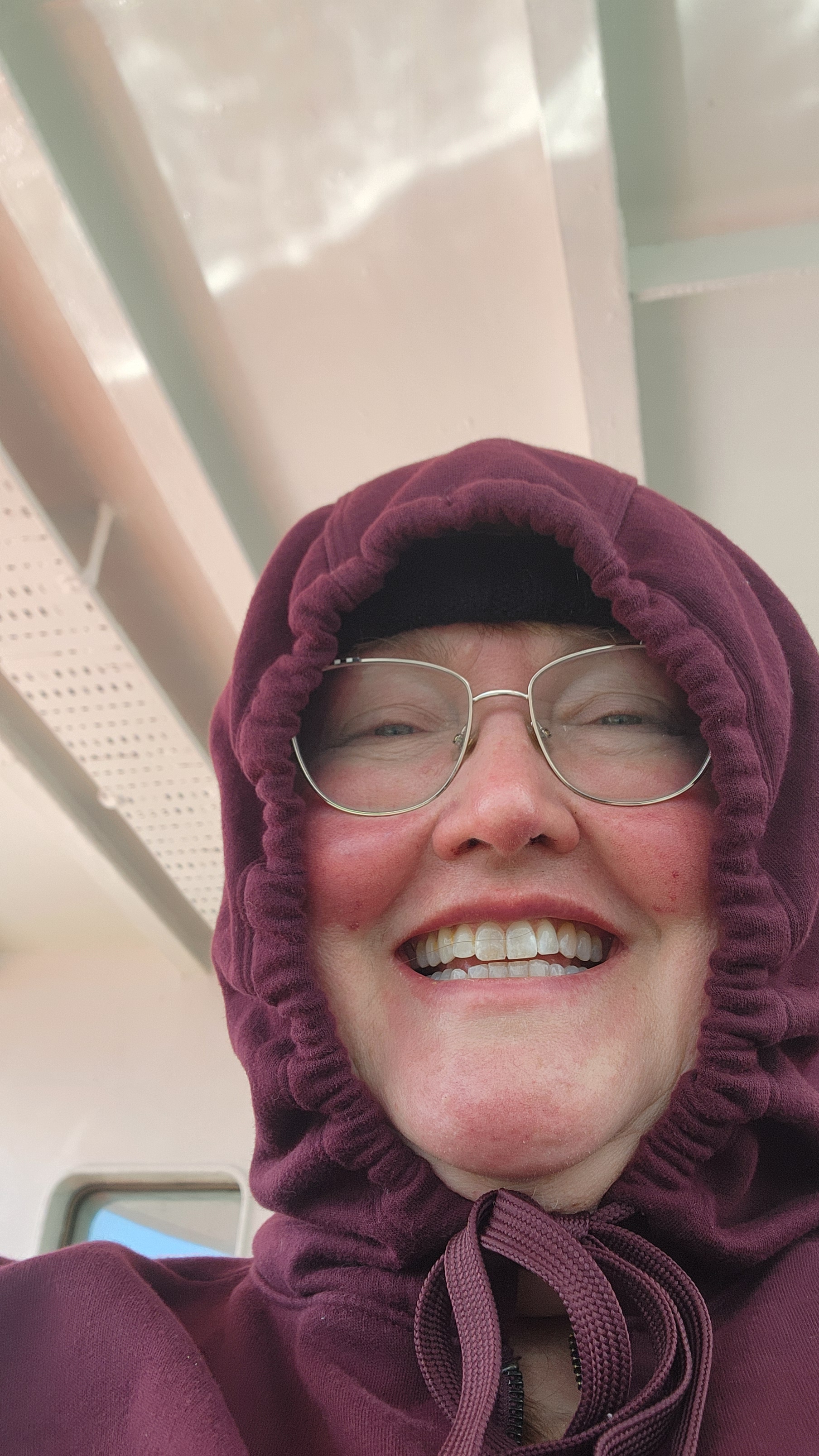
A grinning woman

Me, freezing my face off on the ferry to Oban

Dispatch from Edinburgh #2–Wet and Wild

Saturday the 14th was a soggy mess.  All of Edinburgh had as many puddles as umbrellas and lots of damp, sour faces.  But not mine.  I thrive in the rain. I had lined up the Scottish Highlands Sail, Bike, or Trail Experience (all new for 2025), which would take me to see Loch Katrine, a place I have not been before. What?  A place in the Highlands I have not yet seen?  Could this be true? It was!

Surprisingly, I had the tour to myself.  There were two other folks registered, but they canceled—probably because of the weather.  That suited me just fine, because it gave me the chance to pick any seat on the bus I wanted, window or aisle.  Also it was nice not to have to wait on stragglers who come to the bus late from outings.  And also, I think it spoiled me a little, which was nice.

The Forth Rail Bridge in the rain

The tour began with a close-up of the red Forth Bridge that I had only seen from a distance before.  The misty, dreich weather only enhanced its beauty, making it easy to imagine that I’d gone back in time and was seeing the bridge for the first time. There used to be a ferry from this point in South Queensferry over to Fife, to allow the pilgrims in St. Margaret’s time to travel (early 11th century; in fact, St. Margaret was the one who made the ferry free).  But now there’s only this rail bridge, an icon of the late 19th century, considered one of Scotland’s greatest man-made wonders.  Of course there are other bridges nearby, the 1964 bridge and the 2017 suspension bridge, but it’s the 1890 Forth bridge that has the allure and history, and is a World Heritage site.

The beauty of having a tour to oneself is that the tour guide can dispense with some of the cheesy patter and really only tell you things you want to know.  I think it helped that I mentioned I’ve been on about a dozen Rabbie’s tours over the years and could practically tell all the Scottish jokes and history right along with the tour guide.  He appreciated this comment, because he told me more tailored stories and we could talk about the sights with more depth.  For instance, we talked about the making of the Kelpies and why they were situated on the little river where they stay (because that area was known for its iron works), and they were based on the Clydesdale horses that pulled the wagons that held the iron. He told me about the legend of the Kelpies too, but I already knew it.  (In case you don’t know the Kelpies legend, they were demon horses that came out of the sea, so beautiful that anyone on the beach would feel compelled to touch or ride the horse.  But, beware! As soon as one touched the horse, one would be stuck fast, and the horse would return to the water, dragging the hapless victim to his or her death.)

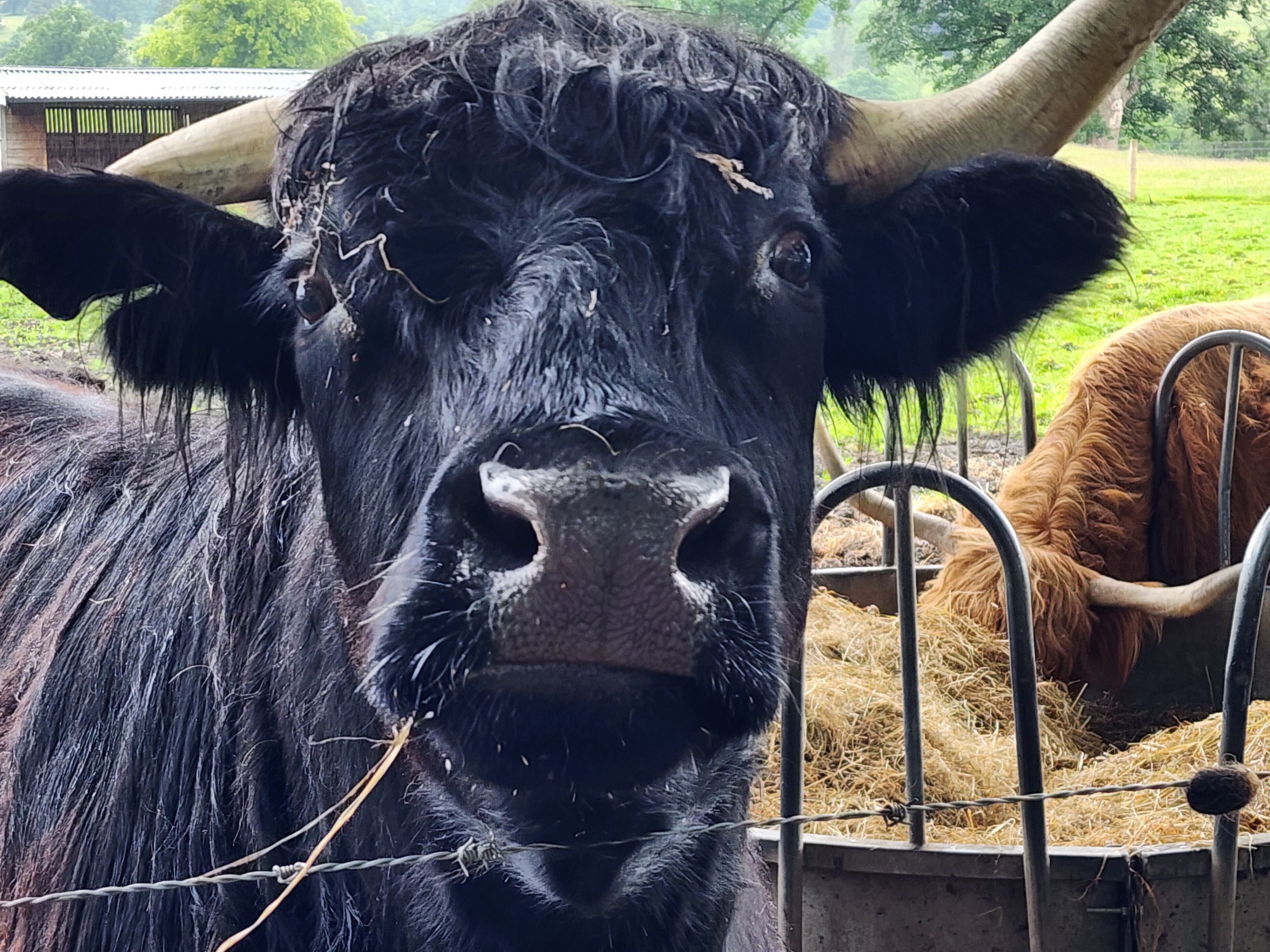
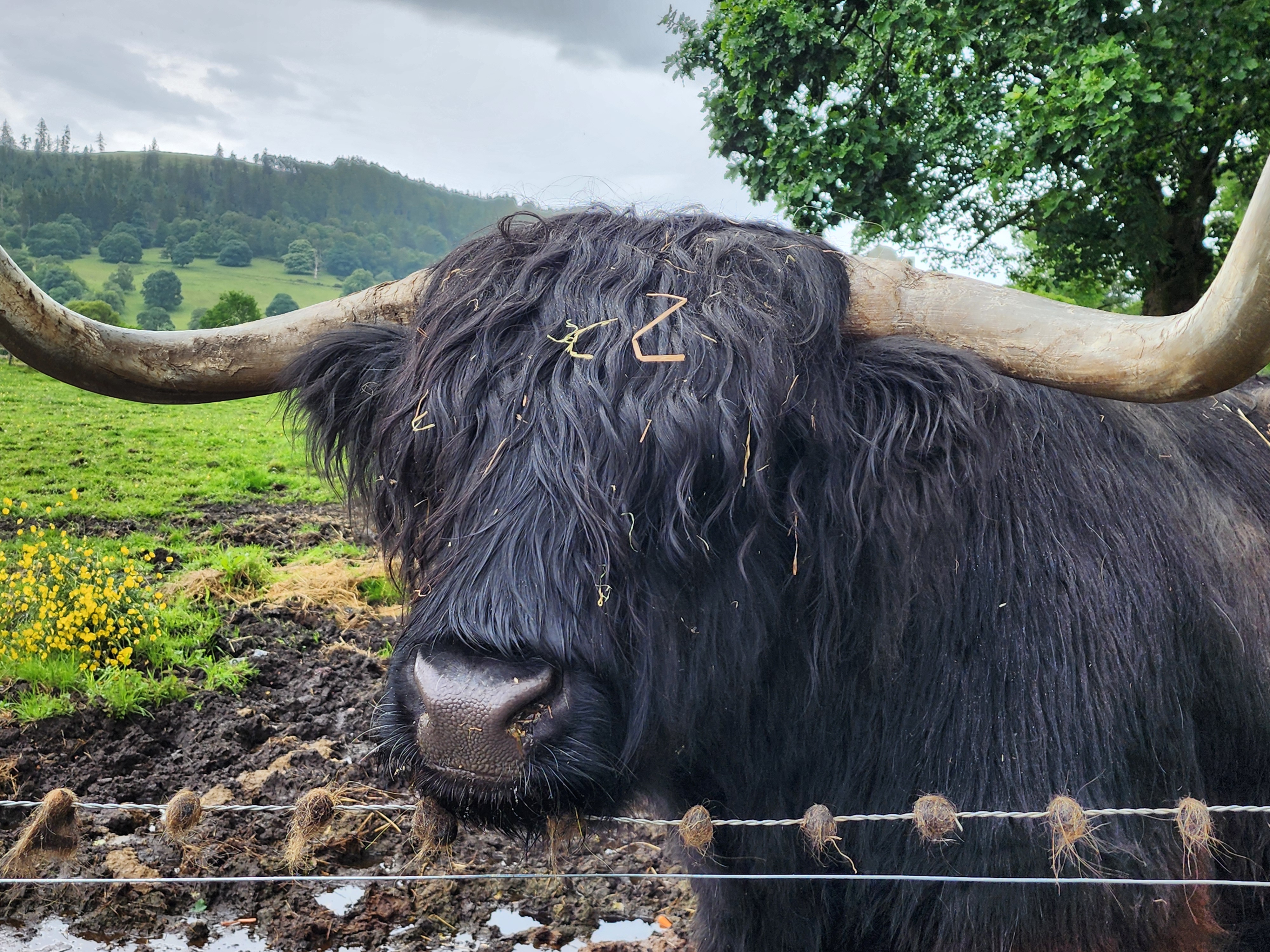
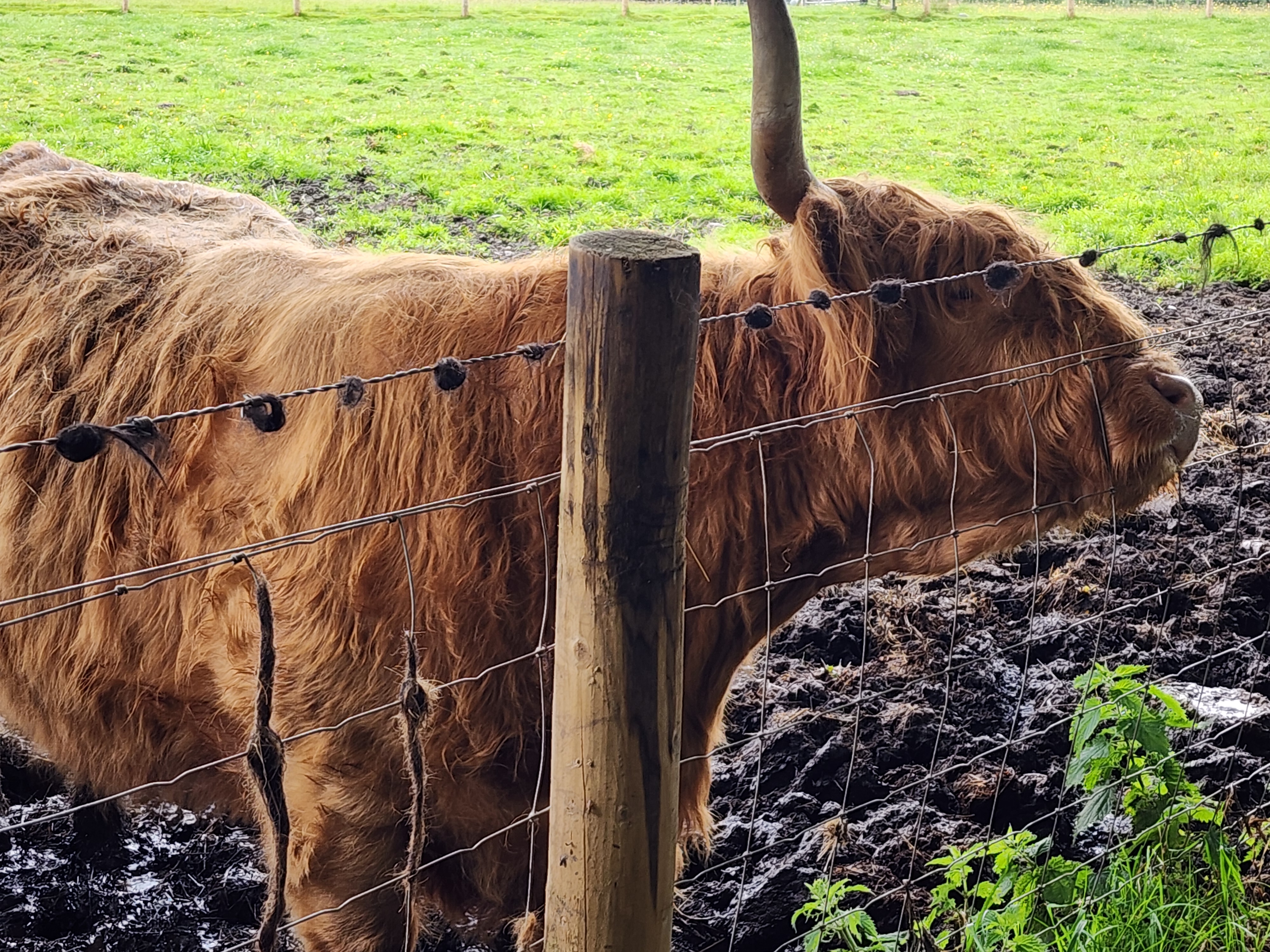
Gentle Heilan Coo!

We drove along the motor way, with yellow weather warnings periodically showing up on the signs alerting us to heavy rain (as if we couldn’t tell), but then we turned off onto two-lane roads and started our climb toward the mountains.  Because there was only me, he made a surprise extra stop at a woolen mill where some Heilan Coos waited patiently in the rain for photos and food.  For a £1 you could purchase a bag of carrots, raw potato, and other goodies for the cows, and they would take the food right from your hand with a wet sweep of their huge black tongues.  I am sure they are used to standing in the rain, bedraggled and sad-looking, but I felt a little bad for the cows.  They liked the veggies though and I was delighted to give them to the cows.

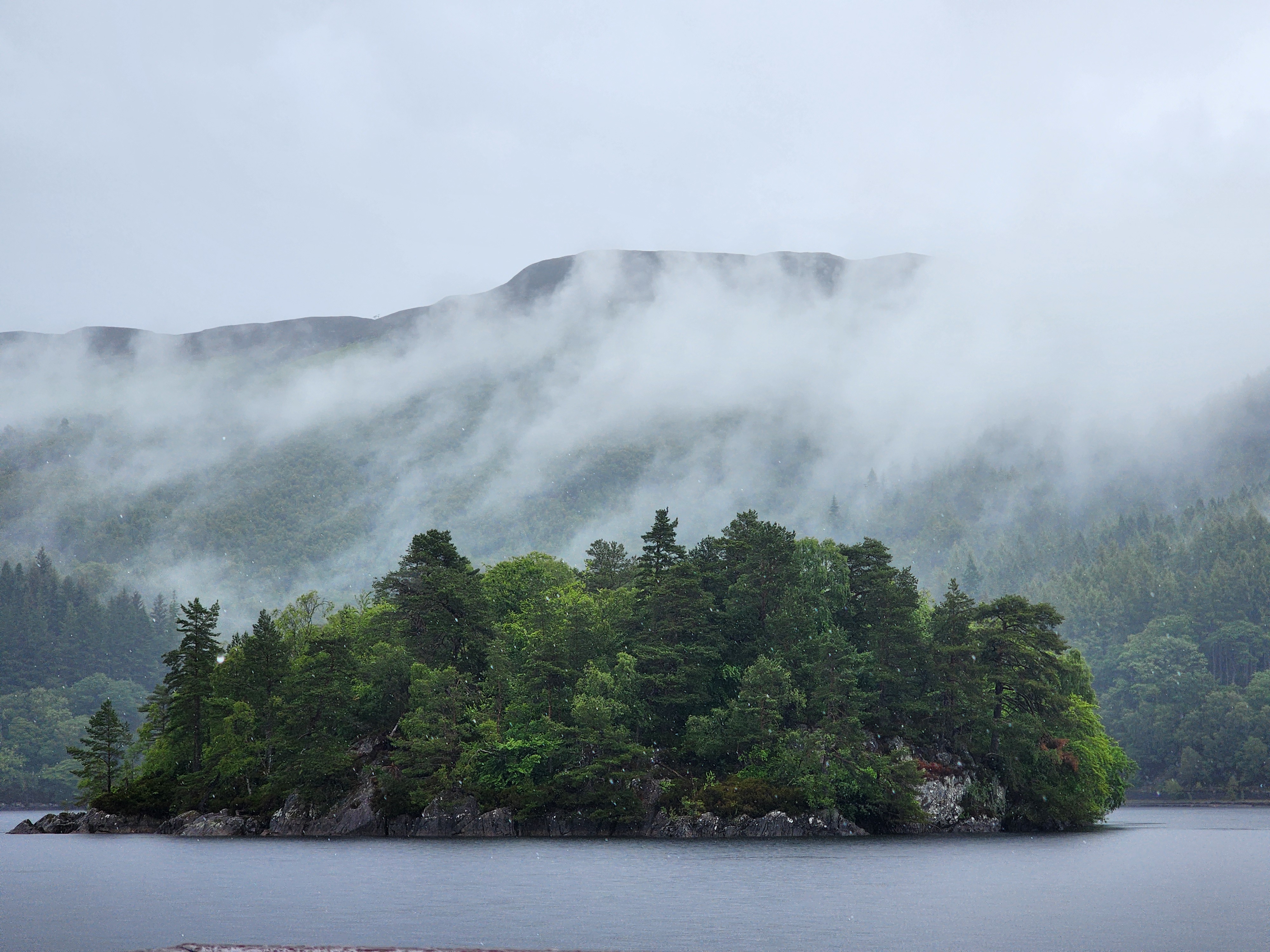
Misty Loch Katrine

Our next stop was Loch Katrine, a huge reservoir that serves Glasgow for its water needs. The loch was deep in the Highlands somewhere, up a twisty, windy road that was so narrow the tour guide asked me not to speak to him so he could concentrate on the drive.  I was glad that I wasn’t the one driving—some of the turns were hairpin, and almost 90 degrees at points. Maybe on a day it wasn’t raining like hell, the road would be less treacherous, but it felt pretty scary and I thought he took the drive too quickly.  But we arrived more or less in one piece, though I was a bit frazzled.

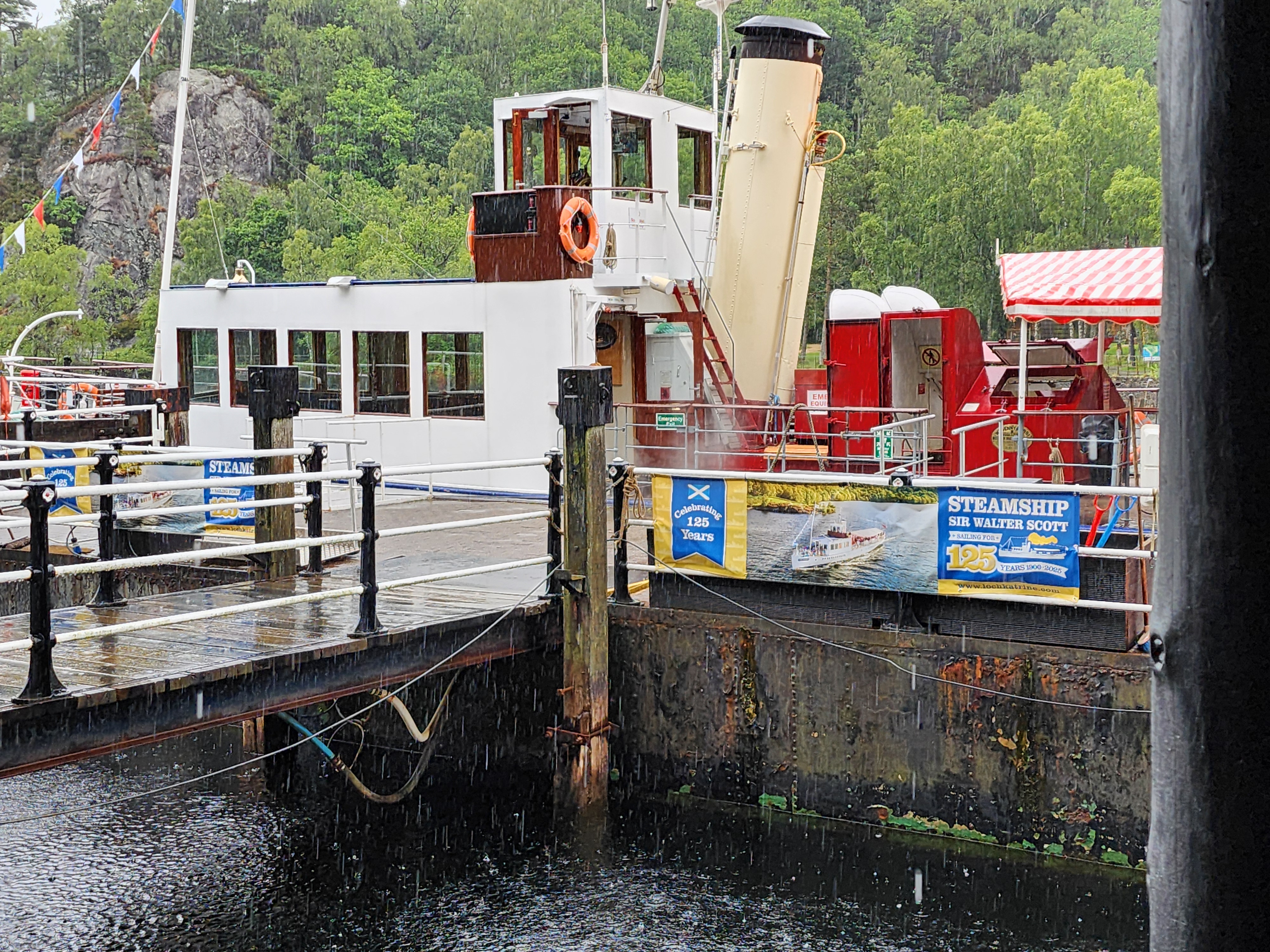
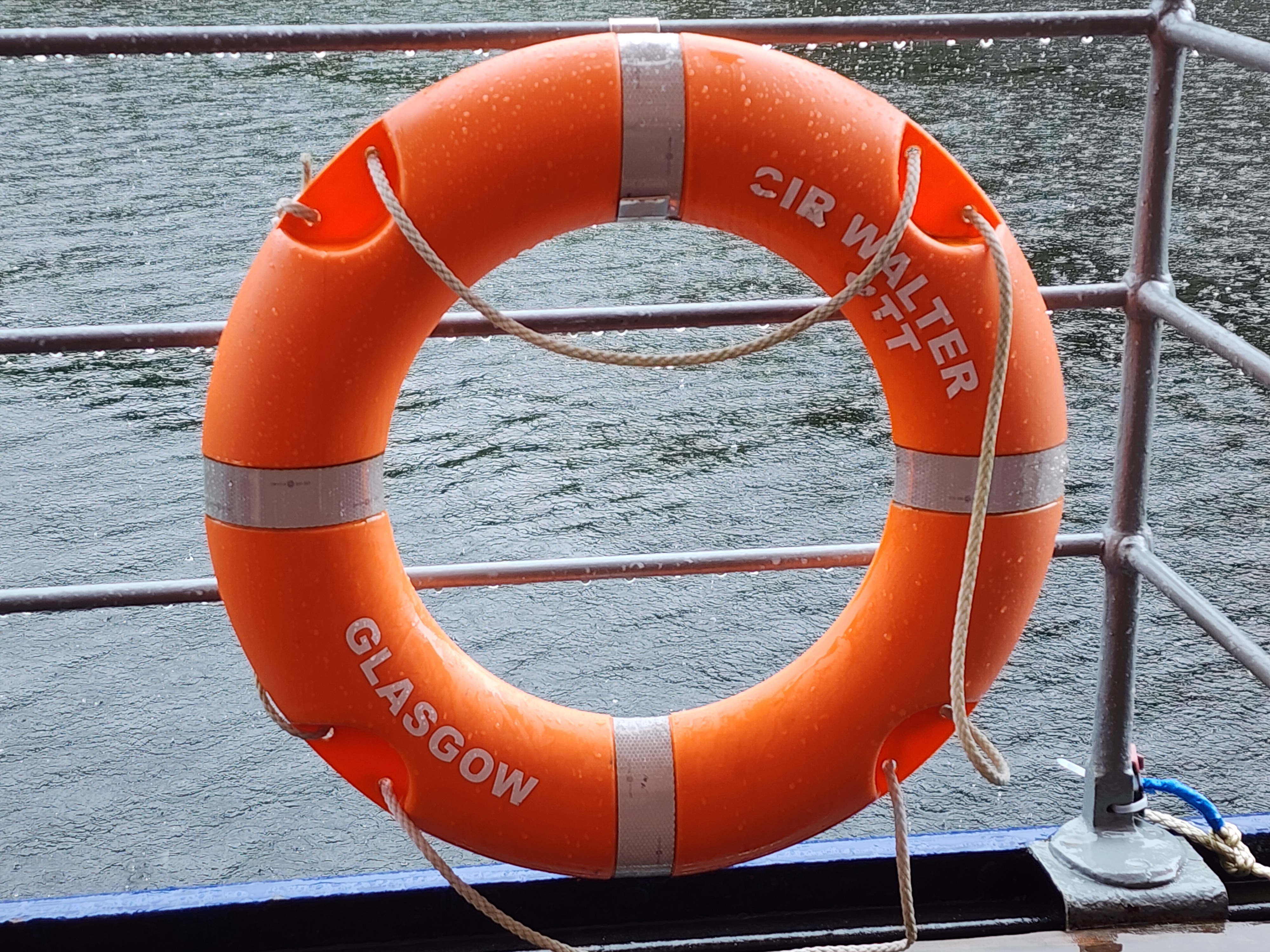
The Sir Walter Scott… if you look close you can see the rain

Had it not been raining, I might have done some walking along the trails that led away from the boat launch.  There was a walk that went past some yurts that I was interested in looking at, but I really just wanted to get out of the rain.  I got lunch in the little café—to-mah-to pepper soup and an egg salad sandwich on wheat, which was more lettuce than anything else. The boat ride wasn’t until one, so after lunch I called Mom on the area’s sketchy wifi to catch up with her. (She was fine.)  The boat ride was on the Sir Walter Scott, a steam engine boat celebrating its 125th anniversary.  There were 41 passengers for our boat ride, but I was amazed to hear that back in the day, even up to the 1950s, the ship carried up to 500 people.  I can’t imagine how 500 people could fit on the ship—we were cozy at 41.  The Captain made a joke that people are “wider” now and so it would be a lot harder to fit 500 on the deck. What he didn’t say was where the 500 people would be going.

Another misty view of Loch Katrine

The rain pelted down and the deck was damp and cold but the ride itself was pleasant—the mountains were hiding in low clouds, and the loch splashed and wavered as the boat steamed its way through it. The Captain was full of cheery chat, among which included the fact that no sheep graze in the mountains surrounding the loch because diseased sheep made runoff into the loch, and poisoned the water…not so good for Glasgow.

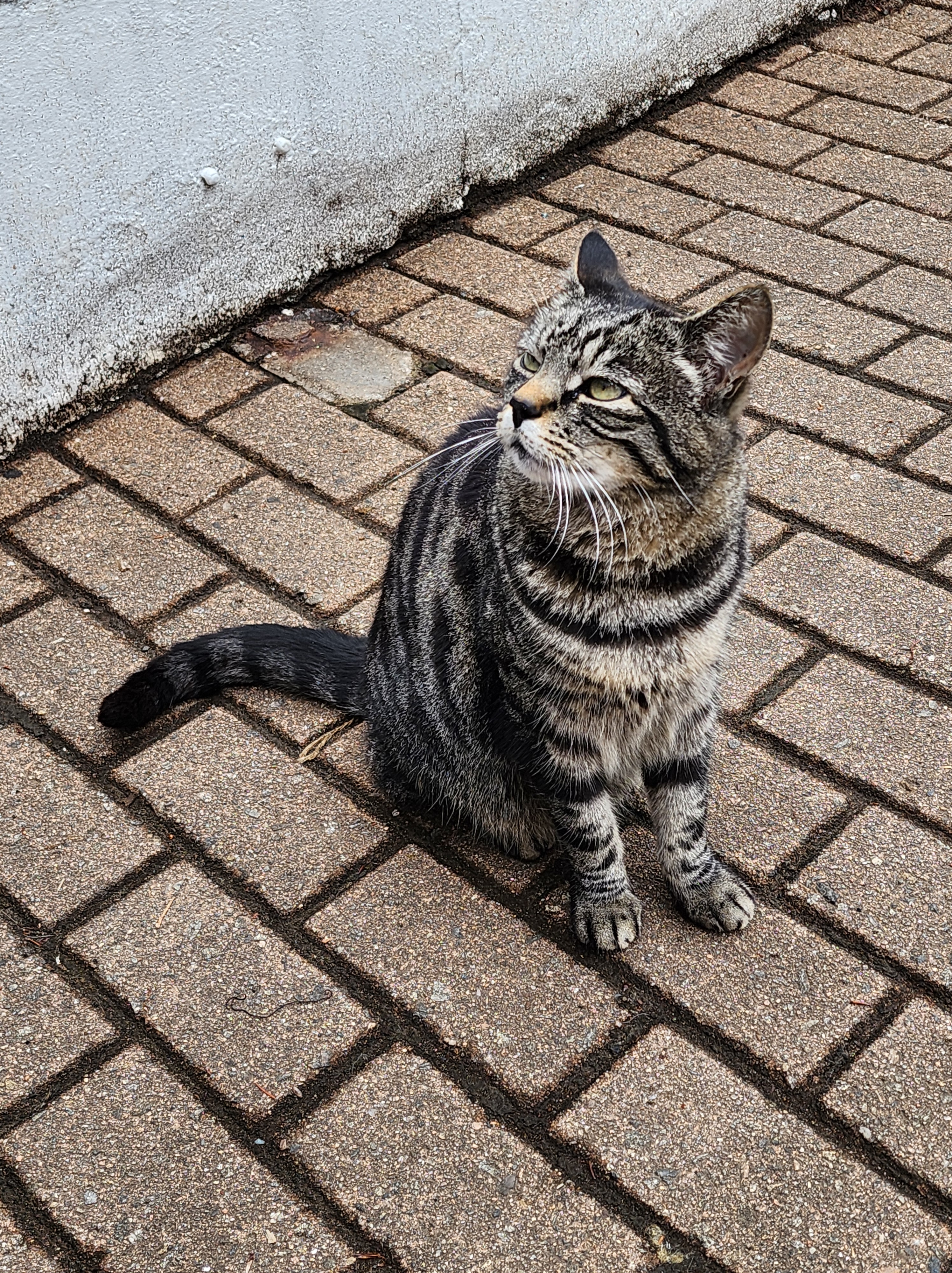
Turret the Cat

Towser the Mouser

Eventually the rain subsided somewhat as we turned around to get to the boat launch. I returned to the coach and we made our way to the last stop, Glenturret, apparently the oldest Scottish distillery, in Perthshire.  They don’t have an assured date, but they settled on 1763 based on archival research and a land deed.  Glenturret was unique because they have distillery cats, Glen (shy; I didn’t see him) and Turret (quite gregarious and affectionate).  A monument to Towser, the Guiness Book of World’s Record winning mouser, stands right as you are walking up a rise to go into the distillery.  Towser caught almost 29,000 mice in her lifetime.  Glenturret doesn’t have the mice problem it used to with the barley, so the cats are mainly decorative at this point, but I liked that they were there.

The smooth 7 Year

As for the whisky, I tried a dram of their Triple Wood whisky and their 7 year lightly peated whisky, which I liked very much, better than the Triple Wood, which I found a little harsh on the palate, even with its buttery notes.  The distillery tour guide told me that they are phasing out the peated whiskies because they were never but 10% of their business. I think part of that is the recognition that peat is a basically unrenewable resource—but sustainability aside, probably phasing out the peated whiskies mostly has to do with the fact that it doesn’t make money for Glenturret.  Another interesting thing about Glenturret is that it is half-owned by the Swiss company who also owns Lalique art glass.  I had noticed all the fancy glass bottles and the Lalique markers, and wondered.  The bottles are beautiful for sure. I would have liked to have checked out the Lalique Boutique but I didn’t have time.  Still, seeing the Lalique bottles for the special whiskies was impressive.  (So was the cost!)  Even though it wasn’t an arduous tour, I was tired by the time we came back to Edinburgh.  I think all the tramping in the rain did me in.

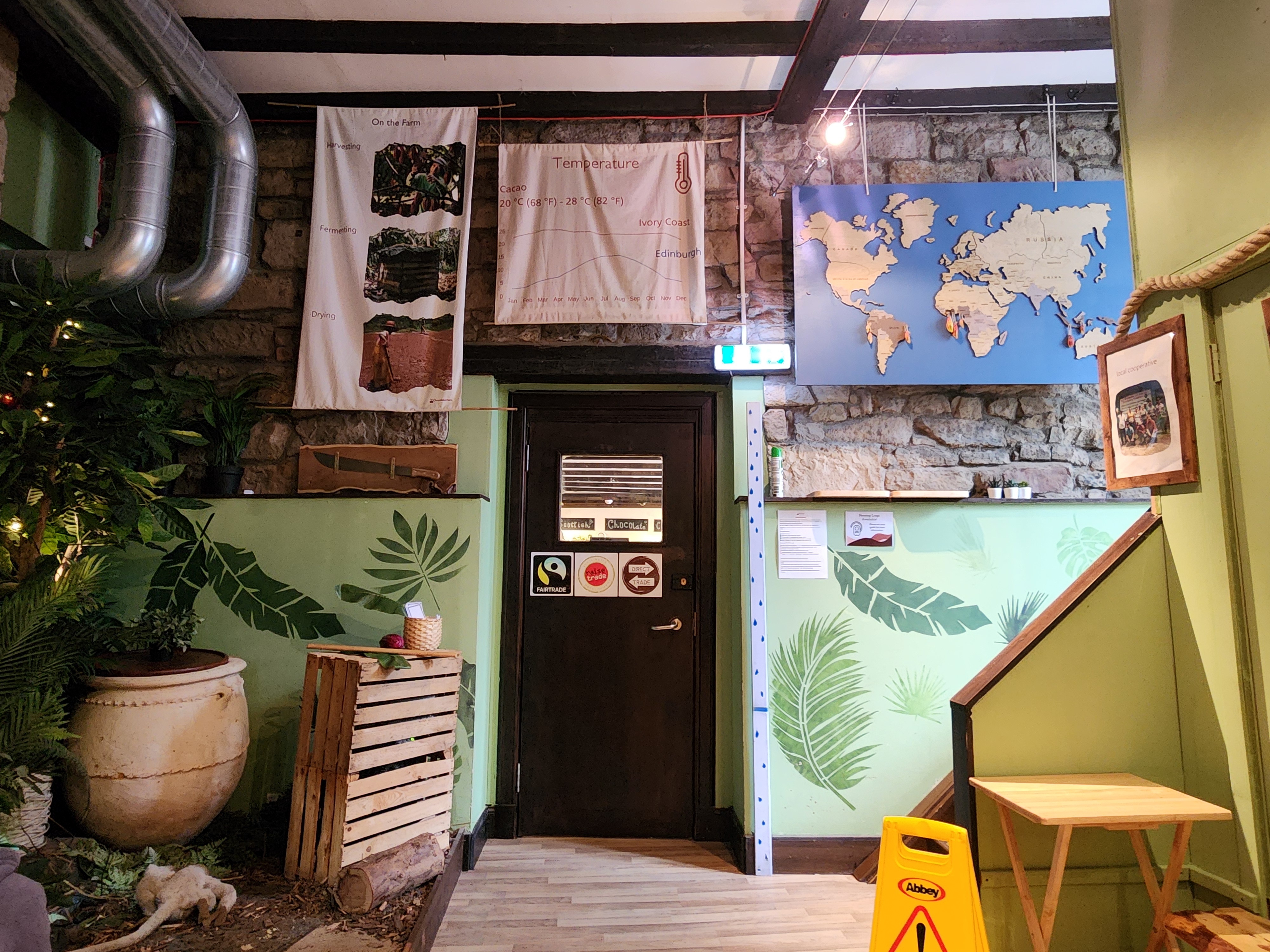
The Cacao Jungle Room at the Chocolatarium

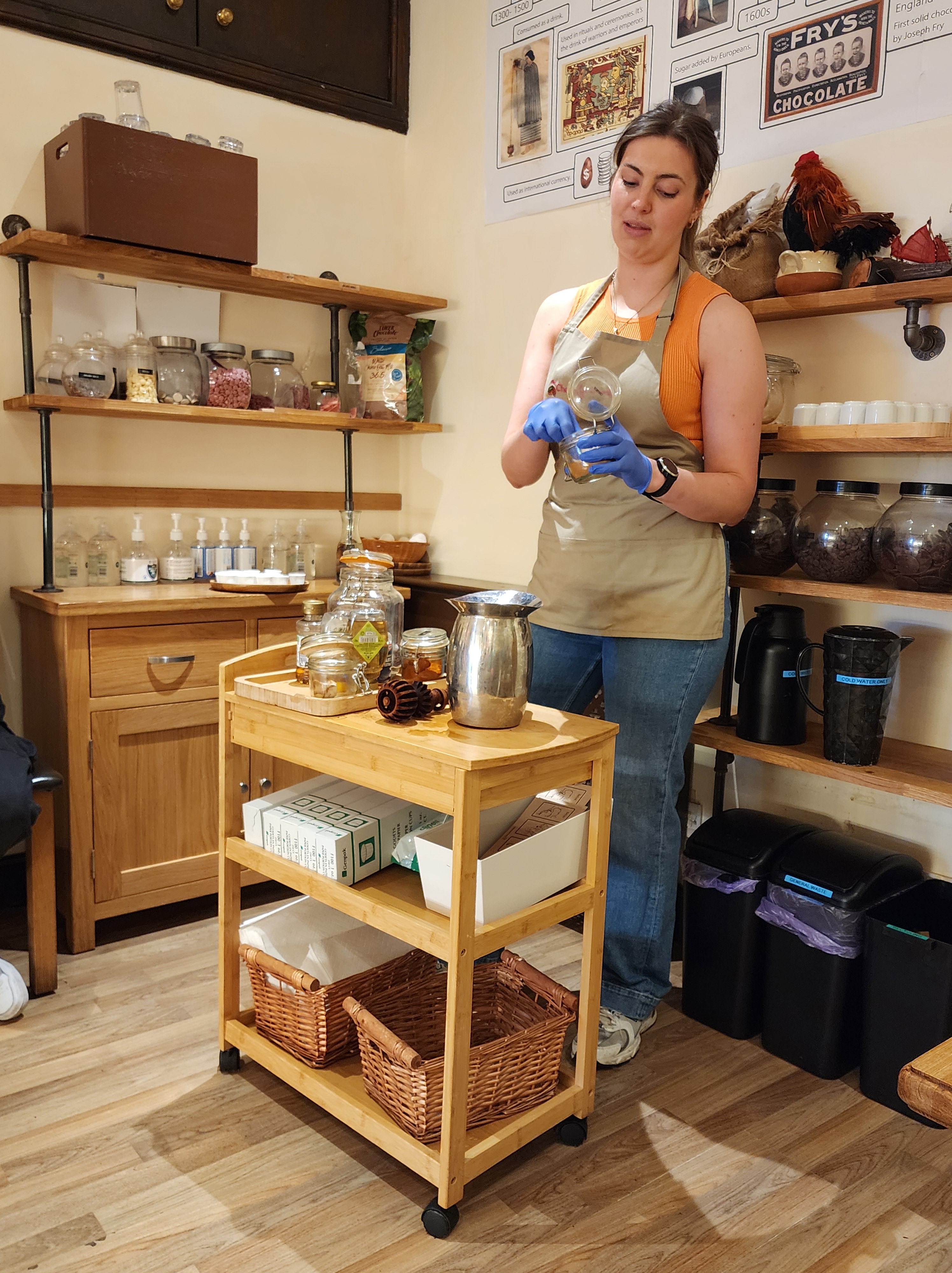
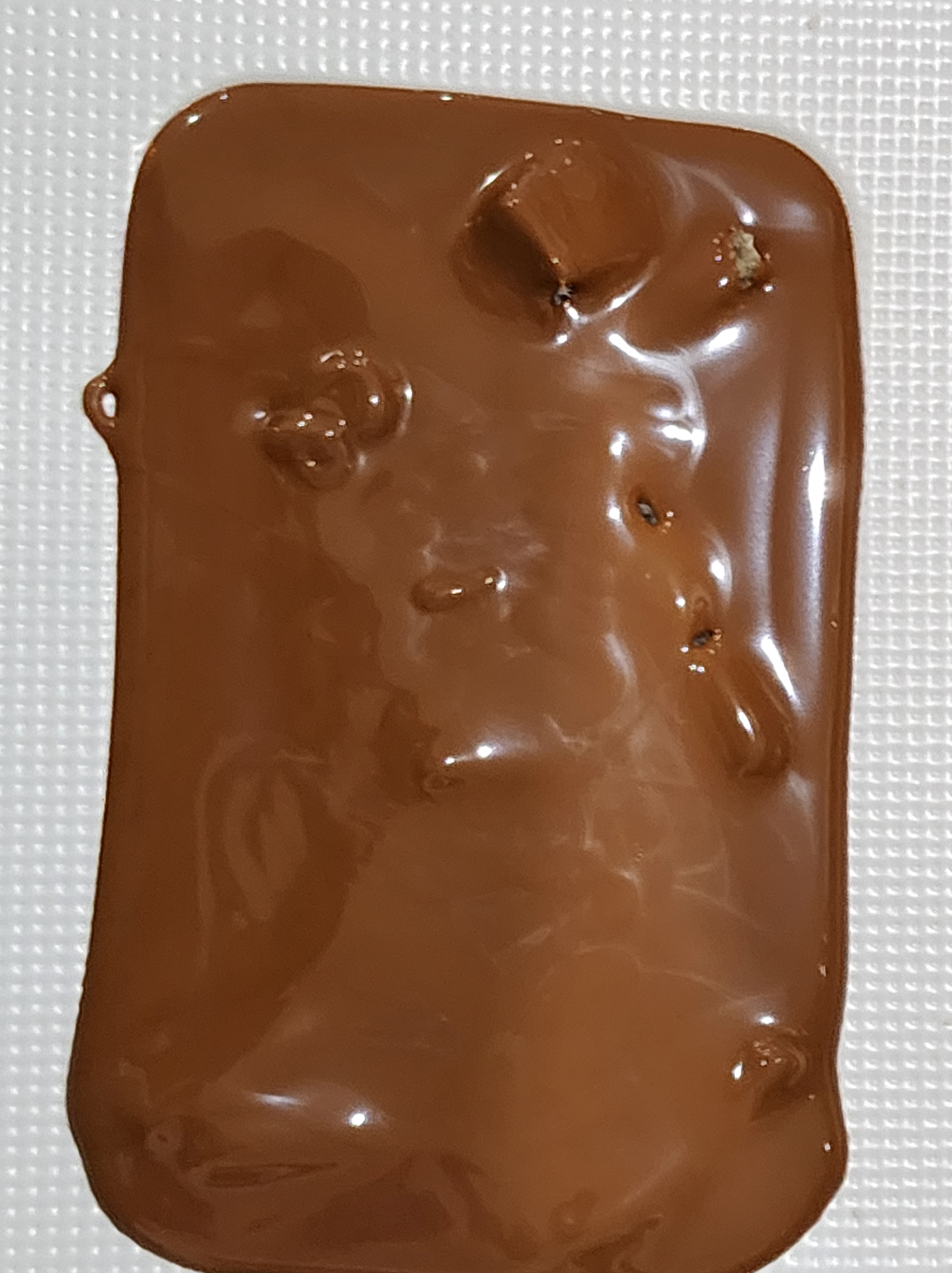
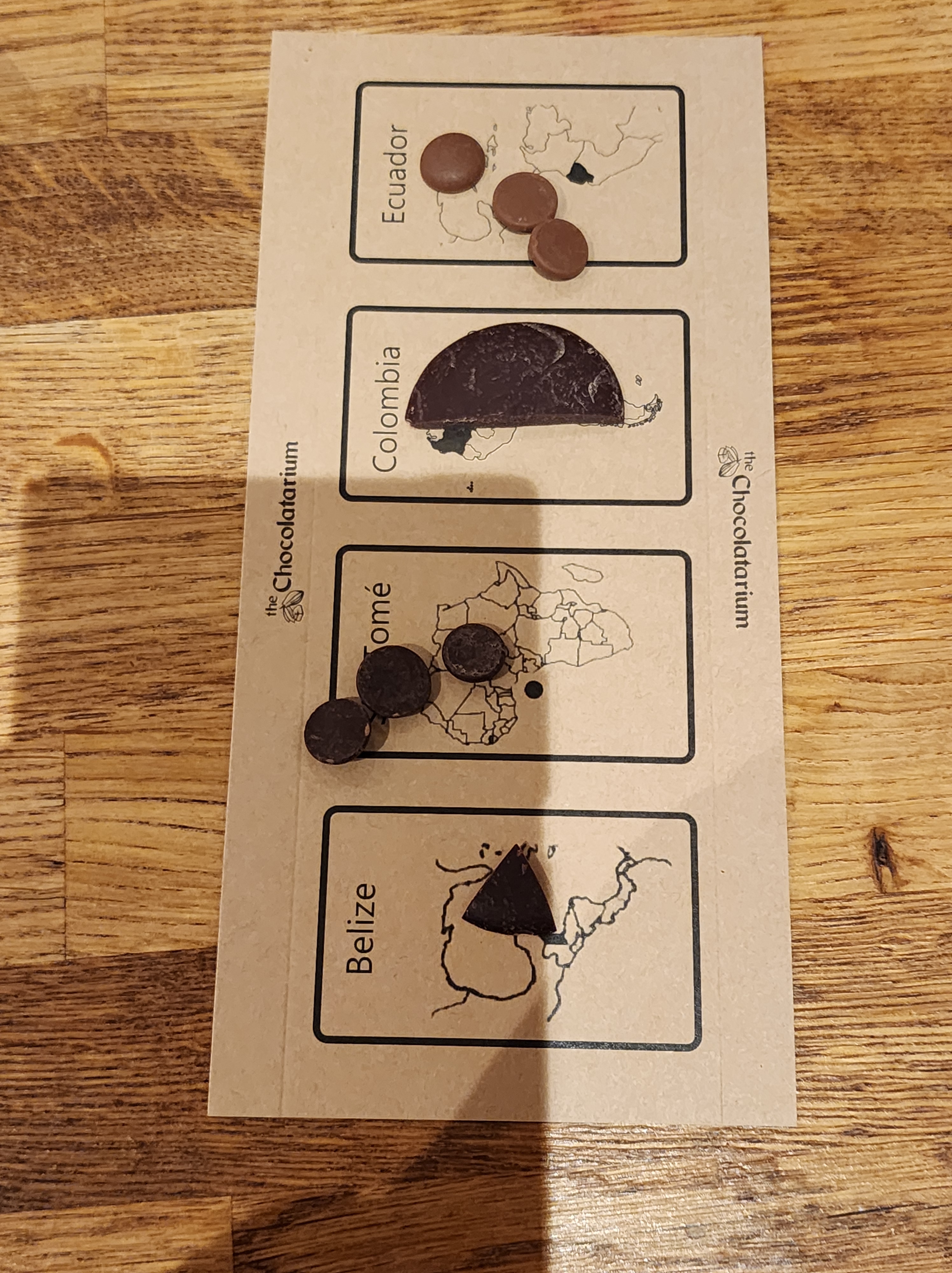
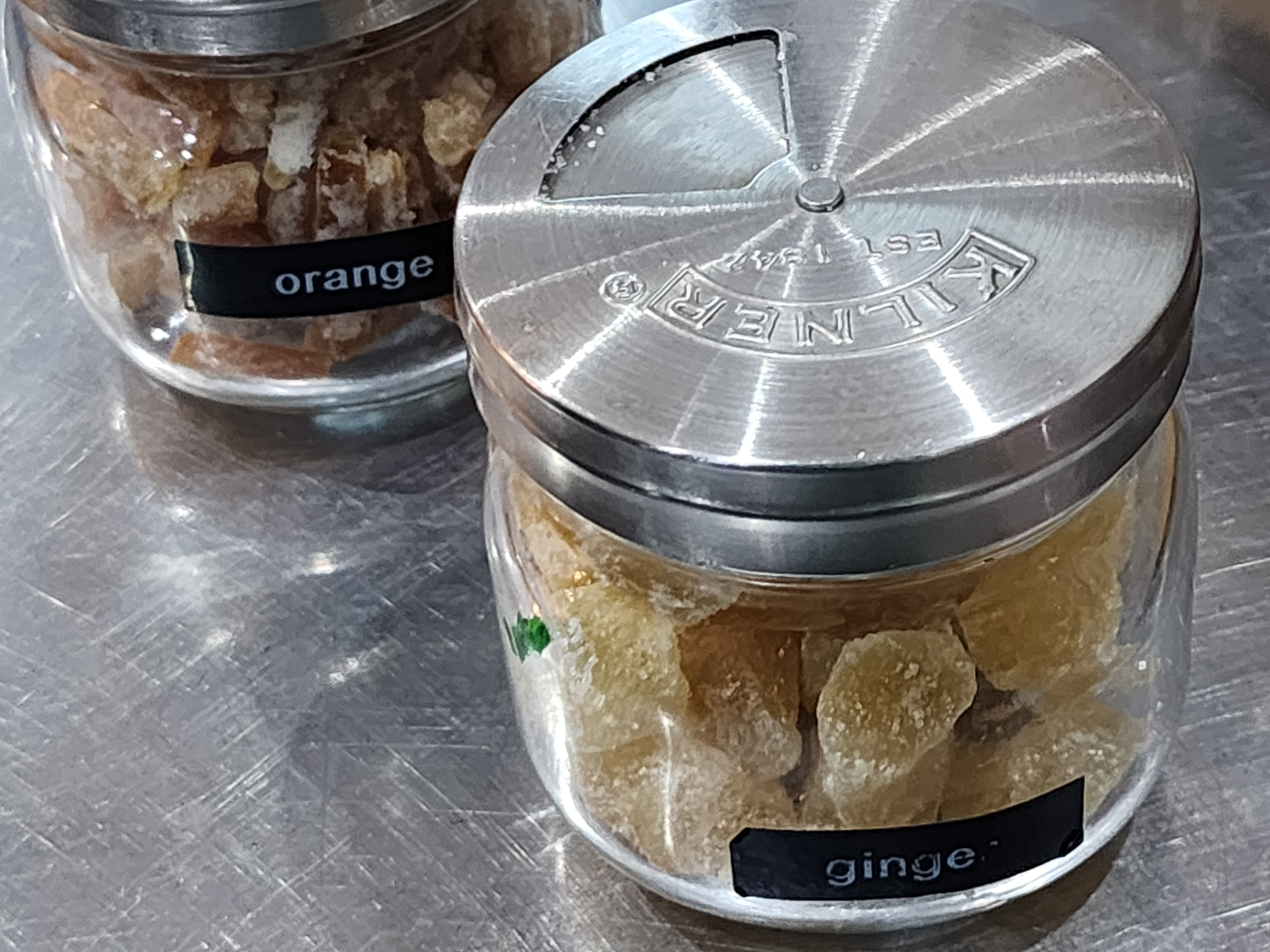
The next day I went to the Edinburgh Chocolatarium, a little hidden hole-in-the-wall chocolate shop off the Royal Mile.  For £29, we could hear the history of cacao and chocolate making, taste several “flights” of chocolate from exotic places like Belize, San Tome, Colombia, and Ecuador, and make our own chocolate bar (mine was milk chocolate with candied ginger and candied orange rind). We drank a hot liquid chocolate made with oat milk that was so thick you could have spread it on a biscuit, as well as tried an Aztec chocolate drink that was made of cacao nibs (basically a macerated cacao bean), honey, water, and hot pepper.  It was as bad as you can imagine. Very gritty, and not very chocolatey.  And for this, they sacrificed 40 people a year to honor the gods who gave chocolate to the world—and 40 because there are an average of 40 beans inside a cacao pod, and 40 pods on a cacao tree.

Our Chocolatarium tour guide making the heinous Aztec drink

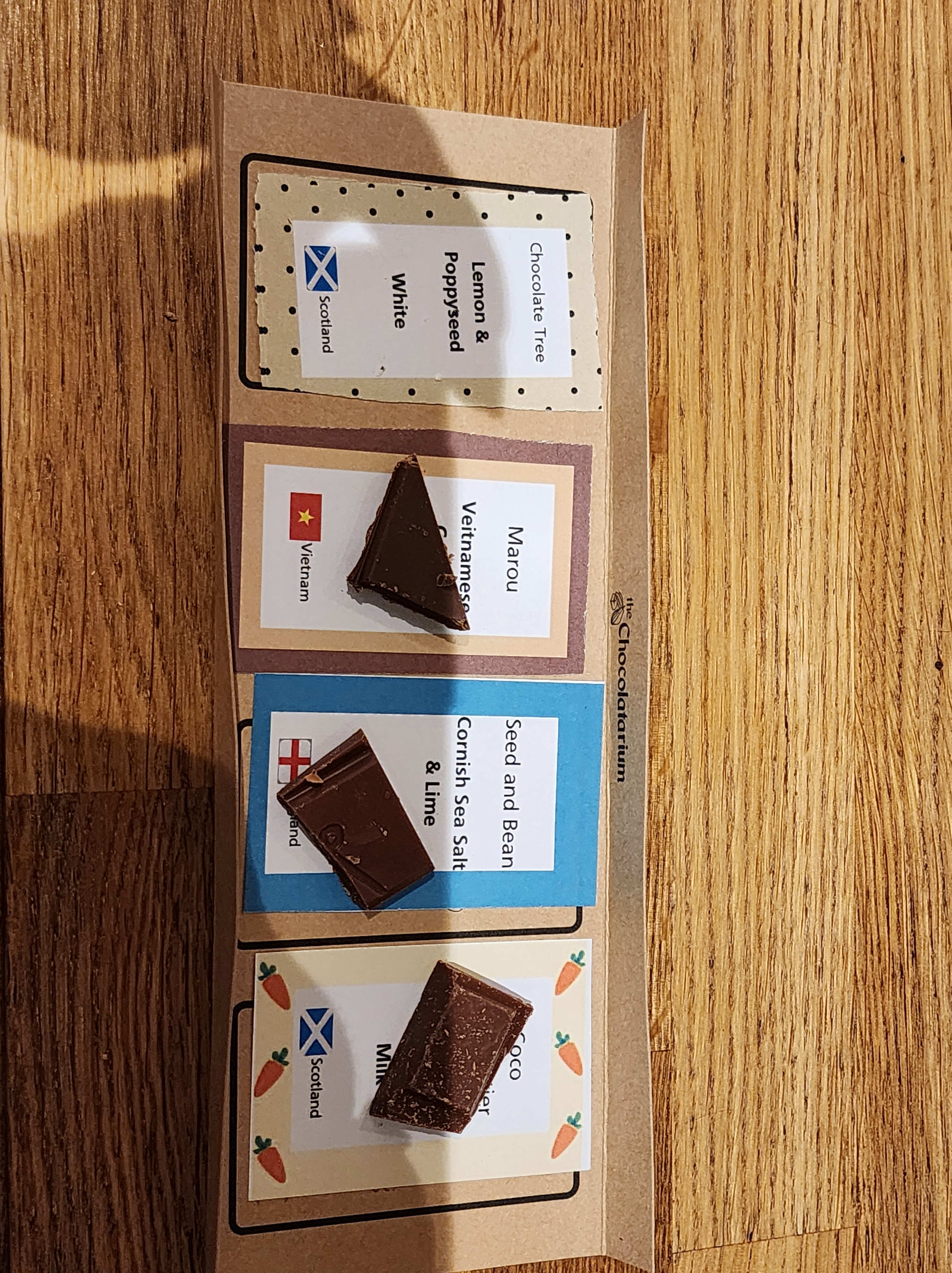
After we drank the weird Aztec drink, we could try as many bits of chocolate as we wanted.  I had a flight of four—lemon poppyseed white chocolate, Vienna coffee chocolate, Cornish sea salt and lime, and Carrot Cake infused chocolate, and by then I was chocolated out.  A girl of maybe 11 or 12 tried over 20.  She never sat down.  (We were supposed to retrieve the chocolate from the jars, then bring four at a time to our seats.)  Not her though.  She just ate them straight out of the jars. She was a serious connoisseur—but I was surprised her mom didn’t tell her to quit grazing and settle down and let other people try some samples.  At the end, we picked up our chocolates and were led back into the store.  I would have been tempted to buy a bar of the lemon poppyseed, but the £6.50 pricetag stayed my hand.

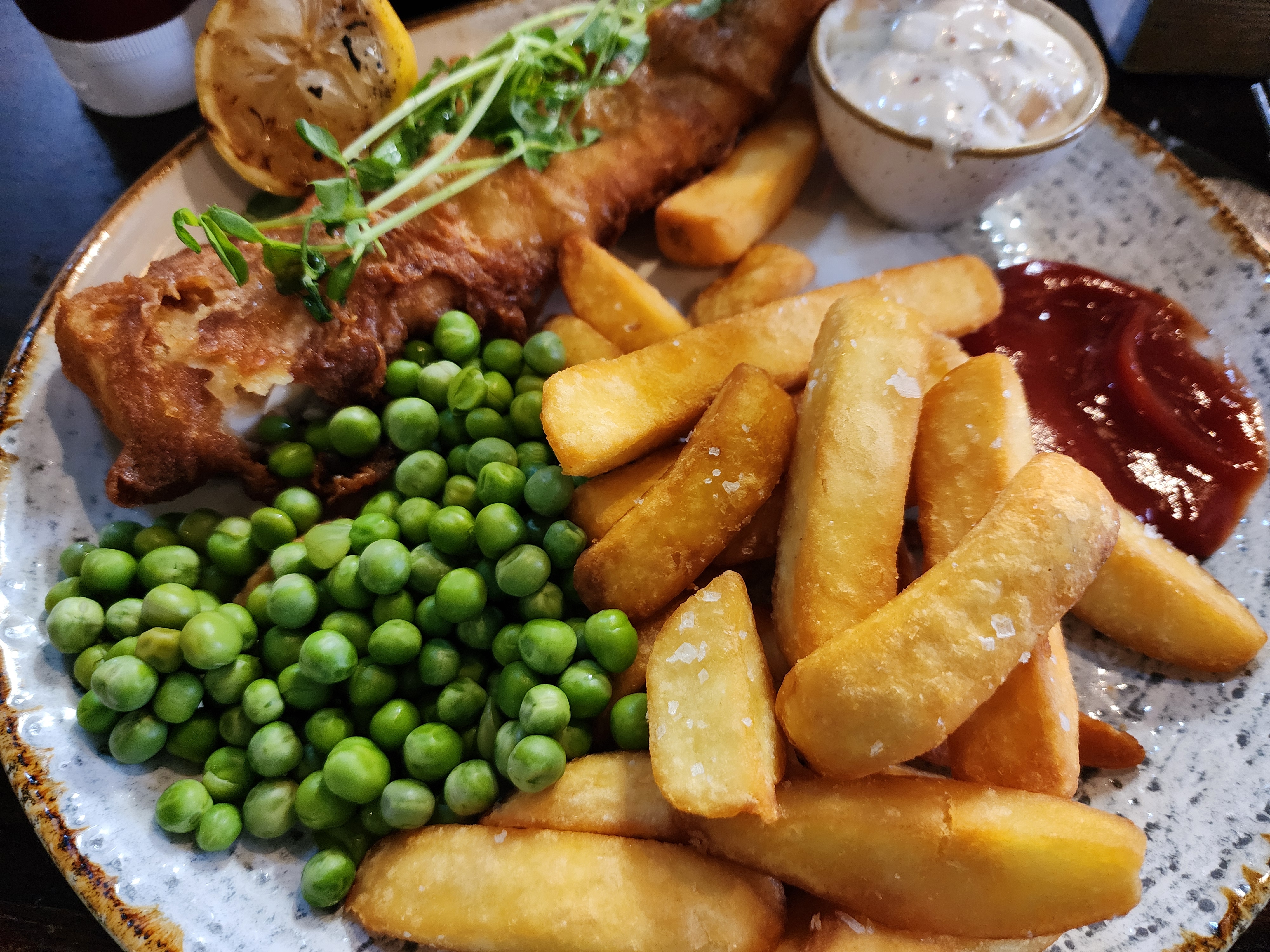
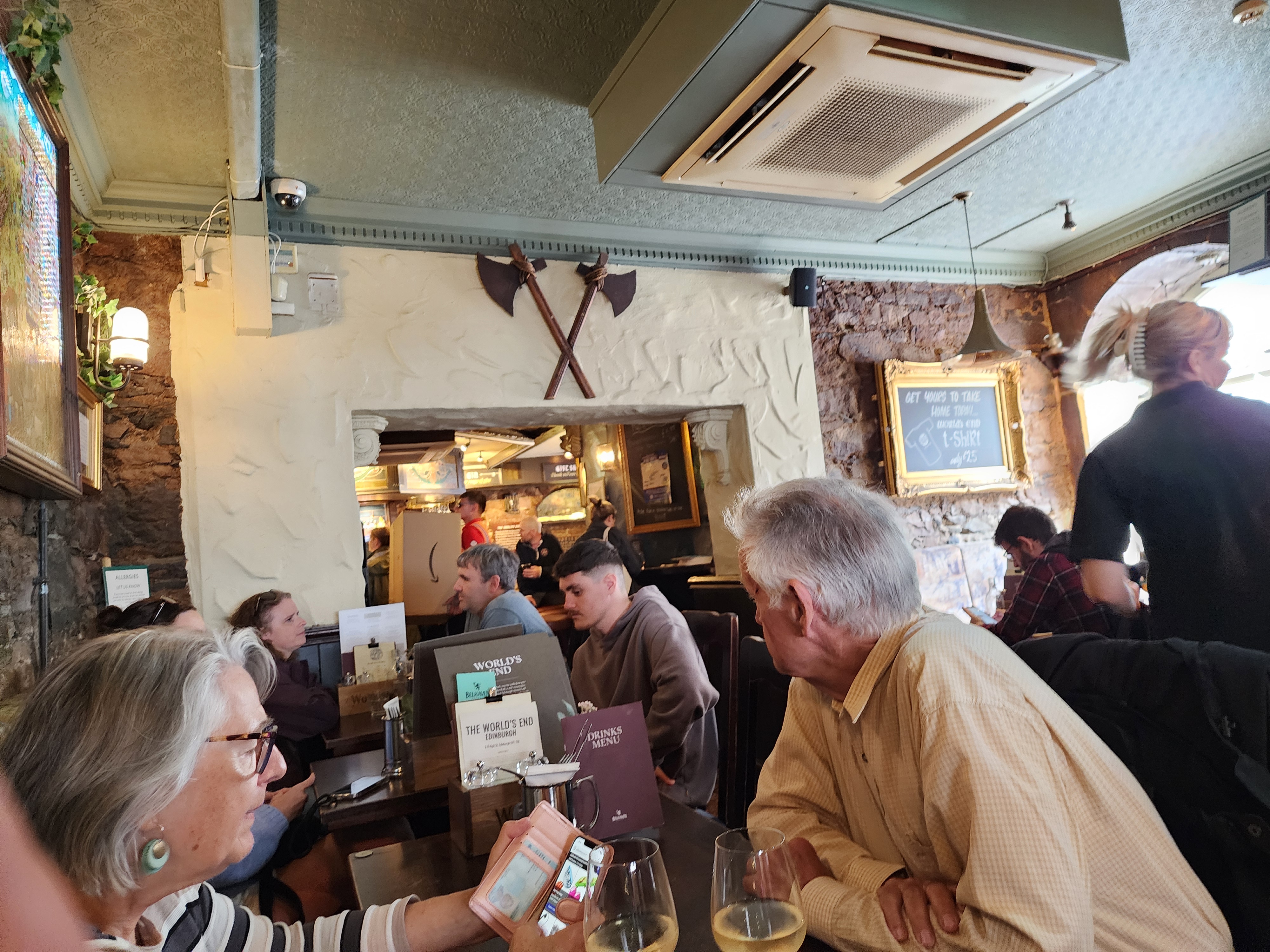
Lunch at the World’s End Pub

Then I somewhat enjoyed lunch at the World’s End Pub, which has been in business since the 1700s, when the wall to Edinburgh ended right beside the pub.  I had made a reservation reluctantly (because really, a reservation for a pub?), but I was glad I did, as they only have about 6 or 7 tables to dine at, and a steady clientele.  I tried their fish and chips, and while it looked very nice on the plate (accompanied by green peas, not at all mushy), it was surprisingly dry and tasteless.  The tartar sauce interested me because it wasn’t like tartar sauce at all—it was creamy like yogurt with something crunchy in it.  Maybe onions.  I am glad I actually went to the World’s End, since it is a tourist trap, but I wouldn’t go again.  The pursuit for Scotland’s best fish and chips continues.

At the end of the weekend I was bushed.  Still not over my cold, I rather wore myself out trying to squeeze all the goodness I could out of the days.  But it was a fun weekend.  I wish you had been there.

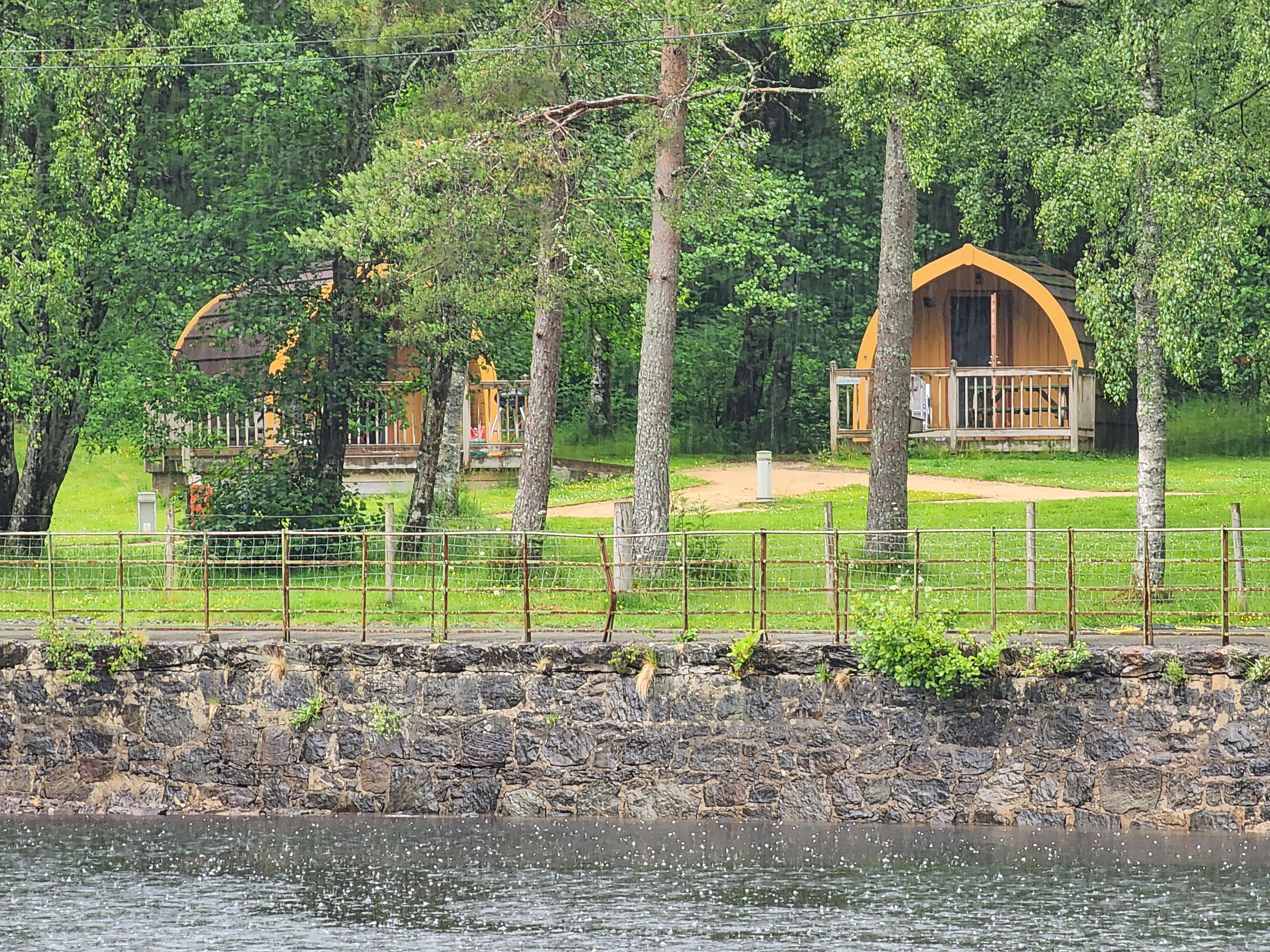
Yurts on Loch Katrine

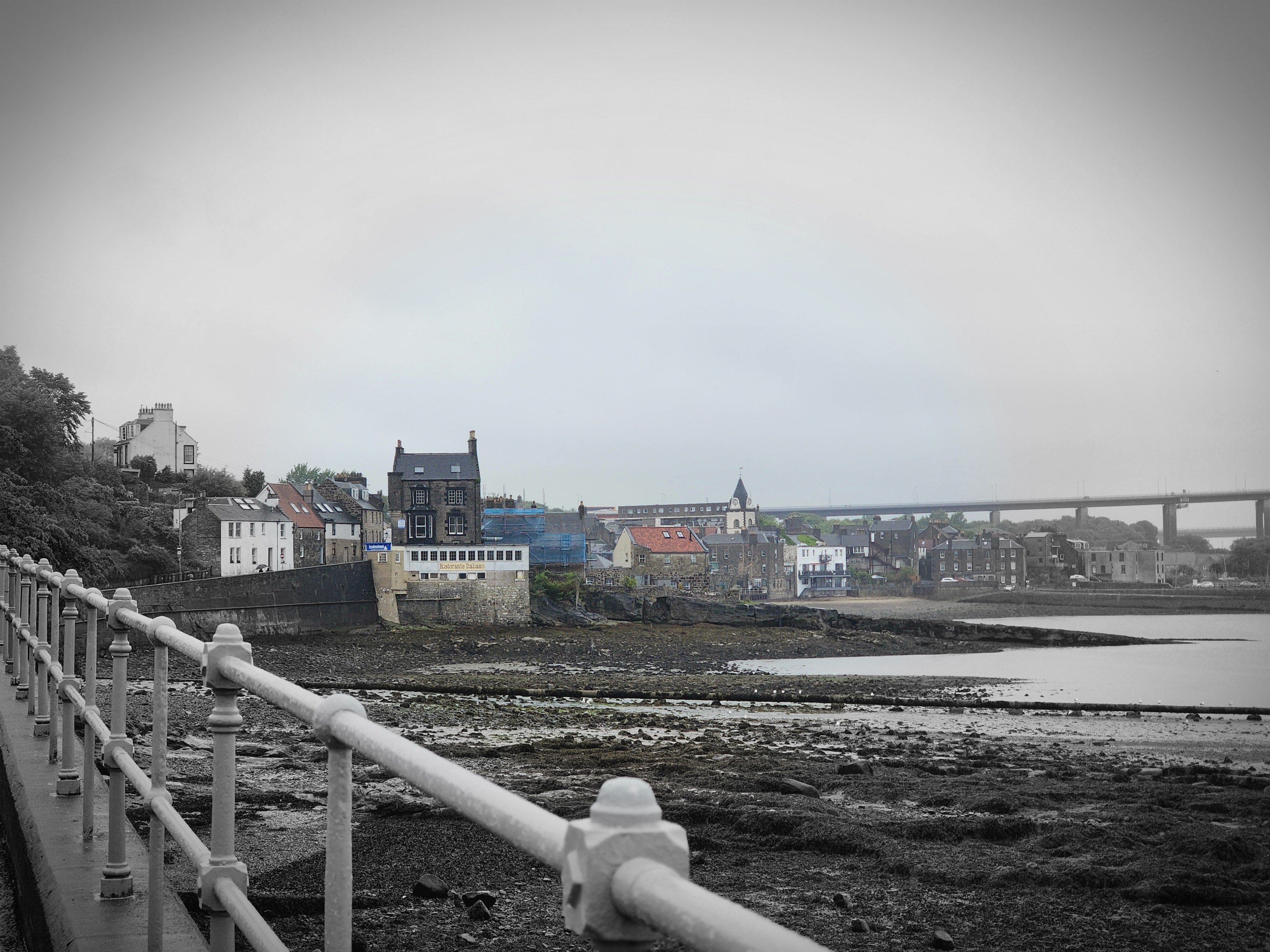
View from South Queensferry

Chocolate flight

One of the toppings I thought about putting into my chocolate bar

A tube of liquid chocolate for the mold

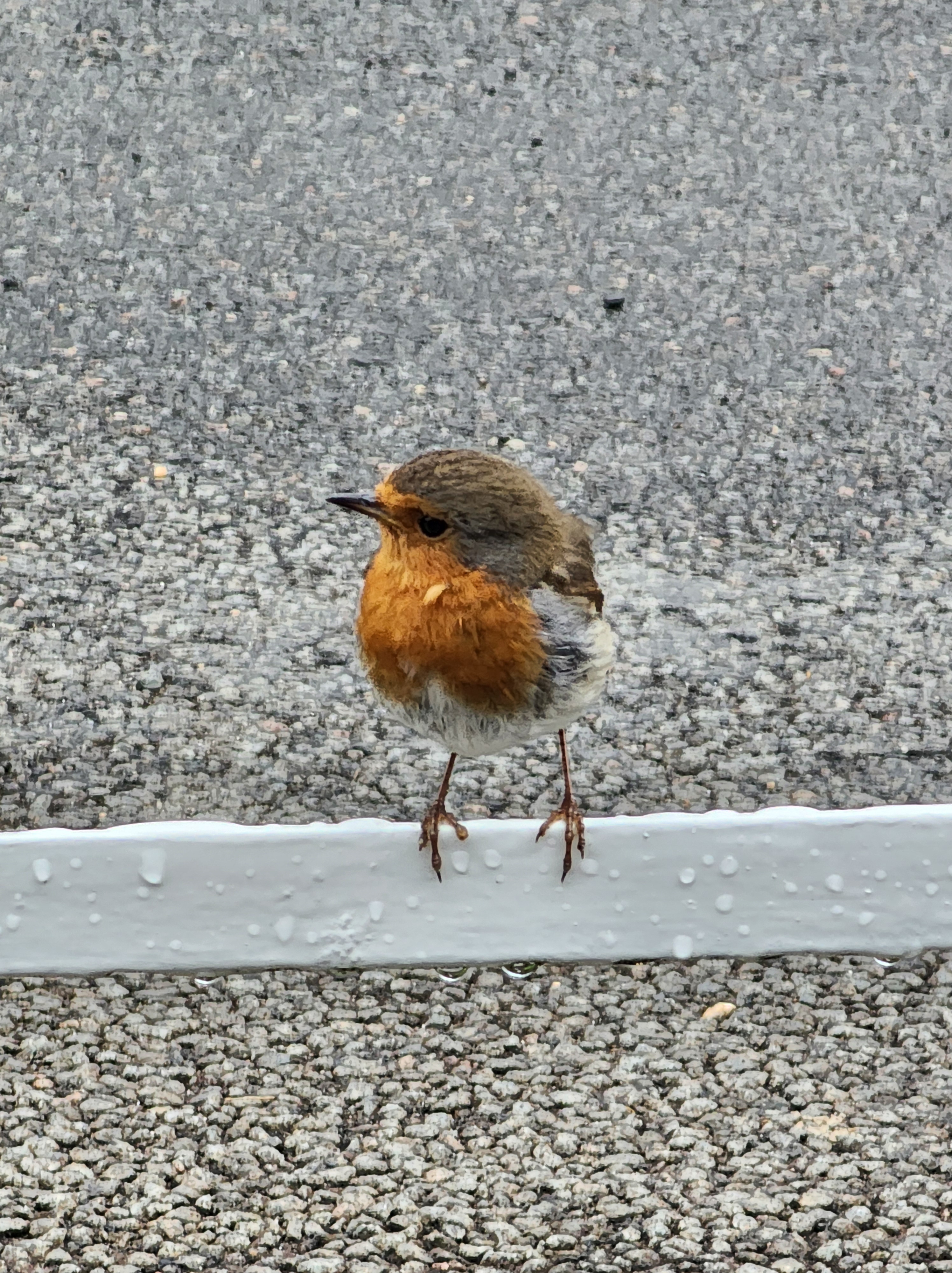
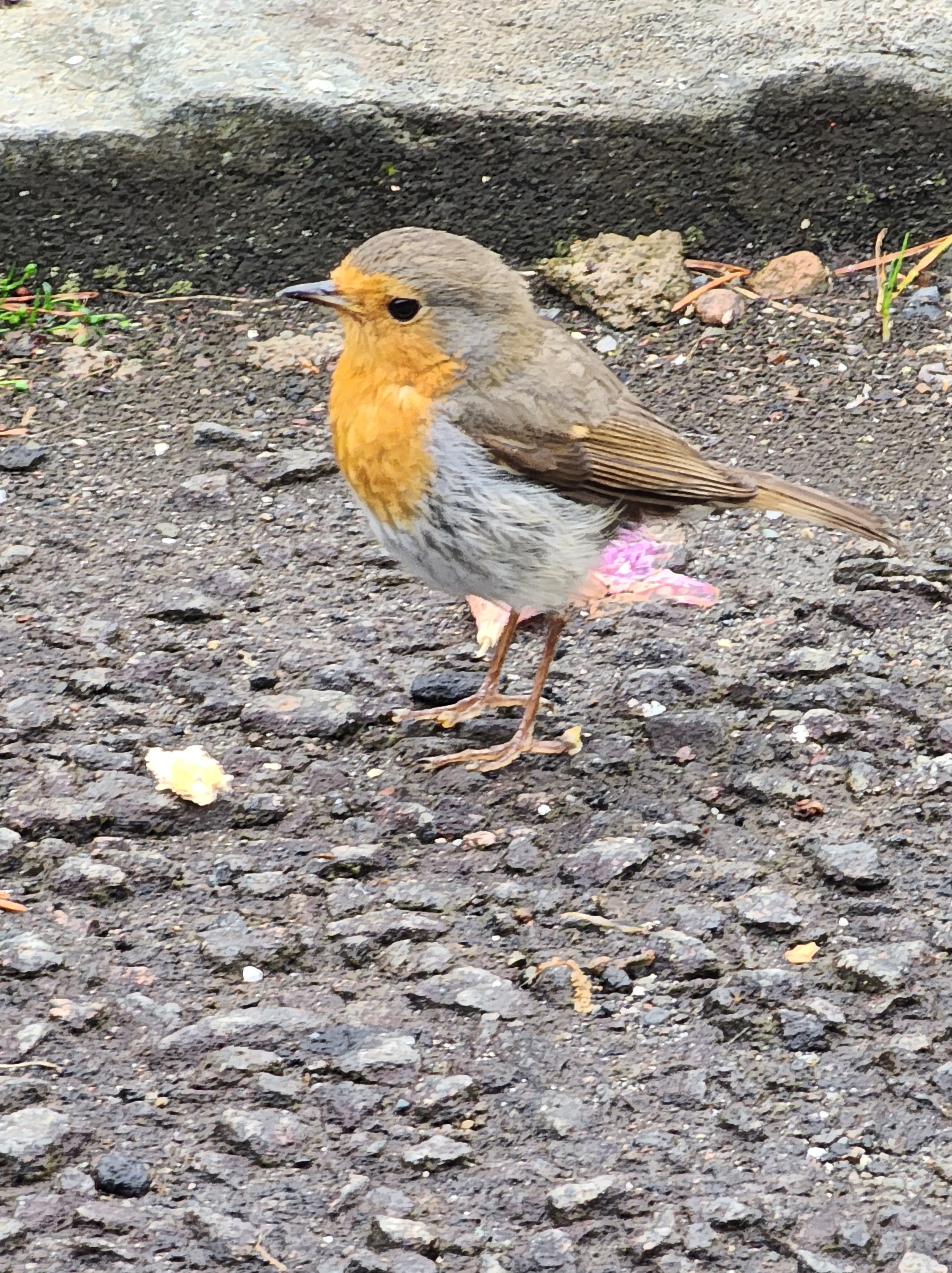
A wee sweet birdie

A view of Holyrood…do you see the plane?

Loch Katrine

No one fell overboard, thank goodness

A pretty flower in the rain

He looks sad, this sweet coo

The wee bird again

The Glenturret mash tun

Boat launch

My candy bar cooling in the mold

Loch Katrine

The two Aussies in the front of the picture talked to me all through lunch at the pub

On the deck of the Sir Walter Scott

A second chocolate flight

Orange rind and ginger for my candy bar

Another sweet coo

How I’m Coping with Social Distancing

It’s a funny thing about human nature that when you’re told you can’t do something (like go out and Mix with the Peoples), that’s pretty much all you want to do.  I’ve been thinking about how this “social distancing” we’re all supposed to practice is tedious as well as difficult.  True, it’s technically Spring Break and I’m working from home, so it’s not like I’m going anywhere during work hours—but if we weren’t in the midst of a pandemic, I could go somewhere, at least for lunch. But instead, I’m stuck at home, contemplating eating a very sad lunch of mixed veggies and rice.  And I miss people at work.

I wouldn’t miss them so much if, after Spring Break ends, we were all going back to campus.  But that’s not happening, as far as I can tell.  I miss Amanda popping in with her silly nonsense and her stern talkings-to to me when I stay late, or Karen standing in the door with some gossip that’s too good not to share.  I miss Carol asking me how things are going with the schedule or telling me about her crazy cat.  I miss hearing voices along the hall, students excitedly telling a professor they’re walking with about a project. All the interruptions from Monday to Thursday that makes my interruption-free Friday work-at-home days so very quiet and appreciated.  (I don’t miss meetings.  I would NEVER miss meetings.  But you get my point—it’s a little bit lonely.)

So far, I am virus-free, and I am very glad about that. As the numbers of cases grow exponentially, I wonder if I will remain virus-free.  So many people are sick—and it’s really hard to avoid people even when you’re socially distancing.  Invariably, you have to go to the grocery and you touch a variety of surfaces, even if you’re being careful.  (Even if you’re using sanitizer and washing your hands like you have OCD.)  And more to the point, if the person you live with still has to attend work, as Chris does, how isolated can you be?  I do worry about his catching something, too, since his job hasn’t shut down yet.  (Fortunately, he tells me that most people who can are working from home, so it’s very empty in the warehouse.)

You think social distancing would be an introvert’s dream.  You don’t have to see anybody, you don’t have to expend any of your limited powers of socializing.  You can just be content in yourself.  And the first couple of days, I think I was.  I mean, I love my house.  I love being here, listening to the bullfrogs and birdsong, seeing the buzzards behind the next door neighbor’s yard,  noticing what new green is appearing on the trees out back and what new flowers have popped up in front.  In every way, my house is a refuge for me, and I love that. But it becomes a little hard to appreciate those elements when you hear and see them full time.  Especially when you feel like you yourself may be becoming part of the furniture.  I suppose I need a little social interaction just so I don’t stagnate.

I’m sure I’ll grow more used to this situation as the weeks pass.  This is just what I’m feeling now.  I hope all of you are making the best of things, and that you’re staying well.

My Book Is Finally Getting Published!

madville publishing picOMGWTFBBQ!  Wonderful news, everyone!  After 45 rejections, give or take, my full-length collection of narrative poetry, What Magick May Not Alter, has found a home at Madville Publishing and will be released in 2020!

Being as you are one of my Five Loyal Readers, you might remember I wrote about the collection in a 2015 blog post, after my Mom had read it and was horrified.  I had no idea that it would be a full three-and-a-half years later before it would get accepted at a reputable press.  (Which is to admit, it got accepted at a couple of other presses, but I didn’t have a good feeling about them, not for this book, anyway, so I passed.)  Considering that I wrote the earliest poems in 2012—the book will be 8 years old when it comes out next year.  I’m so in a different head space now.  (But I can slip back into that world, don’t worry.)

It has been an excruciating process, over all, submitting and submitting and submitting some more, only to have the rejections pile up (not to mention all the money I spent on contest and submission fees).  Anyone who’s a writer is familiar with this repeated anguish of submission and rejection—I know this isn’t unique to me. A bright spot was the 2015 Hillary Gravendyk Poetry Prize, for which it was a finalist, but even that was a long time ago.

I really had gotten to the point of abandoning it—how many times did I hear, “It’s too long” or “No one wants to read a verse novel” or some version of  “It’s unwieldy—weird—just a tough sell.” (Like anyone “sells” poetry anyway.)

Even after the divinely generous, brilliant poet Ilya Kaminsky (basically a living patron saint of poetry) read through it and offered suggestions, I was ready to hang it up.  I just thought that nobody really understood what I was trying to do, and maybe I should try to publish a more conventional collection of poems first.  Heaven knows I have poems enough to spare to create a couple of (oddball) collections.  And, I thought, maybe in a few years, WMMNA would be of interest to someone.  After I had “proved” myself with a traditional book of poems.

But fortunately Madville came along—it’s absolutely been worth the wait.  I’m so excited to be working with Kim Davis, the publisher.  She’s been so positive and supportive and I have such a good feeling about this book coming out under her aegis.  I’m just so happy.

And I can’t wait for you to read it in April next year…in the cruelest month that will no longer ever be the cruelest month for me!


P.S.  I’m available for bar mitzvahs, birthday parties, and you know, just hanging-out-spontaneous-type readings… Just invite me!

P.S. #2  I still have to do a clean edit, and maybe rethink some organization, so it still needs some work, but OMG!  So Awesome!  Yay!

Some New Things Out

fat ladies coney island

Image from NYPL Public Domain Digital Collection

It’s June, which means I’m hip deep in my annual summer doldrums, and not feeling particularly writerly—an unfortunate circumstance, because with things a little on the quieter side (not teaching summer classes, for instance), you’d think I’d be writing up a storm.

Alas, I’m too undone, wishing I was anywhere but in Atlanta (like these great ladies in this stereograph of Coney Island), and I’m so anguished about our current immigrant crisis (and general Washington, D.C. chaos) I can’t even really focus enough to write anyway.  I keep telling myself just hang on until the middle of July—which is when I’ll go away for a couple of weeks to the coast and hopefully rejuvenate my flagging spirit, but that’s still so far away.  Meanwhile, I’m melting into the pavement—and worrying about what new horror will assail us in the next hour of the news cycle.

Anyway, existential poor-me’s aside, I have a couple of poems/ nonfictions (depending on what you call them…I like to think of them as “poemeditations”) in the most recent issue (2017/2018) of Grubb Street.  (Scroll through the online journal to p. 3 and 4.)  These are more from my Venice collection, which will someday find a home, I hope.

And I’ve got five poems in the July issue of The Dead Mule School of Southern Literature.  Actually, it turns out these poems were supposed to come out in last November’s issue, but somehow there was a snafu and the submission disappeared (on their end) in Submittable.  It was lucky I followed up with Dead Mule, because the editor was mystified at how the poems had gone astray, but she was great and fixed it and now the poems are there for you to read.

If you like my work, feel free to leave a comment.  If you don’t, leave a comment anyway, and give me something else to brood about.


New Poem Up at Picaroon Poetry

picaroon-poetry-issue-9“Canali” is another one of my Venice poems, and I was so happy when Picaroon Poetry took it.  (You have to scroll through to page 35 to read it.) This brings my published Venice poem total up to 13 out of 22, or a 59% published rating.

You may wonder why I offer that metric—who cares?  But I share it because collections these days seem to list so many previously published poems on their respective acknowledgments pages—and manuscripts with multiply “vetted” poems seem to have a better chance of becoming books.  I know for a fact that some book publishers say that writers shouldn’t even submit a book to them for consideration unless 25% of the poems in the collection have been published already.  So my hope is, that with a 59% (or more) published rating, my chapbook will someday find a home. (I still have the rest of the poems from the chapbook out circulating, and hope that a few more will “land.”)

Of course, my full collection is 23% published, and it’s still homeless.  Which just goes to prove publishing will always be a crapshoot. *sob*

How to Write a Perfect Bio for Your Journal Submissions*

unfold-here-craneWriting the perfect bio to accompany your submissions is essential—and it can be tricky. After all, a bio offers insight into you as a person; it alerts the editors and your readers about other places you’ve published, and reveals some of your interests—points of connection that can humanize you. You are your words on the page, certainly, but you’re also more than that.  Your bio accomplishes this work for you.

So you might wonder, “How do I summarize my background in a way that is intriguing, meaningful, and appropriate?” Maybe you think,“How do I balance astonishing people with my literary accomplishments while remaining down-to-earth and approachable?”  Good questions, glad you asked.

Because altruism is second nature to me, I have developed the following list of bio-writing tips based on my many years (off-and-on) serving on editorial boards and as editorial assistants to a variety of journals.  I guarantee that if you keep these suggestions in mind, you will craft a Bio to Amaze ™, one that will endear you to editors and readers alike.  Fortunately, the list of tips is short, so you can implement them quickly:

1. Emphasize your credibility as a writer.  Editors want to know that your work has been published in at least a hundred journals, so include the names of every last one of them in your bio, and hope that editors actually have to retype them from your cover letter, because it’s thrilling to see just how many places have published you.  And hey, have you won literary prizes?  Be sure to list all the prizes you’ve ever won, including the Blue Ribbon you got in your kindergarten class for your story about the kitten and the puppy who visited New York.  We’re really impressed by that.

2.  Make it personal.  Editors feel connected to writers who share personal details.  We love to know that you have a deep, abiding affection for the Dallas Cowboys, that you can’t make it through the day without a cup of Earl Grey, that in your off time, you like to read your poetry naked to the pigeons in your local park while doing yoga, and that, were you a tree, you’d be a live oak, reaching your knobby hundred-year-old limbs in prayer to God.  We get a deeper sense of you as a person with this information, and it makes us feel really creepy close to you.

3.  Name-drop.  Have you studied with Famous Short Story Writer at a Really Hard to Get Into Summer Writers Workshop?  Or attended a conference where the current Poet Laureate was reading and you bumped into her later on at the Overpriced Fancy Coffee Bar, getting the same Pumpkin Spice Mochaccino Latte Frappe that you ordered?  Include this trivia, by all means.  We too like to hobnob with greatness, even vicariously, and it’s a mark in your favor when you can list the celebrity writers you’ve met IRL who have influenced you.  Bonus points if you make us editors jealous in the process.

4.  Experiment with form.  Why go with the conventional format of…

[Writer Name] has work published or forthcoming from [Journal A], [Journal B], and [Journal C].  She works as a [Job Title] in [City], and is the author of [Book Title] from [Press Name, Year].  You can read more of her work at [Blog Name.]

…when you could go with a racy picture of a woman that you’ve sketched in charcoal, adding a speech balloon to list your credentials?  Or maybe an origami paper crane that you write the word “unfold here” on a wing, so the editor can open it up to see where you’ve scrawled your bio?  Or, my personal favorite, record the bio as a YouTube video, and link to it?  Not only will a video demonstrate you’re A Totally Creative Special Snowflake of the First Water, it could kick-start your whole YouTube career. You might decide to give up traditional publishing altogether and just record all your poems and stories on a channel, counting the precious thumbs-up “likes” from all your new fans.  Instant gratification.

5.  Be thorough, but to-the-point.  Honestly, I can’t emphasize this enough.  Six hundred words should suffice.

Bios are important, and they should enhance your submission, not detract from and thwart it.  Remember, editors look for any excuse to reject your work—even if they say they read bios and cover letters last, can you really be sure that’s the case?  Of course not.  A bad bio can do real harm—and can negatively influence an editor as she reads.  You might have sent an awesome story, but if your bio offends, sayonara journal publication.

Writing the perfect bio takes some time and thought.  But it’s not difficult, once you’ve mastered the simple five-part process I’ve laid before you in this post.   Give it a try, and let me know in the comments how everything works out!


*Please note, the author of this blog shall be held blameless if oblivious readers fail to recognize the snarky sarcasm contained herein.

Gun Violence, Academic Poetry, & Who Cares About White Pain?

I started writing the post about poetry below (after the horizontal line) a few days ago.  It’s still worth sharing, because it’s about writing meaningfully when all of this tragedy is happening.  But I have to have to say that now, with the death of the African American man hanging from a tree in Piedmont Park (Atlanta’s “back yard”), which the Atlanta Police Department called a “suicide,” I’m at such a loss—I don’t even know that I could write any poetry about the insanity of death and violence that are perpetrated against American citizens because they’re black and brown.  (Does anything I’d have to say even matter?)

If calling this particular death a “suicide” is not an example of institutional racism, if that’s not racist “criminal justice” and a racist “law enforcement” system at work, I don’t what is.  What African American would choose to hang himself from a tree?  What African American would choose to commit “suicide” through a method that clearly smacks of historical racism and slavery?  The answer:  no one.  The night before the murdered man was found, Klan members were seen hanging fliers in Piedmont Park.  I don’t think that’s a coincidence.  Thank heavens, the FBI is now investigating this death—but only because Atlanta’s African American mayor Kasim Reed referred the case to them, not because the police did—and let’s not forget that the FBI is also part of a racist criminal justice system.  If they agree with the Atlanta coroner and the APD that this man’s death was indeed “suicide,” I wouldn’t be remotely surprised. Devastated yes, but not surprised.

And let’s talk about Dallas.  Yes, it’s awful and horrifying that five Dallas officers were shot and killed at an anti-violence rally.  No, these officers didn’t “deserve” to die.  But let me tell you, I can sympathize with the shooters’ anger and frustration.  Maybe these five particular cops didn’t deserve to die.  Maybe these five particular cops were upstanding citizens who would never use their power against African Americans to harass and murder them.  But other police officers every day act on their racism and abuse and kill African Americans with impunity.

The fact is, the attack on these cops is an emblematic strike—it’s the way these suspects felt that they had to deal with constant, racist murders of other African Americans by police departments.  It’s fighting the system, when no one else will.  President Obama has said that there is no possible justification for the attack, but it’s hard to deny that “law enforcement” doesn’t profile and target and harass and murder black and brown suspects just because they can get away with it.  When our lawmakers and President can’t seem to get a hold on the police department’s institutionalized illegal acts perpetrated against African American citizens (and other minority groups, such as Latinx, who are also targets of racism), it doesn’t surprise me that African Americans turn to vigilantism for justice.

In an earlier interview about the slaying of Alton Sterling and Philando Castile the President said, “’All of us as Americans should be troubled by these shootings,” he continued. “These are not isolated incidents, they are symptomatic of a broader set of racial disparities that exist in our criminal justice system.’”  Yeah?  Then do something about the shootings.  Our society has never been less civil.  Mr. Obama, you’re the President.  You have Executive Power.  Do something.  Demilitarize the police.  Take down the NRA.  Take guns away from people.  Please, I beg you.

If you’re like me and feeling especially helpless and sick right now about all this violence, here are some things worth reading/ doing: writer Justin C. Cohen’s Advice for White Folks in the Wake of the Police Murder of a Black Person, former police officer Reddit Hudson’s I’m a Black Ex-Cop, and This Is the Real Truth about Race and Policing, faith-based consultant Joshua Dubois’ letter to police chiefs (in .docx form, so you can cut and paste when you download it), and psychologist Karyn Hall’s suggestions for self-soothing (because we need to take care of ourselves in the midst of all this tragedy).

Anyway, with these latest murders in mind, like anything I say is worth a damn, here is the original post…


I am struggling lately with poetry.  Call it a genuine crisis of faith—or aesthetics.

I am trying to reconcile what I think art should do—which is comment on our time, take a stand, reflect reality and emotions and rage—with what my art is doing—or rather not doing.  That is to say, in the light of the constant stream of mass shootings, and shooting violence in domestic relationships, and officer involved shootings (so many of which our white justice system just gives a pass to), how can I write poetry that is meaningful and worthwhile?  How can I make art that responds to the insanity of murder and the American adoration of and addiction to gun-enhanced power that we see every day reported in the media?  How do I respond to that?

When I consider the writing I have done lately, it seems vacuous and crass that I have not responded to these constant shootings.  It seems so much the purview of academic poets (a group I belong to) wrapped in their laurels of white privilege to ignore what is happening around us.  Do we white academic poets need to be shot or to see someone we love shot before we are galvanized to action?  Do we have to live through the horror (if we’re lucky) of gun violence before we use our art for good?  What is art for if not to rally people around a cause, if not to comment on and critique the way we are living our lives?  What is art, if it doesn’t challenge us to change?

I think academic poets are averse to risk and to reaching out in their poetry, and they take a dim view of political poetry as a genre.  Maybe it’s something to do with the perceived sanctity and safety of the ivory tower that we are privileged to write little lyrics about our families or the natural world or trips we’ve taken oversees—but where’s the risk in that?  Where is the connection to the greater world? I see plenty of poet friends on Twitter tweeting their outrage at every example of injustice and murder perpetrated by cops against minorities—but what are they writing?  What are they doing to stop this?  How are they using their art to say no more?  How am I?

Maybe it’s a class issue—maybe academic poets think political poetry is the work of the laboring classes, or the work of oppressed groups, or maybe the work of spoken word and hip hop artists.  Maybe those of us in the ivory tower are just closing our eyes and pretending we don’t see what is happening around us—because we don’t have to.  Because we believe in the myth of NIMBY.  But even in the ivory tower, we can still be taken out by a sniper or a bomb.  So why are we silent?  Why am I?

Which brings me back to my struggle with poetry.  I can’t think I was ever taught in any of my writing classes about how to write political poetry—I think, maybe, while it was never stated overtly, it was certainly implied, that art was “above the fray.” I barely even read any political poetry—at best, the political poetry I read was women’s poetry, and just reading women’s writing, by virtue of writing the very fact of their lives was theoretically a political act (i.e. the personal is political), maybe I thought that was good enough.

And maybe because it’s white privilege that tells us art should be beautiful, and art is “universal,” that I didn’t ever think I needed to use poetry to discuss politics.  As if you could ever divorce art from politics.  The very choice in deciding what to write about reveals our politics, aesthetics, and values. 

I find that my own writing—which honestly, I generally think is pretty good—strikes me now as deliberately obtuse, privileged, and empty.  As I said in my last blog post, people are dying—we do nothing.  Poets have power—so why haven’t I written about this constant barrage of death?  Why haven’t I used my anguish and anger to write poetry that matters, that speaks to these atrocities?  Poetry that pleads for change?

Part of it is, I don’t know how to write it.  I don’t know how to express my fear and distrust with our “justice” system, I don’t know how to say “these deaths are wrong” and “guns are killing us” and “fuck tha police” (N.W.A. said that first, to be fair) and that “racism is evil”…in an artful, meaningful way.  I don’t know how to write about those things so that it won’t come across as facile or false or like I’m an ignorant white liberal who is trying to write Meaningful Poetry So We Can All Learn a Lesson at best—or at worst, write poetry that somehow appropriates the experiences of oppressed groups, a type of colonizing act, making their pain all about me.  I don’t know how to express these things.

Part of me feels that maybe I don’t have a right to write about these things.  Who am I, but a privileged woman with a Ph.D., an academic poet whose life in every way is impacted by and benefits from my whiteness?  If I get pulled over, I don’t fear for my life.  So how can any poetry I write even speak to the horror that is everyday experience for African Americans who get stopped because they’re missing a license plate?  They know one “wrong” word, one quick movement, and the cop who is stopping them will escalate this moment to death. I can never know this.

And maybe I really don’t have the right to write about these things like racism—because I don’t suffer its effects, though I sure as hell benefit from white privilege.  Still, every day there’s another murder (euphemistically called an “officer involved shooting”).  Every day someone dies; Alton Sterling died on Tuesday, Philando Castile died on Wednesday.  And every day I feel sick.  I feel like I have to express my pain about these deaths.  I want to use my art to do so.

And I know these deaths are not about me.  And nobody wants to hear about a white person’s pain—because it can never compare to the pain of racism and its effects on society.  It can never compare to the quotidian fear for one’s life that African Americans suffer.  And yet here I am, poor me-ing about my feelings of artistic impotence, anyway…when people are dying because they are people of color.  Dying every day because of the color of their skin.  I can’t wrap my head around that.  I can never wrap my head around that.

Maybe it’s white privilege again that makes me think I should use my art “for good”—maybe it’s the white savior complex rearing its ugly head that lets me believe that if I wrote a political poem about gun violence—gun violence on a large scale, and this incessant disgusting racism that is killing African Americans in “routine traffic stops”—that anyone would care.

Not writing about it seems wrong.  But I come back to those voices of recrimination in my head that say, Who am I to think any poem I’d write about this subject matter is worthwhile or right?  Who am I to speak about this?  What right does any white person have to express her pain about these murders?

My pain can never compare.  It’s just so much white noise.

How High Does the Body Count Have to Climb Before We Say “Enough”?

Another day, another mass shooting, another cry for gun control, another example of Washington doing absolutely nothing but mouthing platitudes.

Sunday’s horrifying LGBTQIA hate crime at the Pulse nightclub in Orlando and the utter inability (or disinclination) for our government to enact any kind of sensible, pervasive, and strict legislation in the face of the gun lobby that bribes, bullies, and subdues our Representatives, Senators, and President fills me with an inexpressible melancholy.  People are dying.  We do nothing.

Gun supporters will tell you that there are plenty of laws on the books that regulate guns.  Gun supporters will tell you that it’s not the guns that kill people, it’s people who kill people.  Gun supporters will tell you that there’s no way you can predict who will use a gun unlawfully, that the majority of gun owners are lawful citizens who would never think to kill anyone.  Gun supporters will tell you that the Second Amendment provides for their lawful right to own, collect, brandish, and use weapons, and that anyone who wants additional gun laws are in fact impeding their Constitutional rights.

I’m not a Constitutional lawyer.  I don’t know the ins-and-outs of law and the history behind it—and I recognize that it’s a complicated issue that harkens back to pre-Revolutionary times.  So you might say, what right do I have to interpret the Constitution?  I’ll tell you.  The same right to interpret it as all the gun-addicted, death-and-violence-loving, NRA supporters have, who twist the Constitution to suit their purposes.

I can’t see how the Second Amendment (to wit:  “A well-regulated militia, being necessary to the security of a free state, the right of the people to keep and bear arms, shall not be infringed”) which clearly refers to militia (which the Oxford English Dictionary defines as a “military force raised from the civilian population of a country or region, esp. to supplement a regular army in an emergency, freq. as distinguished from mercenaries or professional soldiers”) can possibly mean the average American citizen, sitting in his (or her) home, who is not a member of a military force (such as the police, the Army, or the National Guard) hired to defend the country.

I can understand about owning a gun for “personal protection” or owning a rifle for hunting, though I would not personally own a firearm for either purpose.  I don’t understand why the average American citizen needs to buy a military-style AR-15 (or any other assault weapon that can shoot numerous, gratuitous rounds of ammunition in a matter of seconds), or why the average American citizen needs to build a personal arsenal.  We are not expecting an imminent invasion from hostile forces.  No country is declaring war on the United States; there is no expectation of conscription to fight invaders, and thus no need to hoard assault weapons.  How can the average American citizen possibly justify owning one or more of these weapons for either personal protection or hunting purposes?  What purpose can such a weapon serve, other than to kill mass quantities of human beings in as little time as possible?  People are dying.  We do nothing.

To me, the slavish, almost masturbatory desire for guns and violence, the veneration of violence as entertainment, the irrational fears propagated by right-wing radio and television personalities (and people who unquestioningly accept what these warmongers and fearmongers are peddling), the prison industrial complex mentality, and our culture’s toxic masculinity, are literally killing us.

We think the only way to protect ourselves is through deadly force; we don’t care about reason and diplomacy and compromise.  We value property above human life, which is evident in so many states (23) adopting Stand Your Ground laws.  We normalize active shooter training in daycares and college campuses (I attended one last week as part of a day of professional development in academic advising)—as if it’s ok that we have to teach children how to avoid getting shot right alongside teaching them reading, writing, and arithmetic.  We listen to media organizations that constantly barrage us with a diet of threats and racist rhetoric, and so we begin to believe we really are under attack. We accept uncritically the language of these media and potential Presidents whose sole purpose is to make money and to accumulate power—they don’t care that they spew hate, misinformation, and racist ideologies.  They don’t care that they whip people into a frenzy of fear, as long as they get a big fat check in the process.  We don’t care that gun manufacturers come out every year with more powerful weapons that promise higher kill counts and sell them at gun shows…to the average American citizen.  The deaths of human beings mean nothing to the gun industry and gun supporters.  People are dying.  We do nothing.

In the wake of the 2012 Sandy Hook shooting (where 20 children at an elementary school died, as well as six adults) which should have been, but wasn’t, a watershed moment to overcome our American anathema against enacting the fiercest gun restrictions yet, a 2013 article on CNN Money reported that a ban on assault weapons could impact Smith & Wesson stock shares by 40 cents a share.  While Smith & Wesson expressed sadness at the deaths of these children, they nevertheless saw a spike in sales for assault weapons as gun enthusiasts purchased record numbers of these weapons merely on the threat of a ban; projected earnings for the company in 2013 was approximately $580M, by the way.

And it’s not just the gun manufacturers getting rich.  According to a 2015 Fortune Magazine article tracking the political lobbying and campaign contributions spent by the National Rifle Association, the NRA spent over $30M in funding government officials and campaigns, and an additional nearly $20M to “candidates who tweeted ‘thoughts and prayers’ after the San Bernardino shooting.’  Our politicians welcome these contributions and consequently continue to stymie any efforts to make gun laws more restrictive.  It’s quid pro quo.  The Center for Responsible Politics reports that among federal candidates in 2014, the NRA directly pledged nearly $1M among the Republican and Democrat House and Senate members.  Granted, the direct contributions are small, ranging from $250 to $9,900, but our government officials know what side their bread is buttered on.  If the NRA is willing to support our lawmakers, lawmakers are unlikely to vote against NRA interests.  It’s as simple as that.

Somewhere along the way, we decided that the lives of human beings were less important than our acquisition of money.  Somewhere along the way we decided that the deaths of our fellow citizens was an acceptable tradeoff in order to “protect” our property.  Somewhere along the way, we sacrificed the belief in a civil society to embrace the law of the jungle.  Kill or be killed.

And as much as it seems like I am tossing the blame at our political leaders and the NRA, the fact is, there are still more of us who believe in restrictive gun control than who don’t—and if we collaborated en masse, through letter campaigns, through lobbying of our own, through marches, through activist means, through voting in third and fourth parties who are not beholden to Super PACs and gun lobbies, maybe we could put a stop to this gun addiction.  People are dying.

But we do nothing.  We are all complicit in the deaths at the Pulse nightclub in Orlando, at Sandy Hook, at San Bernardino, at Aurora, at Columbine—and all the other mass shootings.  Good, law-abiding people are complicit.  We have learned a kind of helplessness; we wring our hands and pray, but accept becoming inured to the horror of these daily mass shootings because it’s painful and wearying to think about them.  We have adopted a worldview that says nothing we do can matter.  That nothing we can do will change our cultural attitudes and beliefs.  That nothing we can do can stop the killings.  And so nothing changes.

But we have to combat that pessimism that keeps us immobilized.  We have to believe that we can change things.  We must.  Americans are dying.

There have been five additional mass shootings since the massacre in Orlando—five.  Five mass shootings since Sunday.  Five.  I can’t wrap my head around this.  Can you?  Five mass shootings in three days?  This is not war-torn Fallujah.  This is America.  In toto (again, according to the Center for Responsible Politics), there have been 16 mass shootings, 69 deaths, and 100 injuries from guns in June 2016 alone—and the month is only half over!  (Of course, this doesn’t even take into consideration any deaths by guns for “regular” property or drug-related crimes or things like domestic partner violence.  I’m sure the June body count is much higher when you put all the gun deaths together.)  In the face of these shootings, how do we sit back and do nothing?  How do I?

My family’s safety and right to life is more important than anyone’s need to own a gun.  Isn’t your family’s?

Write your Congressmen.  Write the President.  Tell them that the death of Americans by Americans with guns is not acceptable.  Tell them the cost-benefit ratio is too high.  Tell them the sacrifice is too much.  Tell them to embrace stricter gun laws especially for assault weapons, and if they don’t, you’ll support candidates who do.  This is not a Democrat/ Republican issue.  This is an issue of basic human rights.  Don’t we, as Americans, deserve to live, free from the persistent threat of imminent death when we go to nightclubs or daycares or movie theaters?

Writing letters not your thing?  Then volunteer with or donate money to gun control advocacy groups (such as the member organizations of the Coalition to Stop Gun Violence or groups like the Violence Policy Center and Everytown for Gun Safety).  Don’t be complicit in the deaths of our fellow citizens any more.  Don’t stand by any more.

Writing a letter to our government officials or volunteering a few hours with advocacy groups may not seem like much, but it’s a start, and I am doing it.  We have to start somewhere.  Americans are dying.  We must, must, must do something.

In Which the Author of this Post Expresses Her Deep and Abiding Admiration for Alexander Hamilton and Broadway Musicals about Our First Secretary of the Treasury

A little more than a month has passed since my last blog.  I’d like to say I’ve been using the time in a worthwhile way—writing new work, perhaps, or reading a bunch of new books of poetry to shore me up in preparation for teaching creative writing this summer.  But the fact is, I’ve gone crazy for Hamilton (the Broadway musical that was just nominated for a record-breaking 162016-05-11 17.34.28 Tony Awards—for those of you living under a rock).

It’s all I think about.  I stay up late watching YouTube videos about anything about the musical—I recommend Leslie Odom, Jr.’s video where he responds to comments and questions on Facebook, and Lin-Manuel Miranda on Jimmy Fallon for the Wheel of Freestyle bit, or any of the #HamforHam videos— just coast from video to video to your heart’s content.  (While I’m at it, I also suggest watching the video of “My Shot,” which was performed at the White House.)  I listen to the soundtrack constantly—I haven’t listened to NPR in my car since the beginning of April—I don’t have time, because I want to get in as many songs as I can on the trip back and forth to work (also, I don’t care to hear anything about stupid Donald Trump [or warmongering imperialist oligarch Hilary Clinton, while I’m at it], and I assume anything election-related will mention those worthies).  If I wake up in the middle of the night, some lines from somewhere in the musical are floating in my head.  Or, if someone says something to me, I can think of a perfect line from Hamilton in response—and I desperately want to sing it to them.  (Really, try me… post a comment below, and I’ll respond with the perfect line.) I also can’t help myself from thinking about writing Hamilton fanfic.  Not that I would… but sometimes I imagine writing it.  Like, I totally want to write some Hamilton/Laurens slash—I don’t know why.  I comb websites (especially tumblr) for anything Ham-related.  It’s insane.  Or, if I read anything in the “Hamiltome” (The Hamilton Revolution), I can’t just read the lyrics on the lyrics pages, I hear the songs sung in my brain… breaking only to read the notes on individual lines.

It’s also all I dream about.  Last night, for instance, I dreamed two separate Hamilton dreams.  In the first one, I dreamed that Lin-Manuel Miranda invited me to audition, and I was supposed to sing/rap any song from the second act.  While it’s true that I don’t know the words to the second act as well as I do to the first one, I know enough that I could totally have aced the audition—I would have chosen “Cabinet Battle #1” for the audition, by the way—which I know 100%.  Except when they gave me the list of songs from the second act to choose from, they weren’t anything I recognized.  (A variation on a “failing the test” dream, I guess?)  In the second dream, I was drawing fan art of Daveed Diggs as Thomas Jefferson. (I want to include an image, but they’re all copyrighted—just Google “Daveed Diggs as Thomas Jefferson”… if you see a man in a purple velvet/velour suit, you’ll know who I’m talking about).  I have never drawn a fan art of anything in my entire life.  (Mainly because I don’t draw.)  But it kind of makes me want to sit down and try.

Additionally, 2016-05-11 17.30.31-1I’ve been reading Ron Chernow’s Hamilton biography; I’m on p. 580 (out of 738 pages + notes), and I go around reporting on what Hamilton has done “the night before”—i.e. what I read the night before in the biography, I report on.  “Did you know… blah blah Hamilton blah blah?”  (Did you know that Hamilton got Yellow Fever?  Did you know Hamilton was made a General under Washington, who came back from retirement at 66, when it seemed that the U.S. was going to go to war with France?  Did you know that everyone in President John Adams’ cabinet supported Hamilton, and John Adams had no idea?  Etc., etc.)  If I haven’t reported a “Hamilfact” to you, it’s probably because you and I haven’t crossed paths any time recently.  And, if you know me at all, you know two things:  1) I don’t read biographies; and 2) I don’t read anything longer than like 300 pages (Harry Potter notwithstanding).  But I’m making good progress in Chernow.  And one of these days soon, I plan to catch up with the Hamilcast, which is a podcast about the musical and Chernow’s biography.  It’s on my list.

So, maybe you wonder why I’ve become obsessed with Hamilton—besides that it’s just a great musical and there are so many great lines in it (and it’s great hiphop with so many great rhymes in it) (all written by Lin-Manuel Miranda)—it’s because Hamilton was a copious, obsessed writer.  These lines from “Non-Stop” describing Hamilton say it all:  “Why do you write like you’re running out of time/ Write day and night like you’re running out of time/ Every day you fight like you’re running out of time…”  One of the things that Chernow goes on and on about is how Hamilton just couldn’t stop writing—when he could write one essay, he’d write ten—or more.  The Federalist Papers (essays that defended the Constitution to the public) were supposed to be 25 essays, with him having written like eight.  But indeed, there were 85 essays, and Hamilton wrote 59 of them in six months.  (I can barely write 3 poems in six months, it seems.  Ok, I’m being disingenuous—I’m a little more dedicated than that, but you take my point.)

Even his essay, the Reynolds Pamphlet (a.k.a. Observations on Certain Documents Contained in No. V & VI of the “History of the United States for 1796,” in Which the Charge of Speculation Against Alexander Hamilton, Late Secretary of the Treasury, Is Fully Refuted.  Written by Himself.) where he falls on his sword to assure the public that he only slept around, he did NOT engage in illegal speculation with the banks (he was overly scrupulous with American money and wanted people to know he never abused his position as Secretary of the Treasury), was 95 pages long.  95 pages!  95 pages to basically explain that he’s very sorry that he was a sex addict who stepped out on his wife (while also responding to other things in the pamphlet History…for 1796 by James Thompson Callender, like American Jacobism—but still) (see Chernow p. 533).  It blows my mind.  He wrote poems, letters, reports, dispatches, plans, essays on everything—as well as created things like our banking system and the Treasury, and coming up with the idea for West Point and the Coast Guard and starting the New York Post…and, and, and…  Hamilton was a genius, and the musical celebrates that he was writer and that he wrote just as soon as breathe, and that is something I admire.  I wish I could be that prolific—or maybe even a quarter as prolific.  Or a tenth. (A hundredth?)

(I think Chernow mentioned that there are 27 volumes of collected works by Hamilton—and of course there’s probably more than that that didn’t survive.  The collection, The Complete Works of Alexander Hamilton: The Federalist, The Continentalist, A Full Vindication, The Adams Controversy, The Jefferson Controversy, Military … (26 Books With Active Table of Contents) is available for Kindle for $1.99.  I might have to get that.  Except I hate reading books of any quality on the Kindle—because I can’t take notes.) (Seems to me I remember that excerpts from The Federalist [a.k.a. The Federalist Papers] appeared in the Norton Anthology of American Literature—back then, when the Norton was practically surgically attached to my hand, the thought of reading any kind of writing from the Revolutionary era sounded about as dry as dirt.  Now I’m like, gimme gimme.  I’ll read it all.)

I liken my love for all things Hamilton to a kind of crush.  I sort of fall in love with things for a while—like anime, or manga, or zentangles, or TV shows like Murdoch Mysteries and Miss Fisher’s Murder Mysteries (remember when I burned through all of Kelly Greenwood’s Phryne books like I was in a race?), and then the interest doesn’t wane exactly, it just becomes more manageable.  I don’t see my Hamilton crush cooling any time soon, though.  I mean, I’m even considering watching the Tony Awards show… and I never watch Awards shows because they are full of bluster and balderdash…and commercials… but I will probably totally watch them on June 12th.  Anything for a glimpse of Hamilton… Since I won’t be going to New York any time soon.  (And even if I could, who can afford $756 for a shitty nosebleed seat?  Plus airfare and hotel and food for a weekend?  New York ain’t cheap.)

Anyway, join me in Hamilmania… Do not “throw away your shot” to download the soundtrack to the musical, watch some videos, and fall in love with Alexander Hamilton. (And then let’s hang out and we can wax effusive about Hamilton together!)