Little House in the Highlands

It’s the first week of May, which means the Spring semester is kaput.  I am always glad when I come to the end of the semester, even though it means saying goodbye to my students.  After 16 weeks, I am ready for a new challenge and ready to see new faces.

I will be teaching again in Scotland this summer and we are reading four books of memoir and nonfiction:  Helen Ochyra’s Scotland Beyond the Bagpipes, Madeleine Bunting’s Love of Country, Deborah Orr’s Motherwell, a Girlhood, and Jackie Kay’s Red Dust Road, which is a perennial favorite of mine.  I debated about teaching Kathleen Jamie’s Findings again, which is really wonderful book; and I’ve taught it all past times I’ve been to Scotland, and I think the students like it. But I thought 5 books would be too much for 7 weeks, and I wanted to have them read some new stuff—which is to say, I wanted to read new stuff too!  So we will see how the readings go, and who knows, I might slip a Jamie essay in at some point.

Scotland has become like a second home for me—I feel so much myself there.  I wish that I could write a book of Scotland poems, but it surprisingly doesn’t inspire poetry in me (or it hasn’t yet).  Is it because I mostly stay in the city, and I don’t find cities that poetic?  Maybe. But Edinburgh is so intriguing, what with the Old Town and the New Town, and all the people constantly in transit—you see them walking along the streets, towing their suitcases—as well as the locals, who appear weary, loaded down with grocery bags and bookbags and bouquets of flowers or bike wheels.  There are lots of things to catch the eye, for certain.  But I think I might feel more like writing poetry if I could have blocks of time in nature to write.  Instead of painting in plein air, I could poem in plein air—and that might be the inspiration I need.  I need to find a space in the greenery and see what happens.  I need to find some Heilan coos!  (Just not be downwind of them!) Mostly I just need time, and of course there will be a lot going on this summer.  (But there’s always a lot going on.)

Sometimes I daydream about finding a cottage somewhere in the Highlands that could be my home away from home, maybe a croft that would be big enough for me to be able to hunker down for a month or so at a time, so I could write and be.  I think I would love that—in the mornings I could go on a ramble, and then I could come home and write and eat lunch and take a little snooze in the afternoon and write some more.  That is the dream.  Unfortunately that is not financially feasible. (I also looked into finding a little cottage in Young Harris, GA, but alas, that didn’t work out either—apparently two-room log cabins are not a thing.)

I wonder what the allure of having a little writing house is? I wonder if it’s the idea that you’re not in your everyday milieu, and that somehow being alone in a cottage means that good writing would come because you’ve eschewed the outside world.  Or is that just a myth?  I mean, don’t you take your baggage with you no matter where you go? And if you’re struggling to write at your “real” home, doesn’t that suggest that you’d struggle anywhere? And yet, I’d like to be blessed with the opportunity to find out that reality for myself!

My financial manager asked me what did I envision for myself—that if money were no object, what would I want?  And I thought about it and then declared my desire for a little writing cottage.  And she said, “Oh, I’m hearing early retirement!”  Sadly, I don’t believe early retirement is on my schedule either.  This makes me think about a person on our faculty who is retiring after this semester.  She has been on the faculty since 1981—she’s given 45 years to this school.  And while I would not want to do the same (45 years in the same place???), I kind of worry that that’s my future.  I feel like I’ll work until I’m dead.

And that would be fine—if I were doing actual book writing and not the penny-ante shit that makes up the bulk of my life.  Don’t get me wrong, I am beyond grateful to have a job.  But I do think it’s the dream of every writer to hole up and focus only on writing.  Of course, most writers have day jobs these days, and that’s nothing new.  Think Wallace Stevens selling insurance of Wm. Carlos Wms. being a doctor.  We can’t all be Steven Kings or Barbara Kingsolvers, who actually make a living at writing.

Of course, I also wonder if I really have the temperament to be a dedicated writer who deserves a writing cottage.  I think of poets like Ted Kooser, who gets up at 4 a.m. every morning, writes for 4 hours, then eats breakfast, and he’s already put in half a day.  (And then, like Stevens, he worked in insurance in his younger life.)  I am comatose at 4 a.m. Hell, I’m barely awake when I roll out of bed at 6. My point is if I had the writing cottage, could I genuinely say that I would have the writing stamina to maintain a consistent practice?  I wonder.

I’ve tried writing every day—it’s what I tell my students to do—but I’m not very good at it.  I’ve said it before and I’m sure I’ll say it again, but the only way to build a writing practice is to write every day—and not wait for “the muse” to strike haphazardly, but to actively go out and court that bitch and make her show up for you.

I do think she might be more willing to show up, though, if I had a cute little cottage somewhere in the Highlands.  I could offer her some tea and cakes, and she could keep me company as I knocked out poetry book after poetry book….

Return to Rockvale Writers Colony

An antique brown wood secretary desk with a brown chair, lamp, and a window behind it.

My desk

I am at Rockvale Writers Colony again, working (as ever) on Medea on the Bayou.  I am in the Giles Hill room, which has a four poster bed with curtains, tasteful furnishings including a wonderful antique writing desk, and a huge bathroom and wardrobe. It has been a lovely quiet week, and I’ve gotten both writing and revising done.  Maybe not nearly as much as I would have liked (it always takes a little while to adjust to being in a “room of my own”) but I am pleased with my progress overall.  What I really need right now is a beta reader (or two!)—someone who can give me real, structural-level and poem-level critique.  I’m not sure what the book needs right now.  I have some thoughts about how to make it more Louisiana-ish, but it’s unclear what the book needs to actually be good.

Look, I know I have a confidence issue, but this isn’t that.  My concerns have more to do with how individual poems work as poems.  Sometimes it feels like they are really just prose in disguise.  And that’s problematic for a number of reasons:

  1. This is meant to be a novel-in-verse. Emphasis on verse.  I don’t want to write prose.
  2. Prose is fine as a thing, but the world doesn’t need a novelized version of Medea. (But to be honest, I’m not sure the world needs a book of poems about a play that was already written in verse.)
  3. If I’m not writing poetry, what the hell have I spent the last 3 years doing? (I guess it’s possible that I’ve written another hybrid piece… and we know how well loved those are (not).
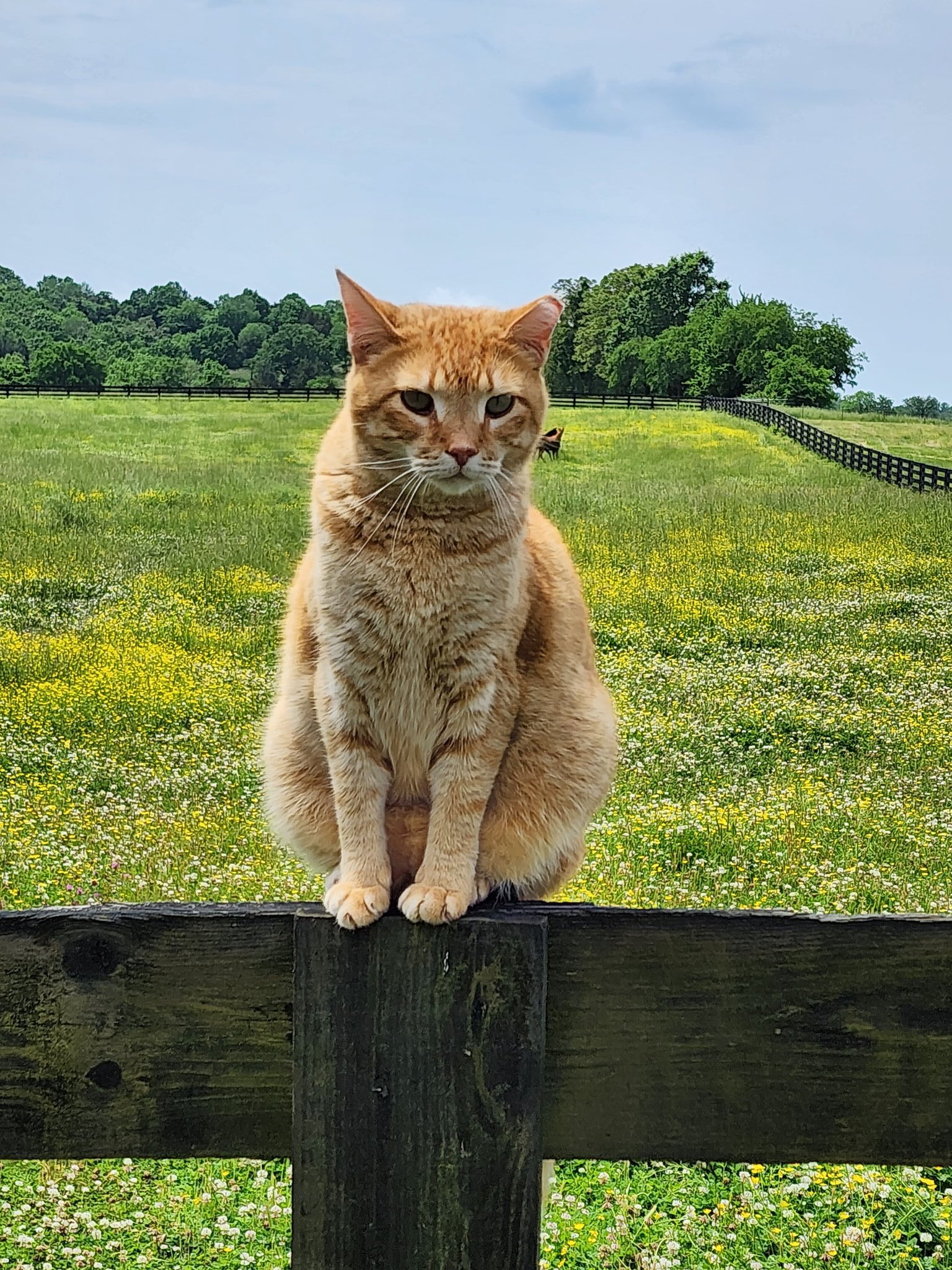
A chubby marmalade cat balances on a fence.

Oliver sits on the horse fence.

Anyway, you can see my dilemma.  For the most part, these poems haven’t seen the light of day (though I’ve sent many out, and even published a dozen of them) so I don’t know if they are working.  By the fact that so many of them have been rejected, one could say “they’re probably not working, JC.”  Or maybe they just don’t work as stand-alone poems.  Which is altogether another problem.  I want them to work as stand-alone poems, but sometimes you need exposition, and exposition isn’t very poetic.

The thing I tell my students about writing adaptations is that you have to honor the original source, but in the end the adaptation is a new piece of writing and it’s only about itself  I’m trying to do that; I honor Appolonius of Rhodes and Euripides by recreating scenes from The Argonautika and Medea, but I’m also adding new characters and new scenes and new information so that readers get a fuller image of Medea as a person. And I’m also trying to maintain a strong narrative voice.  How well I’m succeeding, I can’t be for sure.  But I’m trying.

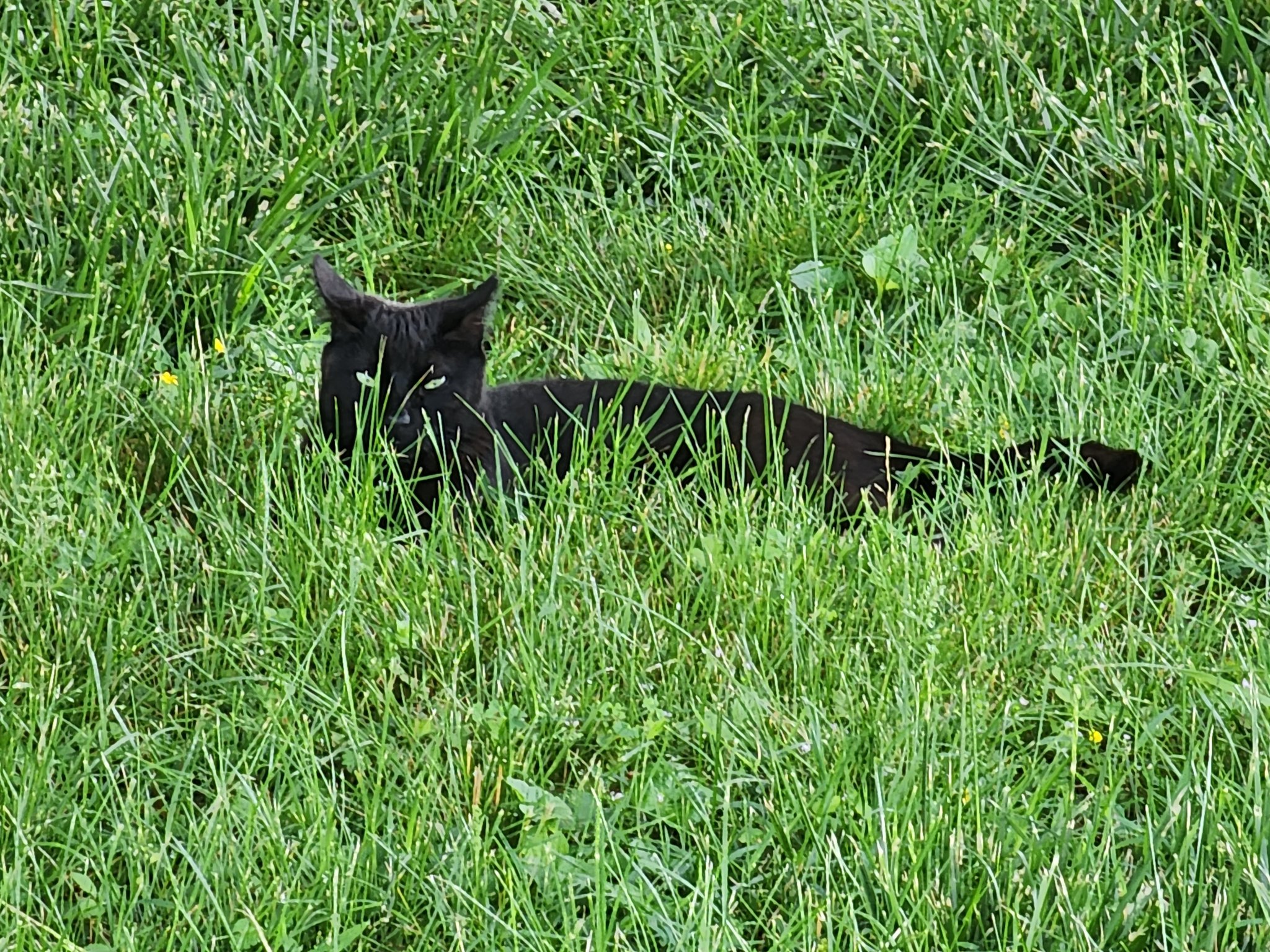
An image of a lean and handsome black cat.

Pip the shy but sweet black cat.

One of the ladies I’ve met here at the colony (Jen Knox, check out her new book, We Arrive Uninvited, available as a signed copy here) read What Magick May Not Alter, which I had left a copy of the last time I was here.  She said she liked it (yay!) especially because of its strong narrative voice.  And I think that’s true about WMMNA—it does have a strong voice and it’s good with character development—but then it should be, because I invented everything.

Here with Medea, I’m not sure I’m delivering on the promise of creating something new and I’m not sure about the narrative voice.  She’s already a known quantity as a character—am I revealing something fresh about her by writing about the early part of her marriage (as well as the plot of the play), or am I just…wasting readers’ time?  I ask myself:  why should anyone read my Medea when Euripides’ play is so perfect?  My go-to answer—“Because I wrote it”—is not what you’d call a particularly compelling response.  Do I think that someday professors teaching a classics and adaptations class will teach my book (this is assuming it finds a publisher)?  Not particularly.  But it would be really cool if they did, right?  Who’s the audience?  People who like poetry and people who like Medea for sure…but is there a broader audience for it?  What if there isn’t?

A tortie cat (black and orange) standing on a wooden deck.

Lucy making a bee-line for my legs to wrap herself around.

I’m not sure what’s brought on this little crisis of faith.  I think it’s because I’m seeing the whole collection (it’s about 96% done) together finally and I’m worried that if it doesn’t work as a collection (or if it’s prose-in-disguise), then I will have wasted my precious writing time writing something that isn’t worth a damn.  Well, ok, it’s worth at least a single damn, but you know what I mean.

I am afraid I might have another albatross around my neck.  Last year, I didn’t sell one copy of WMMNA—not one single, solitary copy.  (In fact, Madville took a net loss of two copies, which were apparently returned.)  I don’t want Medea to be in the same situation. I want her to find an audience.  I want people to know her as someone besides a child-killer. I think my book shows her in a rich full way…I think.  (But what if it doesn’t?)

Anyway, that’s where I am with this project.  I say I’m 96% done because I have a few plot holes that need to be addressed, but I think the collection—whatever it is—is really coming along. (There’s still revising to do, which drops my percentage down to 46% done, but I’m working on that too.)

In other news, tomorrow is Mother’s Day (probably not Medea’s favorite holiday), so make sure that you tell your Moms how much you love them.  They do so much for us—mine is perfect—and they love us just as we are.  Even when what we are is a confidence-lacking, attention seeking, desperate-to-be-adored-by-the-masses writer of poetry.

P.S.  The cats are Rockvale’s super-sweet barn cats.  (Doesn’t it figure that’s what I’d take photos of?)

A large orange marmalade cat with piercing green eyes.

Oliver

A sleek black cat sits in the middle of the grass.

Pip the Panfur in the grass

Memoir, Poetry, and Why Can’t I Do Both?

Pastel image of a black woman wearing a blue dress and writing in a notebook.

from the NYPL Digital Collections

Yesterday I met up with a lovely colleague, Ida, to chitchat and catch up, and we spent a good amount of time discussing my writing.  I am in the middle of two projects right now, and one of them includes poems about my family or based on my family.  Ida and I had that age-old question about memoir and life writing:  what’s true, what’s what you remember, and do you dare to speak your truth?  I don’t think it’s any secret that the relationship I’ve had with my father has been fraught for most of my life, particularly late childhood and the teen years, and there are poems I want to write about certain times in my life with him, but I’m not sure I should/could.

Part of my concern about writing memoir in general (not just in relation to my father) is that I don’t feel like my life is particularly interesting (ergo, who would want to read about it?). Yes, I’ve dealt with trauma and abuse, but where most memoirists could find lots of fodder to write about on those subjects, I find that I have a very intellectualized perspective—which is not surprising, because as I’ve said other times in this blog, I live too much in my head—that resists doing the lyrical work that memoir is good at.  I also just don’t remember the feelings I had, beyond fear and anger, and even they have been dulled with time.  How can I reflect on memories I don’t really have anymore, except as brief snapshots from my life?  How can I delve into the specific details of a life which even to me are fuzzy at this point?  Where does that leave me?  Writing really banal poems, I guess.

(Hmm:  an aside. It just occurs to me that a few times I have written poems that didn’t work as poems, and I took out the line breaks and submitted them as flash memoir and they not only worked, they got published.  Hmm.  Need to think about that a bit more. I want to write poems, because poetry is where I live, but I wonder if my voice is too prosy for that—at least when it comes to writing about family.)

Back to Ida.  I was listening to her talk about her own creative writing, which focuses on Hawaii’s historic relationship with its Japanese settlers, and her own father’s participation in that system.  And I thought, she really gets how poetry collections can be about so much more than their individual lyrics—that they can tell a story that has panoramic scope.  And maybe it’s because she’s looking at a particular historic period as well as her relationship with family that the project comes across as so interesting to me.  Whereas my own life seems so whitebread and humdrum and disjointed that I can’t imagine anyone would find value in reading about it.  Hell, I’m pretty sure not even I would want to read about it.  (I’m only half-kidding.)

And yet, the desire to write poems about my life remains there, as a way to make sense of these experiences—and maybe not to lose them any further than I have.  I should have kept up with my journaling—then at least I’d have material to draw from.  But there was such darkness in my life in the terrible depression of my graduate school years that I just quit, because it was too painful to document. And then I had gotten out of the habit, even when times were better. The upshot? I’ve relinquished my past—which is a terrible thing, when you want to write about it, or need to write about it, or think you should.  And everyone knows a good journaler makes for a better writer.  But anyway.

Ida encouraged me to write a real article (like for a scholarly journal) about my process, and I can’t think of anything more gloomy and dull.  (And scary.) And to be fair, I wouldn’t know where to start.  It’s been so long since I had to do any writing that uses critical research, I’m not even sure I know how to do it—I think I’ve completely forgotten how to flex those critical muscles.  (I barely remember how to write poems, let’s be honest.). She says she would help me, but I hate to be a burden on someone who has her own important writing to do. But we’ll see.  Especially now that my job is in transition, it might make sense to try to write something real and get it published.  It could maybe help me down the line.

In other news, I’ve sent out a bunch of submissions lately… I hope I get lucky. I would love for you to read some of my new work (including this poem, How the Heart Works, which appeared recently in Third Wednesday.)

Thanks for reading this latest post, my lovies.  I hope your own writing is going well!

Climate Change & Christmas

Old-timey Santa carrying a Christmas tree and backpack of toys while two little girls look at him happily.

from the NYPL Digital Collections

Christmas carols may play on my Spotify playlist right now, but it’s 70+ degrees out which feels decidedly not Christmassy. (Maybe if I lived in Florida?)  Of course I know this is due to climate change, something we’re all culpable for.  But I remember cold Decembers, and having to wear snuggly coats and scarves.  I remember snow falling in December and having to defrost my car windows to crack the thick layer of ice. Today I’m wearing bare legs and Birkenstock sandals, and the flowers are coming back out.  It offends me.

We should all be offended by climate change.  Forty-odd years ago, during the energy crisis, President Carter was interested in moving the U.S. to renewable energies, and if he had succeeded in his plans, we could be like Scotland now, carbon neutral and getting most of our energy through wind and solar farms.  But Big Oil and the combustion-powered car industry made sure that the U.S. stayed addicted to oil, and now the entire Earth is warming and our politicians can’t seem to agree on what should be done—mainly because many of them are beholden to the status quo…and to Big Oil and Coal.  Forty years ago, we might have had a chance to change things—now we’re trying to play catch-up, and catastrophic global warming, like the Grim Reaper, is on our doorsteps.

Coral bleaching, whales not being able to spawn, extinctions, glaciers melting, shorelines being devoured by global sea rise, worsening wildfires in the West, more devastating hurricanes, flooding, droughts across the Southwest and South—everywhere we look we can see the effects of climate change, and we do nothing because we don’t want to be inconvenienced.  Because it will take money and cultural change and thinking to make the environment a priority—and frankly our capitalist system is designed to exploit the environment, not protect it.  And as I said before, we’re all culpable.  We participate in the system that will eventually kill us all and will decimate life as we know it for generations to come, if not forever.

But we’ll be dead by then, so why does it matter?  That’s a comment I’ve heard more than once, and I think about the inherent selfishness implied with such a remark.  Yes, we’ll be dead at some point, but shouldn’t we want something better for the folks who come after us? And not just folks, but all the animals in the world too. If I’m honest, I really worry about the animals most—people will be fine—but animals are losing their habitats and becoming extinct because of our selfish over consumption of natural resources and our careless stewardship of the Earth. Why are we like this?  And who benefits?  A handful of billionaires, that’s who.

Starting small isn’t ideal—we need grand gestures at this point—but even incremental changes can help. I’m only driving three days a week, so that’s something.  I try to turn off the lights when I leave a room. And this year, after much debate, we decided to get an artificial Christmas tree instead of a live one this year.

Of course, a lot of energy was expended to manufacture this tree—not just in the production process, but in materials use and shipping as well.  It’s not carbon neutral by a long shot.  But it’s also not cutting down a new tree every year just so we can have it six weeks in our house, only to dump it in the woods where it doesn’t really do anything.

Granted, live Christmas trees are raised to be cut down and Christmas tree farms provide jobs—a good thing.  And since Christmas trees grow for eight to ten years before they can be harvested, they give off a lot of oxygen during their growing seasons.  But in the end, the tree dies and no longer produces oxygen.  It doesn’t seem worth it.

Do I love a fake tree?  Not at all.  We’ve had fresh trees my whole life, and nothing beats the scent of balsam and fir floating in your living room.  But I just don’t see how cutting down a tree makes sense anymore, especially given the environmental crisis.  We need trees to eat carbon dioxide and give off oxygen.  Killing one so I can enjoy it in my living room seems antithetical to my concerns about climate change. Hence, the fake-a-roony.

It will take some time to get used to.  But really, this sacrifice is small.  If I wanted to make a real difference, I’d invest in a horse and buggy.  (As if that’s even a possibility!) But at least the artificial tree is reusable for as many years as planned obsolescence has in store for it.  And if it doesn’t look like a real tree, or smell like one, at least once it’s decorated it will look like all the trees we’ve had in the past, and that’s not nothing.

Struggling

CW:  Depression, navel-gazing

I’ve been thinking a lot lately about writer’s block.  It’s a subject I’ve addressed before in previous blog posts, but, as I’ve said numerous times (to myself anyway), writer’s block isn’t really a thing.  People either write, or they don’t. I mostly don’t these days.

I could blame my old BFF “Deppie” because depression is just a daily part of my life, and despite being managed, it doesn’t really get better.  But I’ve written through depression before.  I’m not sure what’s different this time.  Except I just feel like all my good ideas have dried up.  So it’s actually painful sitting in front of the computer (or in a notebook), trying to compose.

I should have a lot to write about—two months in Scotland for instance.  And I still have my Medea project and my Mary Magdalene project, both of which offer ample opportunities for expansion. They’re just not speaking to me.  In fact when I go back and read poems from those sequences (with a few exceptions), my response is invariably “bleah.”

So try writing something else you say.  Well, I’ve tried writing a little fiction, and writing letters, and writing a bit of prose, but I don’t know, my heart’s not in it. I feel like such a fraud too.  I always tell my students that the best way to avoid writer’s block is to just write something.  But when you hate everything you write, that’s kind of hard.

So do some reading you say.  That I am doing.  Just not poetry.  Talk about painful!  I know that writing is difficult for everyone, so when I see great poems in books, I just feel worse.  Very petty and jealous of me, I guess.  So I’m sticking to light novels, but that only puts off the inevitable.

What’s the solution?  I don’t know.  Not writing makes the depression worse, because if I’m not writing, what is my purpose in living?  I don’t mean to get existential, but it does feel that not writing is a threat to my existence.

Folks trying to be supportive have suggested that I just—for a while—not write and not stress over it.  How does that work?  Because the longer I don’t write a poem, the more it seems like I’m forgetting how to do it.  And I have been trying to engage different parts of my mind and body—I’m crocheting a shawl right now, and sewing, and playing tennis again after a Covid haitus.  I’ve even thought about getting out my paints and trying to be creative that way, with the thought that maybe I could “unlock the block.”  (But I haven’t done that yet.) Maybe I just need to try a different medium until writing wants to come back to me.  But that’s scary too… because what if writing doesn’t want to come back?

Oh well, I’m not really accomplishing anything with this blog post, except reiterating my basket case status.  So forgive me, my five dear readers, for my pity party.  I hope it doesn’t last too long.

The Submission Game

from NYPL Digital Collections

I’ve been getting many rejections lately.  Last week alone I had 8.  This week it’s a “measly” 2.  And 2 of those 10 weren’t even at the journals I sent them to for longer than a day.

Rejections don’t get me down, per se (well, not usually), but they do always make me question if I’m still a good writer, or if I was ever a good writer (were all those other acceptances over the years flukes?).  We shouldn’t estimate our worth based on the capricious nature of the Submission Game—that goes without saying.  And yet. It’s hard not to equate acceptances (either to journals or residencies) with JC = GOOD, and rejections with JC = BAD.  As writers, we all probably think that to some extent some of the time.

I belong to a Facebook (pardon me, Meta) group that advocates trying to get 100 rejections in a year.  On the plus side, if you get 100 rejections, it means you spent the time to send out at least 100 submissions—which is a laudable pursuit, because it demonstrates that you take your writing seriously enough to inflict it share it with 100 journals.

But I wonder if that scattershot goal isn’t a bit misguided. If you just send work to lot of places, that doesn’t mean you’re actually reading the journals you’re sending work to, and so you might be wasting your time.  I know Poetry will never, ever, ever (EVER) accept anything I send them.  So if I send them work again, well, great, I can make a notch on my rejection list, but perhaps my time is better spent researching journals that are more inclined to like the kind of work that I write.

On the other hand, gamifying rejections does remove some of the sting.  After 100 rejections you’ll probably anesthetize yourself almost completely from the disappointment.  And, the rationale goes, statistically there’s no way all of your submissions are going to be rejections.  So, the more you send work out, the more you increase your chances of someone liking and wanting to publish it.  It does make sense, totally.

For me, it’s really hard to send out 100 submissions in a year.  A few years ago, I think I got to 70, and believe me, I was impressed with myself.  So far this year, I’ve sent out 21 subs.  You may say, “Hey, that’s pretty good for it only being February!”  But one always has enthusiasm for a project at the beginning of the year.  I doubt I’ll be sending out 10 a month by the time we hit July.  I mean, it could happen.  I could be a submitting machine this year.  I just know myself a little better than that.

***

A friend called me on Wednesday, just to check up on me because she thought the number of rejections I’ve received lately was getting me down (based on the fact that every time I get one I announce it on Twitter—it’s like a weird and obsessive confession thing).  She wanted to assure me that my writing is “special” because it’s woman-centered a lot of the time, and many publishers who are men are easily turned off by that.  She has a point—I really don’t write typically lyric work at all and narrative is not many people’s favorite mode.  I do appreciate her support—she has been amazing to me (and in an aside, she’s one of the best letter-writers I know) and her words certainly buoyed my spirits.

But worse than people of any persuasion not understanding (and publishing) my work is just my constant inner critic who secretly can’t help worrying that the reason I’m not getting published is because I’m a lousy poet. Or I don’t “have it” like I used to. (Whatever “it” is.)  What would it be like, if I could bind, gag, and toss that inner critic bitch right over the cliff?  What would it be like not to constantly doubt myself?  For all of us, what would that be like?  What could we do if we didn’t have an inner voice sabotaging us all the damn time?

***

Do you play the Submission Game, or some version of it with your writing and submission process?  If you (my five dear readers) do, let me know.  I’m curious about your approach.

Looks Aren’t Everything

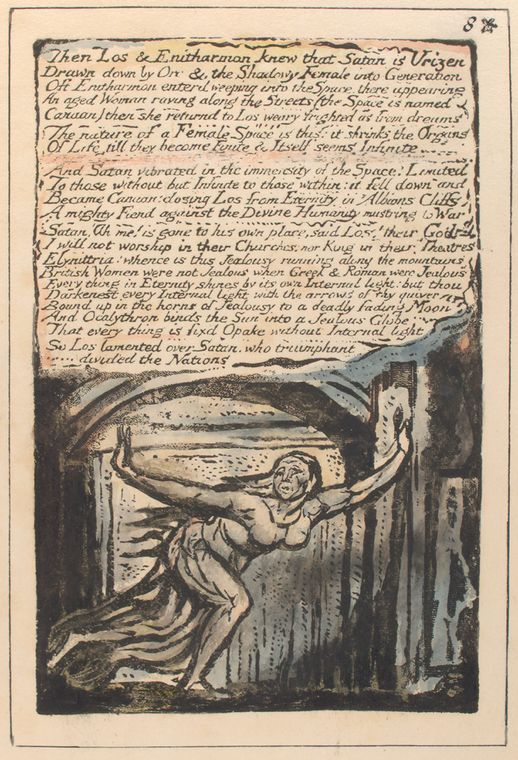
from NYPL Digital Collections, by William Blake

Do you ever think about how poems look on the page?  I confess I’m obsessed with this aspect of writing—how does it look?  Are the lines relatively even?  Or if the lines are irregular, are they regular in their irregularity?  (For instance, stairstep poems, with specific, deliberate indentions?)  If the poem is all over the page, why does it do that?  What stylistically is being communicated?

Sometimes (call it a personal failing), if words are sprinkled over a page like pepperoni on a pizza, it annoys TF out of me, because it feels like, to me, the poet’s arbitrariness serves no aesthetic purpose (that I can tell…please, understand that there are about 1000 qualifiers, and I am speaking only for myself).  (This anathema towards all-over-the-page poems has expanded the longer I’m Man. Ed. of AR—mainly because it’s so damn hard to typeset those poems…so I may be slightly biased for that reason.)

I’ve been thinking a lot about poems on the typed page compared to poems written in longhand. Yesterday, here at Rockvale, another poet and I were discussing this very topic—Kelly is a big believer in longhand. (She returned from the grocery with a pack of three yellow tablets too—which I know she’s going to fill probably just this week.) Other poets I know are Team Longhand as well—and it works for them.  (Sharon Olds also writes her poems in longhand—Katie Farris does too, so really, why have I been so hardheaded?)  As I mentioned the other day, I’ve been “getting messy” and only after I get a draft done longhand do I go back and type it into the computer.  I save these “transcriptions” as “[Poem Title]: raw from notebook” and it has really surprised me.

Far from the regularity that I pride myself on the poem written on the computer, my poem lines written longhand are a variety of lengths (once they’re typed).  It’s embarrassing how irregular the lines are.  Sometimes, of course, this has to do because my handwriting is big and I run out of space on the line, so I carry it down to the next one…which makes one transcribed line huge, and the next one might be half as long.  And it makes me realize that in typing a poem on the computer, I am constraining how the poem visually looks because of some arbitrary decision I have about how my poems should look. (God help a typed line that goes beyond 3.5”—I will butcher that bitch down to make sure I don’t pass that margin.)

To put it bluntly—my poems are constipated. They are uptight, overly controlled, and kind of anal. Typing, of course, I do for convenience’s sake—because I can type quickly, it’s not messy, and I can see what it will look like on the page. Immediately. But writing in longhand this week has really freed me.  Now, not gonna lie, as soon as I type up the second draft (the one after the transcription, where I begin to tinker with the language, music, and lines), I do come up against that 3.5” margin issue again.  I think I really just like poems to look like little blocks of regular text. (Sidenote, wombats poop in little square pellets—make of that what you will.  And yes, you needed to know this fact.)

In fairness, I have to ask myself the same question:  What stylistically is being communicated?  Why do poems have to look this certain way for me? What is it about the uniformity that appeals to me?  Am I trying to demonstrate that I’m an uptight person?  Why would I want to do that?  (To be honest, anyone who knows me, probably thinks that about me already—so I don’t really need to advertise that fact!)

But I really wonder, where did I learn that my poems need to look this certain way?  And how can I break through this rigid form I’ve imposed on myself?  Definitely writing longhand has shown me that when I’m not using the medium of the computer, my lines are more organic, more varied, more free-flowy.  I don’t think anyone ever taught me to make little blocky poems—I must have just picked that up over the years and codified that into what a JC poem looks like.

Or maybe it’s all kind of psychological—maybe I’ve gravitated to that kind of shape because most of my life has been chaotic and at least if I’m consistent on form in my writing I can establish some control.  Not sure where I’m going with this…kind of thinking out loud.  But it’s definitely worthwhile to limber myself up and try different approaches to writing poems.

It’s ok to be expressive, even playful, in the visual aesthetic of a poem.  That’s part of creativity too.  I just need to remember that being open-minded about a poem’s shape can actually provide an unexpected path.  And that can be exciting.

Basketcase

from the NYPL Digital Collections

CW:  Depression, myopia, navel-gazing

The pandemic is almost a year old (in the US, anyway), and it’s been a horrible year for so many people, including the half-a-million folks who’ve died from Covid, and their families.  Then there was the bizarre and unbelievable insurrection on Jan. 6th (Epiphany!), and now the Texas power grid disaster and the below freezing temperatures across the country—with people dying, in their houses, without heat or water.  It seems that we are beset with tragedy everywhere.  I don’t want to sound dismissive, though I fear it might, if I say that the year has been hard on me, because I haven’t been able to write like I’ve wanted to. 

Of course I was saying that five months ago, too.  And in the intervening months, there were Halloween, and Thanksgiving, and Christmas, which are always bright spots, if momentary. But my depression persists—made worse, of course, by the tragedies that surround this country, the inability to see family and friends (oh my goddess, do I miss my Mom), the loss of a friend to suicide last October, the incessant stay-at-home-ism—the endless, endless darkness (not to be a drama queen or anything) that has just taken the spirit out of me.

I can’t seem to do anything. I don’t want to get out of bed. I don’t want to do much more than read books (to take me away from myself) or sleep. I’m irritable, sad, lonely, hating myself, and suffering migraines all the time.  Sure, those are all garden variety symptoms of depression (well, maybe not the migraines), and I’m still relatively high functioning (though I can’t manage household cleaning chores), but I am exhausted all the time. Weary. Unmotivated to the point of laziness.  And so very, very heartbroken about my writing.

Yes, I know there are thousands of people who have it worse.  I know that. I loathe that I’m sounding like a whiny little bitch, when relatively, there is so much decent (if not good) in my life.  But part of the depression sphere is that knowing something objectively doesn’t mean anything if you can’t feel it.

***

Feeling anything has come hard to me as an adult. How many therapists have said to me that I live too much in my head?  Some of that, I’m sure, comes from feeling too much as a child and a teenager, when I was told over and over again that my feelings were invalid/ unreasonable/ ridiculous/ unwanted. So I learned to suppress so much of my humanity—just became a floating intellect. I was pretty good at school, so I did that.  Kept my emotions in check as best I could for as long as I could, till I didn’t seem to have them anymore.  (Like I intellectually love my family and friends—they are great, wonderful people—but I secretly wonder if I really feel that love?  Like, can I ever feel anything, authentically?  Or am I always processing everything on such an intellectual level that I’ve atrophied anything else that was real inside of me?) Everything on autopilot.

Or is this all just depression talking?

It’s not a lie to say that I have developed a true fear of writing (scriptophobia!) this past year.  Fear is a feeling—though I “feel” very intellectual about it. As in, I can compartmentalize it—and do the writing I need to for work without a thought.  But when it comes to my own writing, I’ve been terrified (again, intellectually speaking).  What do I say?  What does it matter? Who cares if I write or not (besides me)?  I’ve wondered if I’ve forgotten how even to write poetry.  Or if I’ve developed a fear of poetry (metrophobia).  This is beyond writer’s block (which I don’t actually believe in)—this is something fundamental, and deeper.  Like poetry is a mountain I can see across the forest, but forget about crossing the forest, I’m floating by in a river, trying not to drown.

And maybe it’ll just be temporary.  Like, maybe this past year is too much to process, and the only way to “cope” (not very effectively, of course) is depression and an “inability” to write.

***

Intellectually, I know I will write poems again, when I’m not so depressed and stuck.  But it’s hard to feel it.  But, even when I do write poems again, to be honest, I know they will be the intellectual exercises they have always been for me.  That’s why I’ll never be a great poet—because my poems don’t have an emotional core, they just don’t—but it will have to be good enough to be good enough as poet. Because if I’m not a person who writes poems, I’m not sure what my point for being is?

Thanks, always, to my five readers for reading this. I wish I had something better to share than just head garbage.

The Longest Hour of My Life, Or: a Confirmed Heretic Goes Back to Church

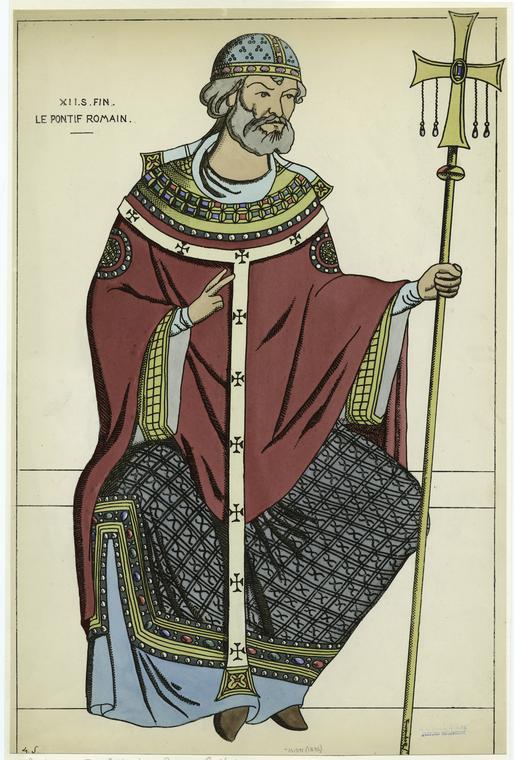
roman popeI recently decided to return to the Catholic Church over a decade of avoidance.  I had quit over a combination of disagreement with dogma, disgust at its sexism, and disappointment in the way it handled my need for spiritual help at a very painful period in my life.  I visited other churches in the interim (and almost joined the Unitarians), but never committed to any.  And let’s be honest, sleeping in on a Sunday morning seems to do me more good than most things, including listening to some man interpreting the Gospel and telling me how to live my life—especially when he has no idea what it means to be a woman in this (or any other) society.

It has been a rough transition back, though. Not because I’ve forgotten the prayers or the songs or the order of standing sitting kneeling—that stuff is ingrained from 12 years of Catholic school and years of being a good, practicing Catholic.  No, what has been difficult to stomach (besides the obvious horrendous sex abuse scandals which should make most of Church leadership burn in Hell) is the retrogression to pre-Vatican II High Mass BALONEY.

Continue reading

How High Does the Body Count Have to Climb Before We Say “Enough”?

Another day, another mass shooting, another cry for gun control, another example of Washington doing absolutely nothing but mouthing platitudes.

Sunday’s horrifying LGBTQIA hate crime at the Pulse nightclub in Orlando and the utter inability (or disinclination) for our government to enact any kind of sensible, pervasive, and strict legislation in the face of the gun lobby that bribes, bullies, and subdues our Representatives, Senators, and President fills me with an inexpressible melancholy.  People are dying.  We do nothing.

Gun supporters will tell you that there are plenty of laws on the books that regulate guns.  Gun supporters will tell you that it’s not the guns that kill people, it’s people who kill people.  Gun supporters will tell you that there’s no way you can predict who will use a gun unlawfully, that the majority of gun owners are lawful citizens who would never think to kill anyone.  Gun supporters will tell you that the Second Amendment provides for their lawful right to own, collect, brandish, and use weapons, and that anyone who wants additional gun laws are in fact impeding their Constitutional rights.

I’m not a Constitutional lawyer.  I don’t know the ins-and-outs of law and the history behind it—and I recognize that it’s a complicated issue that harkens back to pre-Revolutionary times.  So you might say, what right do I have to interpret the Constitution?  I’ll tell you.  The same right to interpret it as all the gun-addicted, death-and-violence-loving, NRA supporters have, who twist the Constitution to suit their purposes.

I can’t see how the Second Amendment (to wit:  “A well-regulated militia, being necessary to the security of a free state, the right of the people to keep and bear arms, shall not be infringed”) which clearly refers to militia (which the Oxford English Dictionary defines as a “military force raised from the civilian population of a country or region, esp. to supplement a regular army in an emergency, freq. as distinguished from mercenaries or professional soldiers”) can possibly mean the average American citizen, sitting in his (or her) home, who is not a member of a military force (such as the police, the Army, or the National Guard) hired to defend the country.

I can understand about owning a gun for “personal protection” or owning a rifle for hunting, though I would not personally own a firearm for either purpose.  I don’t understand why the average American citizen needs to buy a military-style AR-15 (or any other assault weapon that can shoot numerous, gratuitous rounds of ammunition in a matter of seconds), or why the average American citizen needs to build a personal arsenal.  We are not expecting an imminent invasion from hostile forces.  No country is declaring war on the United States; there is no expectation of conscription to fight invaders, and thus no need to hoard assault weapons.  How can the average American citizen possibly justify owning one or more of these weapons for either personal protection or hunting purposes?  What purpose can such a weapon serve, other than to kill mass quantities of human beings in as little time as possible?  People are dying.  We do nothing.

To me, the slavish, almost masturbatory desire for guns and violence, the veneration of violence as entertainment, the irrational fears propagated by right-wing radio and television personalities (and people who unquestioningly accept what these warmongers and fearmongers are peddling), the prison industrial complex mentality, and our culture’s toxic masculinity, are literally killing us.

We think the only way to protect ourselves is through deadly force; we don’t care about reason and diplomacy and compromise.  We value property above human life, which is evident in so many states (23) adopting Stand Your Ground laws.  We normalize active shooter training in daycares and college campuses (I attended one last week as part of a day of professional development in academic advising)—as if it’s ok that we have to teach children how to avoid getting shot right alongside teaching them reading, writing, and arithmetic.  We listen to media organizations that constantly barrage us with a diet of threats and racist rhetoric, and so we begin to believe we really are under attack. We accept uncritically the language of these media and potential Presidents whose sole purpose is to make money and to accumulate power—they don’t care that they spew hate, misinformation, and racist ideologies.  They don’t care that they whip people into a frenzy of fear, as long as they get a big fat check in the process.  We don’t care that gun manufacturers come out every year with more powerful weapons that promise higher kill counts and sell them at gun shows…to the average American citizen.  The deaths of human beings mean nothing to the gun industry and gun supporters.  People are dying.  We do nothing.

In the wake of the 2012 Sandy Hook shooting (where 20 children at an elementary school died, as well as six adults) which should have been, but wasn’t, a watershed moment to overcome our American anathema against enacting the fiercest gun restrictions yet, a 2013 article on CNN Money reported that a ban on assault weapons could impact Smith & Wesson stock shares by 40 cents a share.  While Smith & Wesson expressed sadness at the deaths of these children, they nevertheless saw a spike in sales for assault weapons as gun enthusiasts purchased record numbers of these weapons merely on the threat of a ban; projected earnings for the company in 2013 was approximately $580M, by the way.

And it’s not just the gun manufacturers getting rich.  According to a 2015 Fortune Magazine article tracking the political lobbying and campaign contributions spent by the National Rifle Association, the NRA spent over $30M in funding government officials and campaigns, and an additional nearly $20M to “candidates who tweeted ‘thoughts and prayers’ after the San Bernardino shooting.’  Our politicians welcome these contributions and consequently continue to stymie any efforts to make gun laws more restrictive.  It’s quid pro quo.  The Center for Responsible Politics reports that among federal candidates in 2014, the NRA directly pledged nearly $1M among the Republican and Democrat House and Senate members.  Granted, the direct contributions are small, ranging from $250 to $9,900, but our government officials know what side their bread is buttered on.  If the NRA is willing to support our lawmakers, lawmakers are unlikely to vote against NRA interests.  It’s as simple as that.

Somewhere along the way, we decided that the lives of human beings were less important than our acquisition of money.  Somewhere along the way we decided that the deaths of our fellow citizens was an acceptable tradeoff in order to “protect” our property.  Somewhere along the way, we sacrificed the belief in a civil society to embrace the law of the jungle.  Kill or be killed.

And as much as it seems like I am tossing the blame at our political leaders and the NRA, the fact is, there are still more of us who believe in restrictive gun control than who don’t—and if we collaborated en masse, through letter campaigns, through lobbying of our own, through marches, through activist means, through voting in third and fourth parties who are not beholden to Super PACs and gun lobbies, maybe we could put a stop to this gun addiction.  People are dying.

But we do nothing.  We are all complicit in the deaths at the Pulse nightclub in Orlando, at Sandy Hook, at San Bernardino, at Aurora, at Columbine—and all the other mass shootings.  Good, law-abiding people are complicit.  We have learned a kind of helplessness; we wring our hands and pray, but accept becoming inured to the horror of these daily mass shootings because it’s painful and wearying to think about them.  We have adopted a worldview that says nothing we do can matter.  That nothing we can do will change our cultural attitudes and beliefs.  That nothing we can do can stop the killings.  And so nothing changes.

But we have to combat that pessimism that keeps us immobilized.  We have to believe that we can change things.  We must.  Americans are dying.

There have been five additional mass shootings since the massacre in Orlando—five.  Five mass shootings since Sunday.  Five.  I can’t wrap my head around this.  Can you?  Five mass shootings in three days?  This is not war-torn Fallujah.  This is America.  In toto (again, according to the Center for Responsible Politics), there have been 16 mass shootings, 69 deaths, and 100 injuries from guns in June 2016 alone—and the month is only half over!  (Of course, this doesn’t even take into consideration any deaths by guns for “regular” property or drug-related crimes or things like domestic partner violence.  I’m sure the June body count is much higher when you put all the gun deaths together.)  In the face of these shootings, how do we sit back and do nothing?  How do I?

My family’s safety and right to life is more important than anyone’s need to own a gun.  Isn’t your family’s?

Write your Congressmen.  Write the President.  Tell them that the death of Americans by Americans with guns is not acceptable.  Tell them the cost-benefit ratio is too high.  Tell them the sacrifice is too much.  Tell them to embrace stricter gun laws especially for assault weapons, and if they don’t, you’ll support candidates who do.  This is not a Democrat/ Republican issue.  This is an issue of basic human rights.  Don’t we, as Americans, deserve to live, free from the persistent threat of imminent death when we go to nightclubs or daycares or movie theaters?

Writing letters not your thing?  Then volunteer with or donate money to gun control advocacy groups (such as the member organizations of the Coalition to Stop Gun Violence or groups like the Violence Policy Center and Everytown for Gun Safety).  Don’t be complicit in the deaths of our fellow citizens any more.  Don’t stand by any more.

Writing a letter to our government officials or volunteering a few hours with advocacy groups may not seem like much, but it’s a start, and I am doing it.  We have to start somewhere.  Americans are dying.  We must, must, must do something.