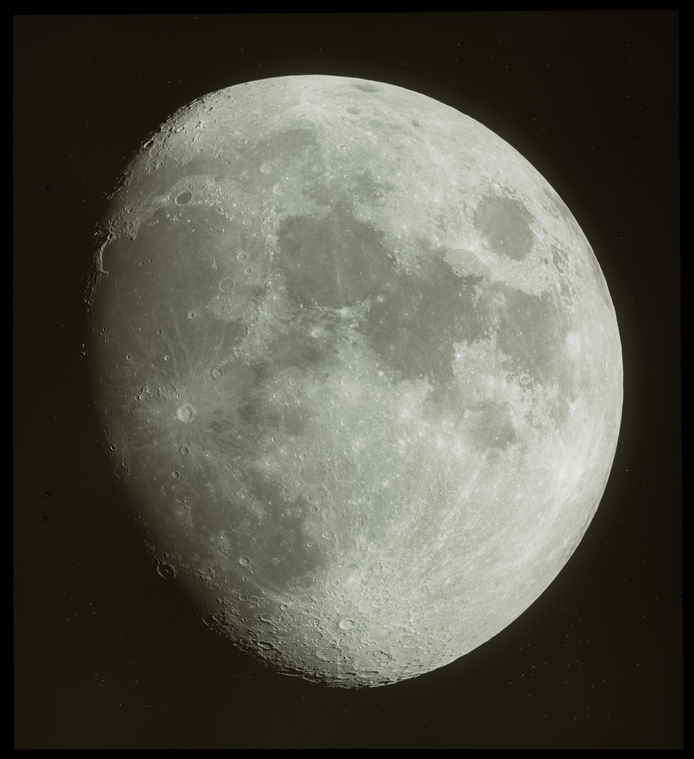
Saintly Visions & a Writing Mania Miracle

Quick Note:  It’s been a while since I’ve written (obvs.)—but in my defense, I was having problems with WordPress’ posting/editing interface, and it took me a while to figure out the sitch. Turns out I’m an airhead.  Anyway, it’s squared for the time being.  Now, onto the post!

So, a few months ago I was lamenting my writing.  Or rather, my lack of writing.

This seems to be a typical thing with me.  I suppose it is for many writers, though—you just go through phases, some of which are productive, some of which suck ass.  And of course, my ever-present and generally intolerable BFF, “Deppie,” has made a real nuisance of herself in my life:  that is to say, the dysthymia and anxiety pretty much kick my ass every day. (Sometimes, I tell myself:  just get through the next hour—and that’s the best I can manage.) But this isn’t a post about effed-up brain chemistry, this is a post about writing.

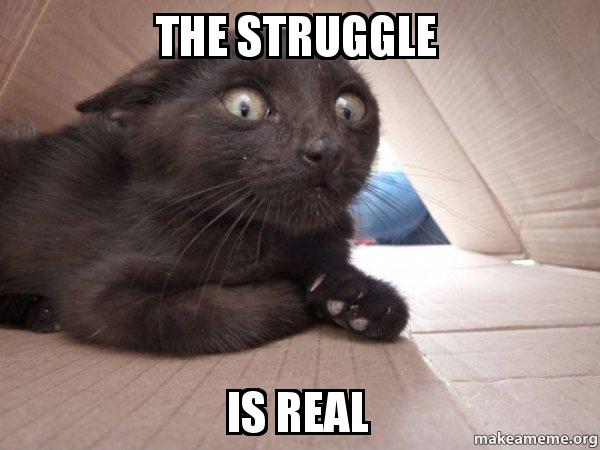
–from makeameme.org

As I was saying:  in February (technically, two posts prior), writer’s block (you know I hate that term, and try not to use it because it always feels like a crutch) was a thing.  I mean, THE STRUGGLE WAS REAL. 

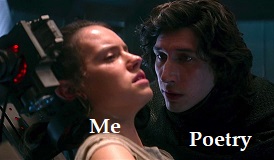
(–from Lucasfilm/Disney)

Poetry and I repelled each other, although there was always kind of a Rey/Kylo (Reylo?) thing going on between us. And while it upset me (not just the least of which had to do with thinking about my writing in terms of the most recent Star Wars trilogy), other more pressing things on my mind (like staying alive) took precedence.  So, I just added “writer’s block” to the list of THINGS THAT MAKE MY LIFE MEANINGLESS O WOES ME. And carried on.

And then I had a vision of Mary Magdalene.

I know this sounds hokey.  Just go with me on this.

Digging through some old files on my computer, I came across a poem I had written years ago about Mary Magdalene—it had been nominated for an AWP Intro Award (which it didn’t win—big shock there)—and it got me thinking.  What could I do with this poem?  Would it just continue to sit in the file in perpetuity?  Or could it be part of a sequence?

The only way to see if a poem will be part of a sequence is by writing another one.  And then another one.  And so on. To help myself focus, I looked at image after image of Mary Magdalene through the ages, remembering the bond I used to have with her (as well as other women from the Bible).  I read hagiographic blogs and articles. I wrote a dozen poems or so, of varying qualities.

The Penitent Magdalene

Caravaggio, The Penitent Magdalene, ca. 1594-95

Some poems were ekphrastic because I believe in THE DREAM (writing a good art poem one day—and I do love me some Italian Renaissance/Baroque paintings), some were my typical narrative poems-with-a-wry-bent, some were just fragments (the Caravaggio poem is in limbo…for my sins). While I still need to revise and complete the sequence, it feels like I’ve accomplished something, and that takes a bit of the edge off.

And then (!!!)—I started another sequence of poems.  I mean, I wrote (and revised!!! OMFG!!) 25 poems in the span of 6 weeks.

I was like HamiltonI worked nonstop.

Or to put it another way, it was as if I had a visitation from The Madonna and she told me to me to get into the groove.  So I did.  And I’ve even started sending them off into the world.  Two of the poems will be published in Soul-Lit: a Journal of Spiritual Poetry in the near future.  Maybe more acceptances will be forthcoming.  (I can hope.)

If I sound amazed, I truly am.  But I don’t want to sound like I’m all, “look at me, look at me, I’m so fricken awesome.”  This is not me espousing a pull-yourself-up-by-your-bootstraps approach to writing. (Barf. I would never.) This is not me trying to lure you to my Patreon (which I don’t have—but maybe I should?) or to broadcast an infomercial at 3 a.m. promising that “You too can conquer writer’s block! For six equal installments of $29.99, you can download my step-by-step method…” It’s just me being surprised at how inspiration (another word I hate when it’s applied to writing) works sometimes.

I have slowed my roll somewhat since the middle of April, but I haven’t rolled to a stop.  So that’s a win.

My to-be-read pile                       (from NYPL Digital Collections)

A lot of work is coming my way though—I’m plodding (slowly) through a ton of reading to do for Atlanta Review (now that we’re down to basically only me as the reader/typesetter/social media maintainer), and a pile of research I need to for my next major WIP is accumulating on my bedside table. (Every time I look at it, there’s another book on the pile.) And of course, the new Fall teaching schedule dangles before my eyes, even if it’s still a couple of months away. Not sure I can maintain much rolling at all, with all this going on.  But slow and steady wins the race, or something like that?  I just need to keep trying  (Which is difficult with that beyotch Deppie albatross hanging around, but I’ll try.)

The middle one is “Deppie.”
(from NYPL Digital Collections)

***

Anyway…enough blathering. I hope your writing is going well.  And I hope you, my beloved 5 readers, are staying safe and healthy, even as the world opens back up.

Basketcase

from the NYPL Digital Collections

CW:  Depression, myopia, navel-gazing

The pandemic is almost a year old (in the US, anyway), and it’s been a horrible year for so many people, including the half-a-million folks who’ve died from Covid, and their families.  Then there was the bizarre and unbelievable insurrection on Jan. 6th (Epiphany!), and now the Texas power grid disaster and the below freezing temperatures across the country—with people dying, in their houses, without heat or water.  It seems that we are beset with tragedy everywhere.  I don’t want to sound dismissive, though I fear it might, if I say that the year has been hard on me, because I haven’t been able to write like I’ve wanted to. 

Of course I was saying that five months ago, too.  And in the intervening months, there were Halloween, and Thanksgiving, and Christmas, which are always bright spots, if momentary. But my depression persists—made worse, of course, by the tragedies that surround this country, the inability to see family and friends (oh my goddess, do I miss my Mom), the loss of a friend to suicide last October, the incessant stay-at-home-ism—the endless, endless darkness (not to be a drama queen or anything) that has just taken the spirit out of me.

I can’t seem to do anything. I don’t want to get out of bed. I don’t want to do much more than read books (to take me away from myself) or sleep. I’m irritable, sad, lonely, hating myself, and suffering migraines all the time.  Sure, those are all garden variety symptoms of depression (well, maybe not the migraines), and I’m still relatively high functioning (though I can’t manage household cleaning chores), but I am exhausted all the time. Weary. Unmotivated to the point of laziness.  And so very, very heartbroken about my writing.

Yes, I know there are thousands of people who have it worse.  I know that. I loathe that I’m sounding like a whiny little bitch, when relatively, there is so much decent (if not good) in my life.  But part of the depression sphere is that knowing something objectively doesn’t mean anything if you can’t feel it.

***

Feeling anything has come hard to me as an adult. How many therapists have said to me that I live too much in my head?  Some of that, I’m sure, comes from feeling too much as a child and a teenager, when I was told over and over again that my feelings were invalid/ unreasonable/ ridiculous/ unwanted. So I learned to suppress so much of my humanity—just became a floating intellect. I was pretty good at school, so I did that.  Kept my emotions in check as best I could for as long as I could, till I didn’t seem to have them anymore.  (Like I intellectually love my family and friends—they are great, wonderful people—but I secretly wonder if I really feel that love?  Like, can I ever feel anything, authentically?  Or am I always processing everything on such an intellectual level that I’ve atrophied anything else that was real inside of me?) Everything on autopilot.

Or is this all just depression talking?

It’s not a lie to say that I have developed a true fear of writing (scriptophobia!) this past year.  Fear is a feeling—though I “feel” very intellectual about it. As in, I can compartmentalize it—and do the writing I need to for work without a thought.  But when it comes to my own writing, I’ve been terrified (again, intellectually speaking).  What do I say?  What does it matter? Who cares if I write or not (besides me)?  I’ve wondered if I’ve forgotten how even to write poetry.  Or if I’ve developed a fear of poetry (metrophobia).  This is beyond writer’s block (which I don’t actually believe in)—this is something fundamental, and deeper.  Like poetry is a mountain I can see across the forest, but forget about crossing the forest, I’m floating by in a river, trying not to drown.

And maybe it’ll just be temporary.  Like, maybe this past year is too much to process, and the only way to “cope” (not very effectively, of course) is depression and an “inability” to write.

***

Intellectually, I know I will write poems again, when I’m not so depressed and stuck.  But it’s hard to feel it.  But, even when I do write poems again, to be honest, I know they will be the intellectual exercises they have always been for me.  That’s why I’ll never be a great poet—because my poems don’t have an emotional core, they just don’t—but it will have to be good enough to be good enough as poet. Because if I’m not a person who writes poems, I’m not sure what my point for being is?

Thanks, always, to my five readers for reading this. I wish I had something better to share than just head garbage.

Catfish Moon (poem reading)

from the NY Public Library Digital Collections

from the NY Public Library Digital Collections

Since all poetry readings are canceled for the foreseeable future, I thought I would take the opportunity to read a few poems over the next several days from my new book What Magick May Not Alter.

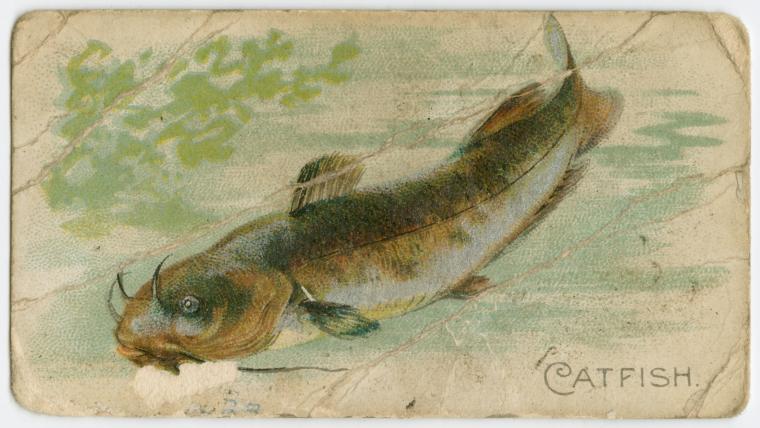
This poem called “Catfish Moon,” named after the full moon in August (which is technically the Sturgeon Moon, but this is poetry, and we take liberties).

(Also, the picture looked backwards when I was filming it, but it’s correct when you watch the video, so forget my little “backwards” comment.)

If you like the video, or this blog, please feel free to share it near and far!


Re-centering

Right now, with the Corona Virus going on, it’s hard to think about anything besides that people are dying and the only thing we can really do is socially isolate ourselves and wash our hands to the Alphabet Song (or Happy Birthday, twice).  But while that is true, it’s also important that we don’t lose sight of what makes us us—whatever it is that makes us feel humanity, we should try to continue to do it, even as we make health and safety of ourselves and others a priority.

For me, that’s writing. The last few months at work, I was putting sometimes 50-60 hours a week trying to get everything done, and unfortunately, what had to give was my writing.  I was just too tired to work on poems, after I had been in the salt mines, and I realize now that more than just what I thought I lost (some sanity and true connection to my inner world), I temporarily lost some of my humanity.  Not surprising, when you become an automaton for work.  But not writing—not connecting—contributed to my anxiety and worsened my already pretty heavy depression, and frankly, no job is worth that.

I am sorry that it’s come down to a pandemic to allow me to write again—but I also feel better for the first time in several months.  I’ve been writing, revising, and sending out poems to journals, and it feels like me again, a re-centering.  Usually, the nudge that AWP provides in the Spring also helps my productivity, but this year the Ed. decided (rightly) that we should probably forego AWP since both of us tend to be immunocompromised. (Everyone knows all you have to do is sneeze my way and I pick up a respiratory infection.)  But it was hard, not getting to chat with writers I know as well as visiting with the people tabling in the Book Fair. The energy from that is so motivating.  So, I’ve just been reading the journals that have stacked up around my house, and I’ve been combing Submittable’s Discover tab, looking for new journals to explore and possibly to submit to.  And, I’m finally connecting to the project I’ve been batting around in my head for months, and that feels good too.

In related news, I’m looking forward to my official release date for What Magick May Not Alter, which is April 17th.  So, that makes my book an Aries (and you know how Aries and Taurus don’t mix too well 😊).  But I’m excited for my book to be out in the world.  I’ve sent ARCs out to several people, with the hope that they would kindly write a review, no matter their opinion.  I know for a fact that one person has written one—she’s just waiting to share it a little closer to its birthday.  And another person is in the process of making a YouTube review and told me that he “damn near couldn’t put it down,” so that is great news. I’m still looking for some readers/ reviewers, so if anyone is interested, please let me know and let’s figure out how we can get a copy of What Magick May Not Alter in your hands!

I know this was a short post—I’ll try to do better than write one post a year!  Maybe I’ll even get back to my Wednesday posts, who knows?  Until then, be safe, sequester yourself, and wash your hands. And if you believe, pray.

Solstice

Long beach postcard 1910

Image from NYPL Public Domain Digital Collection

It’s the summer solstice, the longest day of the year.  Sunset tonight is technically 8:51 p.m., but of course it will still be light out closer to 10 (for a total of 14 hours and 24 minutes of sunshine).  It’s the kind of day I could imagine myself being out by the ocean for as long as possible—you know, if Atlanta was on the coast.  Which alas, it is not.

I simultaneously love and hate this day—I love it because it’s high summer and there’s something interesting about the sun being out as I’m (supposed to be) readying myself for sleep.  But I also hate it because it means the days will now get progressively shorter, creeping as they do towards the fall and a new school term.  (I’ve had this love-hate thing with the day since I was little.)

Anyway, here is a poem I wrote several years ago commemorating the summer solstice.  Initially I planned to write something New Agey and mystical—but then I defaulted to funny.  This poem has always been one of my favorites, and it always makes me laugh.

Solstice

Tonight is the shortest of the year,
not enough time to break into Mr. Next Door’s
shed and rearrange his tools,
hide the scotch he keeps on a ledge
beside the coiled snake of orange power cord,
let the air out of the tires of his ’87 Impala,
fray his collection of ropes,
steal the front wheel of his Schwinn
and replace it with a stale doughnut,
spill turpentine into his jug of marbles,
stuff his sleeping bag with twigs and old leaves,
or tangle his fishing wire into knots
not even the navy knows about.
Tomorrow, the night is two minutes longer.


If you like this poem, you might like the others in my collection, La Petite Mort.

Some New Things Out

fat ladies coney island

Image from NYPL Public Domain Digital Collection

It’s June, which means I’m hip deep in my annual summer doldrums, and not feeling particularly writerly—an unfortunate circumstance, because with things a little on the quieter side (not teaching summer classes, for instance), you’d think I’d be writing up a storm.

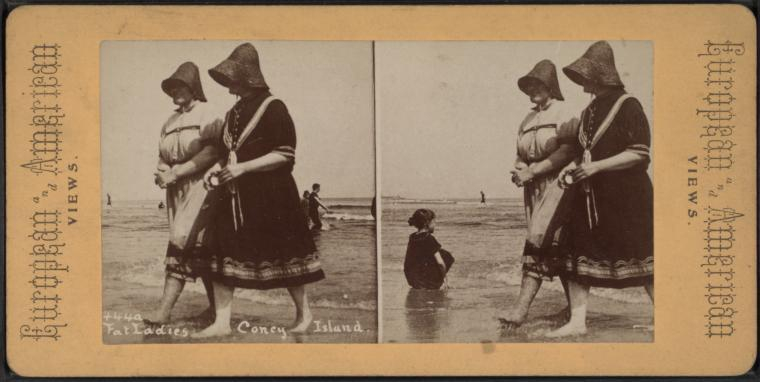
Alas, I’m too undone, wishing I was anywhere but in Atlanta (like these great ladies in this stereograph of Coney Island), and I’m so anguished about our current immigrant crisis (and general Washington, D.C. chaos) I can’t even really focus enough to write anyway.  I keep telling myself just hang on until the middle of July—which is when I’ll go away for a couple of weeks to the coast and hopefully rejuvenate my flagging spirit, but that’s still so far away.  Meanwhile, I’m melting into the pavement—and worrying about what new horror will assail us in the next hour of the news cycle.

Anyway, existential poor-me’s aside, I have a couple of poems/ nonfictions (depending on what you call them…I like to think of them as “poemeditations”) in the most recent issue (2017/2018) of Grubb Street.  (Scroll through the online journal to p. 3 and 4.)  These are more from my Venice collection, which will someday find a home, I hope.

And I’ve got five poems in the July issue of The Dead Mule School of Southern Literature.  Actually, it turns out these poems were supposed to come out in last November’s issue, but somehow there was a snafu and the submission disappeared (on their end) in Submittable.  It was lucky I followed up with Dead Mule, because the editor was mystified at how the poems had gone astray, but she was great and fixed it and now the poems are there for you to read.

If you like my work, feel free to leave a comment.  If you don’t, leave a comment anyway, and give me something else to brood about.


Hostage Situation: When Your Accepted Work Doesn’t Actually Get Published

handcuffsI’ve been mulling over my C.V. and noticing that there are a number of acceptances that are still listed as “forthcoming” because the journals where my work was accepted haven’t yet published them.  This doesn’t bother me with recent acceptances, of course, but three pieces (two poems and one flash fiction) received acceptances last year and have yet to be published.

I think this is unconscionable—especially because the journals that accepted them are little.  It would be one thing, if I were waiting on a print magazine like The New Yorker, which accepts work with the caveat that there is considerable lead time until publication. But these online journals are neither large nor prestigious, so what’s the hold up?

I am especially annoyed at the situation surrounding the publication of the flash piece because that had been accepted at another journal (in August 2015), and it never came out.  I guess the journal folded before it ever even released an issue—although the journal still has a webpage and an active Submittable site.  I wrote them an e-mail to withdraw the story, and began sending it out to other places.  And after a time, it was accepted again (October 2016).  And then nothing.

I’ve looked at the journal and its Duotrope statistics, and it appears that nothing has been updated on the journal, and the most recent response reported on Duotrope was—wait for it—October 2016.  Two e-mail inquiries I sent have received no response.  So the damn story is just in limbo.  I plan to give the journal one more month, and then I’m withdrawing it and starting the whole process again.

The publication sitch with the poems is similar.  Both poems were accepted in April 2016—while I was at AWP, no less—and I waited and waited for some news about their publication.  First I went to Duotrope to see what was the most recent reported response and saw that Duotrope apparently considered the journal “defunct.”  When I went to its listing in Poets & Writers, I clicked on the website, and it brought me to their former website, which had been sold to some rando guy who was now going to post his own stuff on his new blog.  The journal was missing.  I tracked down the journal’s FB page, and sure enough, it had a new website address, but no information about when any new issues would be appearing.

A few weeks ago, I went back to the site, and there was a notice that the journal was restructuring and would be on hiatus until Fall 2017.  I will give them some time before I withdraw the pieces; maybe they are still planning on publishing them—I have to cut them a little slack, since there was obviously some kind of problem.  And at least they (belatedly) had the courtesy of posting a note on the website about the hiatus.

All of this gets me to thinking though about how important it is for editors to be ethical about the writing they accept from people.  Editors should say, in their acceptances, when publication will happen—or at least give a ballpark figure.  (At Atlanta Review, the expectation is that any work accepted will appear in the next issue without question.  If there is some reason why the poem will not appear in the next issue—like if we miscalculate the number of pages we need—you better believe I contact the author with an updated ETA when their poem will appear.)

Of course journals—especially little ones—come and go, but it seems to me that when a journal has accepted work, if some catastrophic tragedy happens, and they can’t actually fulfill their contract to publish the piece, they have an obligation to e-mail the writers and explain.  It’s wrong to keep work hostage, and it’s wrong not to respond to polite and professional queries for updates.

Writing and publication are a writer’s livelihood—and sure, I’m not getting paid for this work—but publications add to my reputation as a writer, and I count on my work being available for people to read.  When work is accepted, and then not published for whatever reason, and editors don’t respond to emails asking about updates on the status, that’s unprofessional behavior.  And they shouldn’t be editors.

Not publishing accepted work compounds the already problematic issue of not getting paid for work (yes, yes, I know poets and most fiction writers don’t get paid—and don’t get me started about that) by denying writers exposure—the exposure that being published for free is supposed to bring.  Exposure helps you to create name recognition and to build your brand.  (Not to be all corporate-business-speaky about it.)

Additionally, when journals charge submission fees (as one of these journals charged me), not publishing my work as promised becomes even more egregiously unacceptable.  It is, in some ways, outright theft.  To wit:

  1. I’ve paid for them to read my submission.
  2. They accepted my story for publication.
  3. They have not published the story.
  4. I’m out the $5 bucks and the story.

That’s not ok.

Journals that engage in behavior like that are not ok.  And they should be called out for their unethical practices. I haven’t named the journals here only because I’m still giving them a chance to redeem themselves.  But if it doesn’t get fixed, I certainly would want to warn other people about the treatment I’ve received at the hands of these journals.  I would hate for other writers to have a similar, crappy experience, getting work accepted and then all their hopes dashed when the journals flake out.

I hope none of you, my five loyal readers, have experienced such a thing.  But if this has happened, what did you do to set it to rights?  (Looking for suggestions.)

New Poem Up at Amaryllis

amaryllisRecently, I received a smack-down from a Brand Name Poet (who evaluated a packet of my poems for a fee) because one of the poems I’d given her was a narrative ghazal—that’s right, in other words, I’d employed the ghazal form to tell a story—and I was told “no way, you can’t do it, it’s wrong.”  It was, I thought, a harsh rebuke—I mean, calling a poem “wrong”?  Just because I had used the spirit of a form to organize the poem?  What if I had replaced the word “Poem” instead of “Ghazal” in the title, I wondered?  Would that have made the other poet happier?
I know what a traditional ghazal looks like.  I’ve written (and published) them before.   I’m a firm believer in the adage, “Follow writing rules until you have enough maturity and experience to break them.”  Because sometimes playing with a form is a good thing—it shows that form can be flexible.  Form is like a corset—it restricts the shape of a poem, but there should always be breathing room.

Result:  “Ghazal for My Father,” published a few days ago in Amaryllis.  I hope you like it.

How the Moon Became a Poem

Storm Moon photo

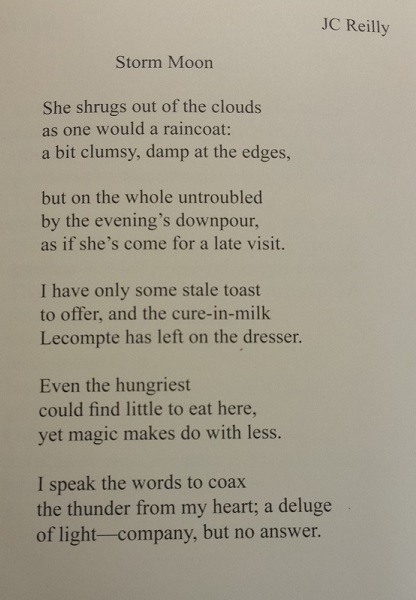
In Tuesday’s mail came the May 2017 issue of POEM.  POEM is a journal of the Huntsville Literary Association, and has been continuously published since 1967—fifty years. They publish perfect little poems—the journal itself is not quite 5”x7”—and I had submitted a pack of poems to them just to say I tried.

So when I got the acceptance last year, I was thrilled—especially because it was one of the Moon Poems from my narrative manuscript (you know, the one I’ve submitted like 50 places).  The Moon Poems, with maybe two exceptions, are “perfect little” 15-line lyrics, that appear throughout the manuscript and (at least in my mind anyway), represent the poetic output of one of the main characters, thought the voice in this particular poem is Vidalia’s, not Tallulah’s.

I’ve been trying to remember what initiated my interest in writing the Moon Poems.  While it may be true that I wanted to demonstrate a range of my writing ability (that I can write something other than narrative), it seemed important to incorporate the moon almost as a character in the manuscript, especially as it is about witches and women who harness energy and strength from the moon in order to enact their spells.

The poems each take as their title one of the (many) colloquial/ northern Algonquin names for each month’s full moon—though the February full moon is technically the “Snow Moon”—but of course, there’s no such thing as snow storms in February in Louisiana, but there is rain, so I fudged a little, and made the poem “Storm.” (Actually, this poem could also represent July—which is the month of  the “Thunder Moon” as well as “Buck Moon” but I believe I meant it for February.  But the word “thunder” appears in the poem itself…maybe the connection to February is wrong?)  As I think about it, February actually has two poems in the manuscript, this one and “Hunger Moon.” Anyway, writing about the moon felt authentic to me, and authentic to the experience of all the women characters in the manuscript.  (Not surprising—as Marge Piercy reminds us, “The Moon Is Always Female.”)

With this publication, the total number of poems in the manuscript that have been published in journals comes to 11—when the manuscript is 83 poems, my publication rate looks feeble, a mere 13%.  But it has been difficult to publish poems from this collection because it’s narrative (the Moon Poems not withstanding), and they are interdependent, and how do you take individual poems which all contribute to a story out of their milieu and make them make sense as stand-alones?

I’d very much like to have at least 20 poems from this collection published—that seems like a reasonable goal—then I would feel like maybe the manuscript would finally have a chance.  And getting the rest of the Moon Poems published might be the way to accomplish that goal.

On the other hand, there is still the other idea I have been kicking around in my head…taking out the line breaks in nearly all of the manuscript poems (except the Moon Poems), and trying to get it published as a hybrid flash fiction/poetry work.  So far I’m not that desperate—I mean, I conceived the book as poetry, and would hate to lose the beauty of well-wrought-lines, so I’m going to hold out the hope until I get the next batch of manuscript rejections that it will get published as the verse novel it is.

But the line break removal thing is still a possibility… because it has worked for me before, transforming what I thought were poems into flash fiction and flash nonfiction—or rather, perhaps the conversion process only revealed what their true form meant them to be.  And in many cases, these erstwhile poems found homes in journals like right away.

Anyway, I hope you enjoy “Storm Moon.”  Let me know what you think.

Gun Violence, Academic Poetry, & Who Cares About White Pain?

I started writing the post about poetry below (after the horizontal line) a few days ago.  It’s still worth sharing, because it’s about writing meaningfully when all of this tragedy is happening.  But I have to have to say that now, with the death of the African American man hanging from a tree in Piedmont Park (Atlanta’s “back yard”), which the Atlanta Police Department called a “suicide,” I’m at such a loss—I don’t even know that I could write any poetry about the insanity of death and violence that are perpetrated against American citizens because they’re black and brown.  (Does anything I’d have to say even matter?)

If calling this particular death a “suicide” is not an example of institutional racism, if that’s not racist “criminal justice” and a racist “law enforcement” system at work, I don’t what is.  What African American would choose to hang himself from a tree?  What African American would choose to commit “suicide” through a method that clearly smacks of historical racism and slavery?  The answer:  no one.  The night before the murdered man was found, Klan members were seen hanging fliers in Piedmont Park.  I don’t think that’s a coincidence.  Thank heavens, the FBI is now investigating this death—but only because Atlanta’s African American mayor Kasim Reed referred the case to them, not because the police did—and let’s not forget that the FBI is also part of a racist criminal justice system.  If they agree with the Atlanta coroner and the APD that this man’s death was indeed “suicide,” I wouldn’t be remotely surprised. Devastated yes, but not surprised.

And let’s talk about Dallas.  Yes, it’s awful and horrifying that five Dallas officers were shot and killed at an anti-violence rally.  No, these officers didn’t “deserve” to die.  But let me tell you, I can sympathize with the shooters’ anger and frustration.  Maybe these five particular cops didn’t deserve to die.  Maybe these five particular cops were upstanding citizens who would never use their power against African Americans to harass and murder them.  But other police officers every day act on their racism and abuse and kill African Americans with impunity.

The fact is, the attack on these cops is an emblematic strike—it’s the way these suspects felt that they had to deal with constant, racist murders of other African Americans by police departments.  It’s fighting the system, when no one else will.  President Obama has said that there is no possible justification for the attack, but it’s hard to deny that “law enforcement” doesn’t profile and target and harass and murder black and brown suspects just because they can get away with it.  When our lawmakers and President can’t seem to get a hold on the police department’s institutionalized illegal acts perpetrated against African American citizens (and other minority groups, such as Latinx, who are also targets of racism), it doesn’t surprise me that African Americans turn to vigilantism for justice.

In an earlier interview about the slaying of Alton Sterling and Philando Castile the President said, “’All of us as Americans should be troubled by these shootings,” he continued. “These are not isolated incidents, they are symptomatic of a broader set of racial disparities that exist in our criminal justice system.’”  Yeah?  Then do something about the shootings.  Our society has never been less civil.  Mr. Obama, you’re the President.  You have Executive Power.  Do something.  Demilitarize the police.  Take down the NRA.  Take guns away from people.  Please, I beg you.

If you’re like me and feeling especially helpless and sick right now about all this violence, here are some things worth reading/ doing: writer Justin C. Cohen’s Advice for White Folks in the Wake of the Police Murder of a Black Person, former police officer Reddit Hudson’s I’m a Black Ex-Cop, and This Is the Real Truth about Race and Policing, faith-based consultant Joshua Dubois’ letter to police chiefs (in .docx form, so you can cut and paste when you download it), and psychologist Karyn Hall’s suggestions for self-soothing (because we need to take care of ourselves in the midst of all this tragedy).

Anyway, with these latest murders in mind, like anything I say is worth a damn, here is the original post…


I am struggling lately with poetry.  Call it a genuine crisis of faith—or aesthetics.

I am trying to reconcile what I think art should do—which is comment on our time, take a stand, reflect reality and emotions and rage—with what my art is doing—or rather not doing.  That is to say, in the light of the constant stream of mass shootings, and shooting violence in domestic relationships, and officer involved shootings (so many of which our white justice system just gives a pass to), how can I write poetry that is meaningful and worthwhile?  How can I make art that responds to the insanity of murder and the American adoration of and addiction to gun-enhanced power that we see every day reported in the media?  How do I respond to that?

When I consider the writing I have done lately, it seems vacuous and crass that I have not responded to these constant shootings.  It seems so much the purview of academic poets (a group I belong to) wrapped in their laurels of white privilege to ignore what is happening around us.  Do we white academic poets need to be shot or to see someone we love shot before we are galvanized to action?  Do we have to live through the horror (if we’re lucky) of gun violence before we use our art for good?  What is art for if not to rally people around a cause, if not to comment on and critique the way we are living our lives?  What is art, if it doesn’t challenge us to change?

I think academic poets are averse to risk and to reaching out in their poetry, and they take a dim view of political poetry as a genre.  Maybe it’s something to do with the perceived sanctity and safety of the ivory tower that we are privileged to write little lyrics about our families or the natural world or trips we’ve taken oversees—but where’s the risk in that?  Where is the connection to the greater world? I see plenty of poet friends on Twitter tweeting their outrage at every example of injustice and murder perpetrated by cops against minorities—but what are they writing?  What are they doing to stop this?  How are they using their art to say no more?  How am I?

Maybe it’s a class issue—maybe academic poets think political poetry is the work of the laboring classes, or the work of oppressed groups, or maybe the work of spoken word and hip hop artists.  Maybe those of us in the ivory tower are just closing our eyes and pretending we don’t see what is happening around us—because we don’t have to.  Because we believe in the myth of NIMBY.  But even in the ivory tower, we can still be taken out by a sniper or a bomb.  So why are we silent?  Why am I?

Which brings me back to my struggle with poetry.  I can’t think I was ever taught in any of my writing classes about how to write political poetry—I think, maybe, while it was never stated overtly, it was certainly implied, that art was “above the fray.” I barely even read any political poetry—at best, the political poetry I read was women’s poetry, and just reading women’s writing, by virtue of writing the very fact of their lives was theoretically a political act (i.e. the personal is political), maybe I thought that was good enough.

And maybe because it’s white privilege that tells us art should be beautiful, and art is “universal,” that I didn’t ever think I needed to use poetry to discuss politics.  As if you could ever divorce art from politics.  The very choice in deciding what to write about reveals our politics, aesthetics, and values. 

I find that my own writing—which honestly, I generally think is pretty good—strikes me now as deliberately obtuse, privileged, and empty.  As I said in my last blog post, people are dying—we do nothing.  Poets have power—so why haven’t I written about this constant barrage of death?  Why haven’t I used my anguish and anger to write poetry that matters, that speaks to these atrocities?  Poetry that pleads for change?

Part of it is, I don’t know how to write it.  I don’t know how to express my fear and distrust with our “justice” system, I don’t know how to say “these deaths are wrong” and “guns are killing us” and “fuck tha police” (N.W.A. said that first, to be fair) and that “racism is evil”…in an artful, meaningful way.  I don’t know how to write about those things so that it won’t come across as facile or false or like I’m an ignorant white liberal who is trying to write Meaningful Poetry So We Can All Learn a Lesson at best—or at worst, write poetry that somehow appropriates the experiences of oppressed groups, a type of colonizing act, making their pain all about me.  I don’t know how to express these things.

Part of me feels that maybe I don’t have a right to write about these things.  Who am I, but a privileged woman with a Ph.D., an academic poet whose life in every way is impacted by and benefits from my whiteness?  If I get pulled over, I don’t fear for my life.  So how can any poetry I write even speak to the horror that is everyday experience for African Americans who get stopped because they’re missing a license plate?  They know one “wrong” word, one quick movement, and the cop who is stopping them will escalate this moment to death. I can never know this.

And maybe I really don’t have the right to write about these things like racism—because I don’t suffer its effects, though I sure as hell benefit from white privilege.  Still, every day there’s another murder (euphemistically called an “officer involved shooting”).  Every day someone dies; Alton Sterling died on Tuesday, Philando Castile died on Wednesday.  And every day I feel sick.  I feel like I have to express my pain about these deaths.  I want to use my art to do so.

And I know these deaths are not about me.  And nobody wants to hear about a white person’s pain—because it can never compare to the pain of racism and its effects on society.  It can never compare to the quotidian fear for one’s life that African Americans suffer.  And yet here I am, poor me-ing about my feelings of artistic impotence, anyway…when people are dying because they are people of color.  Dying every day because of the color of their skin.  I can’t wrap my head around that.  I can never wrap my head around that.

Maybe it’s white privilege again that makes me think I should use my art “for good”—maybe it’s the white savior complex rearing its ugly head that lets me believe that if I wrote a political poem about gun violence—gun violence on a large scale, and this incessant disgusting racism that is killing African Americans in “routine traffic stops”—that anyone would care.

Not writing about it seems wrong.  But I come back to those voices of recrimination in my head that say, Who am I to think any poem I’d write about this subject matter is worthwhile or right?  Who am I to speak about this?  What right does any white person have to express her pain about these murders?

My pain can never compare.  It’s just so much white noise.