New Poem Up at Picaroon Poetry

picaroon-poetry-issue-9“Canali” is another one of my Venice poems, and I was so happy when Picaroon Poetry took it.  (You have to scroll through to page 35 to read it.) This brings my published Venice poem total up to 13 out of 22, or a 59% published rating.

You may wonder why I offer that metric—who cares?  But I share it because collections these days seem to list so many previously published poems on their respective acknowledgments pages—and manuscripts with multiply “vetted” poems seem to have a better chance of becoming books.  I know for a fact that some book publishers say that writers shouldn’t even submit a book to them for consideration unless 25% of the poems in the collection have been published already.  So my hope is, that with a 59% (or more) published rating, my chapbook will someday find a home. (I still have the rest of the poems from the chapbook out circulating, and hope that a few more will “land.”)

Of course, my full collection is 23% published, and it’s still homeless.  Which just goes to prove publishing will always be a crapshoot. *sob*

Christmas-in-July

Christmas tree old time

Image from NYPL Public Domain Digital Collection

Right now as I look at the time, it’s 12:25 on Christmas-in-July.

When I was little, I always planned parties in my head.  We had this mostly-empty garage behind our house that seemed rife with possibilities for two little girls with lots of imagination and plenty of time, and we talked about holding parties back there—for Halloween and for Christmas, and any number of other holidays, but never for Christmas-in-July.  Oh, not that I didn’t want such a party, but anyone who’s familiar with a humid Louisiana summer, full of “waterbugs” and other creepy insects that lurk in dark spaces, knows that hanging out in a garage with no A.C. isn’t the best way to spend an afternoon.

To this day, I often think about holding a Christmas-in-July party at my apartment.  You know, drag out the 4 ft. artificial tree, hang some fairy lights, crank the Christmas carols, experiment with home-made eggnog, and invite the people I work with over for the evening.  Around the actual holidays, everyone has so many Christmas and New Year’s parties to attend, that they couldn’t possibly fit one more party in, so I never hold a party then.  But Christmas-in-July…well, people are around town, and probably not doing a whole lot other than trying to hide from the heat.

But I never remember I want to have such a party until the actual July 25th is upon me, and by then it’s too late to pull anything together.  Maybe next year…

Anyway, a few months ago, I saw a submission call for Christmas stories for a Christmas-in-July themed issue of Edify Fiction, a journal that looks for “uplifting” writing.  And it happened that last December I had written a little Christmas story in Kathy Fish’s “Fast Flash” writing workshop, and it wasn’t doing anything but gathering dust.  And lo and behold, Edify Fiction liked the story, and took it for their fourth issue.

They made some editorial changes which I personally chafe at, including putting a comma in the title, and changing the tenses, but a pub is a pub. (Or so I tell myself.)  And I can “always republish it my way in my flash collection” blah blah, if I ever make one.

Anyhow, to cool you off in this hot Atlanta sun, please enjoy my story, “Love, Tinsel.”

Hostage Situation: When Your Accepted Work Doesn’t Actually Get Published

handcuffsI’ve been mulling over my C.V. and noticing that there are a number of acceptances that are still listed as “forthcoming” because the journals where my work was accepted haven’t yet published them.  This doesn’t bother me with recent acceptances, of course, but three pieces (two poems and one flash fiction) received acceptances last year and have yet to be published.

I think this is unconscionable—especially because the journals that accepted them are little.  It would be one thing, if I were waiting on a print magazine like The New Yorker, which accepts work with the caveat that there is considerable lead time until publication. But these online journals are neither large nor prestigious, so what’s the hold up?

I am especially annoyed at the situation surrounding the publication of the flash piece because that had been accepted at another journal (in August 2015), and it never came out.  I guess the journal folded before it ever even released an issue—although the journal still has a webpage and an active Submittable site.  I wrote them an e-mail to withdraw the story, and began sending it out to other places.  And after a time, it was accepted again (October 2016).  And then nothing.

I’ve looked at the journal and its Duotrope statistics, and it appears that nothing has been updated on the journal, and the most recent response reported on Duotrope was—wait for it—October 2016.  Two e-mail inquiries I sent have received no response.  So the damn story is just in limbo.  I plan to give the journal one more month, and then I’m withdrawing it and starting the whole process again.

The publication sitch with the poems is similar.  Both poems were accepted in April 2016—while I was at AWP, no less—and I waited and waited for some news about their publication.  First I went to Duotrope to see what was the most recent reported response and saw that Duotrope apparently considered the journal “defunct.”  When I went to its listing in Poets & Writers, I clicked on the website, and it brought me to their former website, which had been sold to some rando guy who was now going to post his own stuff on his new blog.  The journal was missing.  I tracked down the journal’s FB page, and sure enough, it had a new website address, but no information about when any new issues would be appearing.

A few weeks ago, I went back to the site, and there was a notice that the journal was restructuring and would be on hiatus until Fall 2017.  I will give them some time before I withdraw the pieces; maybe they are still planning on publishing them—I have to cut them a little slack, since there was obviously some kind of problem.  And at least they (belatedly) had the courtesy of posting a note on the website about the hiatus.

All of this gets me to thinking though about how important it is for editors to be ethical about the writing they accept from people.  Editors should say, in their acceptances, when publication will happen—or at least give a ballpark figure.  (At Atlanta Review, the expectation is that any work accepted will appear in the next issue without question.  If there is some reason why the poem will not appear in the next issue—like if we miscalculate the number of pages we need—you better believe I contact the author with an updated ETA when their poem will appear.)

Of course journals—especially little ones—come and go, but it seems to me that when a journal has accepted work, if some catastrophic tragedy happens, and they can’t actually fulfill their contract to publish the piece, they have an obligation to e-mail the writers and explain.  It’s wrong to keep work hostage, and it’s wrong not to respond to polite and professional queries for updates.

Writing and publication are a writer’s livelihood—and sure, I’m not getting paid for this work—but publications add to my reputation as a writer, and I count on my work being available for people to read.  When work is accepted, and then not published for whatever reason, and editors don’t respond to emails asking about updates on the status, that’s unprofessional behavior.  And they shouldn’t be editors.

Not publishing accepted work compounds the already problematic issue of not getting paid for work (yes, yes, I know poets and most fiction writers don’t get paid—and don’t get me started about that) by denying writers exposure—the exposure that being published for free is supposed to bring.  Exposure helps you to create name recognition and to build your brand.  (Not to be all corporate-business-speaky about it.)

Additionally, when journals charge submission fees (as one of these journals charged me), not publishing my work as promised becomes even more egregiously unacceptable.  It is, in some ways, outright theft.  To wit:

  1. I’ve paid for them to read my submission.
  2. They accepted my story for publication.
  3. They have not published the story.
  4. I’m out the $5 bucks and the story.

That’s not ok.

Journals that engage in behavior like that are not ok.  And they should be called out for their unethical practices. I haven’t named the journals here only because I’m still giving them a chance to redeem themselves.  But if it doesn’t get fixed, I certainly would want to warn other people about the treatment I’ve received at the hands of these journals.  I would hate for other writers to have a similar, crappy experience, getting work accepted and then all their hopes dashed when the journals flake out.

I hope none of you, my five loyal readers, have experienced such a thing.  But if this has happened, what did you do to set it to rights?  (Looking for suggestions.)

New Poem Up at Amaryllis

amaryllisRecently, I received a smack-down from a Brand Name Poet (who evaluated a packet of my poems for a fee) because one of the poems I’d given her was a narrative ghazal—that’s right, in other words, I’d employed the ghazal form to tell a story—and I was told “no way, you can’t do it, it’s wrong.”  It was, I thought, a harsh rebuke—I mean, calling a poem “wrong”?  Just because I had used the spirit of a form to organize the poem?  What if I had replaced the word “Poem” instead of “Ghazal” in the title, I wondered?  Would that have made the other poet happier?

I know what a traditional ghazal looks like.  I’ve written (and published) them before.   I’m a firm believer in the adage, “Follow writing rules until you have enough maturity and experience to break them.”  Because sometimes playing with a form is a good thing—it shows that form can be flexible.  Form is like a corset—it restricts the shape of a poem, but there should always be breathing room.

Result:  “Ghazal for My Father,” published a few days ago in Amaryllis.  I hope you like it.

How the Moon Became a Poem

Storm Moon photo

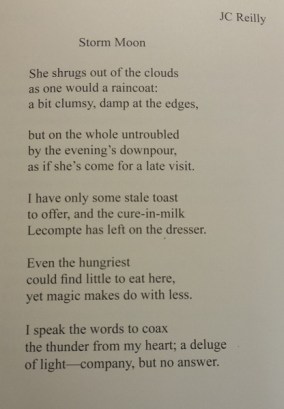
In Tuesday’s mail came the May 2017 issue of POEM.  POEM is a journal of the Huntsville Literary Association, and has been continuously published since 1967—fifty years. They publish perfect little poems—the journal itself is not quite 5”x7”—and I had submitted a pack of poems to them just to say I tried.

So when I got the acceptance last year, I was thrilled—especially because it was one of the Moon Poems from my narrative manuscript (you know, the one I’ve submitted like 50 places).  The Moon Poems, with maybe two exceptions, are “perfect little” 15-line lyrics, that appear throughout the manuscript and (at least in my mind anyway), represent the poetic output of one of the main characters, thought the voice in this particular poem is Vidalia’s, not Tallulah’s.

I’ve been trying to remember what initiated my interest in writing the Moon Poems.  While it may be true that I wanted to demonstrate a range of my writing ability (that I can write something other than narrative), it seemed important to incorporate the moon almost as a character in the manuscript, especially as it is about witches and women who harness energy and strength from the moon in order to enact their spells.

The poems each take as their title one of the (many) colloquial/ northern Algonquin names for each month’s full moon—though the February full moon is technically the “Snow Moon”—but of course, there’s no such thing as snow storms in February in Louisiana, but there is rain, so I fudged a little, and made the poem “Storm.” (Actually, this poem could also represent July—which is the month of  the “Thunder Moon” as well as “Buck Moon” but I believe I meant it for February.  But the word “thunder” appears in the poem itself…maybe the connection to February is wrong?)  As I think about it, February actually has two poems in the manuscript, this one and “Hunger Moon.” Anyway, writing about the moon felt authentic to me, and authentic to the experience of all the women characters in the manuscript.  (Not surprising—as Marge Piercy reminds us, “The Moon Is Always Female.”)

With this publication, the total number of poems in the manuscript that have been published in journals comes to 11—when the manuscript is 83 poems, my publication rate looks feeble, a mere 13%.  But it has been difficult to publish poems from this collection because it’s narrative (the Moon Poems not withstanding), and they are interdependent, and how do you take individual poems which all contribute to a story out of their milieu and make them make sense as stand-alones?

I’d very much like to have at least 20 poems from this collection published—that seems like a reasonable goal—then I would feel like maybe the manuscript would finally have a chance.  And getting the rest of the Moon Poems published might be the way to accomplish that goal.

On the other hand, there is still the other idea I have been kicking around in my head…taking out the line breaks in nearly all of the manuscript poems (except the Moon Poems), and trying to get it published as a hybrid flash fiction/poetry work.  So far I’m not that desperate—I mean, I conceived the book as poetry, and would hate to lose the beauty of well-wrought-lines, so I’m going to hold out the hope until I get the next batch of manuscript rejections that it will get published as the verse novel it is.

But the line break removal thing is still a possibility… because it has worked for me before, transforming what I thought were poems into flash fiction and flash nonfiction—or rather, perhaps the conversion process only revealed what their true form meant them to be.  And in many cases, these erstwhile poems found homes in journals like right away.

Anyway, I hope you enjoy “Storm Moon.”  Let me know what you think.

Contests, & Waiting, & Rejections, Oh My

What does it take to get a book of poetry published in this country?  I wish I could write a blog where I list out all the steps a person needs to follow to help ensure success in this process.  These are the things I would mention:

  1. Write a book of poetry.
  2. Get friends to read it and make suggestions for revision.
  3. Edit and polish the hell out of it.
  4. Send it out to publishers.
  5. Get published.
  6. Become the latest darling of the poetry world.
  7. Repeat for Books 2, 3, 4…

Except, it hasn’t worked that way.  Well, I mean, I’ve got Steps 1-4 down pat.  I’ve sent out my manuscript (at this point) 42 times (which as you know is the answer to life, the universe, and everything), so you would think that perhaps the universe will come calling for me pretty soon.  (And to be fair, after a hiatus of several blues-ridden months where all I was getting was rejections, I’ve sent it out 10 places in the last month, 5 of which are contests. I guess you could say I’m feeling hopeful again—so technically speaking, it’s only received 32 rejections.)

And I get rejection is part of the gig.  Your manuscript has to find the right person who loves, loves, loves your writing, someone who will pass it along to the next reader, who also needs to love, love, love it.  And so on.  And contests aren’t the best way to ensure that your manuscript finds a loving audience, because readers simply don’t have the time to invest—particularly if your book is a little odd. (Which I fully admit mine is.)  Readers barely have time to invest even if the poetry they read is something they expect and understand. I know this.  On an intellectual level, I know this.  Everyone is getting rejected (well, except for one person).  Most contests report that they’ve had anywhere from 600-1000 entries.  Lots of people are getting told to take their manuscript and go bite the big wienie.  I get it.  I just wish that the process didn’t suck so hard.

I have a writer friend who told me that he knew someone for whom it took 70 times before her book won a contest and got published.  70 times.  Considering that most contests only award $1000 and run $25 a pop to submit, that times 70 contests comes out to $1750, meaning the contest cycle put her $750 into the hole.  (I don’t even want to think about how much into the hole I am.)  (Not that anyone goes into poetry to earn a living.)  (Honestly, what kind of business model is this, where the poet has to take it on the chin, nose, or other body part to get her work into the world?)

Of course, railing about it here is not going to change the status quo.  For whatever reason (because hardly anyone reads poetry anymore and contests are one of the only ways that publishers can make any money), this is how the process goes if one wants to be published by a reputable press and hopefully receive accolades for it.  And I buy into the system (literally and figuratively), which makes me complicit, and I have to be ok with that.   I am ok with that. Because, hey, who doesn’t want to win the Academy of American Poets Walt Whitman Award and spend 6 weeks lounging around and poeming in Italy plus get their book published and sent out to everyone who is on the rolls of the AAP?  If you won that, the $35 fee you invested (for me $70, since this is my second time around) when you submitted your manuscript would be hella worth it.

I could just wish I knew what the magic number of submission times for my book  to get published would be.  Because that would so alleviate my anxiety.  Like, let’s say the Goddess of Publication were to come down from On High and whisper one night when I’m asleep:  64 times, JC!   Then I would know that I only have 22 more rejections to go.  That would be great.  I could send them out all on one day and get it all done, knowing that soon I’d hear the good news.  Ah well.

Meanwhile, back at the ranch…

I haven’t been working on Hecate Applebough.  I was thinking about why this is, and it’s a combination of factors—the weirdo exhaustion, a preponderance of tennis matches in the evening when I would normally write, and a renewed vigor about writing poems.  But actually, those aren’t the biggest reasons.  I think the biggest reason is because I’m waiting to get notes back about the first book…and so I’m kind of feeling like I don’t want to write any more on the 3rd book in case there are repeated mistakes in the 1st one that I could prevent myself from writing in the 3rd book if I just knew to avoid them.

That’s certainly a true enough statement.  Avoiding mistakes if they’re preventable is always preferable to making a bunch more and having to go back and fix them.  But if I’m honest, another thing making writing the 3rd one a pain right now is I’ve dug myself into plot hole and I really don’t know how to get Cate out of it.  When I sit down at the computer and see that last chapter., I’m like, “Bleah” and then I get up and do something else.  It’s the first time since starting to write this series that I’ve just felt like I’ve lost control over the story and over Cate’s life.

And so in your endless wisdom, you might say, just throw out that chapter and start fresh.  And that’s really good, practical advice.  But the thing is, I don’t know what to replace it with.  I don’t know how I can make it better.  I have a blind spot right now.  So I kind of thought it might be ok to just set Hecate aside for a little while, and focus on writing poems and sending them out.  Maybe when I get the notes on the 1st book, it will help me see the 3rd one with a fresh eye too.  (There is no pressure on the person reading the book right now to hurry up and make those notes… I need some down time from Cate, so it’s totally ok.  Take as long as you need.  Srsly.)

And maybe this weekend, I’ll get a bee in my bonnet and suddenly figure out how to proceed with Hecate.  Or maybe I’ll write three more poems.  When it comes to my writing, it’s always just a mystery what will happen.  I kind of like it that way.

And, as a total non sequitur, please enjoy a photo of Jenny, who has been keeping me company:

2016-03-09 20.05.25

Big News in My Writing World (But Not a Manuscript Acceptance, Let’s Not Get Crazy)

It’s chilly—44 degrees out, and blustery.  There are few leaves on the trees, but they rattle as the wind blows, and somehow the weather is fooling me into believing it’s October.  I want to believe Halloween is right around the corner…because it would mean that November was right around the corner too, and that would mean it’s time for another NaNoWriMo.

I’ve been missing the energy of NaNoWriMo.  I’m still in the early stages of Hecate Applebough 3 (still untitled), and part of my lack of progress has to do with a weirdo persistent migrainey exhaustion I’ve been suffering for the last month (and which my Mom has nagged me about going to see a doctor for—ugh), and also not feeling that compulsion to write every day those 1,667 words because I have nowhere to chart the progress, no pep-talk e-mails from the NaNo people coming every few days encouraging me.  It’s just me now, and it’s harder to write, without the community.

But, a couple of days ago, a fortuitous tweet put me on to an app called Writeometer, which exists only for Android (sorry iPhone folks) and which gamifies the writing process, kind of the way NaNo does—you can set a daily/ monthly/ word goal, use its timer, enter your daily word count, and get reminders about writing, and you can earn “guavas.”  I don’t know all tricks of the app yet, so I’m not sure what earning the guavas can do for you, but I’m sure I’ll find out as I become more familiar with the app.  I’m looking forward to using it—I need the motivation.  So I’ll let you know how it goes.  (If any of my Five Readers have tried the app, I’d be curious to know what you think about it—but I suspect most of you are Apple users.)

Other than working on Hecate, I’ve produced a few short pieces lately—a few honest-and-for-true prose poems—one of them came out so well that I’ve “given” it to Hecate, and shoehorned it into the second book…although if I can get it published on its own, I will—and a few bits of flash that I want desperately to be prose poems, but I knew they aren’t.

Prose poems have a certain surreal quality—and so does my flash, except that the surrealism of prose poems is its own little thing.  When I try to do surreal flash, it just comes out as nutty.  Like maybe I’m trying too hard.  But hey, two pieces of just such flash were accepted by a journal on Monday, so I guess nutty works too.  In general, I just have a little “heart on” for prose poems, because they’re hard to do well, and because I think, in my mind, I still privilege poetry over prose as being Important and Worthwhile… while fiction just seems like something you do for cash.  (Not that I have received any cash for ANY bit of fiction I’ve produced—not ever—but you take my meaning, I’m sure.)  And of course, even as I write that, I know that’s a false dichotomy—but there it is.  The poet’s bias against fiction writers.  Hmm.

How’s this for burying the lede?  In other news, now that Dan Veach is passing the editorial reigns of The Atlanta Review over to Karen Head, she has asked me (WHAT????) to serve as the managing editor.  OMG OMG OMG.  This is an amazing opportunity, and I can’t wait to sit down with her and discuss all the ins-and-outs, and really sink my teeth into this project.  Reading some brand-new poems (that aren’t mine—haha) that are searching for a home is exciting.  It’s been a long time since I did any work on a literary journal, and The Atlanta Review is a Big Deal—this isn’t any dinky fly-by-night online journal, this is prize-winning print journal with an international following.  The work that Dan Veach has done on the journal (founding it and running it) is amazing and impressive, and I’m so thrilled that I get to be involved…and so grateful to Karen for asking me to assist her.  Read Collin Kelley’s article in Atlanta INtown, about the transition of editorship to Karen, because it’s interesting and offers some history about the journal.  (As my first order of business as managing editor, I propose we update the website!)

What else is there to share?  I’m still working on reading those three books of poems I mentioned in my last blog post—I got a little distracted by my manga habit, and my weirdo exhaustion that makes me want to fall asleep at 6 p.m.—but I hope to finish them this weekend (in and around the 85,000 tennis matches I’ve scheduled).  And, I’ve gotten yet another rejection on my poetry manuscript, but I sent it out to two more places, and I’m crossing my fingers. At some point, SOMEONE is going to want it, right?  Maybe I need to “attach a few more zeros” onto the contest fees I send off… maybe bribery would work?  (You never know!)

Seriously, JC, They Make Pills for This

My novel went on a “first date” yesterday.  Metaphorically speaking.

What I mean is, it is in the process of being “courted” by a potential future editor, which is to say, my Brilliant Fiction Writer Friend™ (whom I’ve mentioned before in this blog), who, despite not being a fan of YA, has graciously, and generously, and kind of insanely agreed to read my NaNoWriMo novel Hecate Applebough because he believes in me as a serious writer (even a serious writer of fluff), and sight unseen is willing to work with me to revise it and maybe make it into something good (or good-ish).

I must admit I am in the absolute worst dither of insecurities about my writing ever.  Like I’m back in my first creative writing class when I’m 20 years old, and so shy about what I’ve written that I really fear—not just that what I wrote is crappy (because that is surely a given)—but that I will have a) inflicted my mental crappiness/ drivel on another person; b) wasted someone’s already limited amount of leisure reading by forcing them to read something appalling (and deeply flawed on all levels); c) imposed on someone’s friendship, even when they offered, even when they are doing their best to wear me down to make me agree to continuing this part of the writing process (and I am deathly afraid of imposing on people, like pathologically so); and d) allowed someone to discover proof  that I’m not nearly as hilarious and awesome as I think I am.  (Perhaps that last fear on the list sounds trivial or frivolous, but I assure you, it’s a deeply-seated fear.)

It’s really a weird place to be in—like I believe in my ability as a poet.  I might be having a shitty time convincing contest editors that my volume of poems is fantastic, the next best thing, blah blah, and they need to publish it already, goddammit, but I don’t doubt in any fiber of my being that I’m a poet.  When I think “JC,” I think “poet.”  These ideas fit in my head together, like synonyms.  And sure, it makes sense—you think about all this time that I’ve worked on writing poetry, that I earned that Ph.D. in poetry—I mean, if I didn’t see myself as a poet after the time I’ve invested in it, that would be a huge (and annoying) problem. (And would make having to pay back student loans even more of an insult.)

Except, I don’t want to be just a poet.  I have more words in my head than that.  I’m not saying I believe BFWF that I’m a “novelist” either (just by virtue of having written 1.99 “novels”), but limiting myself to one version of “who I am as a writer” doesn’t fit me any more either.  Of course, in terms of writing fiction—well, I still feel like I’m still 20 years old, with zero experience—but there’s an expansiveness that’s been coming the last few years, a real desire to try something new, and to tell stories that take more than a page.

That narrative bent in my writing and my voice is there—and let’s be honest, the poetry world does not appreciate narrative as a form.  So, I need to use forms that narrative work in… which is why I wrote Hecate Applebough, which is why I also write these memoir-y vignettes that seem to find homes in little journals too.  Hmm.

But getting back to the possibility of having a real reader/ editor:  I was asked if I want to be worn down.  That’s a hard question to answer.  Like, realistically, who wouldn’t want a person you admire who is brilliant and has critical and practical expertise and proclaims a genuine wish to help you succeed to be the one who reads your book and helps you edit and revise it—the two hardest parts of writing?  You’d have to be an idiot to turn that down—particularly when there is so little return in it for them.

(But to be fair, my idiocy is well-documented.)

As I’m thinking about this and talking myself in-and-out of this amazing opportunity that has shown up in my life like a late Christmas gift, I realize my fear isn’t anything like worry that I’m a “fraud” as writer.  I don’t question I’m a writer, per se.  Because there’s so much that goes into writing beyond the actual writing of whatever the piece is, you have to believe that you’re a writer deep down in your heart because if you don’t believe it, then what is the point of doing this really lonely, difficult  (and often barely rewarding) work?  Once a piece of writing is released into the world (and that’s after the writer has spent her time polishing her poem or story until it gleams) you can’t control the people who read it.  If your submission (or your “novel”) shows up on a day that the editors/ grad students working on a journal are on the rag, or hungover, or pissed off at their bosses, or they hate anything that smacks of genre or narrative poetry or they just read a great bird poem right before they picked your bird poem up from the pile and so can’t imagine any bird poem after the one they just read as measuring up (or whatever), your writing, no matter how good it is, won’t go beyond the first pass.  It might not even go beyond the first lines. (I say this as a person who has participated on the grad student side of the journal publication process.)

There’s so much luck involved in a person’s work entering the wider world by being published. And forget about the accolades.  You have to believe you’re a writer—because the odds are so stacked against you that your work will ever resonate with anyone and find a home in their journal or on their upcoming publications list.

So it’s not a matter of lacking faith in myself as a writer (in the generic sense) that is the stumbling block with my sharing Hecate Applebough—the fear emerges from the realization of just how drafty the first draft is—and sharing a piece of my writing with someone that is 98% imperfect terrifies the fuck out of me.

Because when I share my poems with people, they only see them after—typically—the poem has gone through 8-10 drafts already.  Like my writing group?  I show them poems that are, to my mind, already mostly good.  Poems after I meet with them may go through another 5-10 drafts, but when the writing group sees them initially, they don’t see the first draft.  They see something I’m not ashamed to show.

First drafts are unfit to be seen by anyone.  And Hecate Applebough is a first draft.  I mean, it’s prettier than a first draft, in that I’ve line-edited it, I’ve changed some words here and there, or added a few scenes to smooth over some plot holes.  But the aggregate is still first drafty.  (It’s so drafty, it needs to wear a coat.)  And sharing imperfection with someone, even someone as committed to helping me as BFWF is (someone who expects imperfection, moreover, so I’m not going to shock them), even someone who is my friend, is just one of my worst anxieties.  It just seems so wrong—so contrary to my process.  So naked.

And I guess I either need to get over myself and stop being so crippled by self-doubt and all this blather and take the opportunity because when the Universe wraps it in a bow, how stupid do you have to be to say no?  Or I just need to STFU about this book and move on to the next thing and be satisfied with sabotaging myself (again) and learn to enjoy obscurity and blown chances.

(Ugh.  When I put it like that, suddenly I think I must be pretty foolish to have spent 1400 words to realize I planned to say “Yes” all along.)

P.S.  I know BFWF will have read this post (being one of my Five Faithful Readers). And BFWF will think “I knew it.”  But I’m pretty sure, recognizing the kind of headcase I am, that I will change my mind at least 58 more times.  Possibly more. So certainty tonight may shift back over into uncertainty many more times before I actually hand a copy of the book over.  Fair warning.

P.S. #2  BFWF should in no way feel compelled to comment or to cheer me on. (This post is not a plea for more convincing.)  Sometimes I blog just to take the edge off my neuroses.
Queen of Analog

I am a huge proponent of index cards.  I have been tracking my submissions to journals and contests on alphabetized index cards for years.  Some years, there are fewer cards in the box than others (though last year and this year, there are a ton).  I like that I can thumb through them, find what I’m looking for, and move on.  I like their tactile quality, that I can hold them and smell their papery-ness, that I have tangible proof at all times that I am working on publishing.

I keep my pack of cards with me in my purse or bag—I sometimes joke, à la Gollum, that the cards are “My Precious.”  They are precious to me, like a talisman or a charm, and I don’t like to be far from them.  It sounds a little wacky, but then, writers are by definition, wacky folk, so I don’t let my little partiality to (I won’t say “obsession with”) the cards bother me.

The red plastic case that holds them has the space for about 120 3x5s.  Inside, there’s a tab for Sent, Rejected, Accepted.  When I’m feeling like I need a boost, I just look through the cards and tell myself, “JC, you are working it.”  Seeing the Sent and Accepted piles is naturally pleasing (and self-affirming), but I even like the Rejected tab, because after I look for some new journals, I will mine the cards in there for submissions that I can send somewhere else.  And I don’t have to think about what pieces go with what, because the submission groupings have already been created—I’m just reusing the card with new journal title on the top.  Easy peasy.

But this is all by way of saying, that in February, I bit the bullet and got a Duotrope subscription, due in part to a young writer friend who mentioned that he was going to subscribe in order to take his writing more seriously, and that getting a subscription to Duotrope was one way he could feel “professional” about the work.  I thought about that and could see his point.  For myself, I wondered if I could justify the expense; after all, I already subscribed to Allison Joseph’s CRWROPPS list in Yahoo Groups, and got a weekly digest from the New Pages website.  So did I really need a Duotrope subscription?  It turns out, I did.

Now, let me be very clear, that I am in no way shilling for Duotrope—they haven’t promised me a free subscription for next year if I tout all their great qualities or anything.  But I like Duotrope for a number of reasons (and not just for the submission tracker element): I like to see the Response List—it’s quite illuminating about the journal process because people who subscribe are really serious about entering this data.  So you’ll see, for instance, one day, BOAAT will have accepted one person’s work, and there will be 15 rejections, or 32Poems will have accepted one or two pieces, and there’s a ton of rejections.  What it helps to do, in my mind, is to let me see the reality of the journal process—I’m not the only one getting rejections here.  It helps to see that other people’s work also is rejected—not from a “ha ha haha ha” schadenfreude perspective, but more like a “we’re all in this together” perspective.

The other thing about Duotrope that I like is that it is constantly updating when markets are open or closed as well as listing new markets that are available.  Having an academic background (and having worked as a reader on Prairie Schooner back in the day), you kind of have a sense that a lot of journals at university presses take the summer off.  But other journals have different submission cycles, so Duotrope is handy in that they let you know when these cycles are happening.

And finally, Duotrope offers metrics for lots of stuff—because people take a few minutes to record data about their submissions, I have an idea about how long it takes some markets to respond.  I’ll give you an example.  Last May (of 2014!!), I submitted poems to a journal and I just never heard from them–until I queried them in December and said, hey, what’s the deal?  I was told by a very harried editor that this was a Name Brand Journal, and they were Very Busy, and I just needed to wait.  And so I did.  Wait, wait, wait.  I finally got a rejection from them on June 10th—a 384 day wait, according to Duotrope.  The average response time for this market is 155 days; the longest reported was 401 days.  I wouldn’t know that, except that Duotrope offers that data.

Now, it’s probably obvious that I’ve become a fan of Duotrope.  I record my submissions and responses there; I look up new markets (and have had some acceptances directly because I found them on Duotrope)… but I still keep my cards.  Because they’re mine.  Because they’re easy to hold onto and easy to maintain, and I don’t need a computer to check on them.  I can keep My Precious with me at all times, and remind myself when I need to, that I’m doing what I can to get my writing out into the world.

Well, But One Acceptance Is Better than None at All, Right? So Quitcherbitchin.

I recently had the experience where I received an acceptance for two pieces of flash creative non-fiction.  To say I was delighted would be an understatement, particularly because the journal was one in which I’ve discovered many pieces that have moved me in one way or the other since I began reading it.  And I thought, hooray!  My writing will be archived among these paragons of the short form!  I was feeling pretty pleased with myself.

Then the other day, the journal contacted me about the galleys, asking me to look over the work and see if anything were amiss.  But they only sent me the link to one of the pieces they accepted.  So I inquired—what happened to the second piece?  Shouldn’t they have sent me the galley to it?

The CNF editor apologized, but said that clearly Submittable had made an error, and really, they only meant to take Piece A, not Piece A and Piece B.  They hoped I was ok with this, and they hoped Piece A was still available.

I’m not sure if the editor thought I might hold Piece A hostage—like, “You said you were going to publish both, and if you can’t publish both, you can’t publish either, nyah, nyah, nyah.”  I’m not so stupid that I would do that—an acceptance is an acceptance.  But it made me wonder if she had had that experience before, where she or one of the other editors had a Submittable “glitch” which accepted multiple pieces from an author only to have to break it to the author that there must have been some error with Submittable that day, and they only desired to publish one piece.  I could understand an author choosing to say, “To hell with that journal!  If they can’t even be clear about the works they want to publish, maybe I don’t want my work published there.”

I understand about computer errors, and software glitches, and even human mistakes—I get that.  Computers are machinery and bound to fail at some point, and editors have a lot on their plates and don’t always catch things.  But it’s hard, when you’re hungry to start racking up pubs in a different genre than you’re used to publishing in, to have an acceptance snatched away from you like that.  Part of me wishes that they would just have agreed to publish both works, since that’s what they said—and since I withdrew Piece B from all the journals I had sent it to, like a good little simultaneous submitter should do.  But then another part of me thinks I’d rather the work they didn’t want find a home in a journal that loves it for what it is—and not feel constrained to publish it under duress.

I’m trying really hard to see the multiple perspectives here.  I am grateful, of course, that they wanted to take any of my work at all.  That should be enough right?  Mistakes happen, blah blah—at least they wanted one piece—they could have told me the entire acceptance was a mistake.  But I’m stubborn and don’t want to be reasonable about this situation—particularly in light of some other recent (huge) writing rejections that have really demoralized me.  A little part of me feels like this “accidental” acceptance scenario is just too much to take.

I know, I know, this is the publishing biz.  I’m just having a little difficulty being rational while I wallow in my self-pity.