Dispatch from Edinburgh #4–Islay and the Whisky Coast

Three years ago, I went on a Speyside whisky tour—it was the first time I had ever tasted whisky, and I was a total n00b about it.  But after the tour, I realized that I liked whisky and could see drinking it on occasion—especially on a cold, dreary night that would remind me of Scotland.  I realized too that I didn’t like peated whisky, because the smoky flavor reminded me too much of lapsang souchon tea which to my mind, is an abomination in the tea world.  So I knew going on a tour to Islay (pronounced EYE-lah) and the whisky coast would be problematic—because all of the distilleries over there produce peated whiskies.  I was prepared not to like anything. But that’s not what happened, fortunately.

We started our tour by driving west and a bit north, through the Trossachs and past Loch Lomond.  We stopped in Callender, which is little more than a high street but is known to be the “Gateway to the Highlands” since it is just south of the dividing line between the Lowlands and the Highlands. I bought an airy loaf of cheddar jalapeño bread at Mohr, a local bakery, for a snack, but then we were off again.  The West Highlands are are not nearly as dramatic as the eastern Highlands, but they are still quite beautiful, and while I had traveled the roads through them before, I was still glad to be able to see them again.

View from Oban harbor

Norries fish and chips…mmm

We stopped for lunch in Oban (“Gateway to the Isles”), which is a little sea resort town I’ve been to before, back when I went to the Isle of Mull (I think).  Anyway, I went to Nories for fish and chips and then walked along the streets to visit the Oban Chocolate Company, which I remembered from the last time I was in Oban—it was packed with people getting coffees and hot chocolates and candy bars.  I picked out a few truffles including a dark passionfruit crème, a chili “chuffle,” a ginger ganache cup, a whisky truffle, and a toffee orange truffle, which I saved for later. Then I walked to the harbor and took some pictures. There were people playing with their dogs on the beach, but it was rather cold to my mind and I wondered what is it about dogs that they love to go into water—especially freezing water!

Kilmartin grave stone

The bus picked us back up and then we continued on to Kilmartin Glen to look at some standing stones and to take a rather long walk to see some cairns.  Somehow I don’t have any pictures of this; I’m not sure why—it’s not like me.  Maybe something happened with the camera.  But they were fine, as far as standing stones go—they were sort of in the middle of a field so I had to be careful of sheep pellets.  But I enjoyed the walk, even though my foot was hurting.  Still I was glad to get back on the bus.  Later we stopped at a little church in Kilmartin with gravestones from the 1300s-1500s, whose carvings were faint now, but still cool.  And then we headed down to Kennacraig so we could board the ferry.  It was a long ferry ride (and damp, so damp)—maybe two hours—but as always I remained outside to take in the air, hoping to see some whales or dolphins.  (I saw neither.)

When we arrived in Bowmore, I was ready to get to our residence—it turned out to be a kind of cottage attached to the Bowmore distillery (est. 1779) called the Old Bakery.  Everyone else (I didn’t get their names)—the Norwegians, the Brazillian, the the New Yorkers, the very friendly Japanese couple, and the father and son from Maine—gathered in the dining room to chat after dinner, but I was ready to get into bed, even though it was pretty early.  Still, I went over to the Co-Op to get some cheese and crackers for dinner (since I hadn’t made any dinner reservations), and a two-liter of Coke Zero to make sure I got my caffeine over the next few days. Then I settled in for the night, enjoying my black-out curtains (which I don’t have at my place in Edinburgh), and I slept well, even though I was in a tiny twin bed.
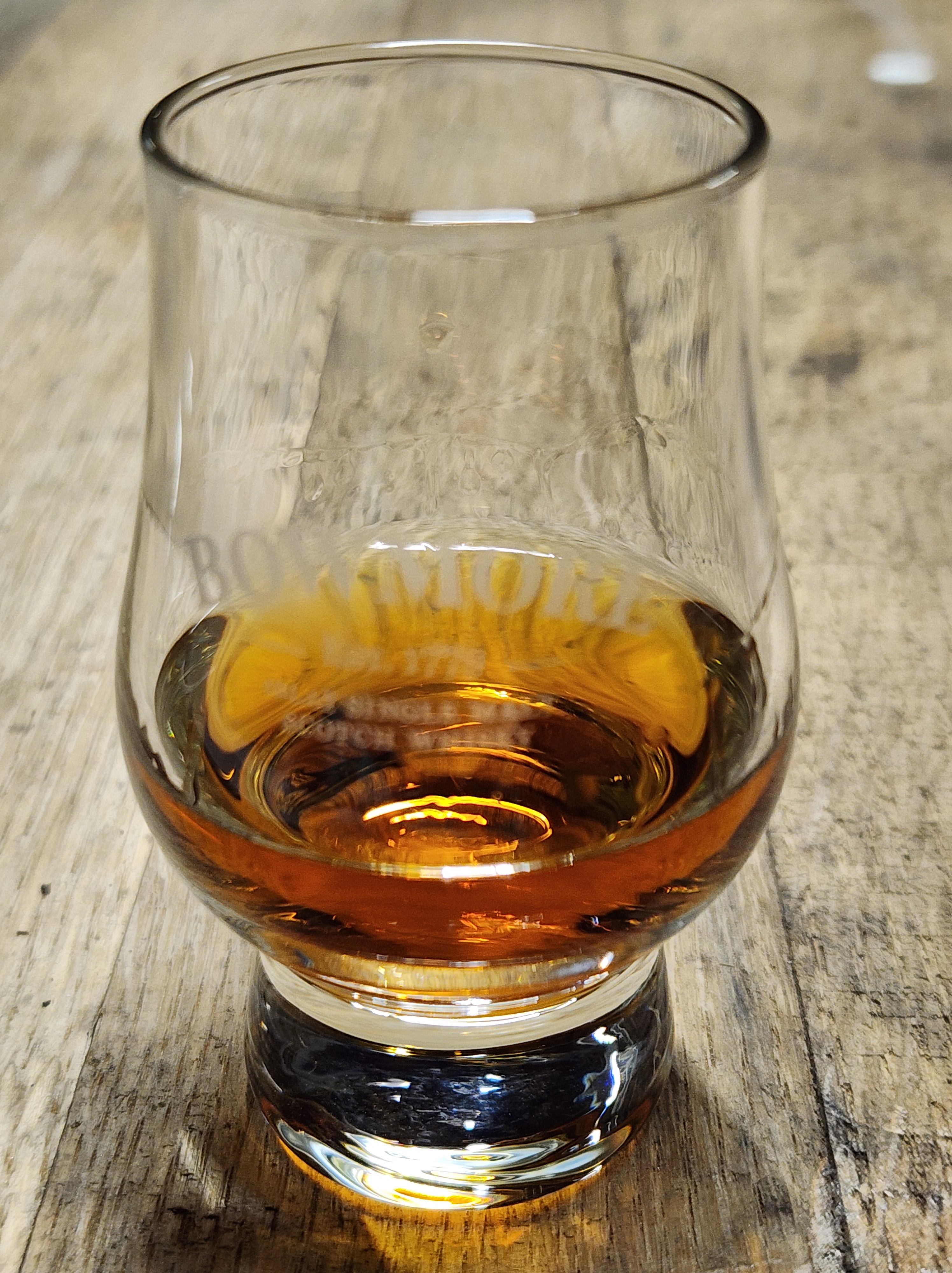
A Bowmore dram, bourbon cask

After breakfast the next day, we all walked over to the Bowmore distillery for our tour. I knew what to expect, because I’d been to distilleries before obviously, but it was interesting because we actually got to see the barley on the malting floor (where the barley begins to germinate).  That was new to me. The tour guide encouraged us to touch it, and he didn’t seem to mind walking on the barley (which I did not do—because, hello, shoes aren’t clean!).  He took us to see the wash backs, the mash tun, and the stills, and then to a room where the casks were stored where we enjoyed a taste of whiskies.  We tried the 2012 Bourbon Cask whisky first, with a 53.5% alcohol content, and it was dark amber and pretty peaty.  Next we tried the 2010 Oloroso Sherry Cask, with a 54.6% alcohol content.  Then we went into the bar where they gave us another whisky (although I didn’t see the bottle), as well as pairing chocolate, and a tiny dram of Bowmore 18 year to take with us.

Kilchoman spirit
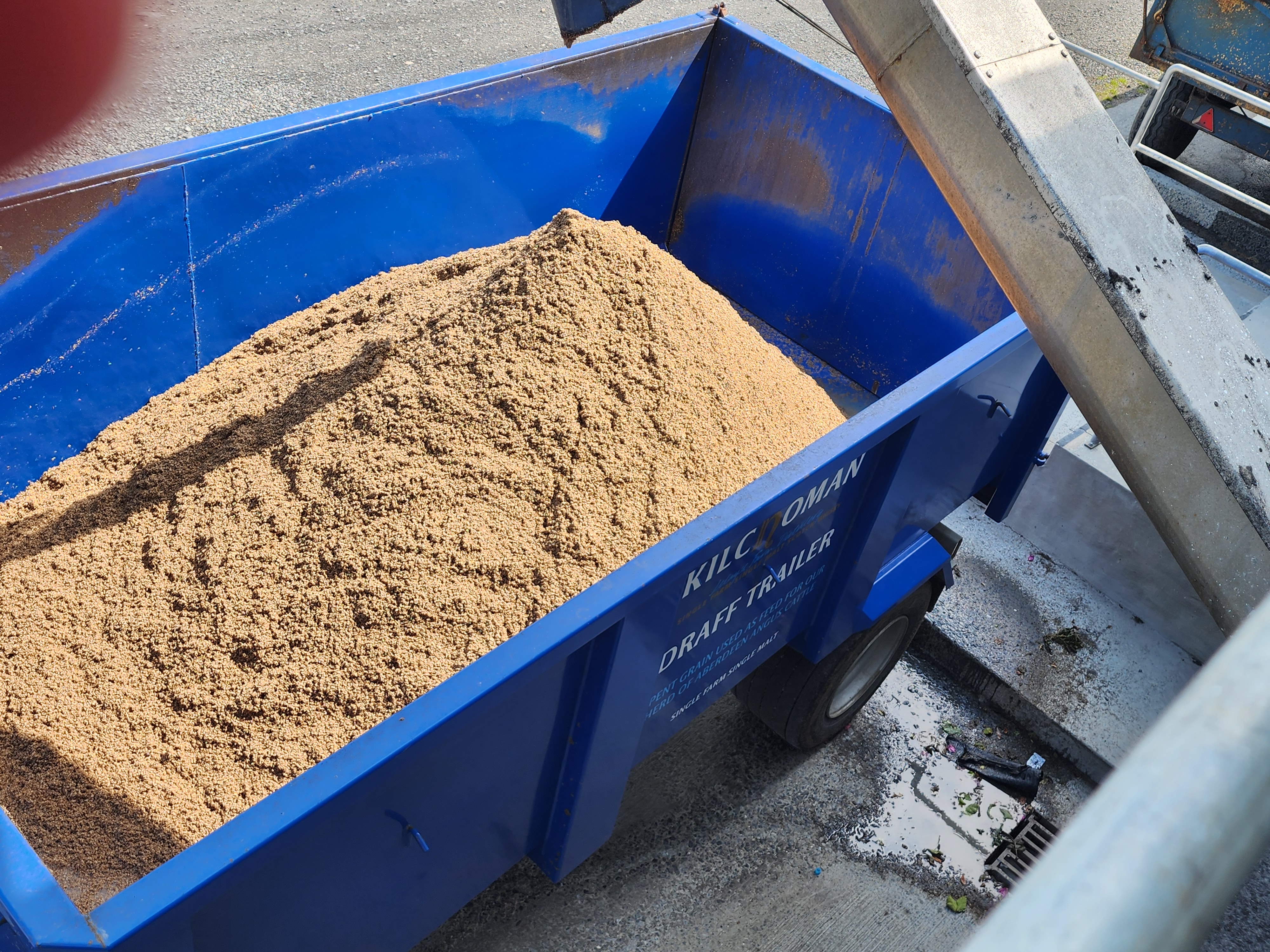
Draff cart

Our next distillery was Kilchoman, which has only been in operation for 20 years because the proprietor just apparently decided he was going to start a distillery.  We got to see the same kind of operation, but it was cool that the proprietor himself gave us the tour, and we had whisky tastings at various stops throughout.  We even had a nosing glass on a lanyard to drink from, which was very convenient.  One of the things we got to try was “spirit”—that is, un-aged liquor right from the still. And it was delicious—super sweet, basically it was alcoholic sugar water (63.5%). It’s the aging that makes it whisky.  But it was definitely interesting to drink.  And one of the things we learned there is that nothing goes to waste.  After the barley is used for the whisky, it’s still usable; it still has proteins and nutrition, so there’s a conveyor belt which moves the barley into a large cart, and then the barley, called “draff,” is sold as animal feed.  I don’t believe they charge a lot for the draff—in a way, it’s a chance for the distillery to give back to the farmers who live on Islay and who help raise the barley.
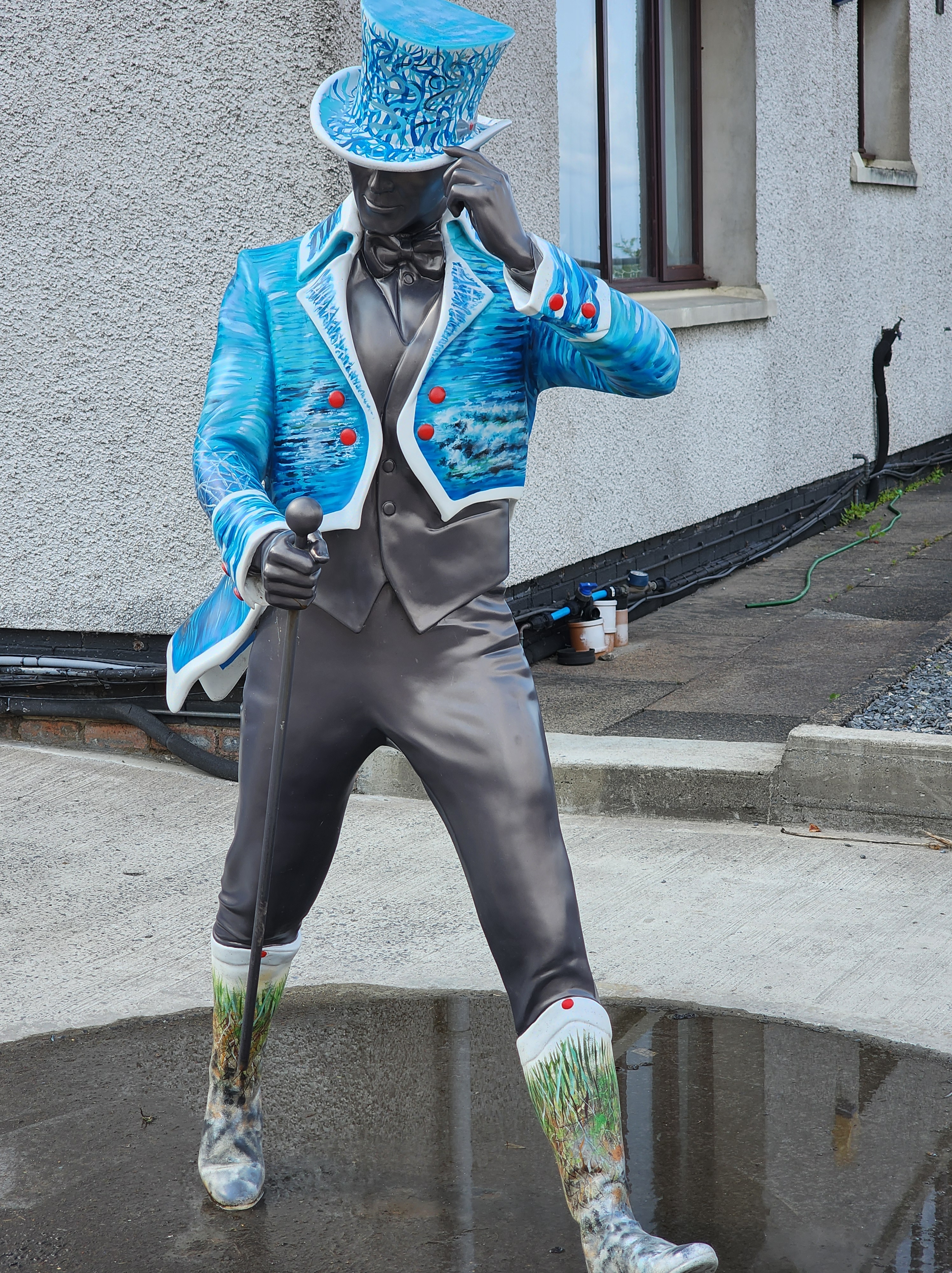
The Johnny Walker dude

After Kilchoman, we went to Caol Ila (pronounced Cull-EE-lah), on the east coast of Islay, owned by Johnny Walker (like Cardhu in Moray, Scotland, is a Johnny Walker distillery) which was just a whisky stop (I just got a Diet Coke because after five or six drams, I was pretty pickled already). The driver, Robbie, was very kind and because I was walking with my cane, he said he’d meet us down below in the disabled parking area to get us after our visit to the distillery.  Everyone except the Brazillian met up there.  Apparently, he hadn’t heard that we were going to meet there.  We saw him walking on the long path upward, so Robbie said we’ll just get him at the top of the path.  But in the interim, the Brazillian thought, I’ll go down and meet them.  So we were up at the top waiting for him, and he was down at the bottom waiting for us.  So we drove back down to the bottom but the Brazilian walked back up to the top.  It was some Keystone Cops hilarity happening. We must have done this dance a couple more times, and I said to the tour group, we’d lost him to the Angel’s Share, which made everyone laugh.  (The Angel’s Share is how much whisky evaporates each year that a whisky is in the cask.) Finally, Robbie walked down by himself and got the Brazilian.  It was pretty funny, this back-and-forthing—although I suppose it loses something in the translation.

Then we went to Bunnahabhain (pronounced Bunna-HAY-ven) for a whisky tasting—these were unpeated whiskies (2022 Abhain Araig, 2012 Olorosso Bott, and something that looks like Toiteach a Dila; it’s handwritten, not very clearly, although the 46.3% notation was clear), and they were very nice.  I took a taste, but I didn’t drink them up because I would have collapsed on the floor. I wanted to buy a bottle for C, but then I remembered two things:  1) he wanted a peated whisky and 2) how the hell would I get a bottle home?  Anyway, I didn’t buy one—and they were crazy expensive anyway—like £79 for a tiny bottle.

Seriously, they look like boobs. (Jura island)

Across from the distillery was the isolated island of Jura (only 300 inhabitants), which, in my mind looked like a couple of boobs (what can I say, maybe I’m a 12-year old boy) instead of mountains. It was a lovely day, especially compared to the day before which was so wet and dreich.  I found myself after the tasting just looking out on the water and the beach and enjoying the fresh sea air.

Kildalton High Cross

The next day, we hit up three more distilleries. But before we did that, we stopped at the Kildalton High Cross, which was carved in the 700’s, and according to the sign is “one of the finest and most complete early Christian crosses in Scotland.” It’s a tall Celtic cross, maybe twice as tall as a person, and it’s next to the roofless ruins of a church.  It’s beautiful, and the carvings are in great shape, not worn smooth at all.  There was a little donation box asking for money so I dropped in a pound, and a sign saying to leave the gate shut to keep out the sheep.  But obviously someone had left it open recently, due to all the fresh sheep pellets in the grass.

After that little diversion, we were off to Ardbeg distillery, on the south coast of Islay. Our tour guide was this snarky Gen-Z-er who was very knowledgeable about the whisky process, and her name was Jura, after the island. Taking guests on tours was her summer job, she told me, as she was attending a university on the mainland (I think).  The whisky was good, but I thought Kilchoman was better.  There was a walk to some old ruins, but my foot was killing me, so I just sat in the peaty grass for a while and took a little walk towards the cliffs.  Next door was Lagavulin distillery, and we stopped in for a bar visit.  I was parched, and got both a sparkling water and a pink fancy passionfruit whisky cocktail that was delicious but maybe not worth £8.  The Norwegian men got a flight to share—it was like a top tier flight because it wound up being over £120, and they didn’t blink an eye.  Granted they got some snacks too and cocktails for their wives, but still it was an impressive amount of money to drop for five drams of whisky.

Laphroaig sea sign–it’s big so ships delivering barley can see it in the mist.

The last stop was Laphroaig (pronounced La-FROYG); the New Yorkers were looking especially forward to going there, as it’s the husband’s favorite whisky brand.  Laphroaig began in 1815 when the sons of a farmer decided to make whisky on the Campbell estate.  What was interesting was that one of the brothers emigrated to Australia, and the other brother drowned in a vat of burnt ale. (I’m not sure how you burn ale, but that’s what the sign said.) His son inherited the distillery at age 11, but since he was underage, the manager of the Lagavulin distillery ran it.  But when the son had grown, he ran it until his death.  Thus was the early history of Laphroaig. But another cool fact about the whisky was that during American Prohibition, the Feds were persuaded that Laphroaig was medicinal, so people could totally buy it and drink it.

The Laphroaig flagship whisky–the one to try!

After our tour, the guide let us choose 3 among 7 different whiskies to try.  My choices included the 10 year Cask Strength, the 10 year Sherry Oak Finish, and the quintessential 10 year aged in ex-bourbon barrels, the Laphroaig flagship whisky. The regular 10 year was pretty good; I didn’t care for the Sherry finish, which is surprising, since I usually appreciate the sweetness of sherry cask whiskies.

Islay is lovely, like all of Scotland, but there’s not much here besides sheep and distilleries. I was glad I went, and glad I could try so many different drams, but I think I was a little disappointed overall.  I really had hoped that somehow, Stewart, the tour guide on the Speyside trail a couple of years ago, could have been our guide this time—that would have been magic.  He really enjoyed whisky, and I didn’t get the feeling that Robbie cared one way or the other.  I also felt like for Robbie, this was just a tour, whereas for Stewart, whisky was a passion, and making people love whisky was also a passion. But you can’t pick your tour guides, and it was nice to see a new part of Scotland. And it was nice to find out that peated whiskies are good too; I guess they are an acquired taste. Which I acquired.

The Kilmartin church

Kilmartin church
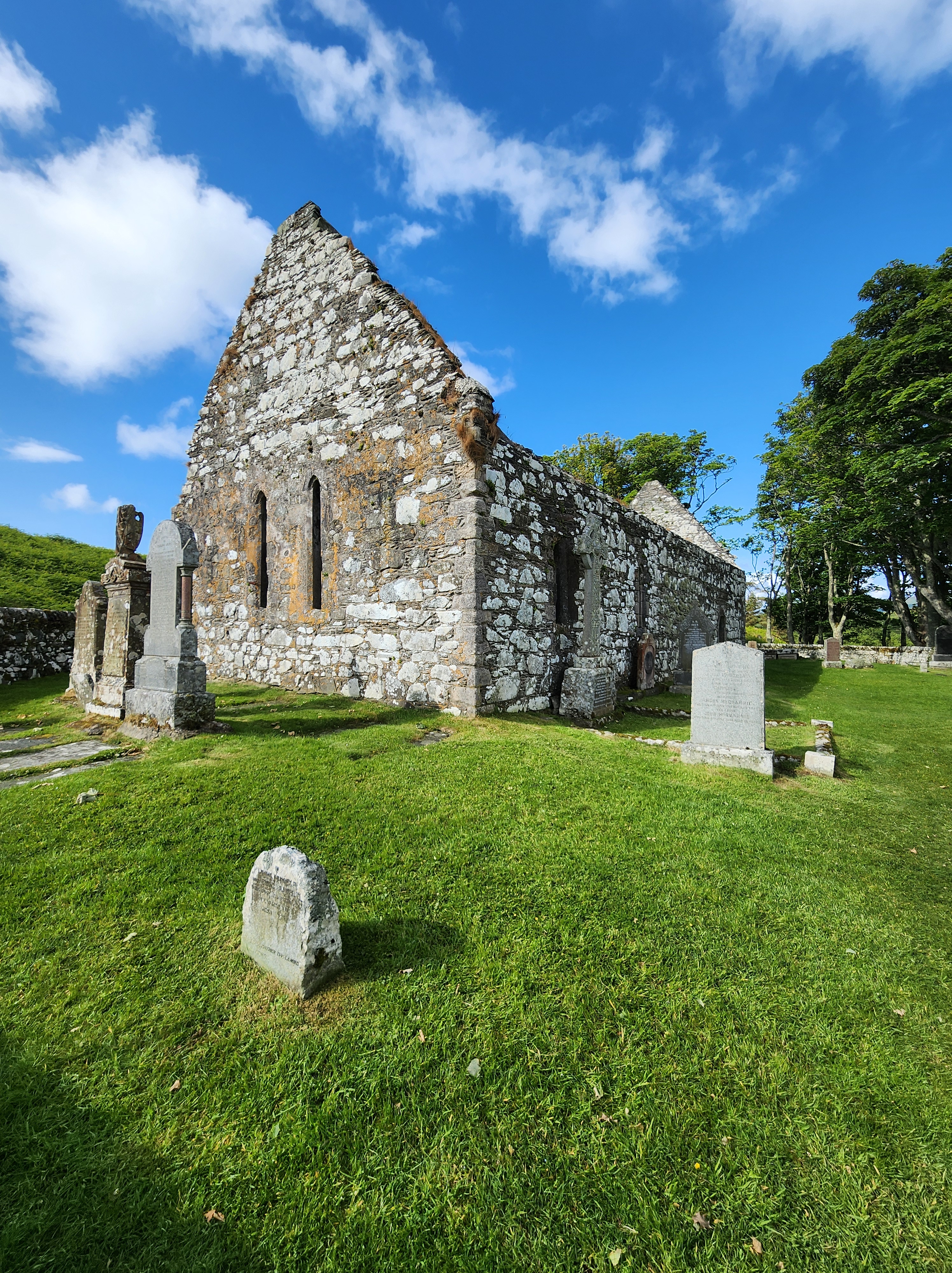
Kildalton church–I really like the composition here.
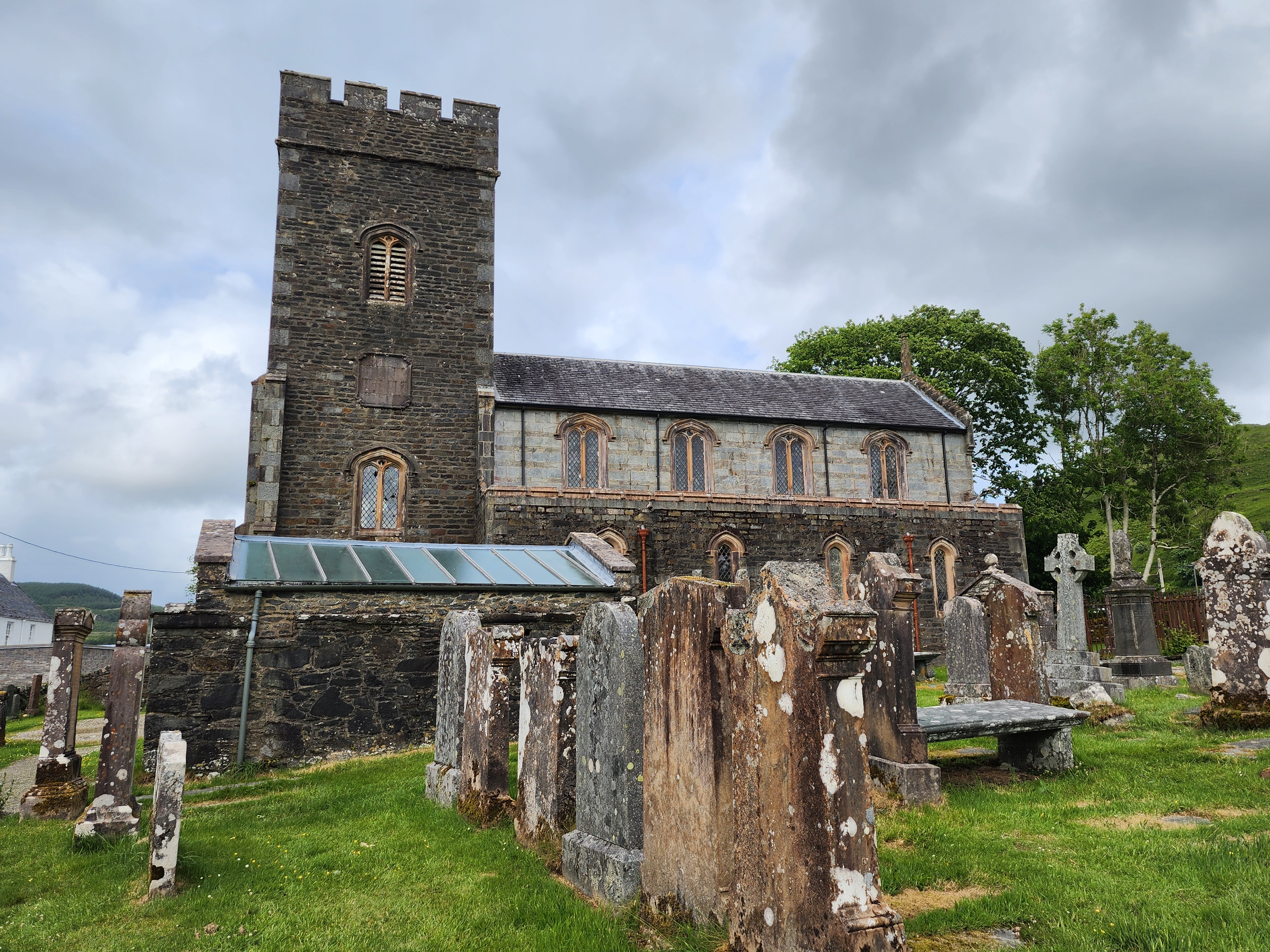
Kilmartin church

Kildalton church

Old gravestones at Kilmartin church

Lagavulin distillery
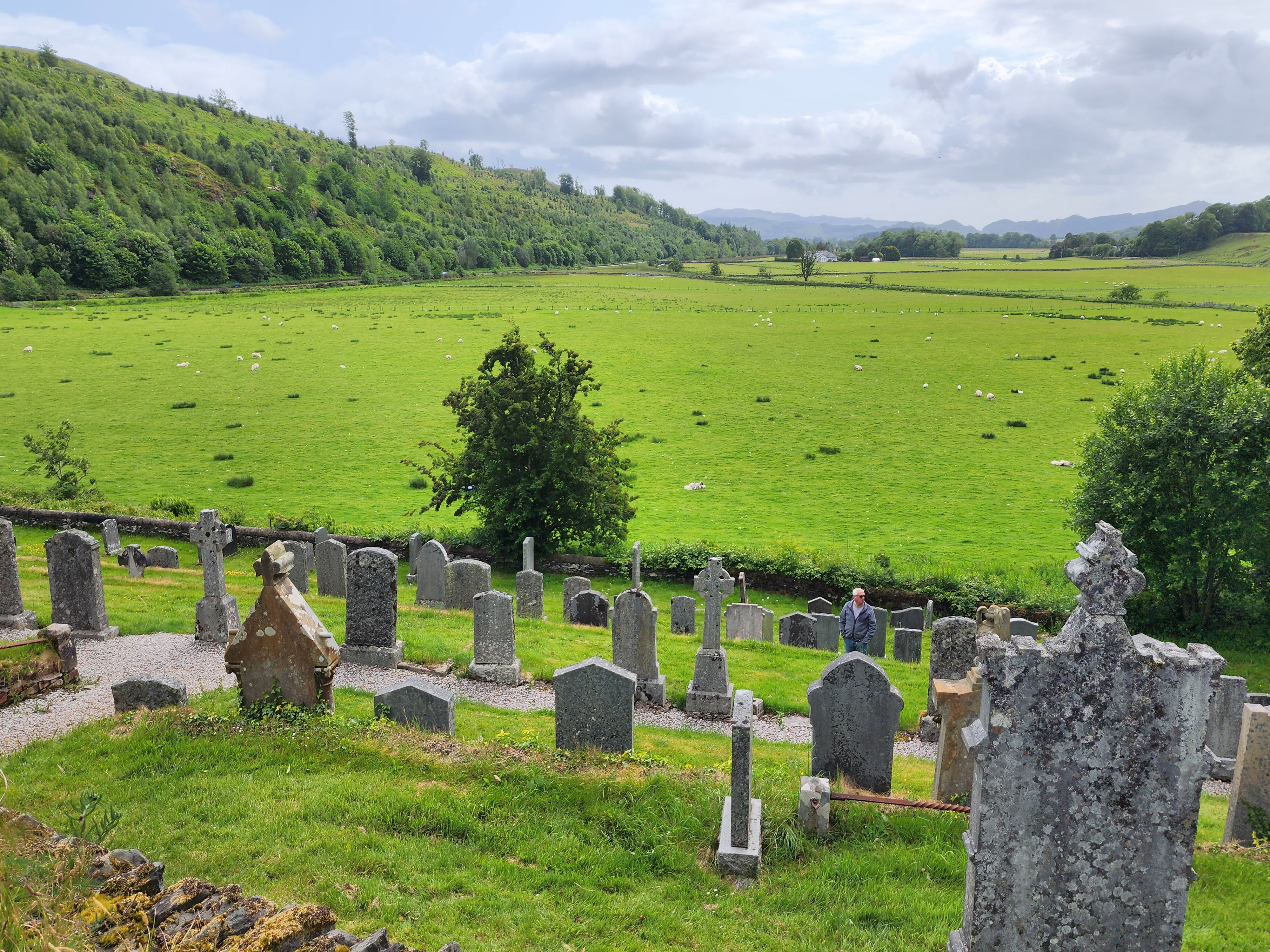
More old graves at Kilmartin
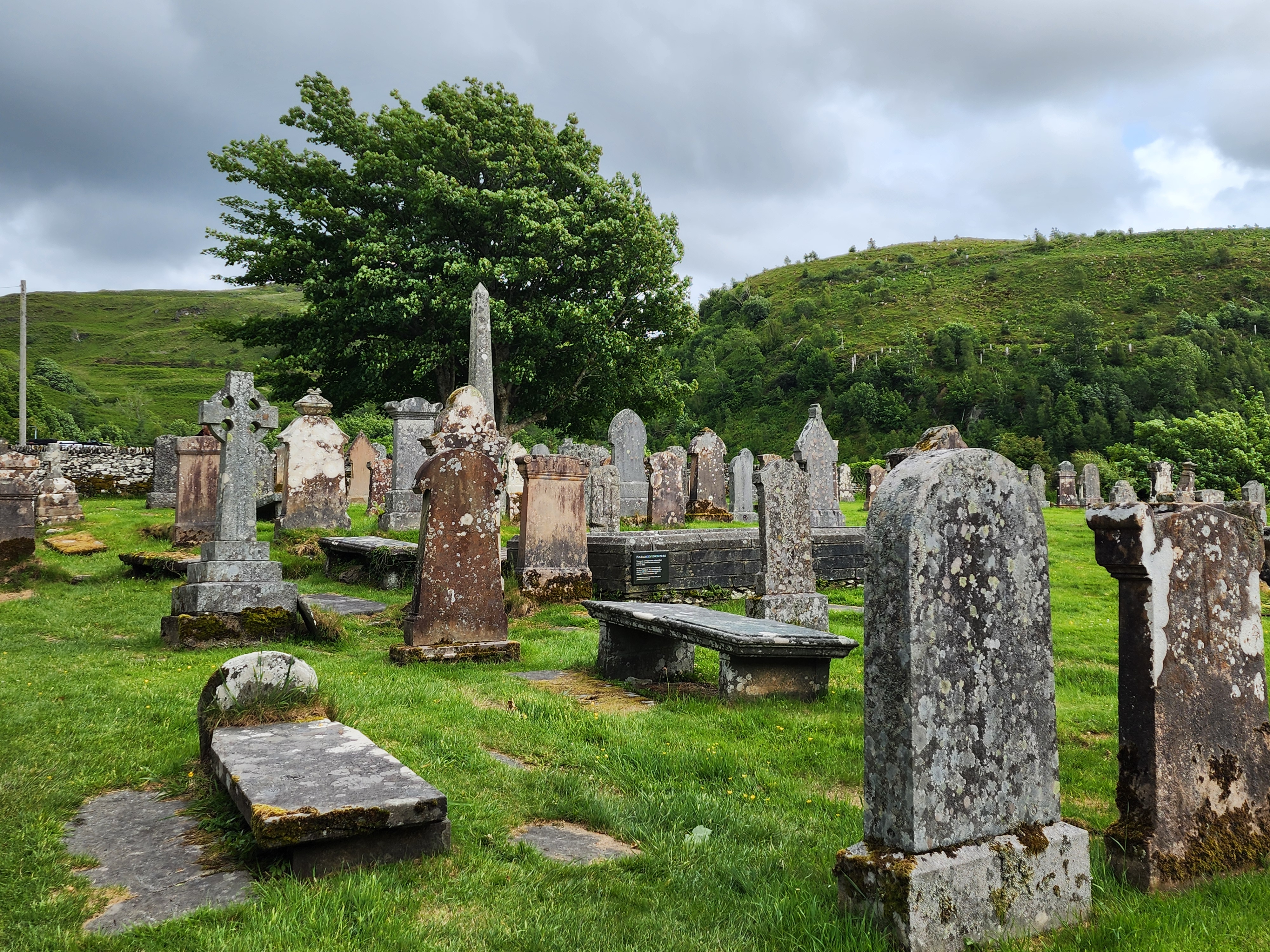
More graves at Kilmartin. I don’t know why I took so many pics of them.

These really old graves from the 1300s were in a protected shed.
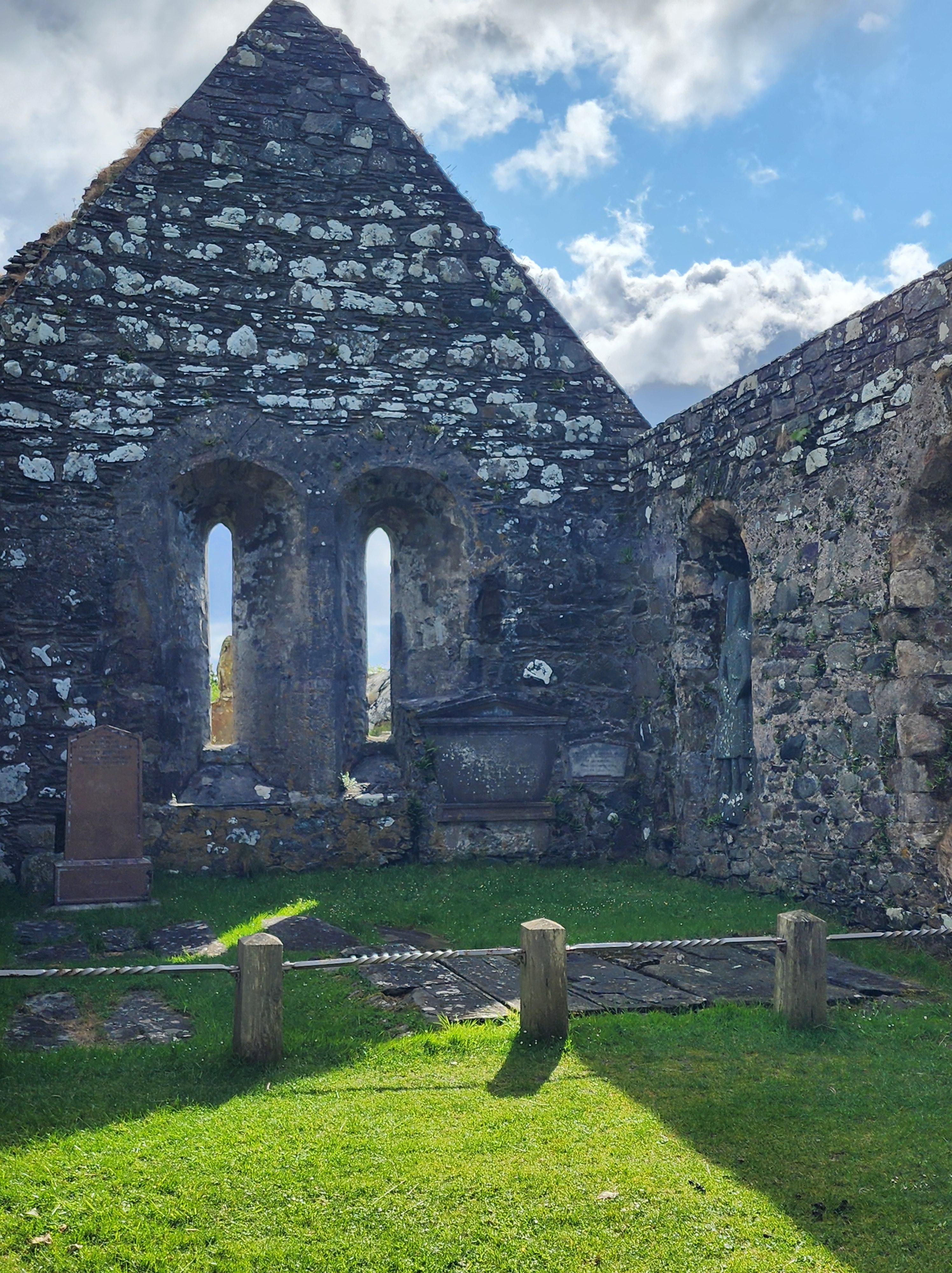
Kildalton church
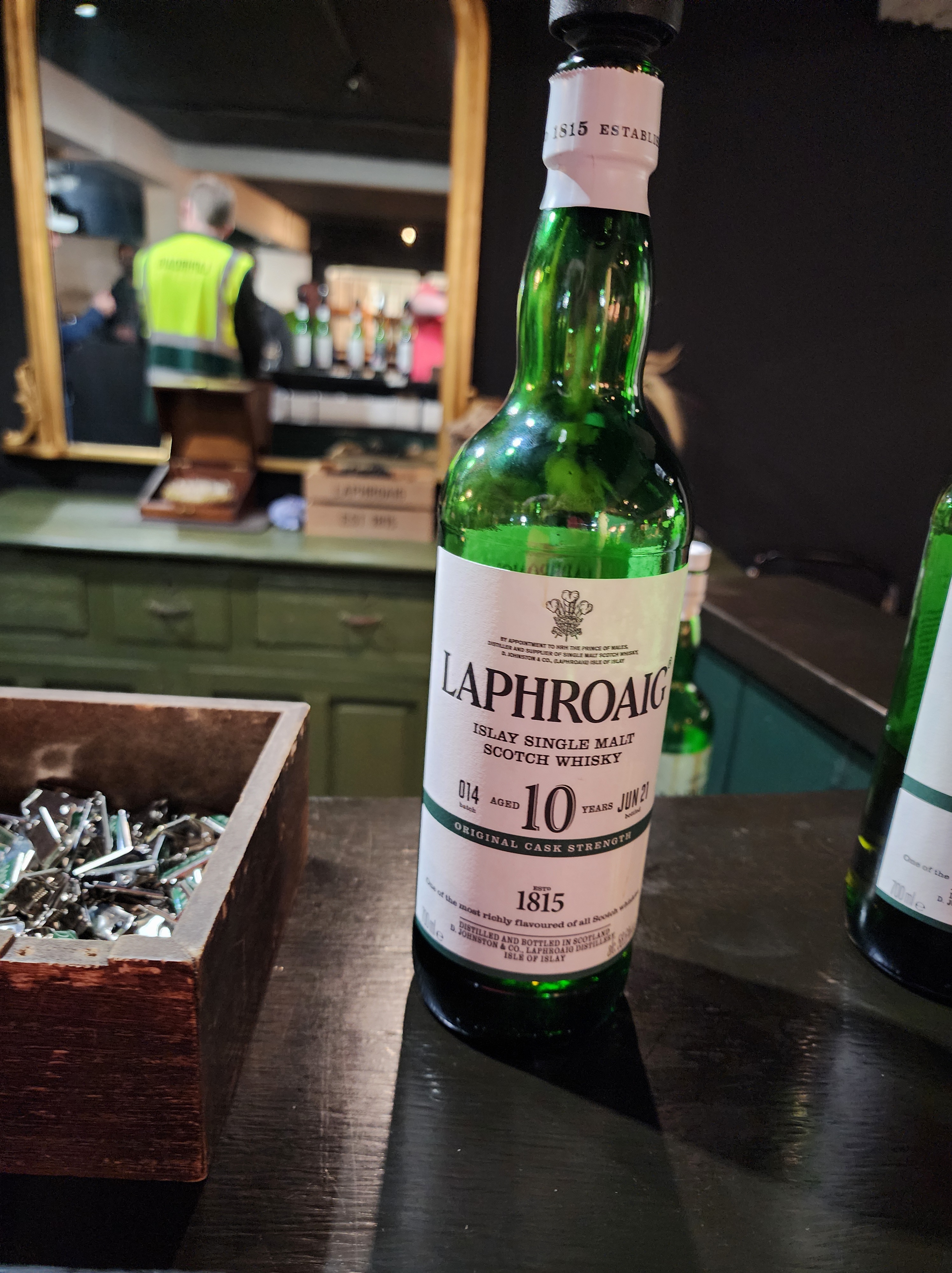
Laphroaig cask strength–it was pretty strong.
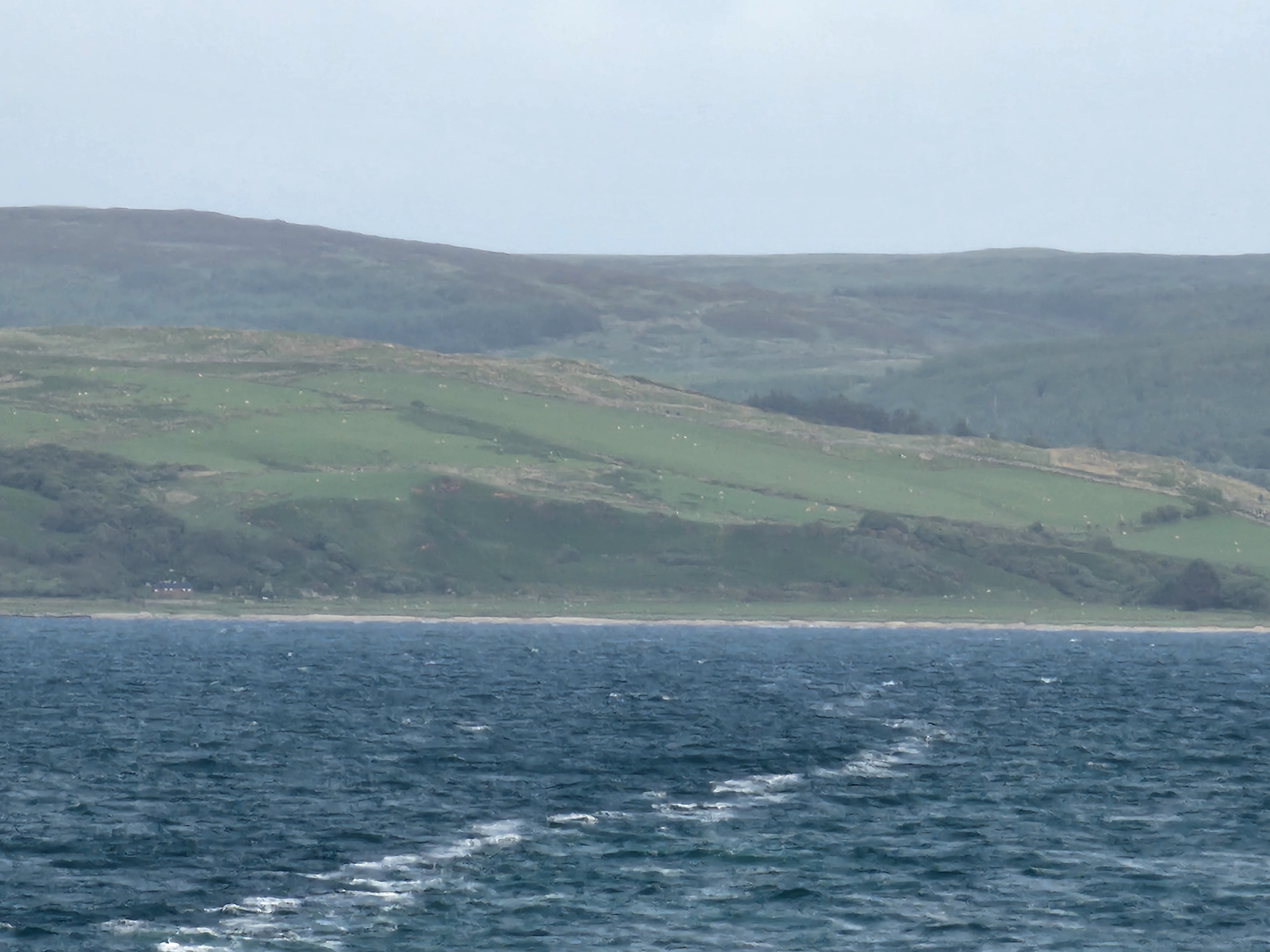
On the ferry

Caol Ila whiskies. I stayed away because I would have been drunk off my ass.

Kildalton High Cross… with people for scale.

Kildalton Cross with the Norwegians

The malting floor at Laphroaig
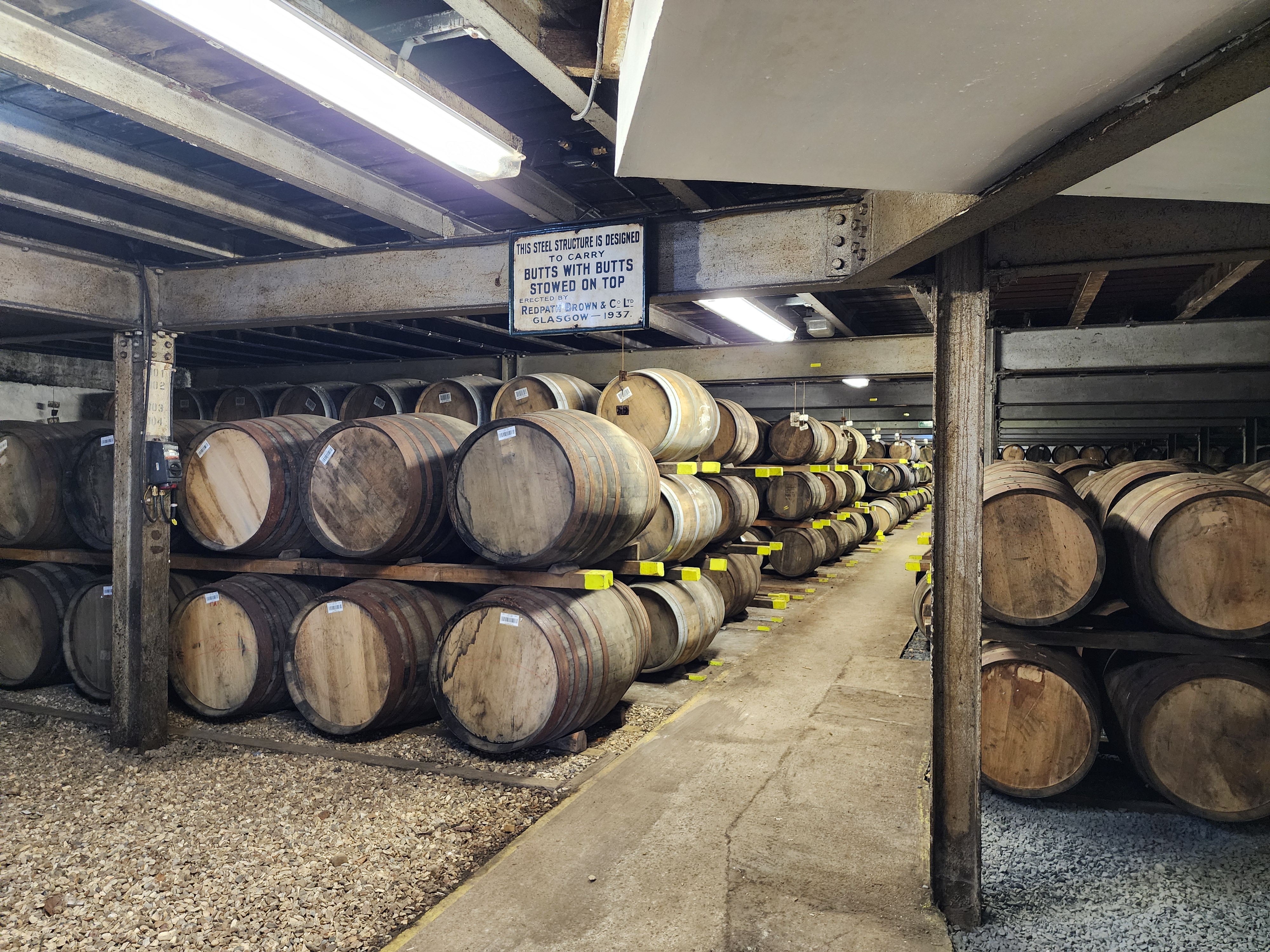
This pic reminds me of the end of Indiana Jones, where the Ark gets put in with thousands of other boxes. There were 100s of barrels here.

Me on the CalMac ferry
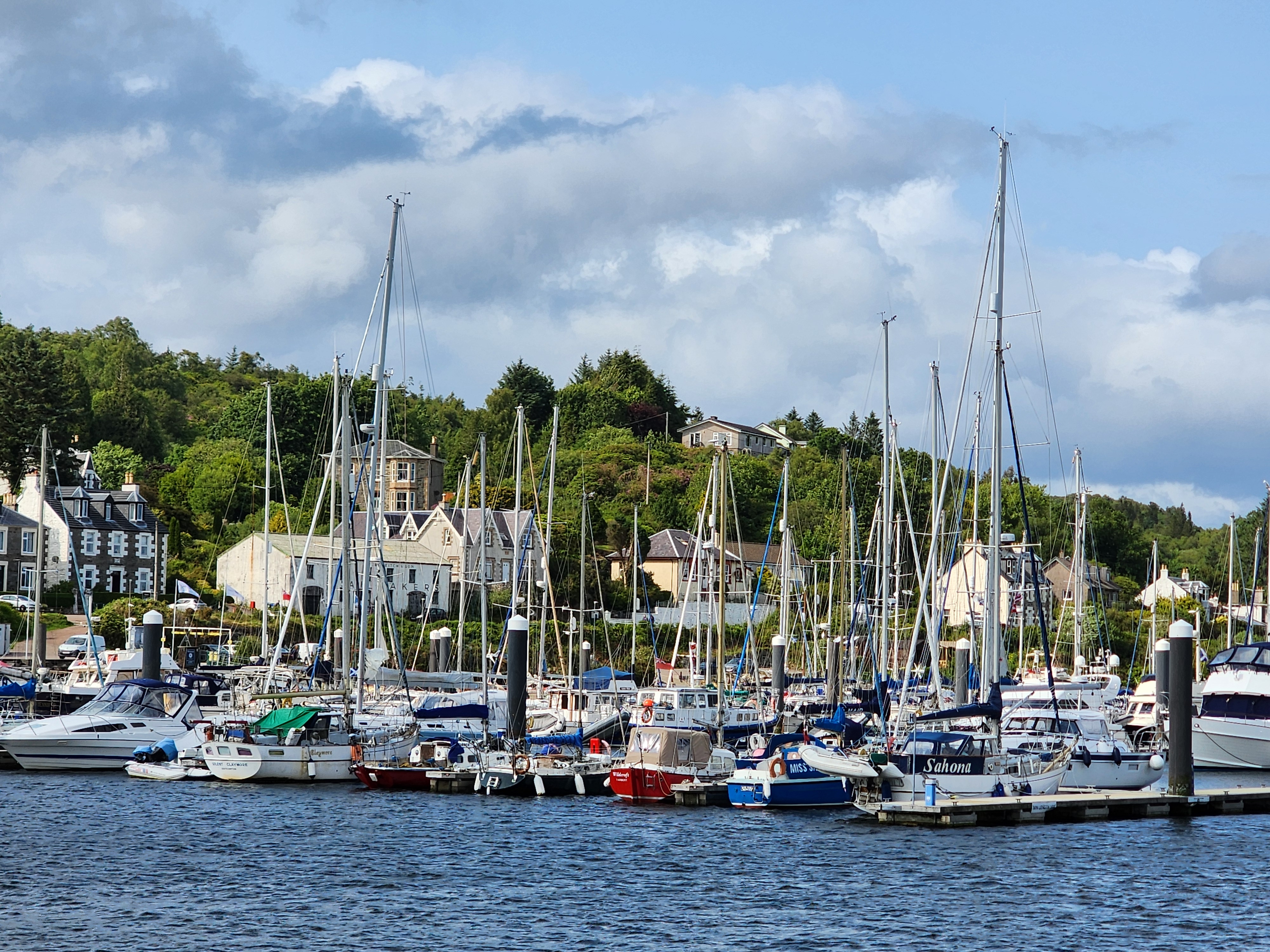
Oban harbor

Oban harbor

I feel like my Dad would like this pic of the Oban harbor. That dark sky meant some serious rain.
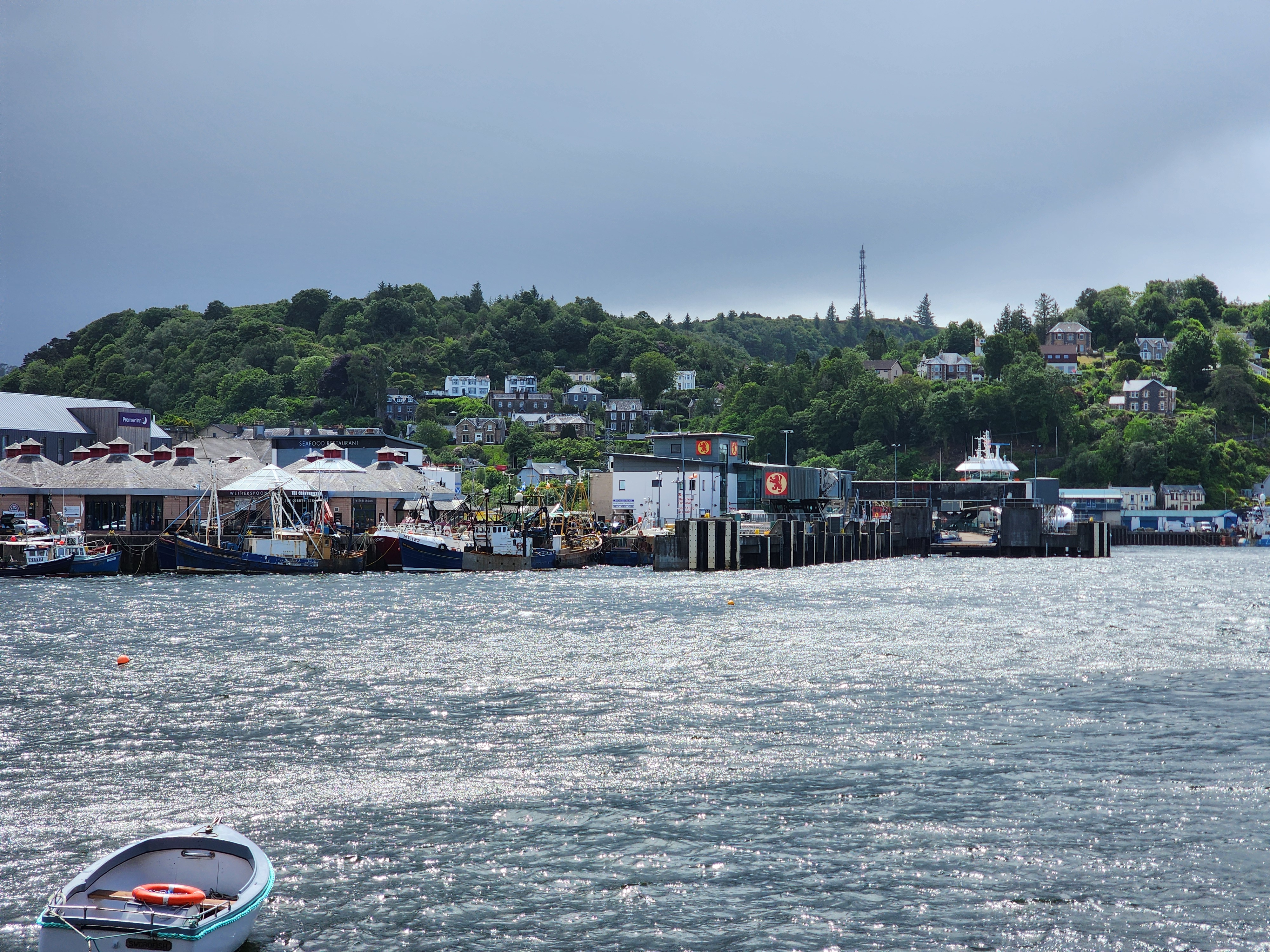
Oban harbor

Oban harbor
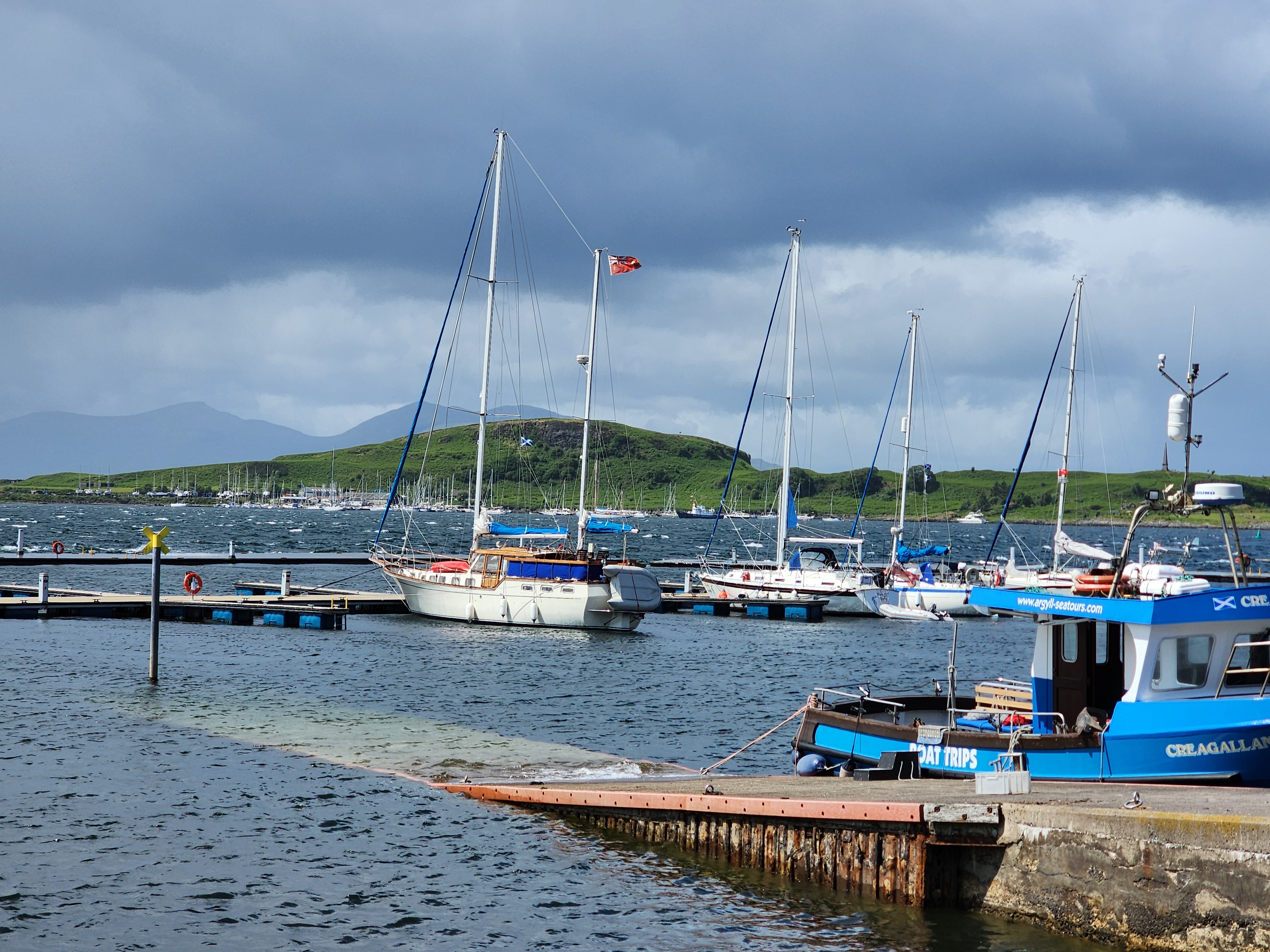
Oban harbor ramp

Old castle ruins near Lagavulin distillery

Hotel on the Oban harbor high street

Laphroaig peat oven–it was surprisingly small.
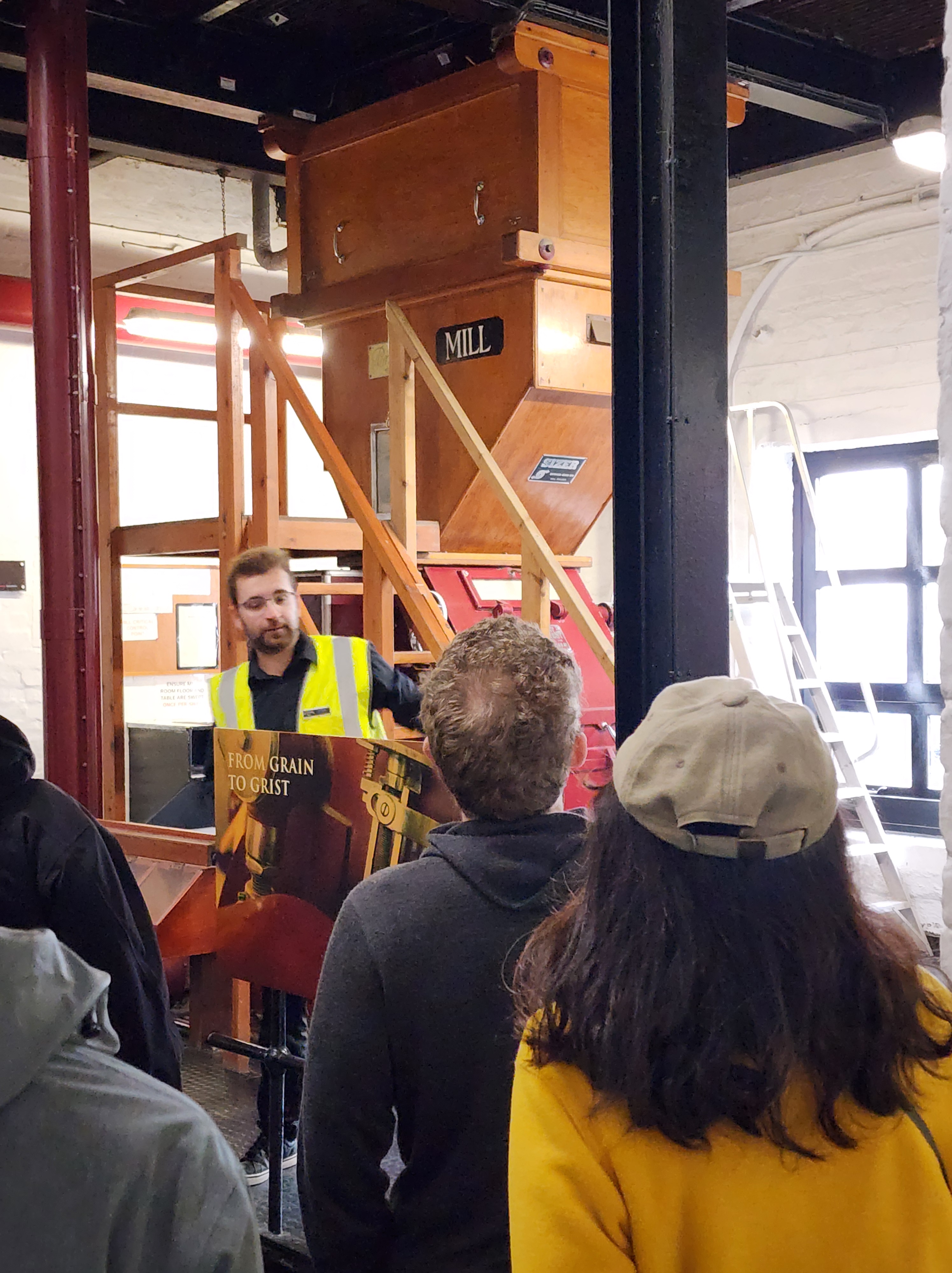
Bowmore mill–the mills across Islay were all made by the same manufacturer, and so hardy that they’ve lasted over 150 years.  They never break down, and the company went out of business because they never had to repair the mills!
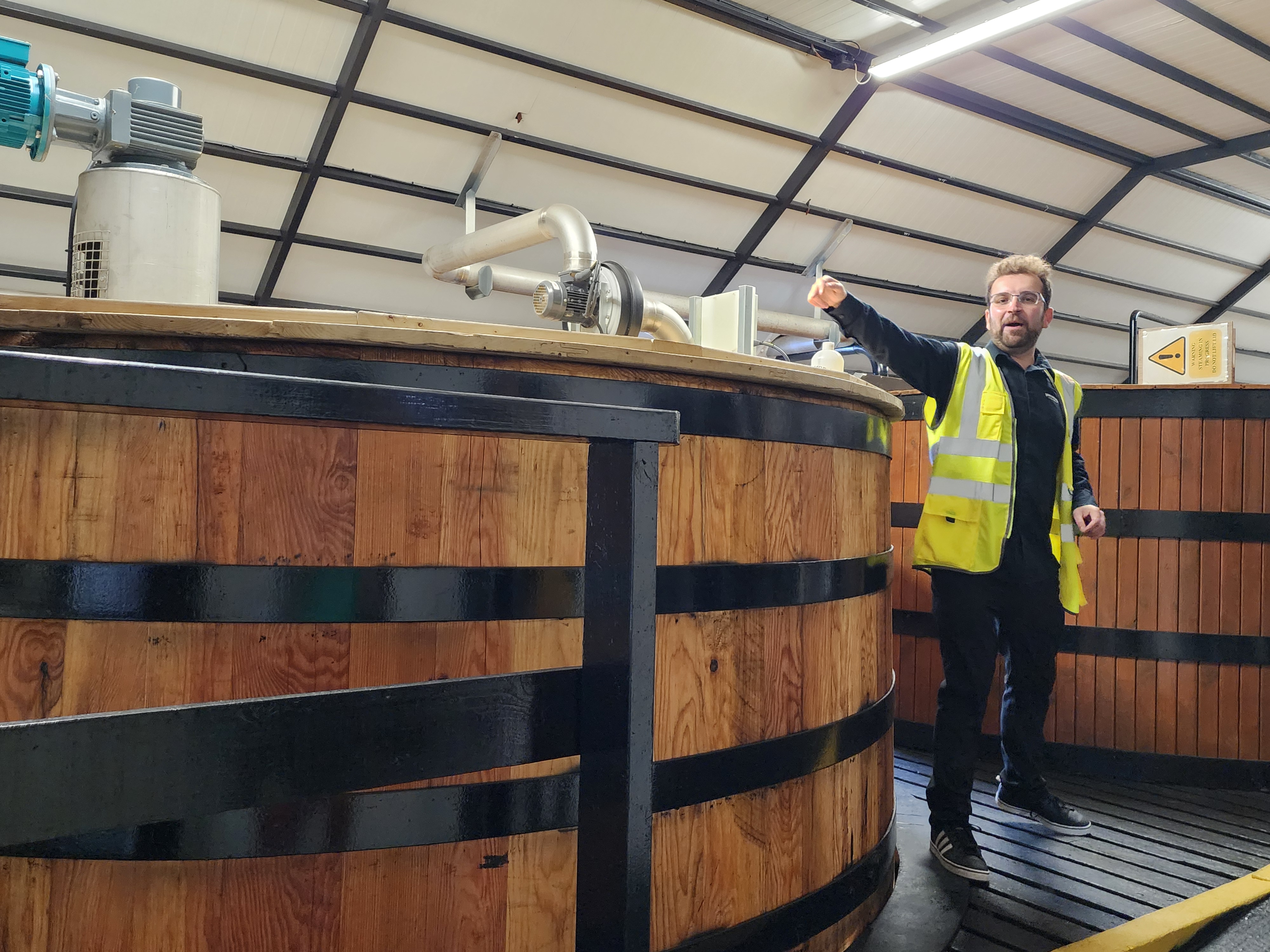
Bowmore wash back (where the barley water ferments)

Get these mountains a bra, for heaven’s sake.
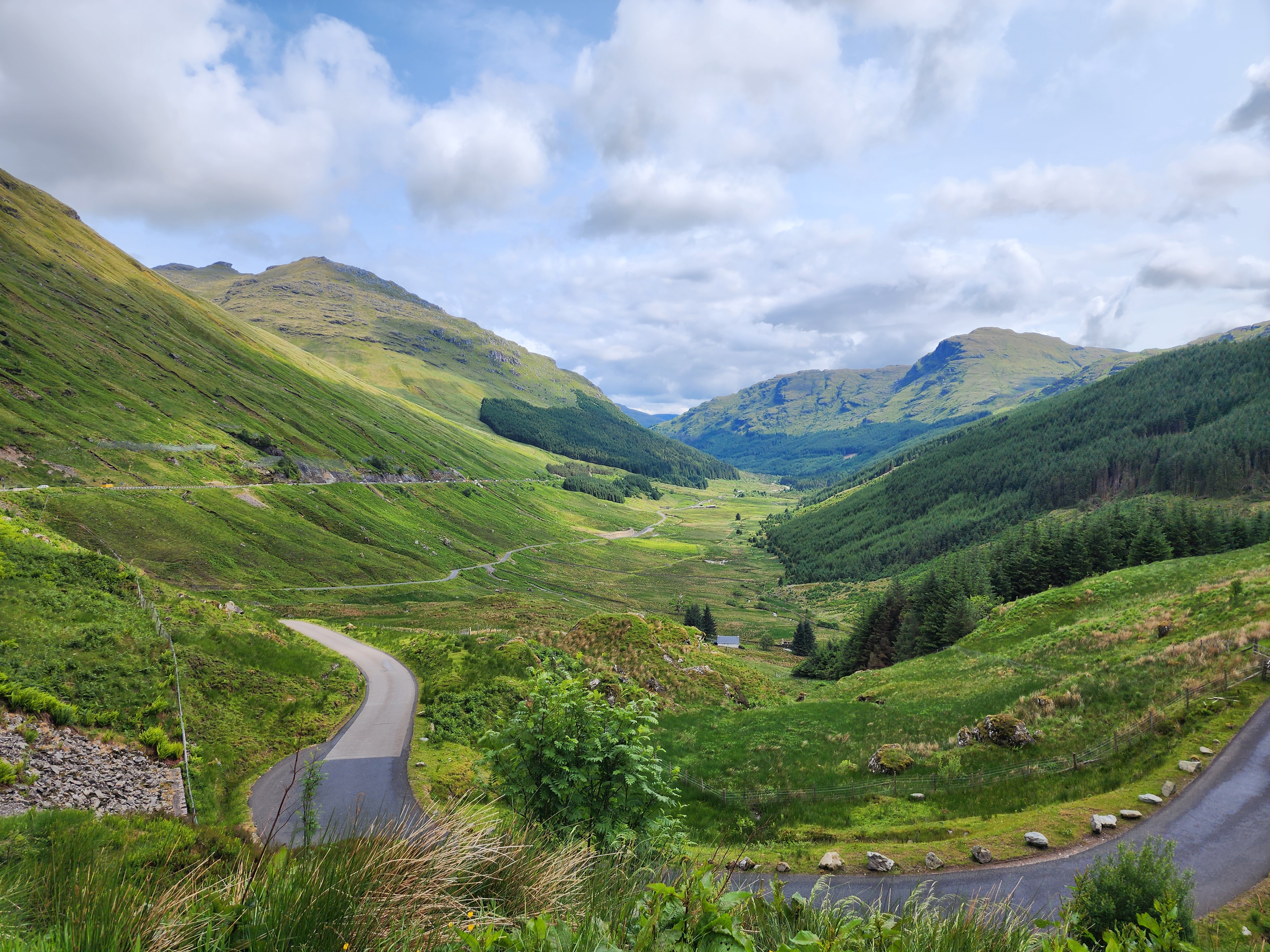
On the way home we stopped at the “Rest and Be Well” glen.

In Inverary, on the way home, I had lunch at the George Hotel. It was mediocre.

The 3 flags flying over Laphroaig–yes, Japan has a big interest in the distillery.

The different grain sizes once they go through the mill
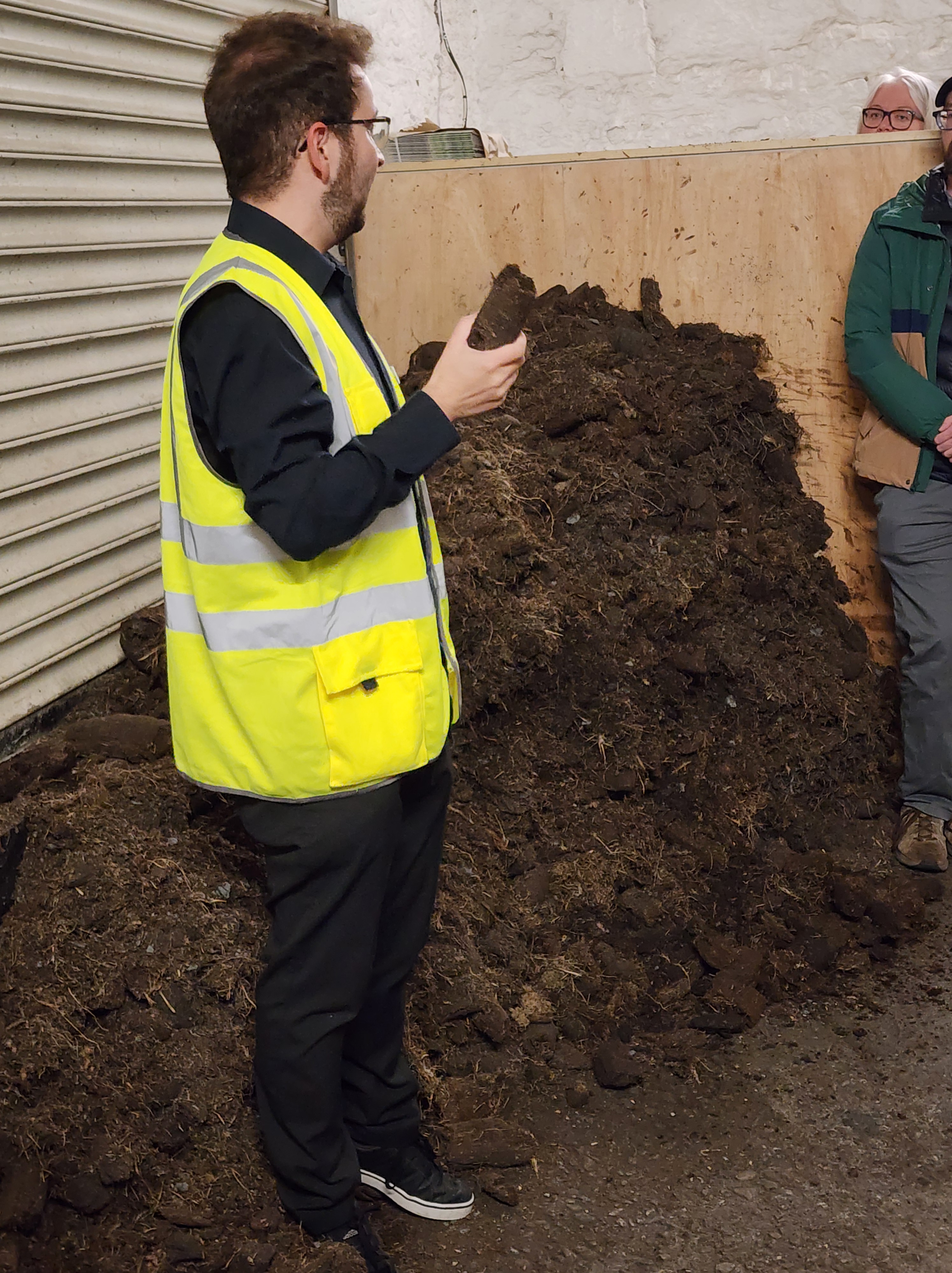
Bowmore guide next to a peat pile
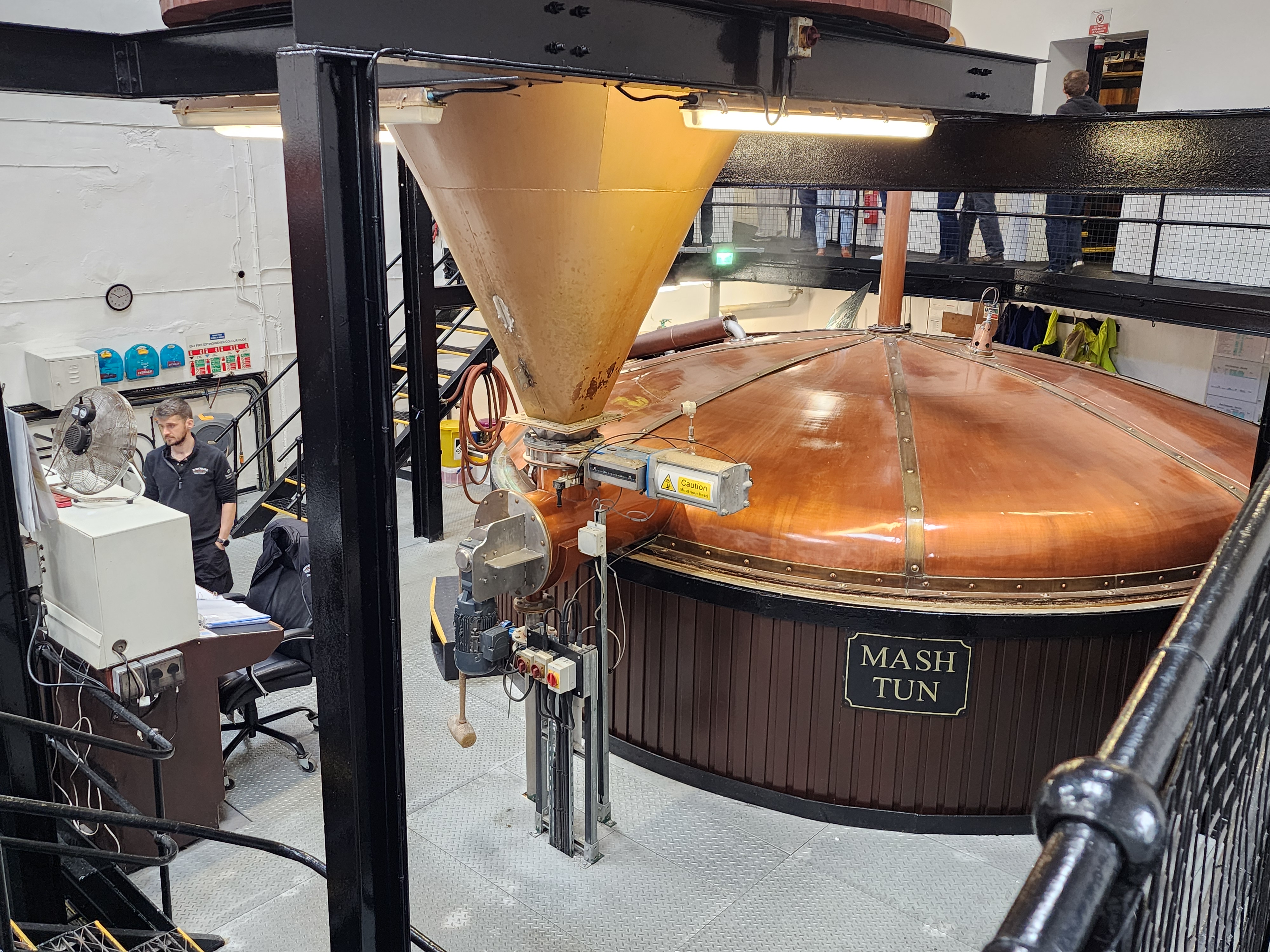
Bowmore mash tun (where the malt gets mashed)
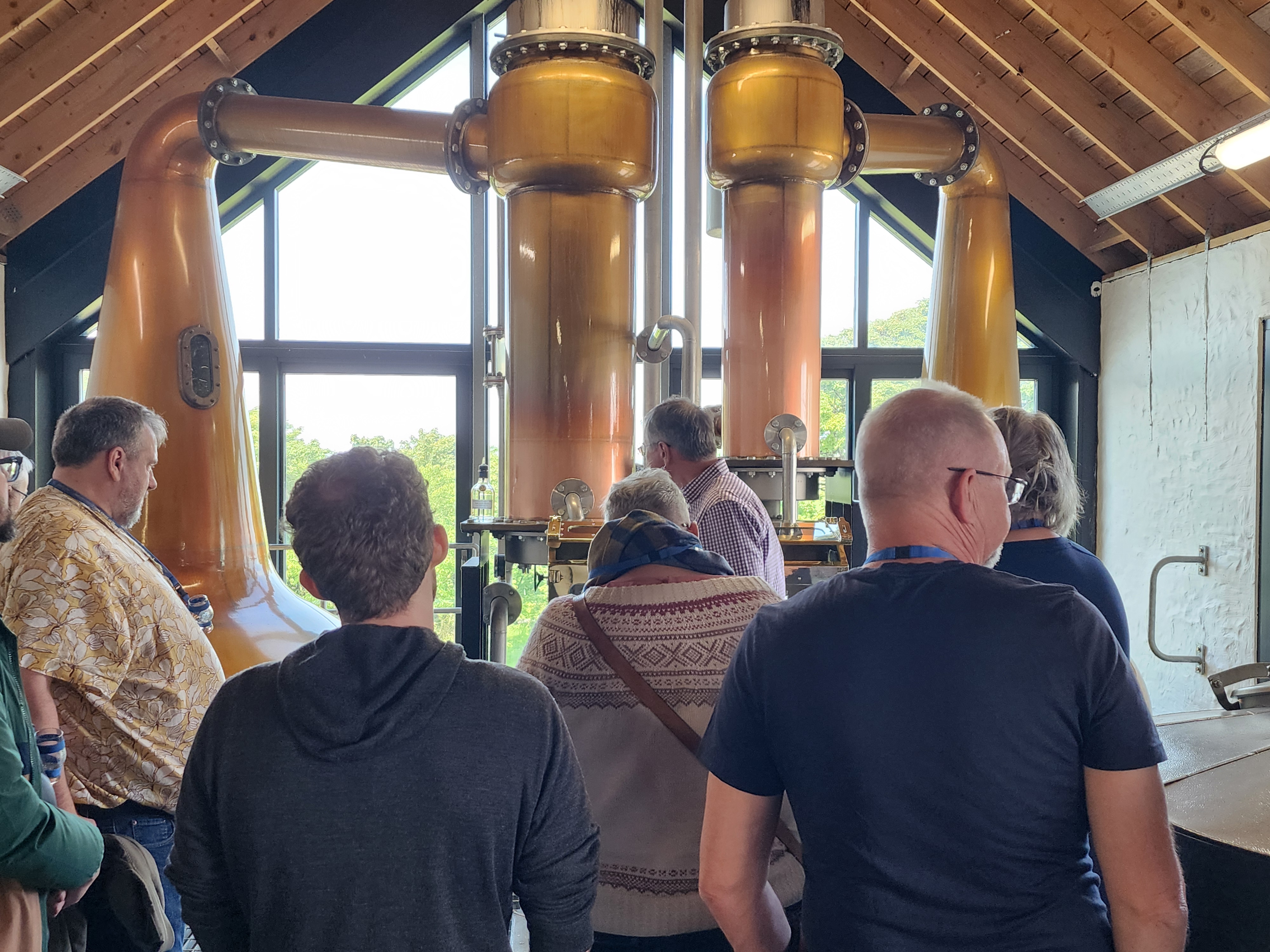
Kilchoman stills

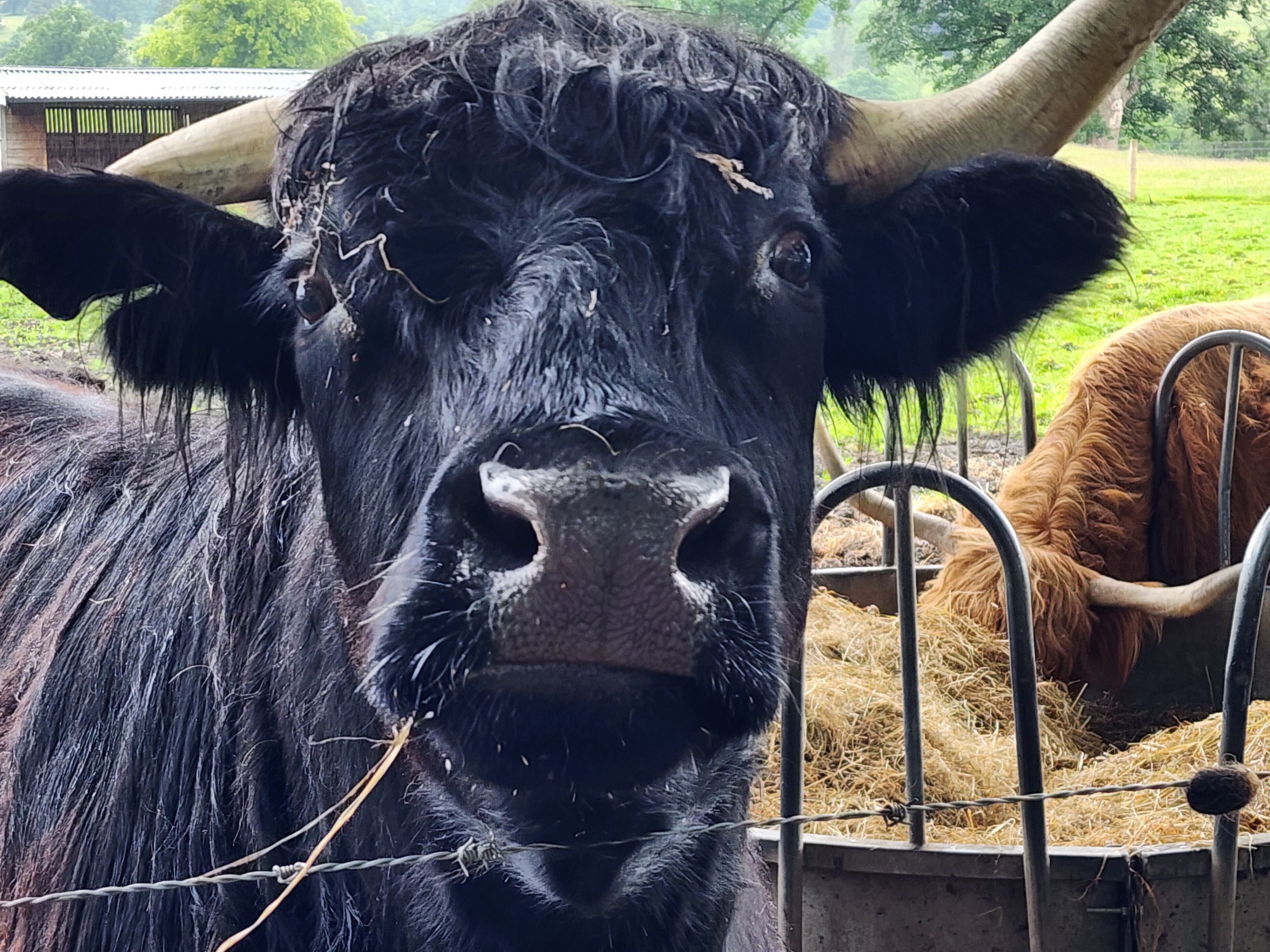
Dispatch from Edinburgh #2–Wet and Wild

Saturday the 14th was a soggy mess.  All of Edinburgh had as many puddles as umbrellas and lots of damp, sour faces.  But not mine.  I thrive in the rain. I had lined up the Scottish Highlands Sail, Bike, or Trail Experience (all new for 2025), which would take me to see Loch Katrine, a place I have not been before. What?  A place in the Highlands I have not yet seen?  Could this be true? It was!

Surprisingly, I had the tour to myself.  There were two other folks registered, but they canceled—probably because of the weather.  That suited me just fine, because it gave me the chance to pick any seat on the bus I wanted, window or aisle.  Also it was nice not to have to wait on stragglers who come to the bus late from outings.  And also, I think it spoiled me a little, which was nice.

The Forth Rail Bridge in the rain

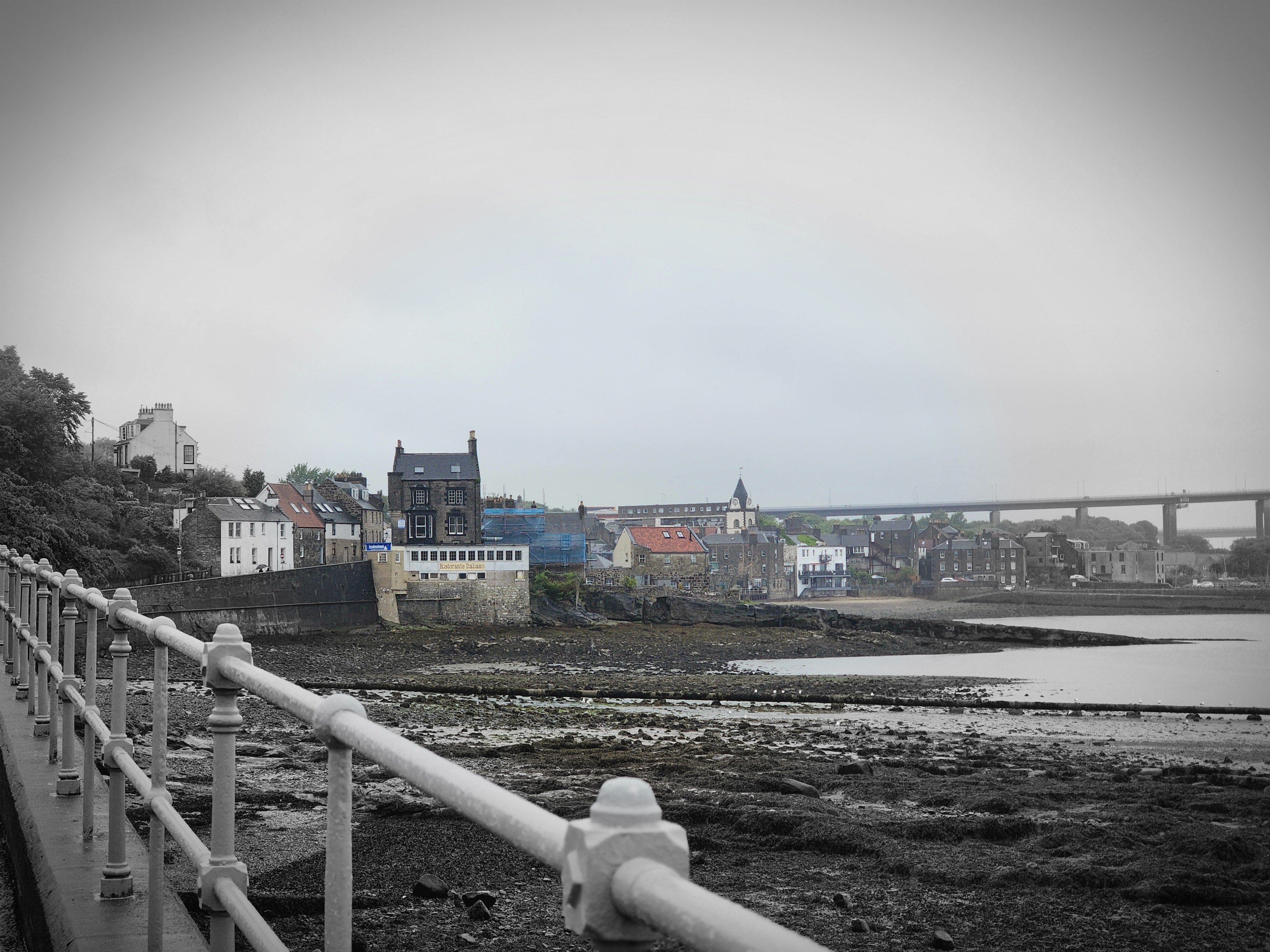
The tour began with a close-up of the red Forth Bridge that I had only seen from a distance before.  The misty, dreich weather only enhanced its beauty, making it easy to imagine that I’d gone back in time and was seeing the bridge for the first time. There used to be a ferry from this point in South Queensferry over to Fife, to allow the pilgrims in St. Margaret’s time to travel (early 11th century; in fact, St. Margaret was the one who made the ferry free).  But now there’s only this rail bridge, an icon of the late 19th century, considered one of Scotland’s greatest man-made wonders.  Of course there are other bridges nearby, the 1964 bridge and the 2017 suspension bridge, but it’s the 1890 Forth bridge that has the allure and history, and is a World Heritage site.

The beauty of having a tour to oneself is that the tour guide can dispense with some of the cheesy patter and really only tell you things you want to know.  I think it helped that I mentioned I’ve been on about a dozen Rabbie’s tours over the years and could practically tell all the Scottish jokes and history right along with the tour guide.  He appreciated this comment, because he told me more tailored stories and we could talk about the sights with more depth.  For instance, we talked about the making of the Kelpies and why they were situated on the little river where they stay (because that area was known for its iron works), and they were based on the Clydesdale horses that pulled the wagons that held the iron. He told me about the legend of the Kelpies too, but I already knew it.  (In case you don’t know the Kelpies legend, they were demon horses that came out of the sea, so beautiful that anyone on the beach would feel compelled to touch or ride the horse.  But, beware! As soon as one touched the horse, one would be stuck fast, and the horse would return to the water, dragging the hapless victim to his or her death.)

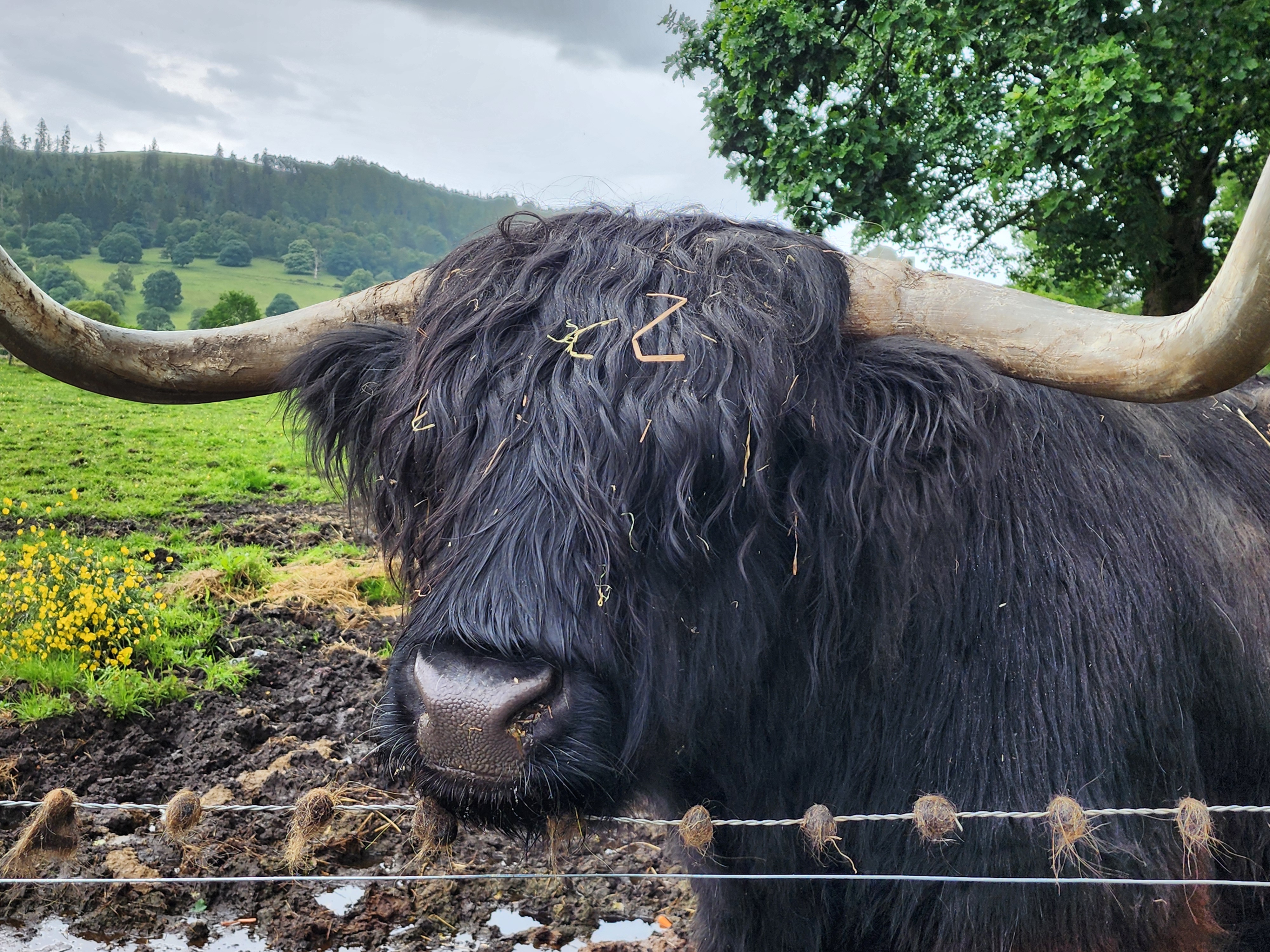
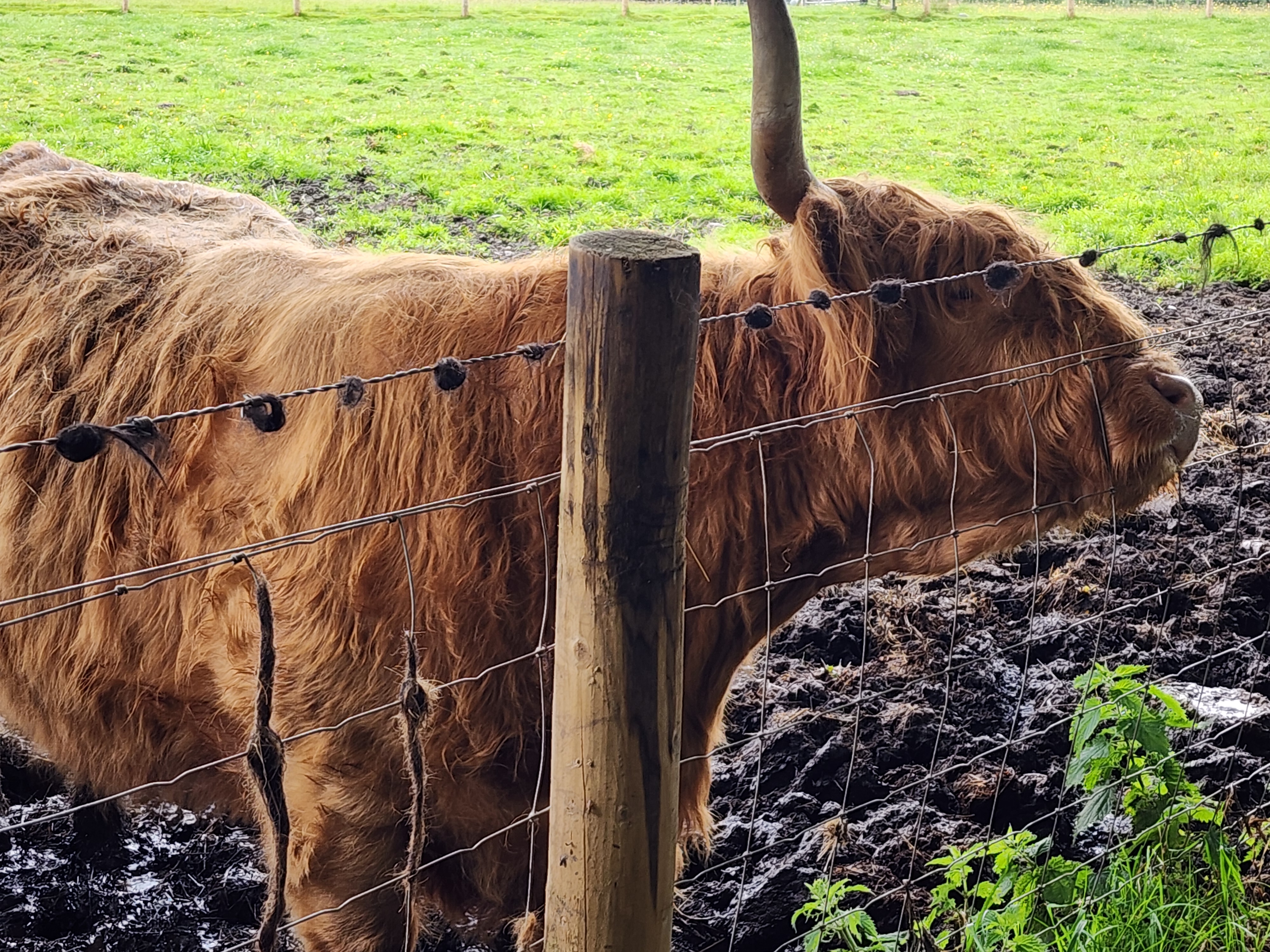
Gentle Heilan Coo!

We drove along the motor way, with yellow weather warnings periodically showing up on the signs alerting us to heavy rain (as if we couldn’t tell), but then we turned off onto two-lane roads and started our climb toward the mountains.  Because there was only me, he made a surprise extra stop at a woolen mill where some Heilan Coos waited patiently in the rain for photos and food.  For a £1 you could purchase a bag of carrots, raw potato, and other goodies for the cows, and they would take the food right from your hand with a wet sweep of their huge black tongues.  I am sure they are used to standing in the rain, bedraggled and sad-looking, but I felt a little bad for the cows.  They liked the veggies though and I was delighted to give them to the cows.

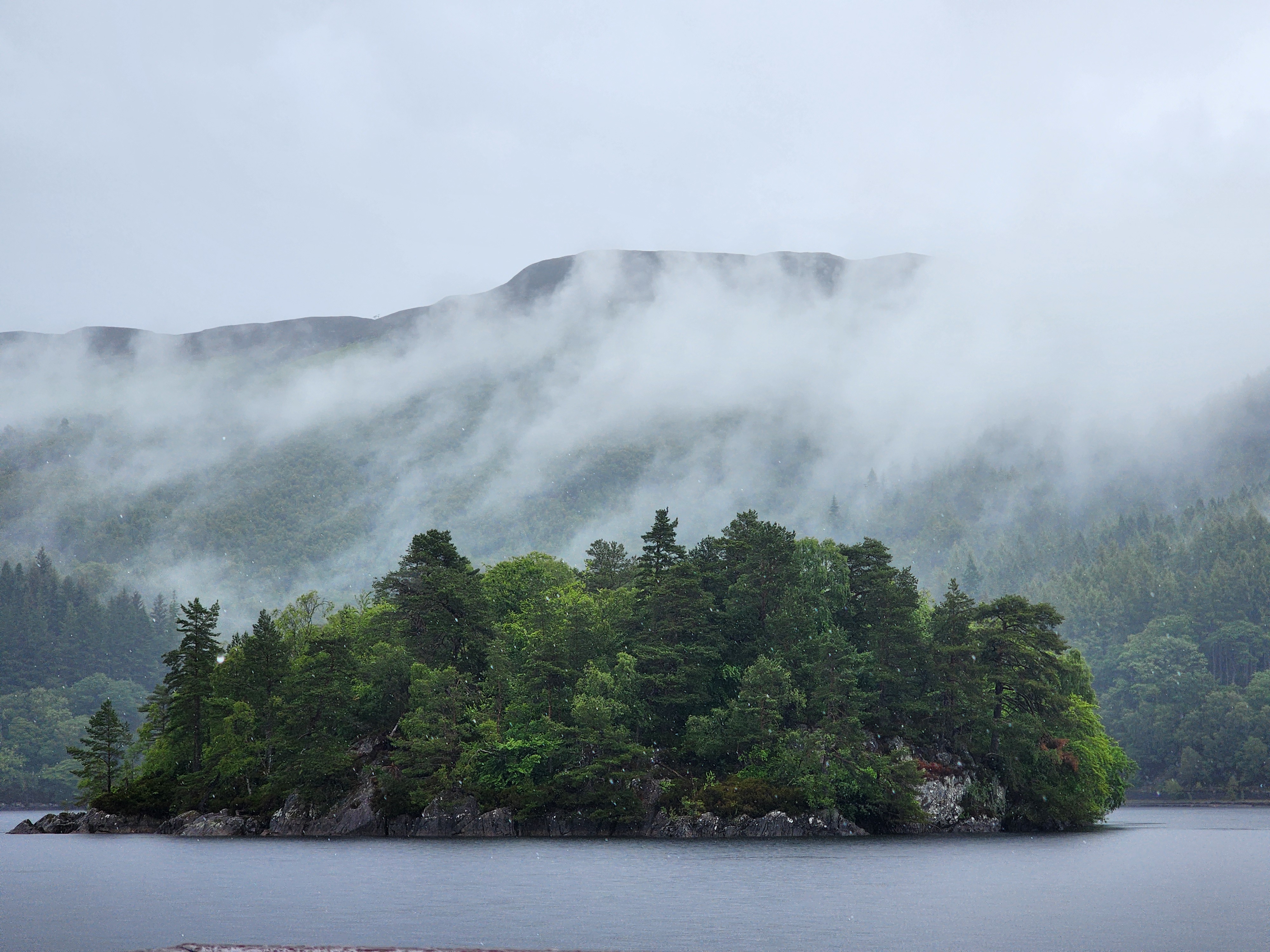
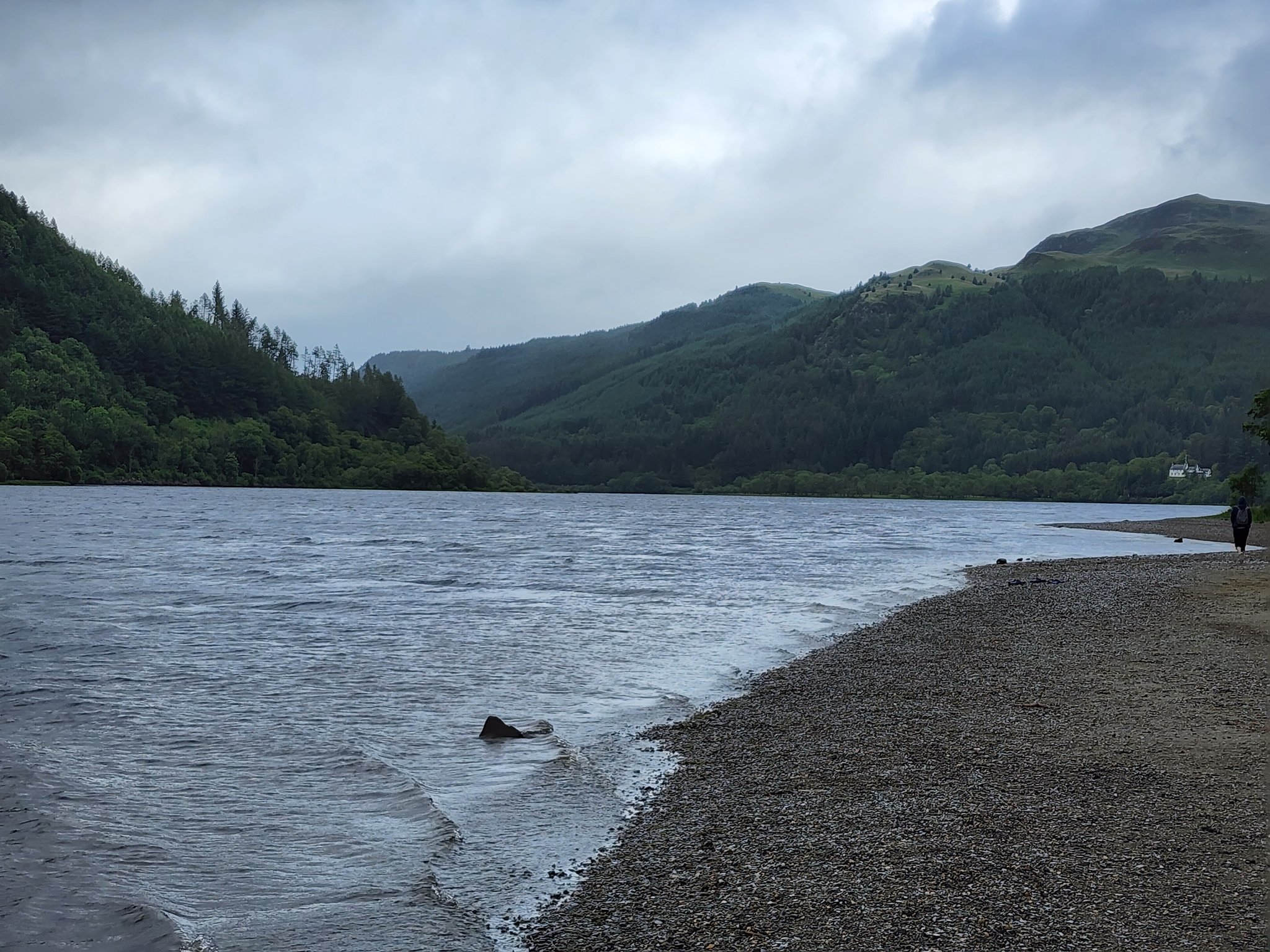
Misty Loch Katrine

Our next stop was Loch Katrine, a huge reservoir that serves Glasgow for its water needs. The loch was deep in the Highlands somewhere, up a twisty, windy road that was so narrow the tour guide asked me not to speak to him so he could concentrate on the drive.  I was glad that I wasn’t the one driving—some of the turns were hairpin, and almost 90 degrees at points. Maybe on a day it wasn’t raining like hell, the road would be less treacherous, but it felt pretty scary and I thought he took the drive too quickly.  But we arrived more or less in one piece, though I was a bit frazzled.

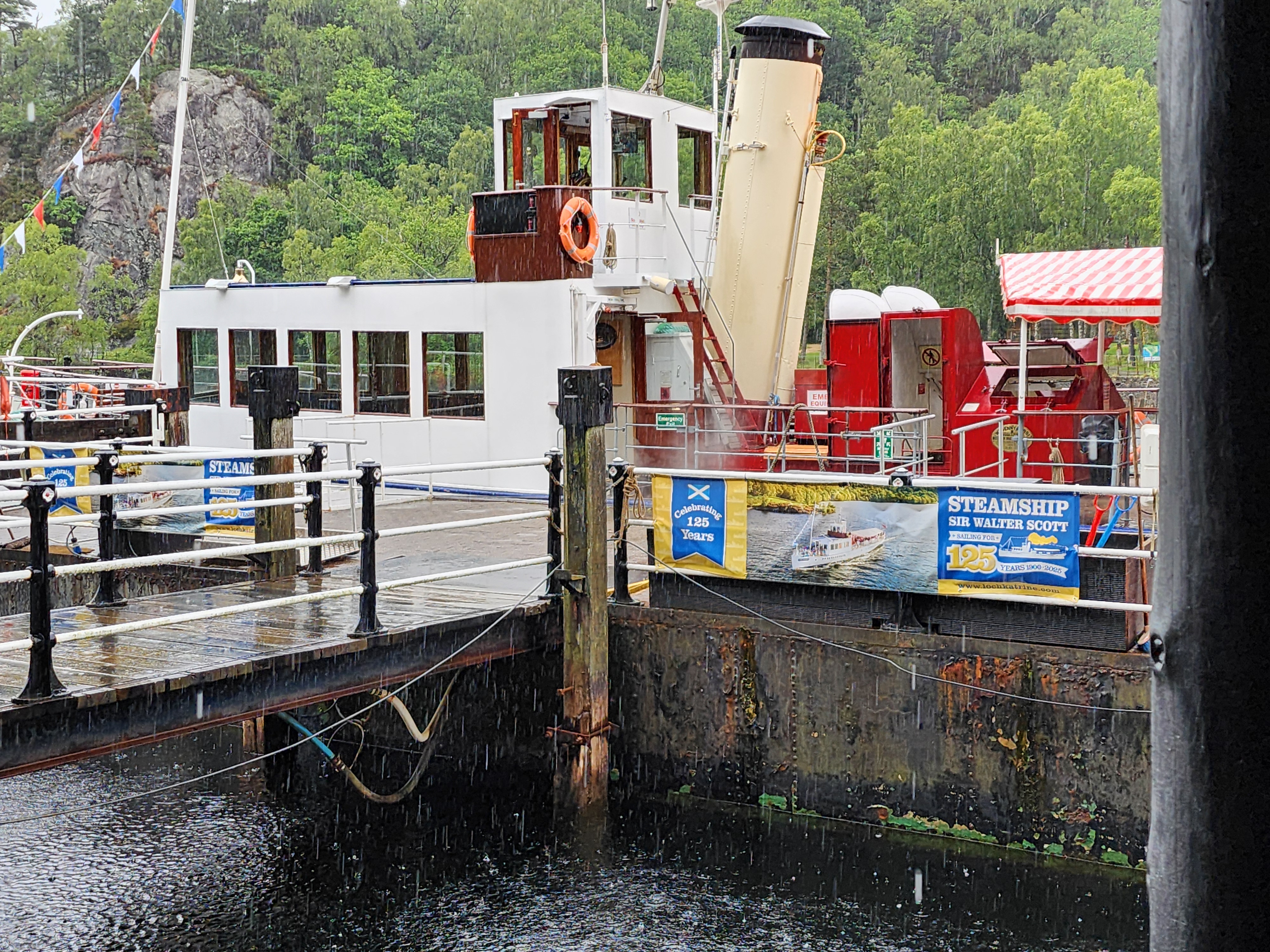
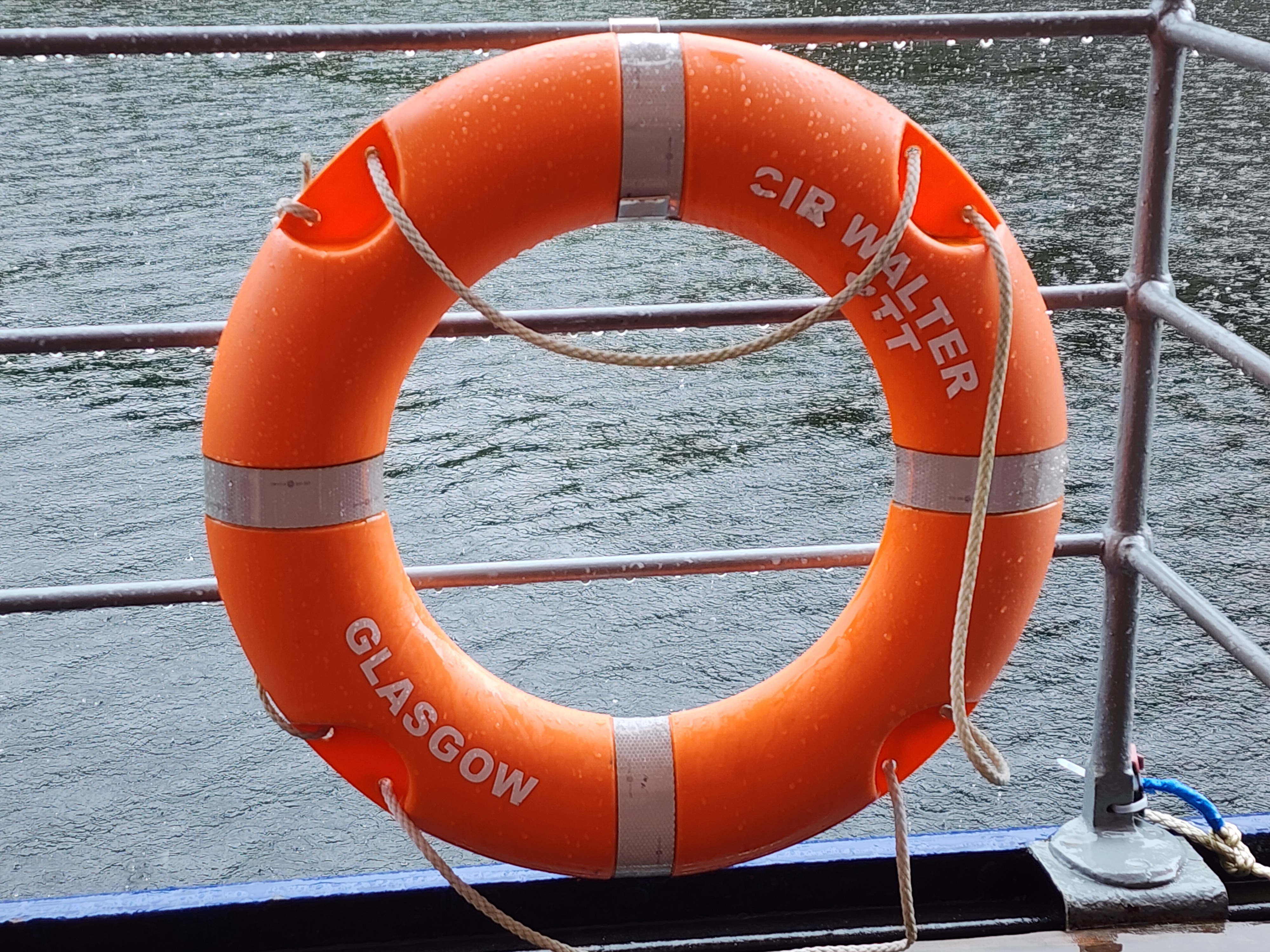
The Sir Walter Scott… if you look close you can see the rain

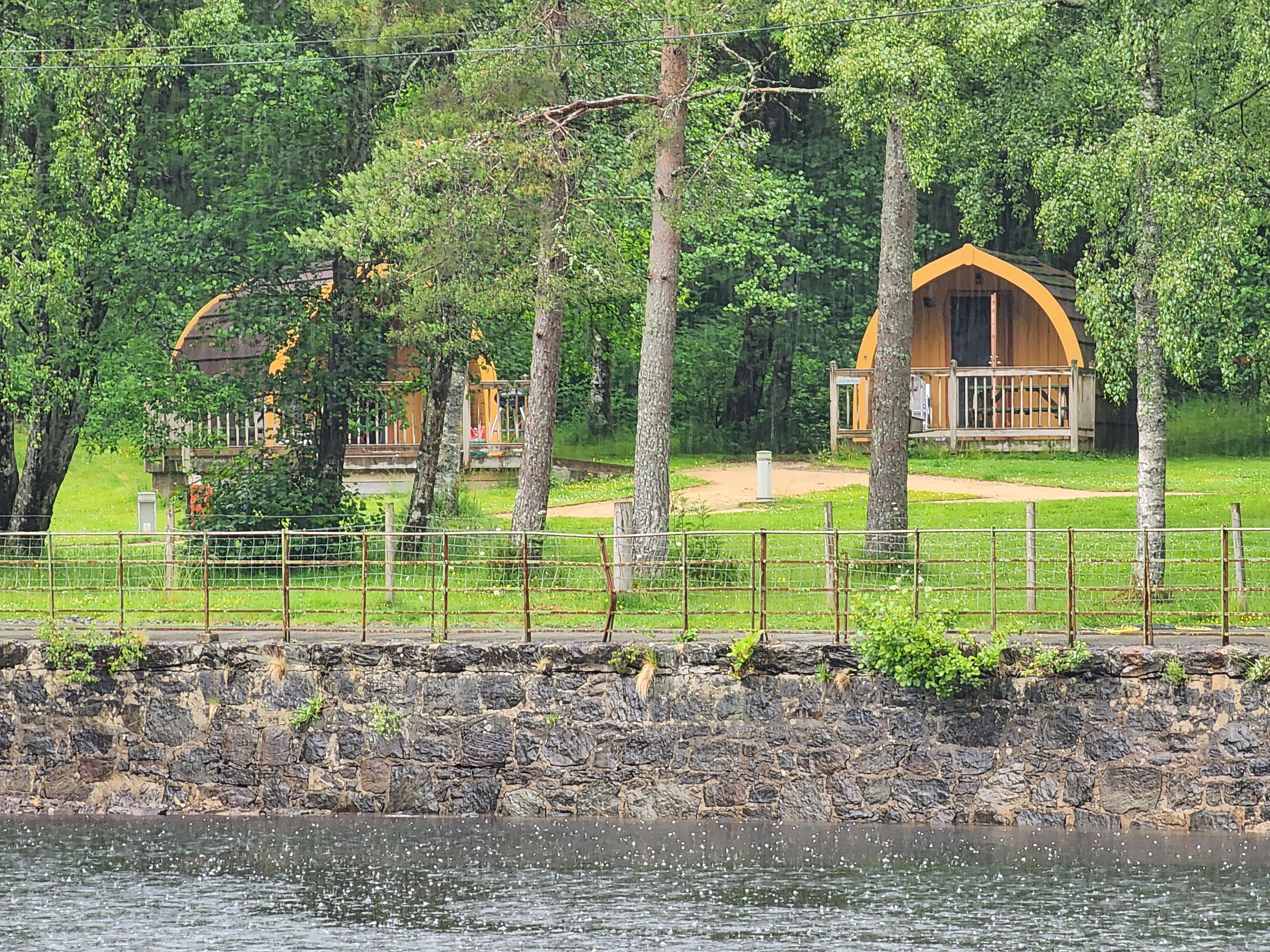
Had it not been raining, I might have done some walking along the trails that led away from the boat launch.  There was a walk that went past some yurts that I was interested in looking at, but I really just wanted to get out of the rain.  I got lunch in the little café—to-mah-to pepper soup and an egg salad sandwich on wheat, which was more lettuce than anything else. The boat ride wasn’t until one, so after lunch I called Mom on the area’s sketchy wifi to catch up with her. (She was fine.)  The boat ride was on the Sir Walter Scott, a steam engine boat celebrating its 125th anniversary.  There were 41 passengers for our boat ride, but I was amazed to hear that back in the day, even up to the 1950s, the ship carried up to 500 people.  I can’t imagine how 500 people could fit on the ship—we were cozy at 41.  The Captain made a joke that people are “wider” now and so it would be a lot harder to fit 500 on the deck. What he didn’t say was where the 500 people would be going.

Another misty view of Loch Katrine

The rain pelted down and the deck was damp and cold but the ride itself was pleasant—the mountains were hiding in low clouds, and the loch splashed and wavered as the boat steamed its way through it. The Captain was full of cheery chat, among which included the fact that no sheep graze in the mountains surrounding the loch because diseased sheep made runoff into the loch, and poisoned the water…not so good for Glasgow.

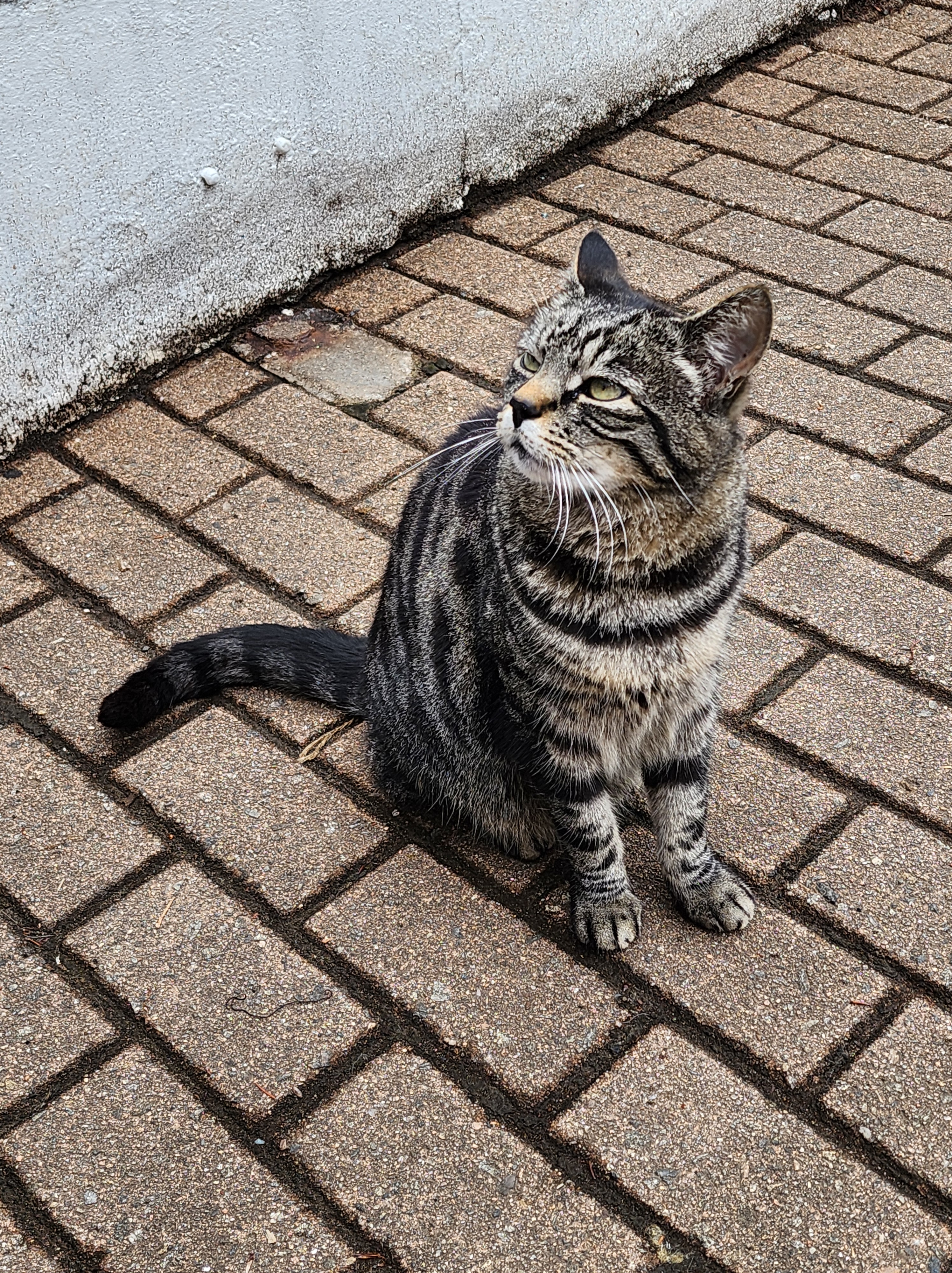
Turret the Cat

Towser the Mouser

Eventually the rain subsided somewhat as we turned around to get to the boat launch. I returned to the coach and we made our way to the last stop, Glenturret, apparently the oldest Scottish distillery, in Perthshire.  They don’t have an assured date, but they settled on 1763 based on archival research and a land deed.  Glenturret was unique because they have distillery cats, Glen (shy; I didn’t see him) and Turret (quite gregarious and affectionate).  A monument to Towser, the Guiness Book of World’s Record winning mouser, stands right as you are walking up a rise to go into the distillery.  Towser caught almost 29,000 mice in her lifetime.  Glenturret doesn’t have the mice problem it used to with the barley, so the cats are mainly decorative at this point, but I liked that they were there.

The smooth 7 Year

As for the whisky, I tried a dram of their Triple Wood whisky and their 7 year lightly peated whisky, which I liked very much, better than the Triple Wood, which I found a little harsh on the palate, even with its buttery notes.  The distillery tour guide told me that they are phasing out the peated whiskies because they were never but 10% of their business. I think part of that is the recognition that peat is a basically unrenewable resource—but sustainability aside, probably phasing out the peated whiskies mostly has to do with the fact that it doesn’t make money for Glenturret.  Another interesting thing about Glenturret is that it is half-owned by the Swiss company who also owns Lalique art glass.  I had noticed all the fancy glass bottles and the Lalique markers, and wondered.  The bottles are beautiful for sure. I would have liked to have checked out the Lalique Boutique but I didn’t have time.  Still, seeing the Lalique bottles for the special whiskies was impressive.  (So was the cost!)  Even though it wasn’t an arduous tour, I was tired by the time we came back to Edinburgh.  I think all the tramping in the rain did me in.

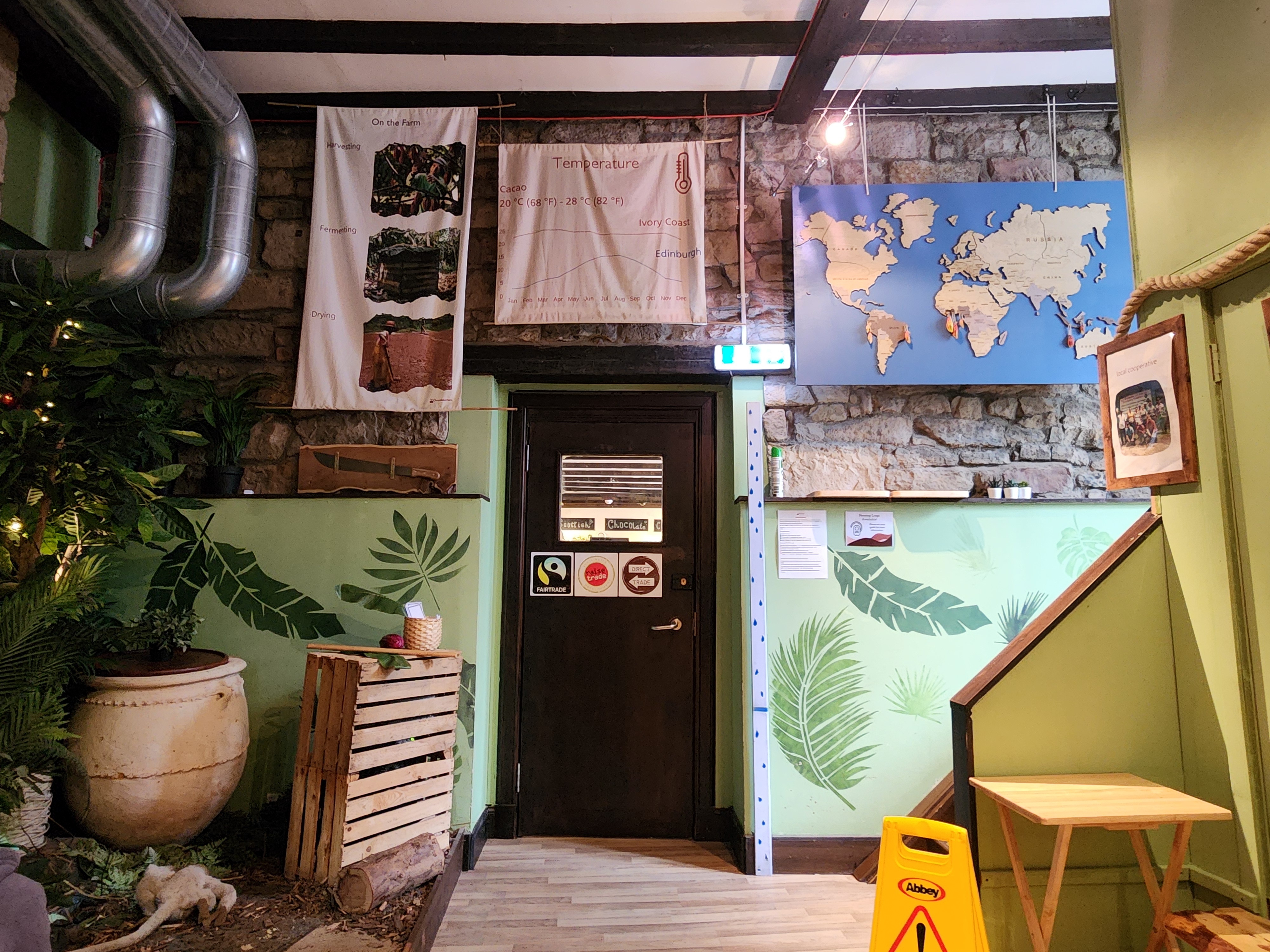
The Cacao Jungle Room at the Chocolatarium

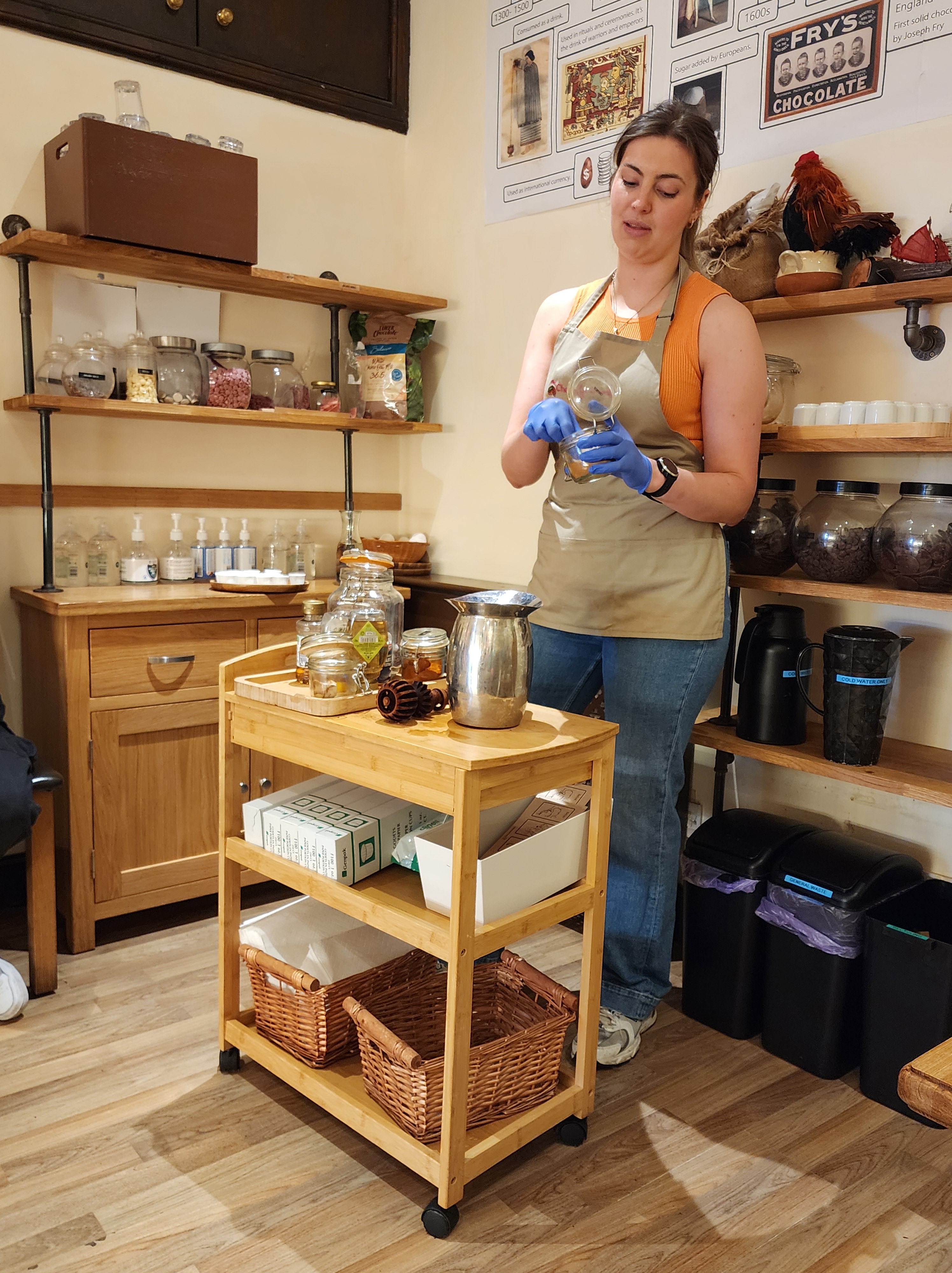
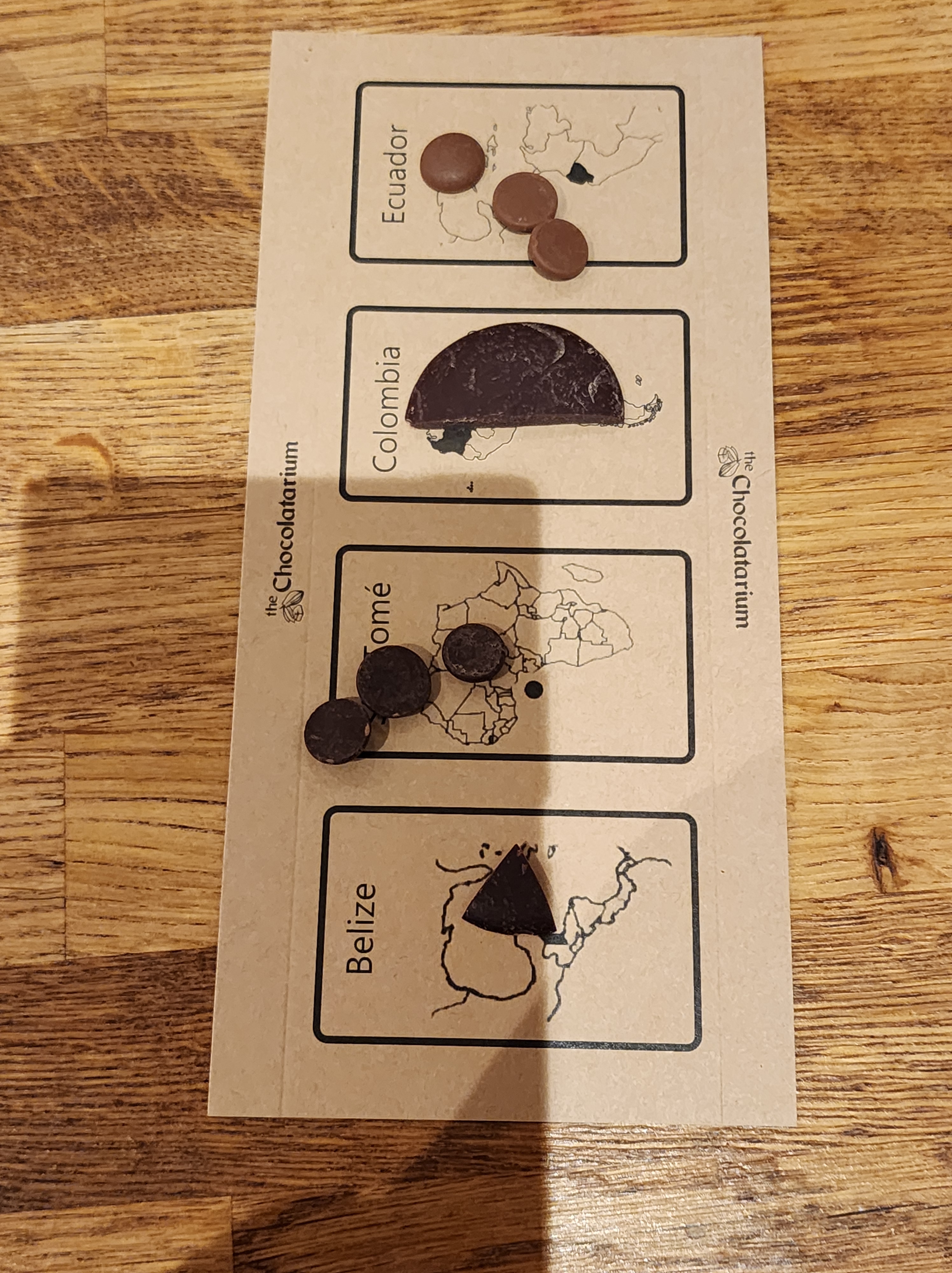
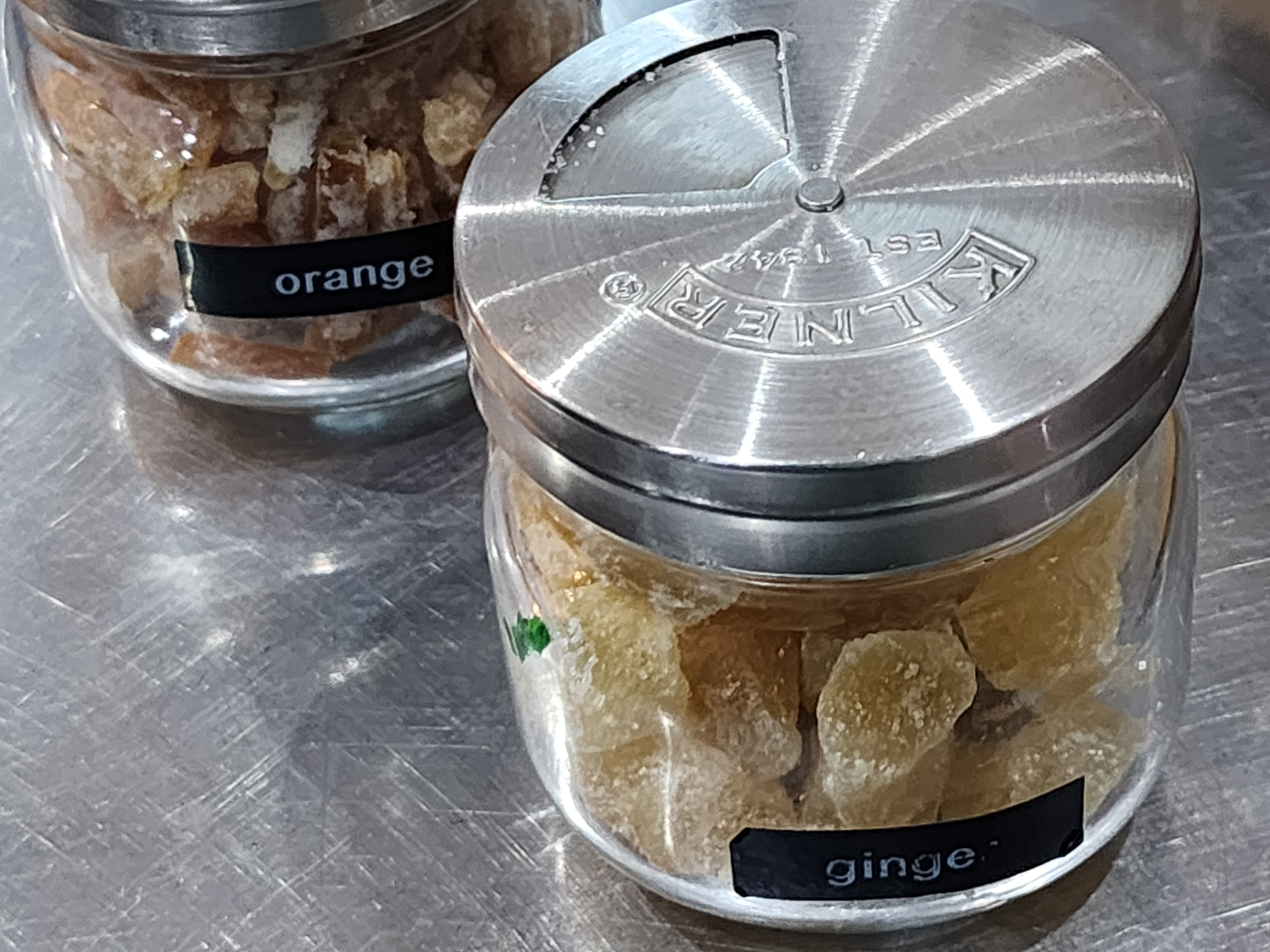
The next day I went to the Edinburgh Chocolatarium, a little hidden hole-in-the-wall chocolate shop off the Royal Mile.  For £29, we could hear the history of cacao and chocolate making, taste several “flights” of chocolate from exotic places like Belize, San Tome, Colombia, and Ecuador, and make our own chocolate bar (mine was milk chocolate with candied ginger and candied orange rind). We drank a hot liquid chocolate made with oat milk that was so thick you could have spread it on a biscuit, as well as tried an Aztec chocolate drink that was made of cacao nibs (basically a macerated cacao bean), honey, water, and hot pepper.  It was as bad as you can imagine. Very gritty, and not very chocolatey.  And for this, they sacrificed 40 people a year to honor the gods who gave chocolate to the world—and 40 because there are an average of 40 beans inside a cacao pod, and 40 pods on a cacao tree.

Our Chocolatarium tour guide making the heinous Aztec drink

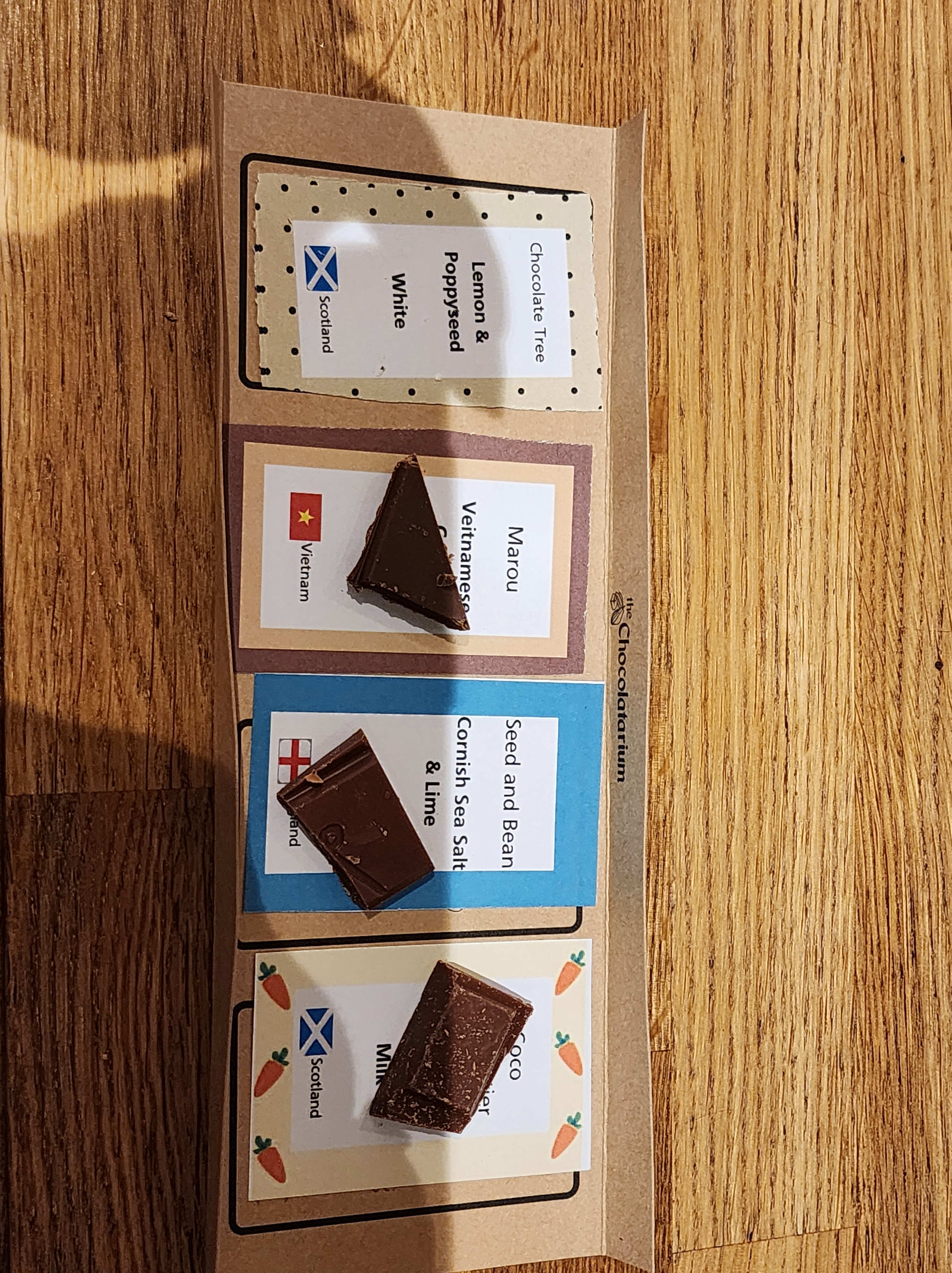
After we drank the weird Aztec drink, we could try as many bits of chocolate as we wanted.  I had a flight of four—lemon poppyseed white chocolate, Vienna coffee chocolate, Cornish sea salt and lime, and Carrot Cake infused chocolate, and by then I was chocolated out.  A girl of maybe 11 or 12 tried over 20.  She never sat down.  (We were supposed to retrieve the chocolate from the jars, then bring four at a time to our seats.)  Not her though.  She just ate them straight out of the jars. She was a serious connoisseur—but I was surprised her mom didn’t tell her to quit grazing and settle down and let other people try some samples.  At the end, we picked up our chocolates and were led back into the store.  I would have been tempted to buy a bar of the lemon poppyseed, but the £6.50 pricetag stayed my hand.

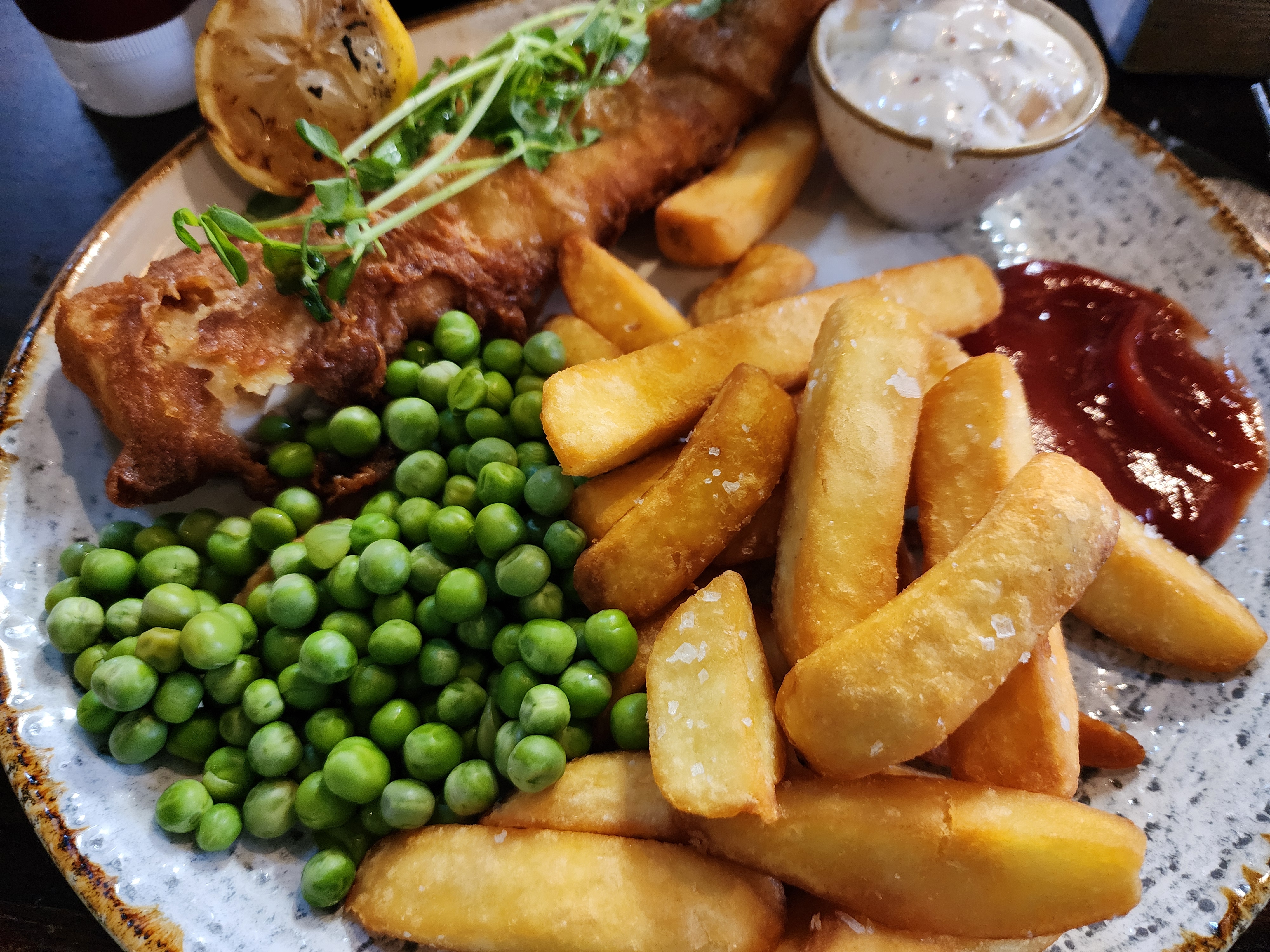
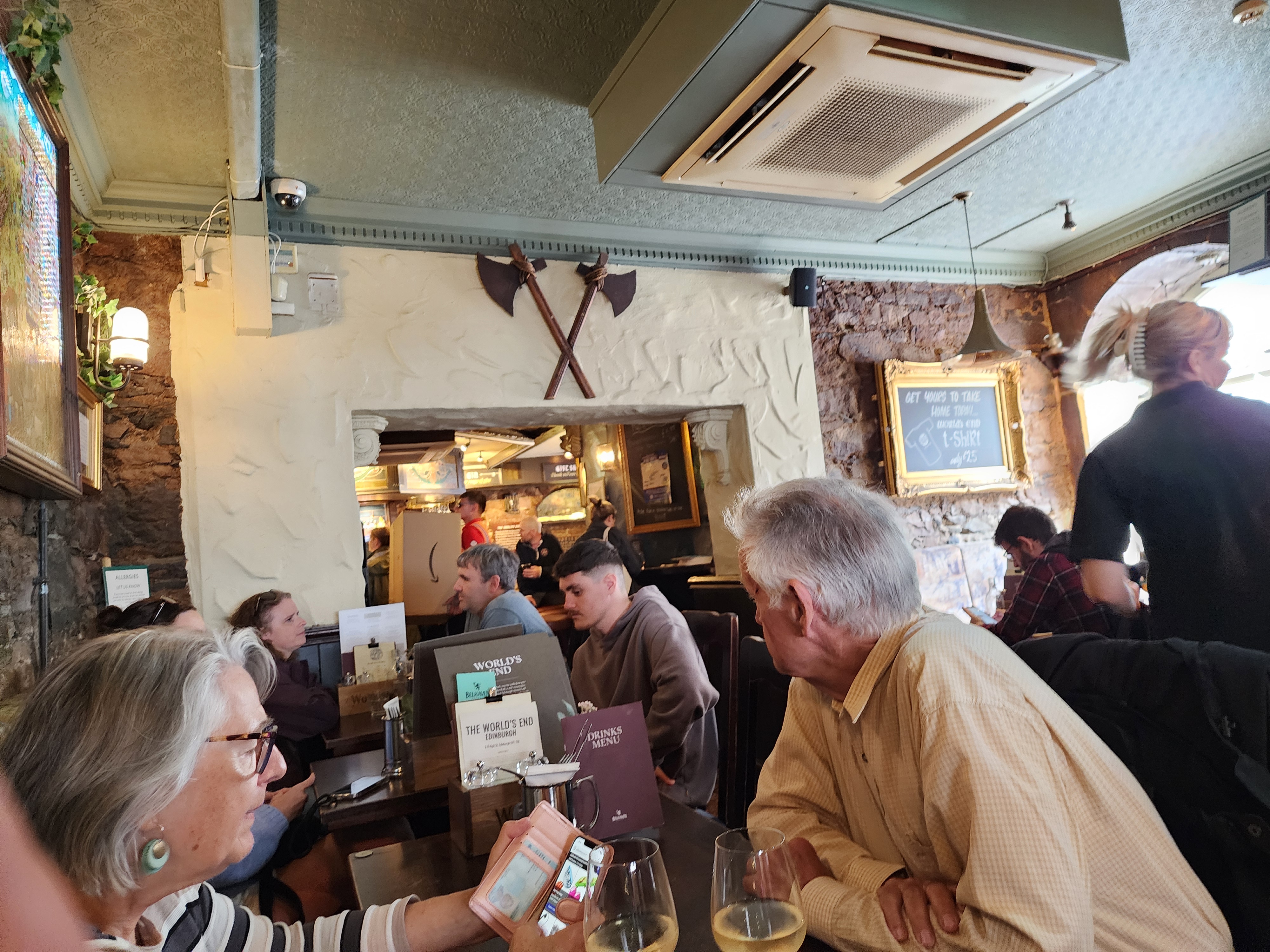
Lunch at the World’s End Pub

Then I somewhat enjoyed lunch at the World’s End Pub, which has been in business since the 1700s, when the wall to Edinburgh ended right beside the pub.  I had made a reservation reluctantly (because really, a reservation for a pub?), but I was glad I did, as they only have about 6 or 7 tables to dine at, and a steady clientele.  I tried their fish and chips, and while it looked very nice on the plate (accompanied by green peas, not at all mushy), it was surprisingly dry and tasteless.  The tartar sauce interested me because it wasn’t like tartar sauce at all—it was creamy like yogurt with something crunchy in it.  Maybe onions.  I am glad I actually went to the World’s End, since it is a tourist trap, but I wouldn’t go again.  The pursuit for Scotland’s best fish and chips continues.

At the end of the weekend I was bushed.  Still not over my cold, I rather wore myself out trying to squeeze all the goodness I could out of the days.  But it was a fun weekend.  I wish you had been there.

Yurts on Loch Katrine

View from South Queensferry

Chocolate flight

One of the toppings I thought about putting into my chocolate bar

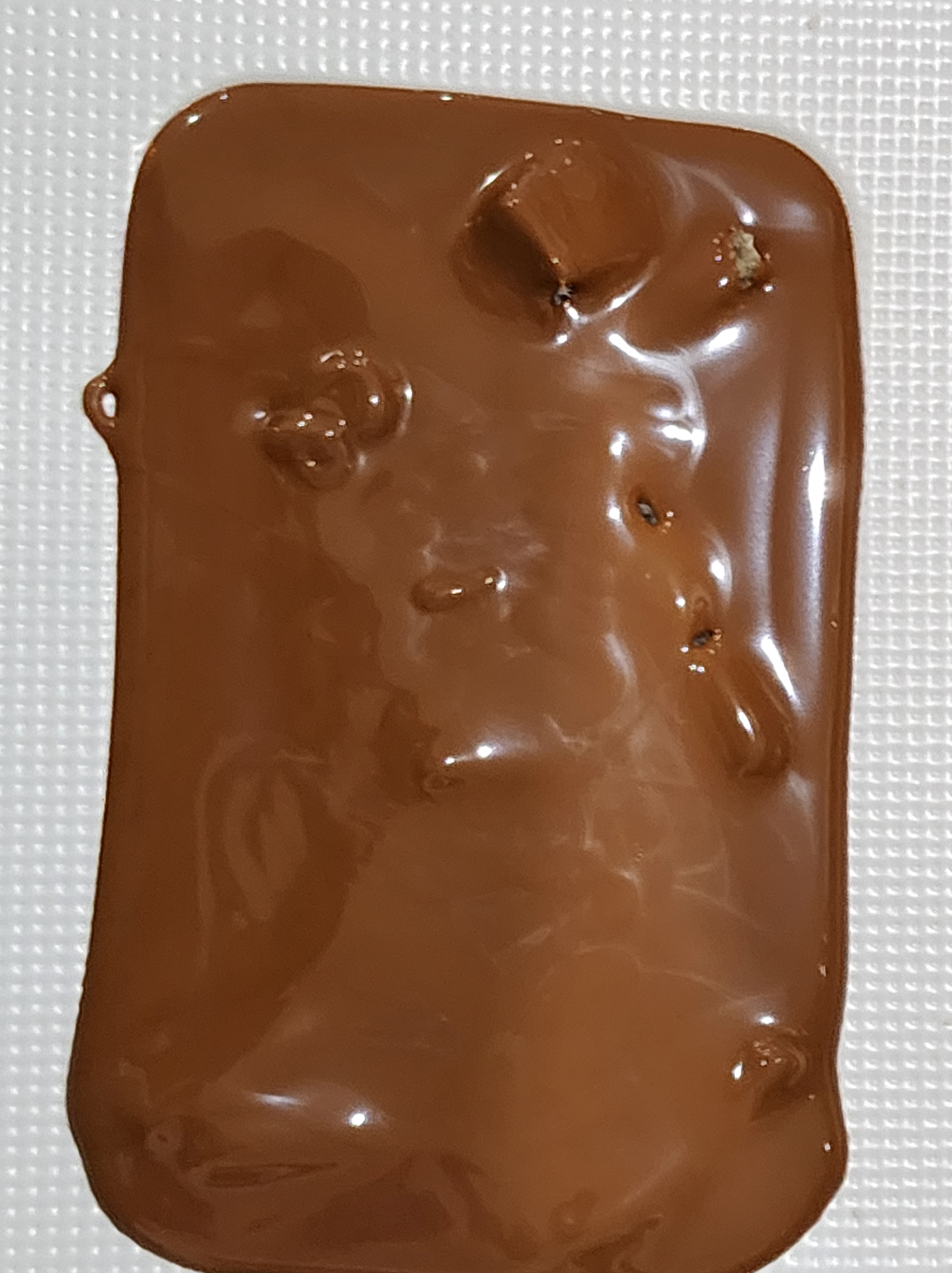
A tube of liquid chocolate for the mold

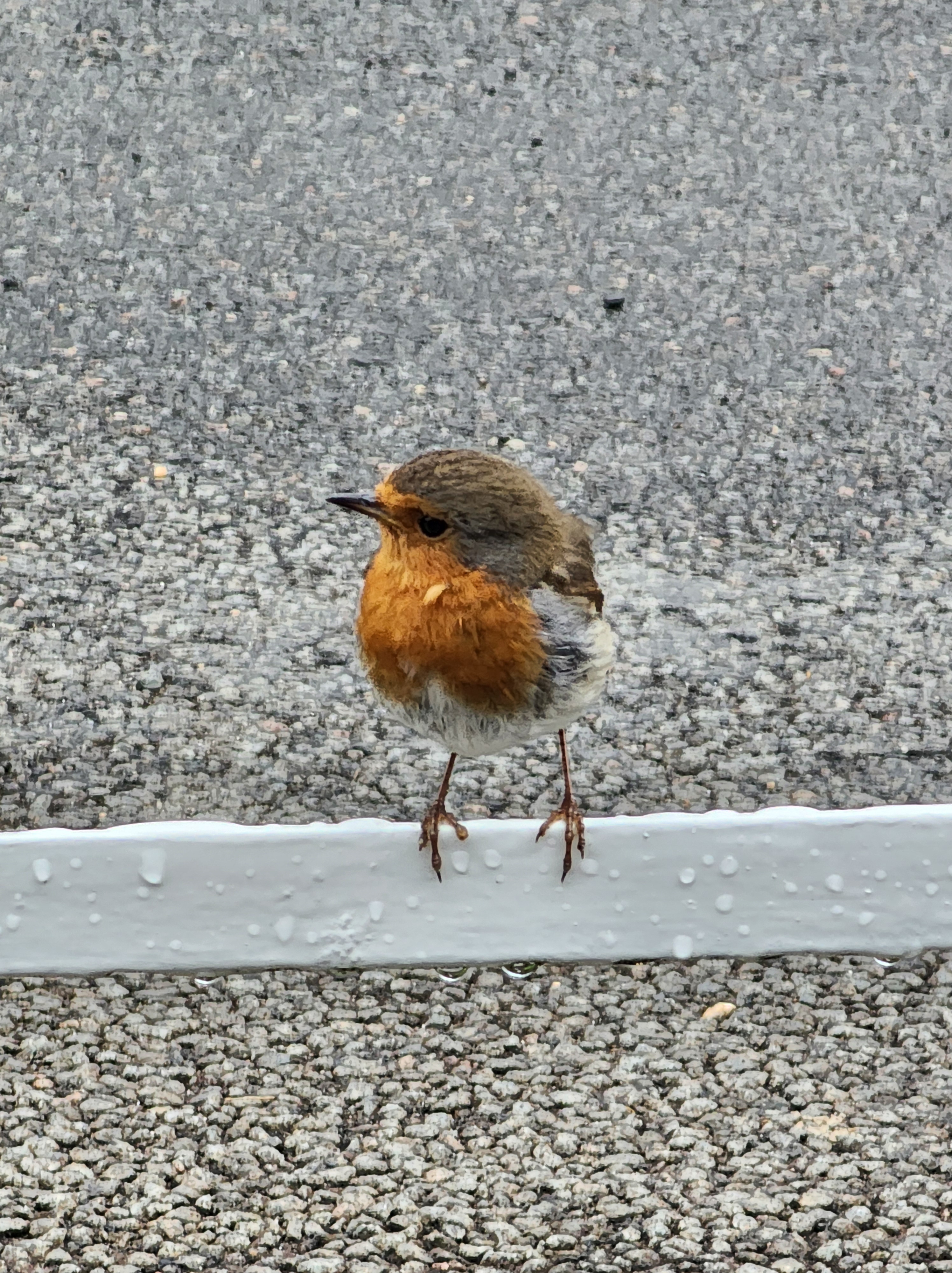
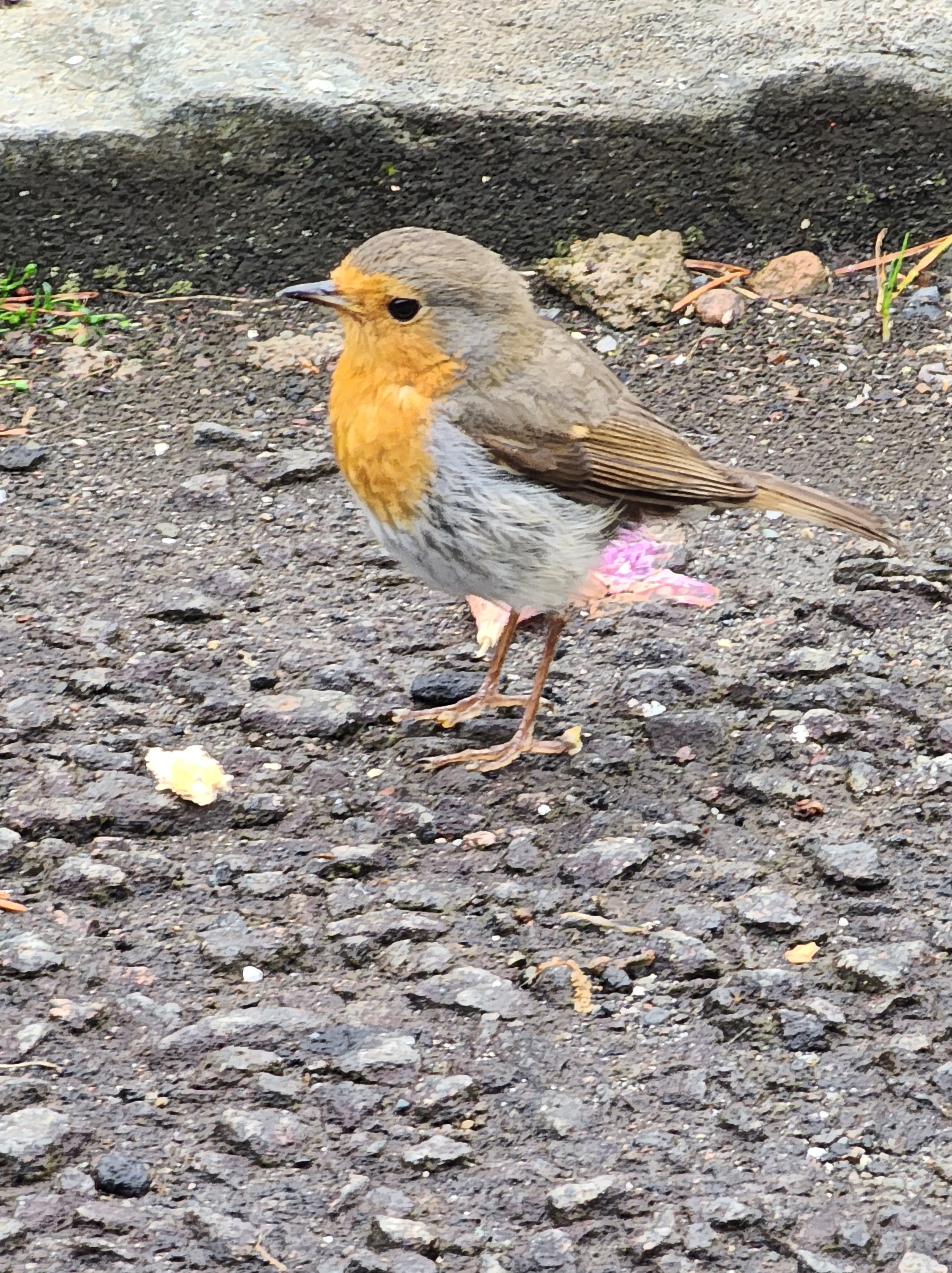
A wee sweet birdie

A view of Holyrood…do you see the plane?

Loch Katrine

No one fell overboard, thank goodness

A pretty flower in the rain

He looks sad, this sweet coo

The wee bird again

The Glenturret mash tun

Boat launch

My candy bar cooling in the mold

Loch Katrine

The two Aussies in the front of the picture talked to me all through lunch at the pub

On the deck of the Sir Walter Scott

A second chocolate flight

Orange rind and ginger for my candy bar

Another sweet coo

Scotland 3.0

Now that it’s past my birthday—in other words, half-way through May—I’m feeling the nervous energy of going back to Scotland this summer.  There’s so much to do to get ready—laundry, packing, teaching prep, laundry (did I mention that already?) and so much on my mind.  As much as I enjoy being in Scotland, which truly feels like a second home, there are adjustments to be made—in temperament, in expectations, even in time management—and it’s hard leaving my life in Georgia.  I’ll miss C, I’ll desperately miss my cats, and I’ll miss my very American creature comforts (like pizza and a king bed).  And while the compensations are many, it’s hard being absent from my everyday life for two months. I can hear some of you say, “Oh poor JC, how hard it is for you to live in a beautiful country full of culture and mystic mountains and men with sexy accents, you poor dear.” Well, I did say there are compensations, after all.

This time I’m teaching only memoirs/ nonfiction.  In the past, I’ve taught memoir, fiction, and poetry (to greater or lesser success) but I’ve revised what I want students to do for a big project this time around.  I want them to write their own travelogue, specifically about Scotland.  They will be reading Jackie Kay’s Red Dust Road, Kathleen Jamie’s Findings, Robert McWilliams The Kiss of Sweet Scottish Rain:  a Walk from Cape Wrath to the Solway Firth, and for a dash of fun, Sam Heughan’s and Graham McTavish’s Clanlands: Whisky, Warfare, and a Scottish Adventure Like No Other.  The authors are two actors in the Outlander show, and while it’s not AMAZING literature, it’s definitely charming and gives a different perspective on Scottish life. 

Hopefully my students will look past the fact there’s a lot of reading (though it’s not hard) and just allow themselves to get sucked into the stories that are being presented. I also thought only having them have to read 4 books instead of 6 or 7 as I have done previously might allow them to go deeper into the material. We’ll see.  (I am afraid they—and I!—might get bored droning on about the books for 5-6 days at a stretch, but hopefully we can co-create knowledge that we’re all interested in.)

I have been reading other books for insight.  I read (most of) Sally Huband’s Sea Bean:  a Beachcomber’s Search for a Magical Charm: a Memoir, which is about a woman who searches the beaches of the Shetland islands for useful detritus, specifically sea beans, which are seeds of large plants that have drifted across the ocean. Finding one is, apparently, quite a prize, especially if you can get it to grow. I’ve just gotten to the part where she starts discussing how much plastic washes up on shore, which breaks my heart to think about those relatively pristine islands being befouled by floating garbage/ plastic.  But I chose not to have the students read this book because it wasn’t—if you’ll forgive me—Scottish or memoirish enough.  And it’s also very slow.  But I’ve certainly enjoyed learning about the Shetlands, and I hope to finish the book soon. 

Another book I’ve been working my way through is Lochs & Legends:  A Scotsman’s Guide to the Heart of Scotland, by Andy the Highlander (Andrew McAlindon, with Lily Hurd) which is kind of an armchair history of Scoland.  It’s light but informative.  Finally, I picked up Scotland: The Story of a Nation by Magnus Magnusson, but let’s be honest, it’s thick and I’ve only been using it as a doorstop. I need to actually crack open the spine and read some of it.  (But it’s thicccc with four C’s!) I do like to give a mini lecture on Scottish history at the start of the class, and I got this book to help me do that.  I swear I’ll start reading it ASAP.  Maybe tomorrow, in other words.  (Haha.)  I do have other notes on Scotland prepared, but I did think this book would add some richness to my knowledge—of course, I should have been reading it all along.  Mea culpa.

Truly, I am looking forward to my third summer in Scotland, and I hope to do a few new-to-me activities, like go to the Writers’ Museum, visit St. Giles’ Cathedral (and this time actually going in instead of hemming and hawing about spending £5 for the entrance fee), maybe take a Ghost Tour, and finally, finally, finally take one of the double-decker tour buses around the city.  (I keep saying I’m going to do that, then I never do.) I also thought about going to Surgeon’s Hall, especially because Kathleen Jamie writes an essay about it in Findings, but honestly, I’m too afraid of being squicked out. (I do have a low tolerance for yuck… even if it would be intellectually interesting and teach me a lot about the history of medicine.)

Anyway, I promise you lots of pictures and lots of reporting on my visit… one more thing I have to add to my never-ending list of things to do in the coming weeks! (Oh dear!)

Loch Ness & the Highlands, 2.0

I thought taking a two-day tour to Loch Ness and the Highlands would prove to be twice as good as last week’s one-day tour, but I wasn’t as impressed with the tour this time.  Don’t mistake me, I loved seeing both sights again, but the tour itself was lacking.  For one thing the tour guide had the personality of a flaccid noodle; whereas the other tours I’ve taken the guides have been chock full of stories and history and chatter, this guy was sparing to the point of laconic in his speech.  For another he didn’t seem to have a real itinerary, which offended me.  He kept asking the tour group what we wanted to do.  (I was like, dude, this is your country—you show us what we should see.)

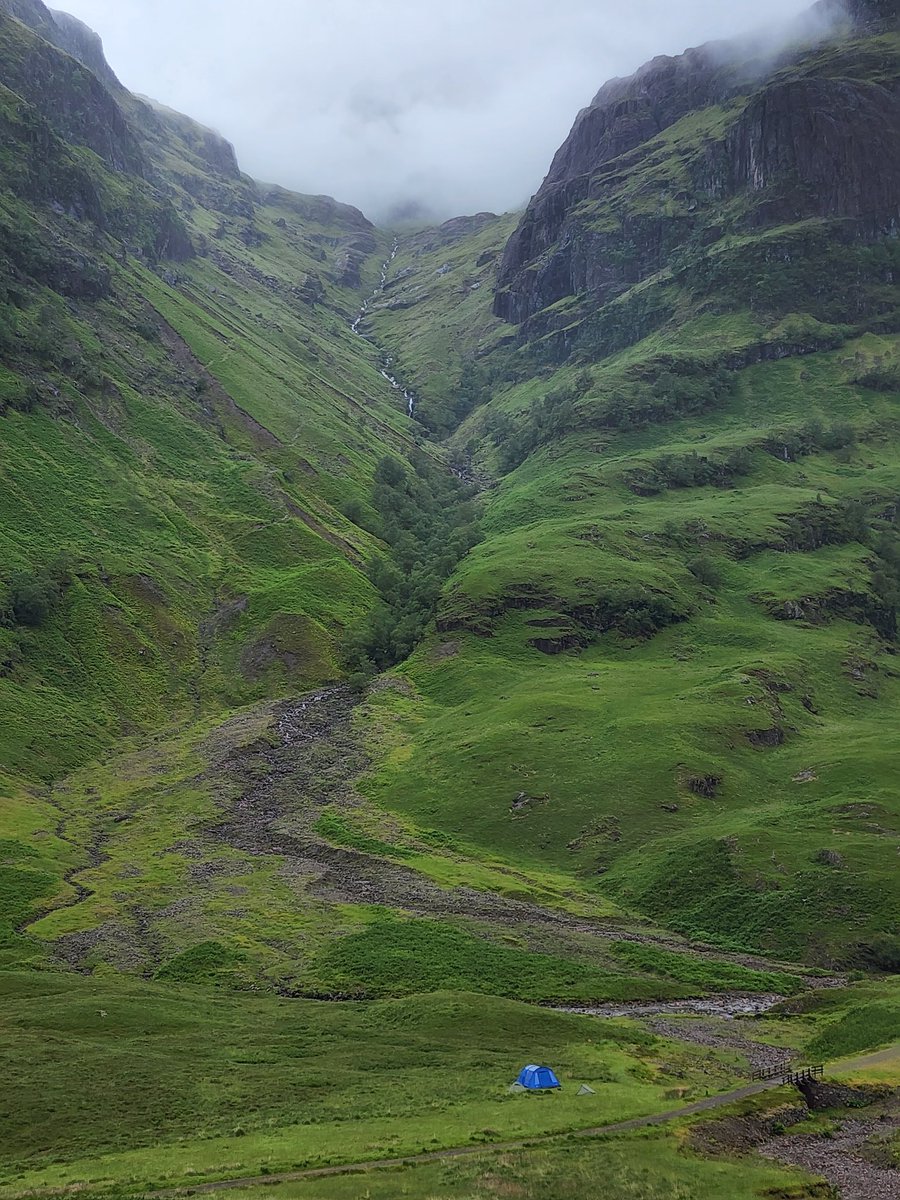
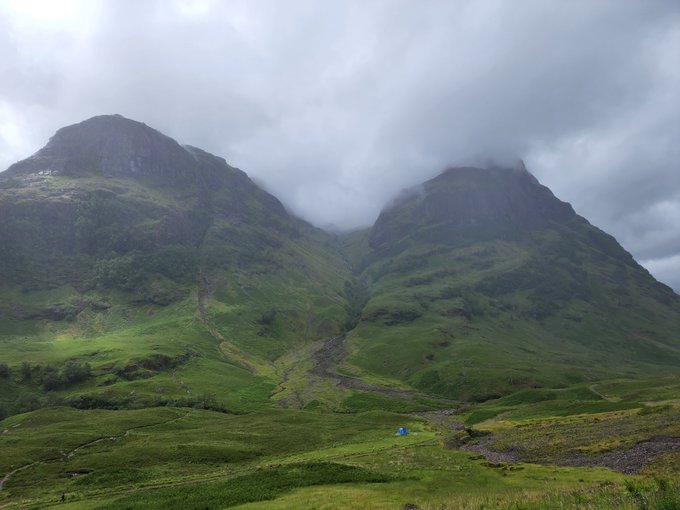
A burn (little creek) in the Three Sisters. That little blue thing at the bottom is a tent!


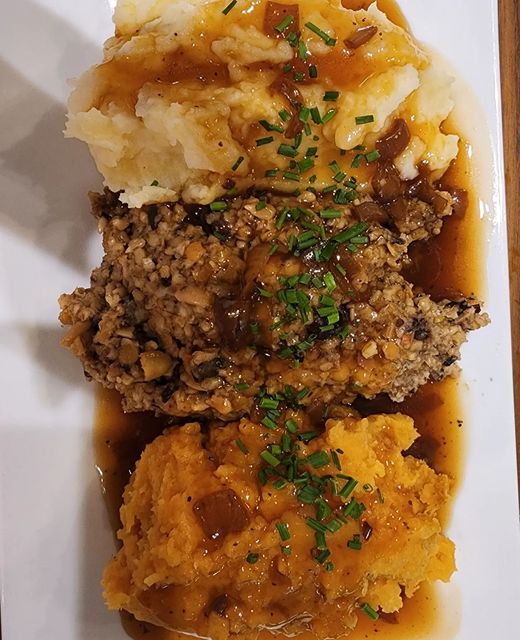
We hardly stopped our drive at all.  We did go to Loch Lubnaig and the Three Sisters in Glen Coe again, but there were other places we might have stopped even for just a few minutes to take pictures. We stopped in Ballachulish at the Clachaig Inn where I made a fine lunch of (vegetarian) haggis, tatties (potatoes), and neeps (turnips), but it was a surprisingly heavy meal that I couldn’t finish.

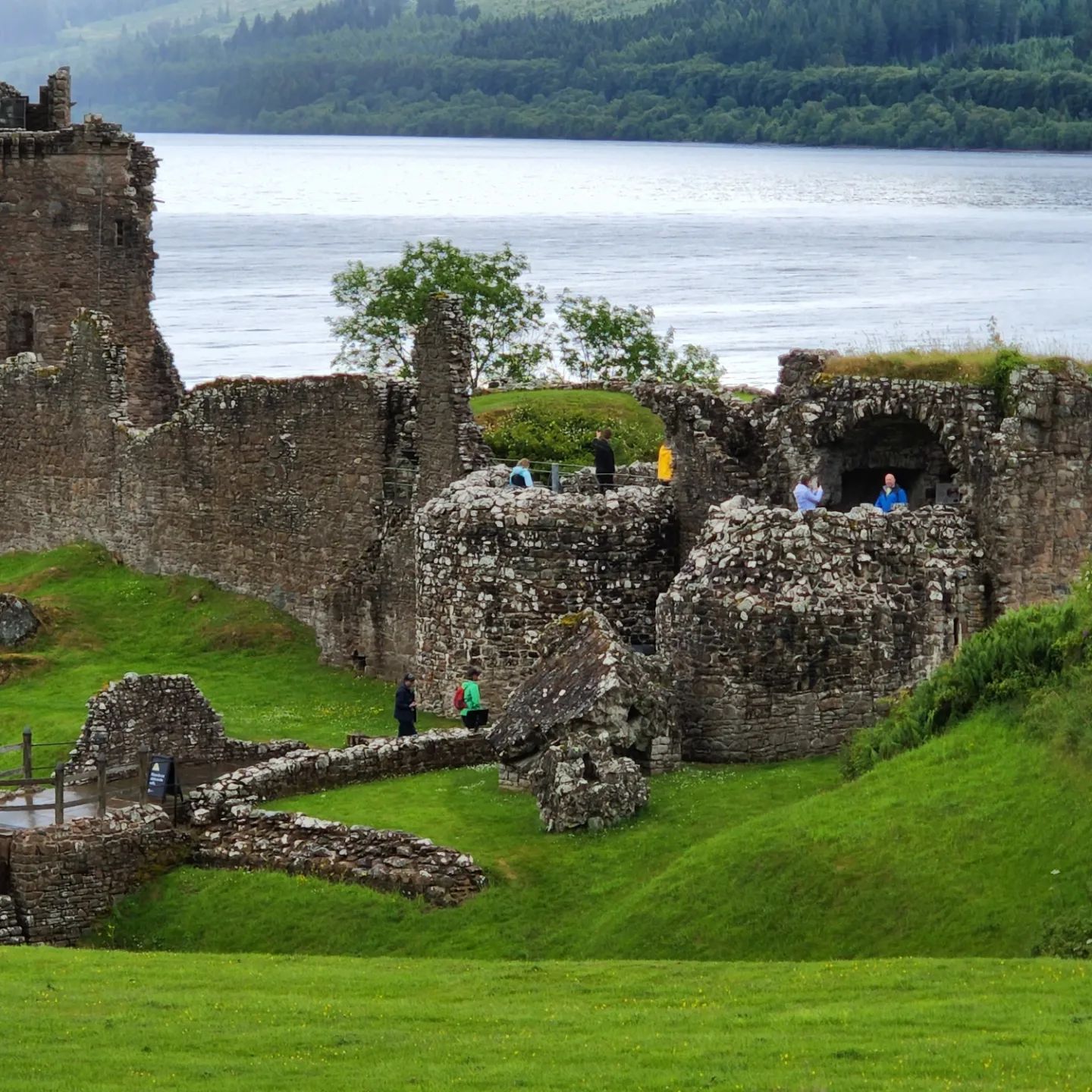
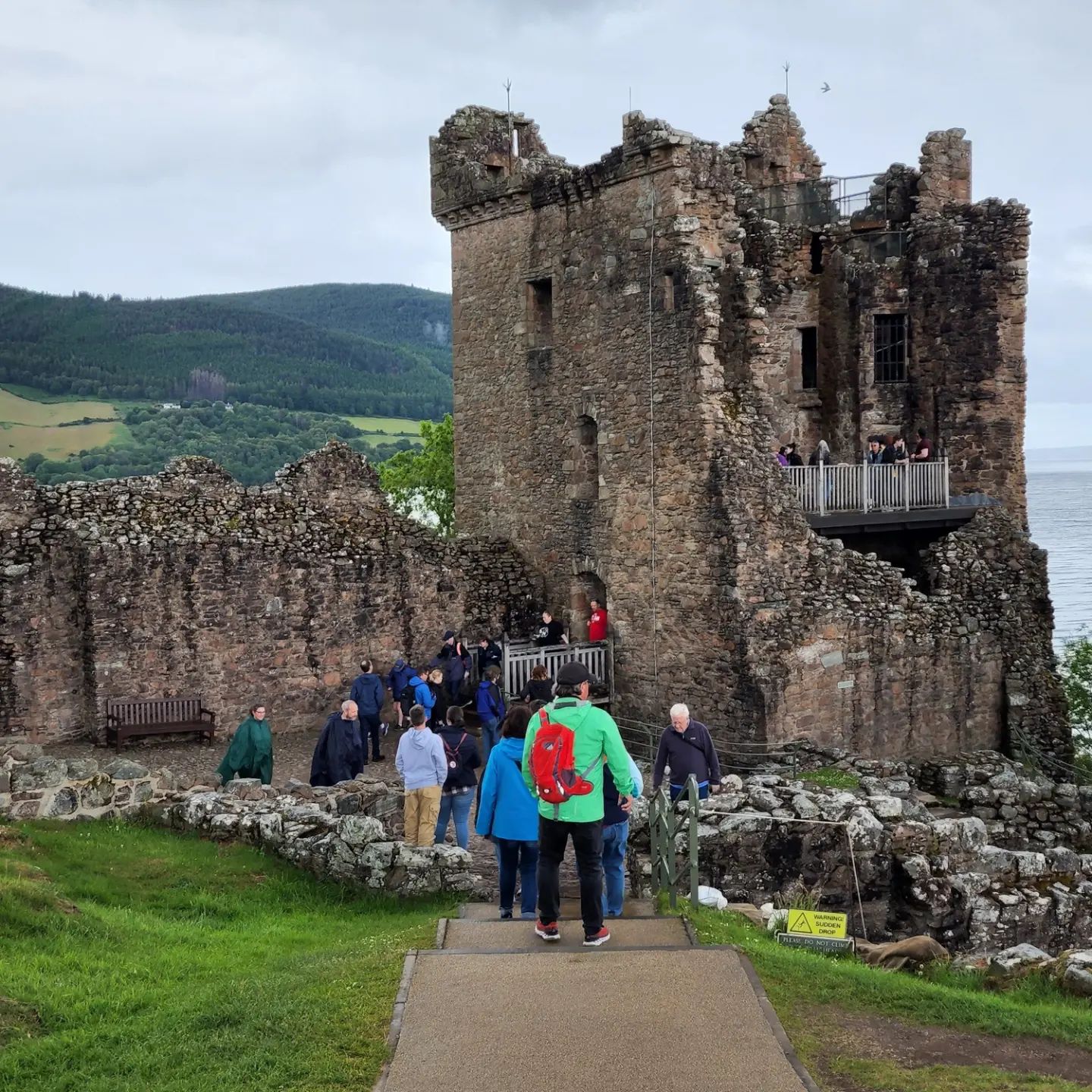
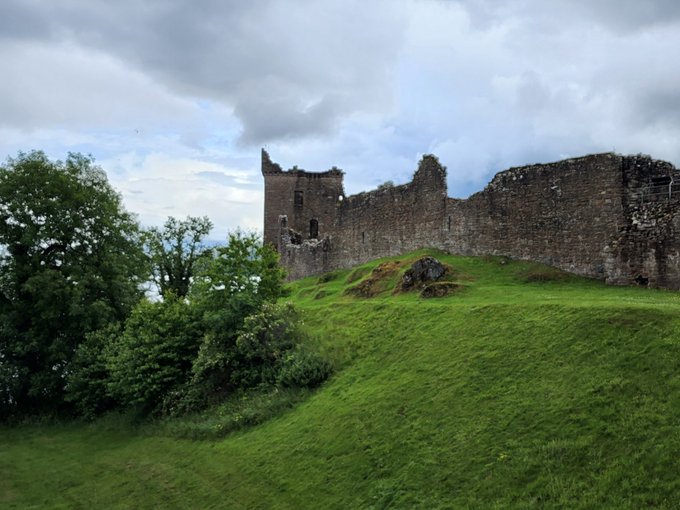
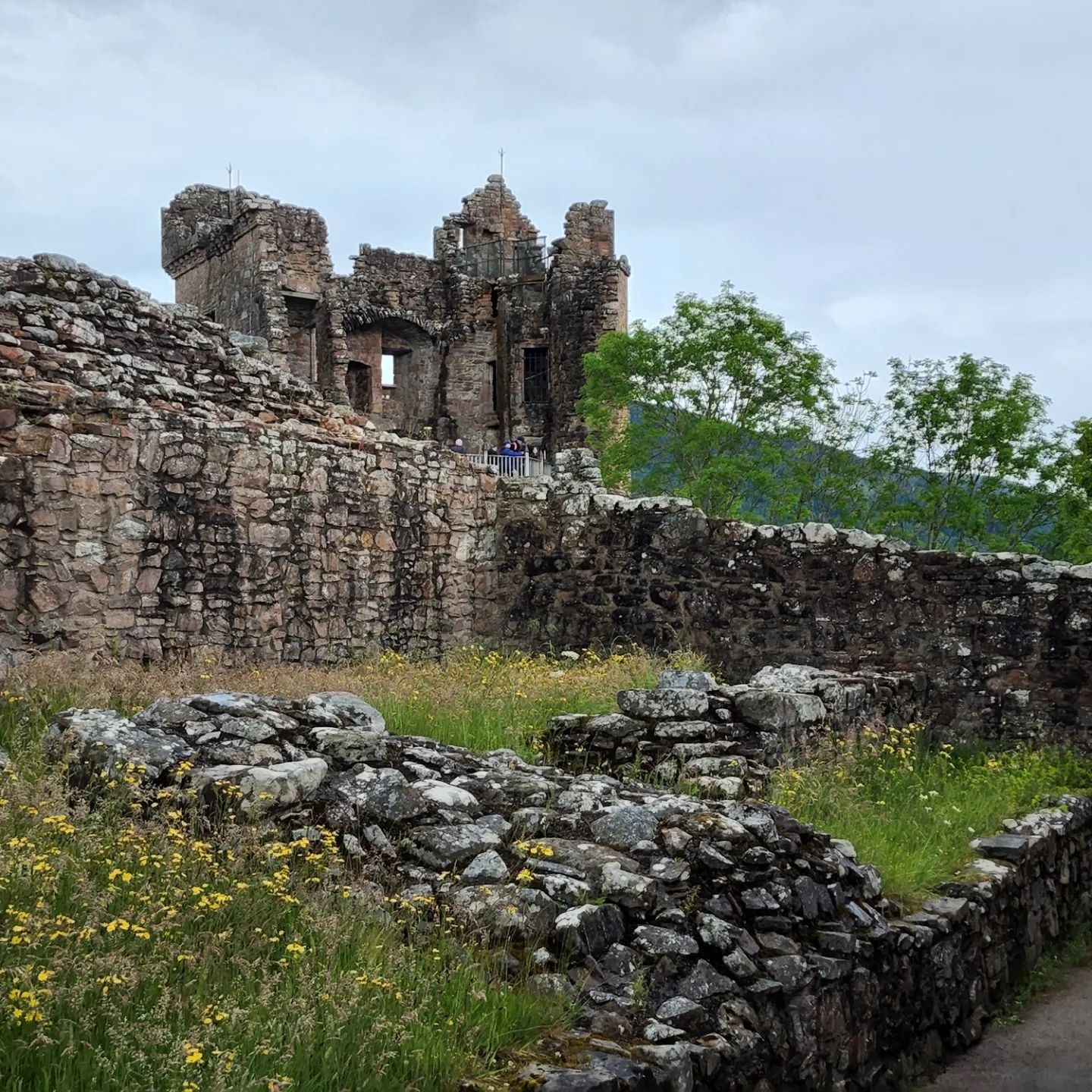
Urquhart Castle, with Loch Ness in the background

And then we drove to Urquhart Castle, a little south of Inverness.  I know I said, “Once you’ve seen one castle, you’ve seen them all,” and I kind of stand by that statement, but I love ruins, and this castle definitely qualified. There wasn’t much to see since it was half knocked down but ruins speak to me in a way that preserved castle buildings don’t.  And the setting, of course, was lovely, as the castle was on the banks of Loch Ness.

The other people in the tour decided to take a boat ride, but as I took a boat ride on Loch Ness last weekend, I didn’t want to repeat it.  And it was just as well.  It started pouring.  I felt so bad for the rest of them because they got soaked, while I enjoyed some extra time in the gift shop and café, perfectly dry.

“Lay on, Macduff, And damned be him that first cries ‘Hold! Enough!'” (Inverness Castle)


And then it was on to Inverness.  I didn’t see as much of Inverness as I wanted.  Once I got to my B-and-B, Eskdale Guest House, I was kind of super tired and just kind of conked out in my tiny single bed right next to the radiator.  In the morning, I saw a little bit more of the town, but I didn’t get to visit Inverness Castle.  I thought it was closed, because of the time we got to Inverness the night before (6 p.m.), but actually it’s not open to the public.  I was disappointed because I really wanted to see the castle where I thought MacBeth would have lived (although he was King from 1040-1057, and technically the first castle was put up in 1057, so he didn’t live there after all), but I still wanted to see it.  The current castle was put up in the 19th century, and it’s veneered with lovely red sandstone.  And it’s in great-looking condition, though there was orange plastic fence all around it because they are doing repairs.

Who dis? It me!

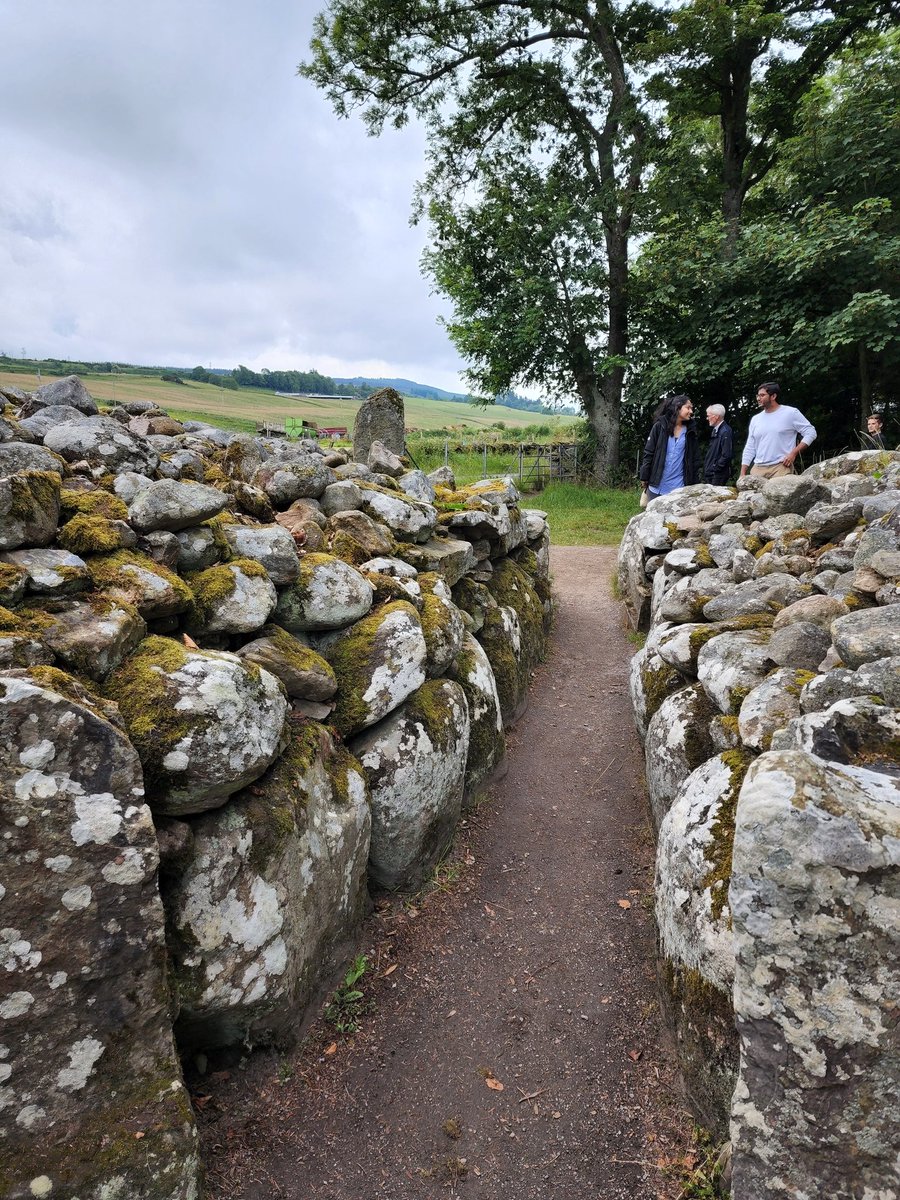
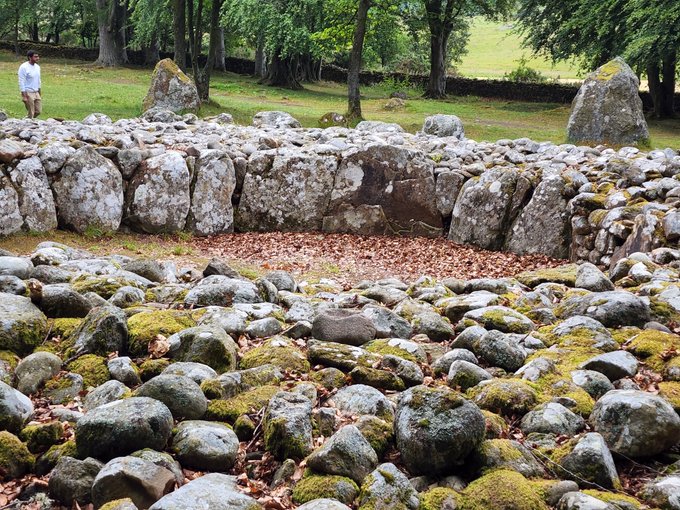
The trip home was not exciting.  We made several stops for walks-in-the woods, which, if you know me, wouldn’t be my first choice.  One stop was at Loch an Eilein, in  Rothiemurchus Woods, and this was a pretty little loch.  I took the path beside the loch, but wanted to get a good picture from a different vantage point than the pictures I took initially (which, let’s be honest, were mostly about the ducks), and of course, I stumbled over a root and went down like the proverbial ton of bricks, getting mud all over my jeans, tearing holes in my sneakers, and fouling up my knees and legs and arms something fierce.  It never fails. This is why I don’t go hiking.  (Because the woods always try to kill me.)  And then, to add insult to literal injury, in trying to get back up, I fell again.  I was disgusted and filthy, and was glad to get back on the bus.  Then we stopped at another walk by the Tay River (?) and the river was quite pretty, but I didn’t walk too far because my ankle was throbbing and I knew that I was tempting fate to go into the woods a second time. So I found a picnic bench and watched the water.  We also stopped at the scenic Cava Cairns, big piles of stones used for burial and other religious purposes.  Actually, I kind of dug them.  One of the other people on the tour took my picture at the center of one.

The best part of the trip back was stopping at Dalwhinnie distillery, where I tried a flight of whiskies which were paired with festive chocolate truffles.  I didn’t have my camera on me, or I would have taken a picture of the drinks, but of the three of them, the 15-year, the Winter something brew, and the Distiller’s choice, I was partial to the 15-year.  It was raining and cold then too, so the whisky poured a little fire into our bellies.  Of course, the last thing I needed was three “wee drams” on an empty stomach, but fortunately I wasn’t driving.  Or required to stand upright for any length of time. 😉

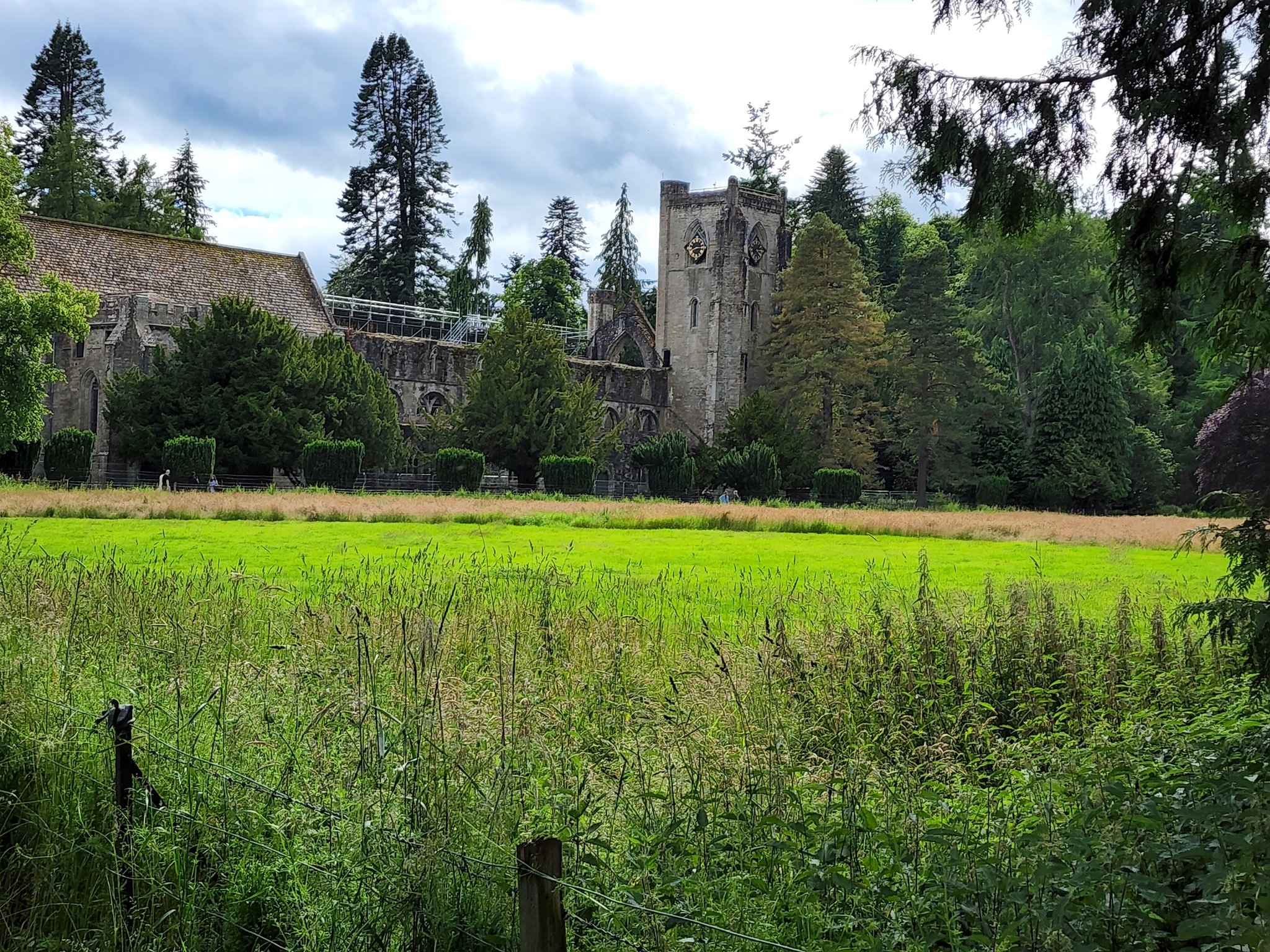
A church missing its roof in Dunkeld

Afterwards, we stopped for lunch at Pitlochry and I ate fish and chips at McKay’s Hotel. The haddock was perfectly fried and crispy though it needed salt. I wish we had longer than an hour because Pitlochry’s High Street was full of cute little shops I would have liked to look in.  I might have considered skipping lunch, but the whisky was strong with this one, and I needed to offset the booze.  And then we stopped in one more place (Dunkeld) for another walk, where I saw a lovely church in the process of being restored.

In writing this down, I guess we stopped a quite a few places after all, more than I initally remembered, but because the tour guide didn’t really bother telling us about anything, it seemed like kind of a wasted few days.  I guess I’d have liked fewer walks in the woods, and more actual stops at things to see.  But everyone else seemed to enjoy themselves so perhaps my attitude was crappy.  And maybe I expected too much—but after the last few tours, I guess I was a little bit spoiled.

I still have a few more weekend tours planned, so I’m hoping they will be a little more energizing and interesting than this weekend’s.  But it was good to get back to the Highlands.  I just kept thinking how great it would be to live there part of the year (winter). I could so see myself in a little semi-restored farm house, with a sheep out back and a cat at my feet, where all I would do is drink hot tea, eat fresh scones, and write, write, write my heart out.  Maybe some day.

Hope you enjoy this new batch of pics!

Urquhart Castle

Lunch at Clachaig Inn–tatties, haggis, and neeps covered in a tasty brown gravy

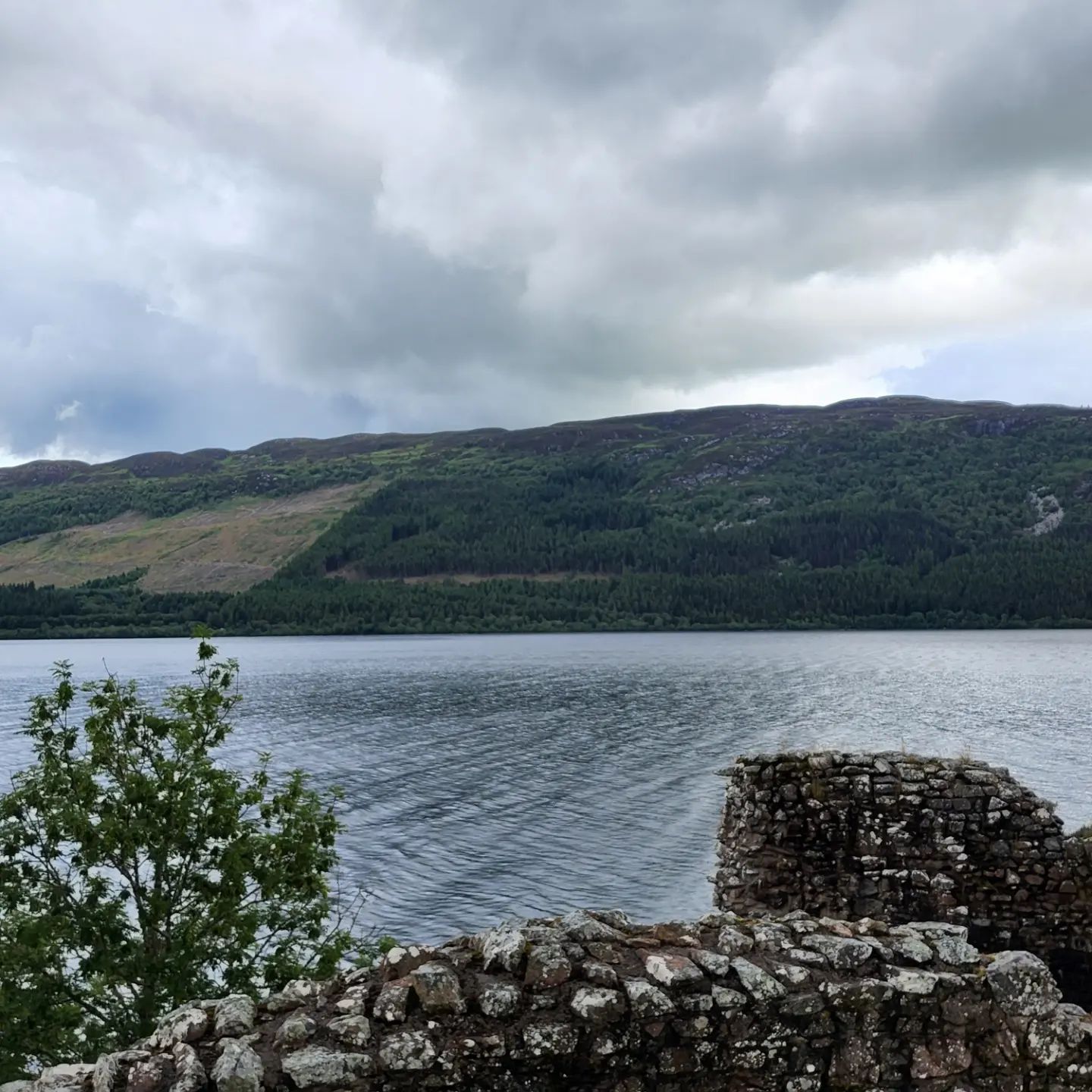
Loch Ness, from Urquhart Castle

Urquhart Castle

Urquhart Castle keep

A view of Loch Ness from Urquhart Castle. In the middle left, you can see signs of tree farming. For every tree cut, Scotland plants 2 more.

A friendly gull

A lovely field at Dunkeld

A train bridge at the Hermitage, near the Tay (?) river

The train bridge from a further vantage point

Loch an Eilein… For this view, I injured myself. You’re welcome.

Mama duck at Loch an Eilein (Rothiemurchus Woods)

As soon as I sat down, these ducks came out of the water to see if I had anything to feed them. Sadly, I did not. (Loch an Eilein)

View from the center of a cairn in Cava Cairns

Ring Cairn, at Cava Cairns

Another view of Urquhart Castle

Another burn in the Highlands

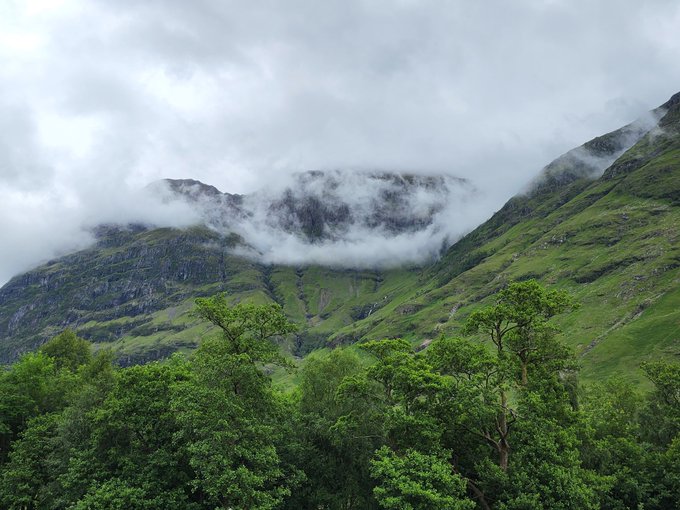
Low hanging clouds in the Highlands (Ballachulish)

Inside of the Clachaig Inn, where I tried veggie haggis

Three Sisters (well, two of them, at any rate)

Another two of Three Sisters

Glen Coe, looking north

A sunny day at Loch Lubnaig

Glen Coe Mountain (from the back)

Glen Coe Mountain, with even more clouds

A view of Edinburgh Castle from Princes Street on the ride out of town

The Highlands & Loch Ness

Loch Lubnaig

Loch Lubnaig

I felt the call of the Highlands this weekend—and suddenly I know why so many medieval romance novels are set there.  They are mystical and majestic, full of history, but more than that, they are primal.  They spoke to me on a profound level; as soon as I stepped foot in the mountains, I felt something—a pull from the Earth I’ve not felt before.  Of course they were already quite beautiful from what I saw on the drive, but once we stopped at Loch Lubnaig—and I touched the freezing water—some fairy magic was transferred. I got the Highlands.  I imagined stories I could tell; I saw characters coalesce in my mind almost instantly.  It felt like a writer’s high.

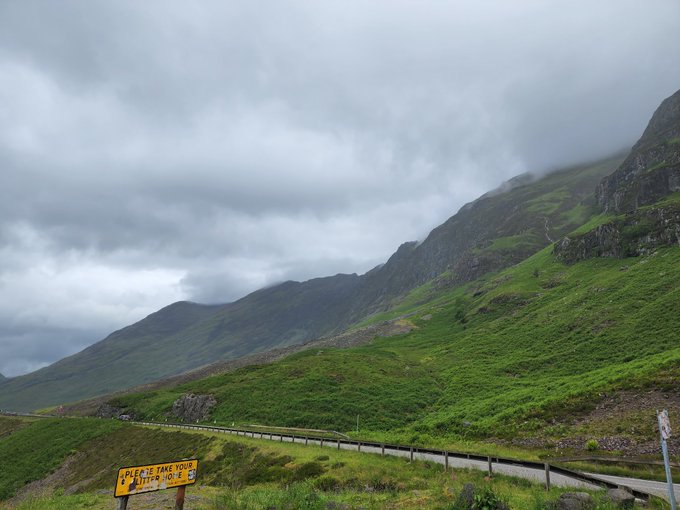
We stopped a number of places—Glen Coe (the “valley of tears”), where members of the Clan MacDonald defied the King and refused to pledge loyalty so they were all slain in their beds; the Three Sisters, a trinity of mountains also in Glen Coe (but a different part), that were wreathed in mist and rain; and of course Loch Ness.  I can’t be sure, but I saw a shadow which might have been Nessie.

Loch Ness

I loved Loch Ness.  I took a boat tour, and learned some fascinating facts about it, among which there is more fresh water in Loch Ness than all of the lakes in the Lake District in England, and the loch is so big you could fit all the people in the world in it.  (I don’t know how that would work, but I’ll take the tour guide’s word for it.)  Also, the loch is very deep and inky dark, so dark that you can’t see anything except by sonar after 25 meters, because there’s so much black peat in the water light can’t penetrate.  It’s basically like the loch version of a black hole. It was bracing and freezing to be on the water, and the wind actually buffeted people sideways on the top (open) deck of the ship.  I could have cheerfully stayed on the ship longer though, if that were an option, despite the wind and cold, because it felt right to be there—part of that magic I mentioned earlier.  Of all the things in Scotland I wanted to see, Loch Ness and the Highlands were the “Scotland-est.” (If you were to ask me before I left Atlanta what I think of when I think of Scotland, I’d answer “Loch Ness and the Highlands.”)  I’d always imagined going these places, and the reality did not disappoint.  I’m really glad I accidentally booked myself on another bus tour to see these places, because one time is not enough.

Entrance to Edinburgh Castle

Yesterday I finally dragged myself to Edinburgh Castle. I say dragged because I really didn’t want to go—if you’ve seen one castle, you’ve seen them all, right?—but also I had to literally drag myself up this huge stairway—Peter Somebody’s Staircase—because I took a wrong turn down Victoria Street and landed at the foot of the castle, instead of just walking the Royal Mile like I meant to from the bus stop.  Ah well.  My

calves are still sending me hate mail.

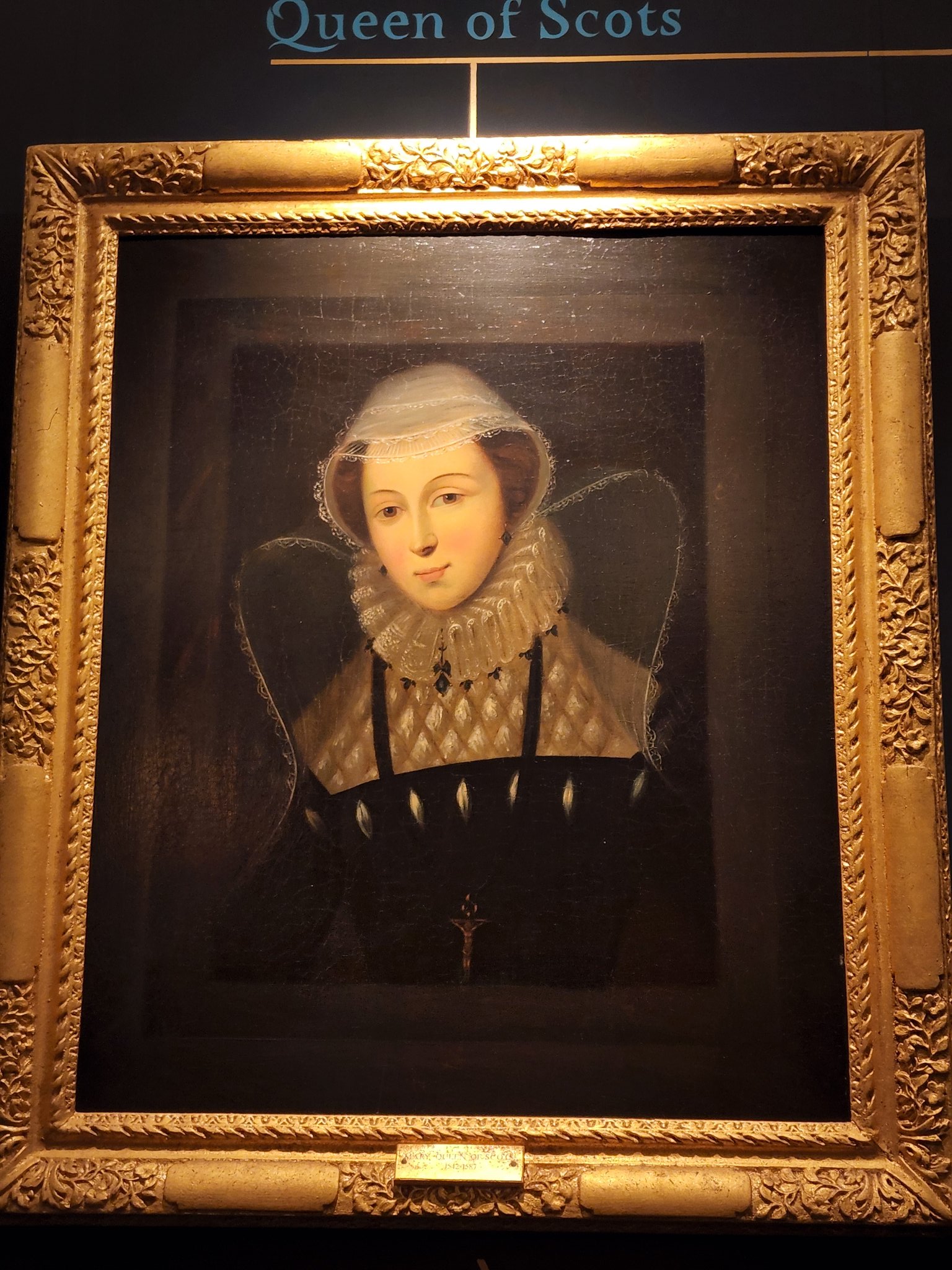
Mary Queen of Scotts

The castle was windy and cold—my favorite weather, especially in summer—and amazingly high above the city.  You could see all the way past the North Sea.  I liked seeing the Crown Jewels (a crown and a scepter, as well as the Stone of Scone [pronounced “skuun”] also known as the Stone of Destiny, the stone upon which monarchs are crowned which was stolen from Scotland by England’s King Edward in 1296).  Unfortunately, we weren’t allowed to take pictures of the jewels—I don’t know why—because they were kind of cool, though maybe not as ornate as I had expected.  Mary Queen of Scots was born at Edinburgh Castle, so after looking at the Crown Jewels, you got to walk through her rooms.  There was a room which had Mary’s family tree on it…it reminded me kind of like Sirius Black’s family tree mural from Harry Potter, adorned with beautiful and elegant portraits from her family.  You also could look into the birthing room, which frankly was literally the size of a closet.  There was also a lovely and ornate tapestry (and/or bedspread) she had made, but I didn’t get a picture of it because there were too many people in front of it and it was a dark room.  But the needlework impressed me.

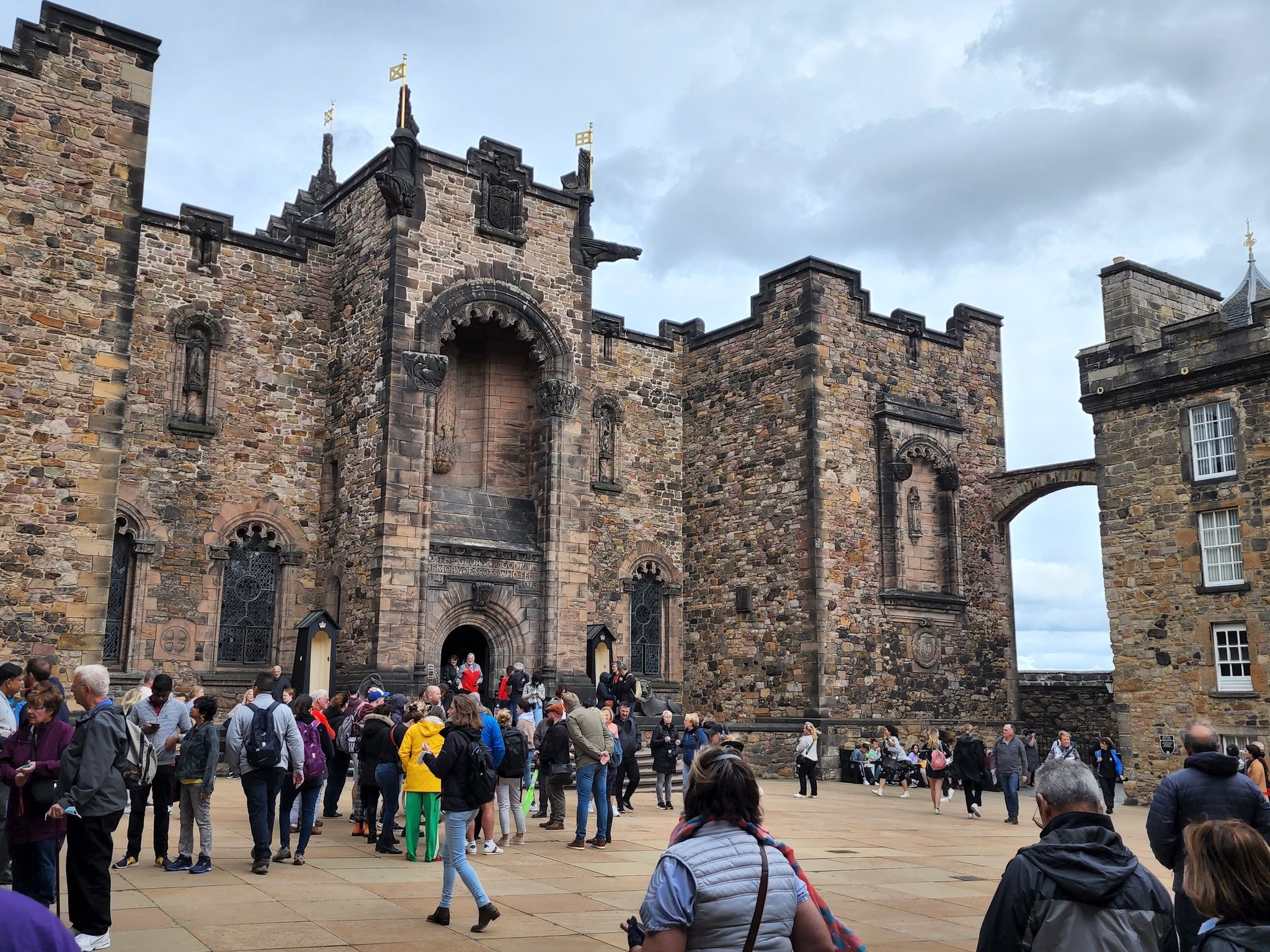
Scottish National War Memorial

I also scoped out the Scottish National War Memorial which was dedicated to the memory of the soldiers who died in WWI.  It looked like it should have been a chapel, not a war memorial.  Maybe it had been at some point?  But the sign said it was made in 1927 for the memorial’s purpose, which kind of amazes me because it looks like it was built part of the castle, if not originally, certainly more than 95 years ago.  I also peered in at the Great Hall, and perused the History of War Museum, and I can categorically state the only thing that interested me about the History of War was seeing the medals from the uniforms the men wore.  Some of it looks like jewelry.  And I love me some jewelry.  But the history of war leaves me cold—and with the exception of a brief nod to women as nurses, women’s role in the war(s) was ignored.  Overall, I’m not sorry I went to Edinburgh Castle, but between seeing it and Sterling Castle last week, I’m about castled out.  I appreciate their historical qualities, but they are surprisingly unromantic buildings (yes, yes, I know they are built for military purposes, not fairy tales), and seeing them in real life demystifies them in a sad kind of way.

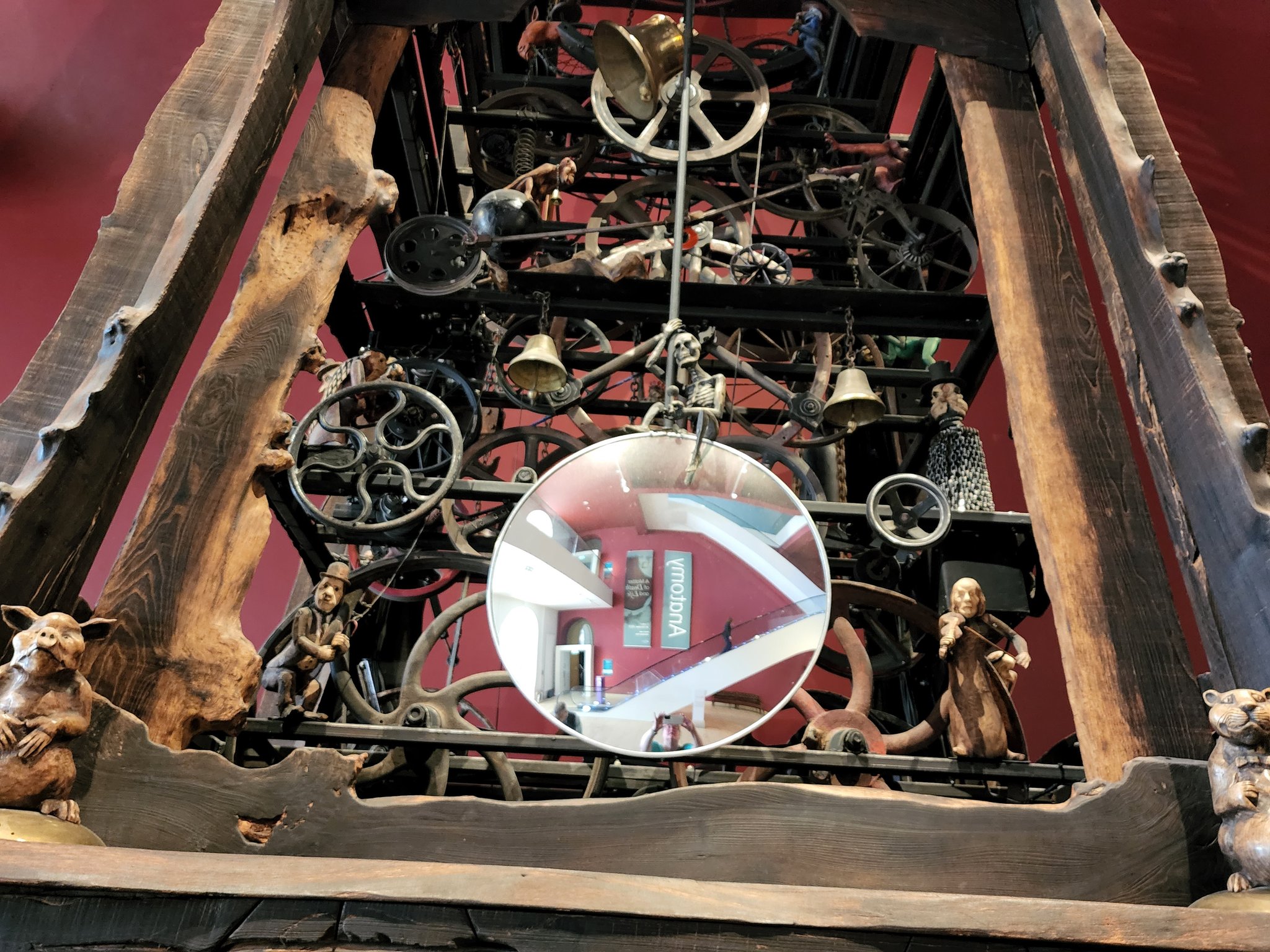
Millennium Clock Tower, National Museum

Backtracking a little bit, Friday I went back to the National Museum of Scotland.  I had intended on going to the Royal Scottish Academy of Art and Architecture instead, but when I got there, the guard told me it was closed because it wouldn’t have an exhibit until the end of July.  I was glad I went back to the National Museum—I got to see things I missed and enjoyed my leisurely walk through the collections.  Something I hadn’t seen the previous time I visited was the two-story Millennium Clock Tower.  If I had been on the first floor, I think I would have filmed it going through its various songs and chimes at 1 p.m., but I missed some of it and wasn’t at a good spot to film anyway.  It’s a wonderful clock though, with four levels—a Crypt, a Nave, a Belfry, and a Spire, to correspond to the way a medieval cathedral is constructed.  Apparently, it was built in 1999—but just like the War Memorial, it looks older than it is.  I really enjoyed looking at it, and seeing various parts lighting up as it rang.

Another thing I saw that was very interesting was their extinction/climate change exhibit.  You would never see such a indictment of things like oil and pollution in a governmentally-supported museum in the States.  Oh, it was critical of human destruction of the planet—and so bald about it.  I mean the exhibit just points out all over the place how human selfishness causes animal extinction events and how we are probably going to end up with a planet that is beyond saving.  Can you imagine if this were the Smithsonian?  Republicans would go bananas.  But I loved it.  It’s a devastating exhibit, of course, but I really appreciated its in-your-face predictions of climate doom. We need truth like that.

One thing doing so much on the weekends helps with is keeping my loneliness issues at bay—you can’t be too lonely when you’re tramping all over the wilds of Scotland as well as the less-wilds of the city of Edinburgh.  So I think I’m doing a little bit better with feeling disconnected and discouraged than I was earlier, which is a good thing, especially since I still have several more weeks to go before I return home.  I still miss folks, and the days are still too long.  But I’m coping.

Hope you like this latest batch of pictures.

A church in front of Edinburgh Castle. At the lower right you can just see a Fish and Chips seller.

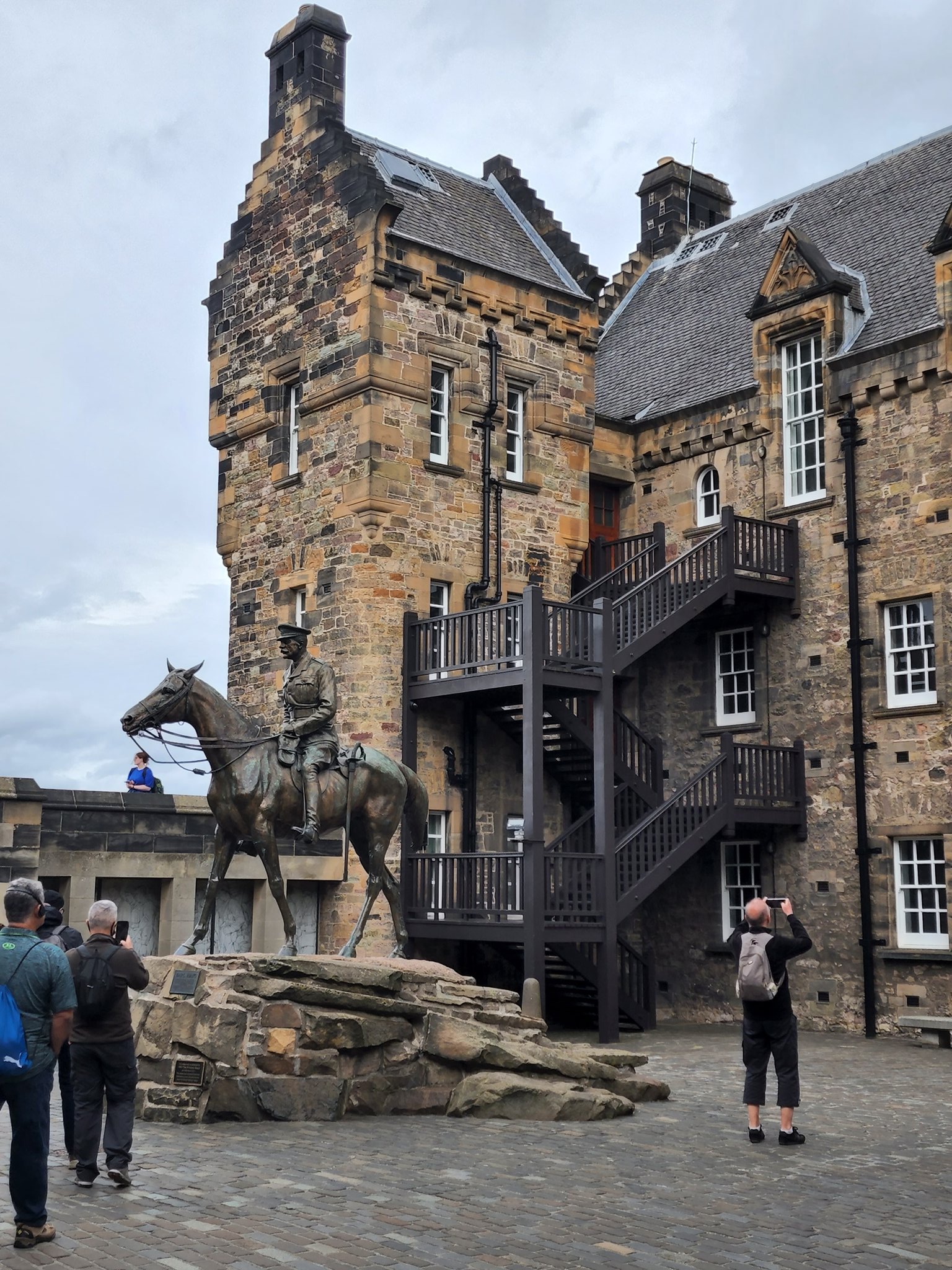
Field Marshal Earl Haig statue

View from the castle

I love the clouds in this picture. What you can’t see is just how steep this incline is.

The royal palace with clock tower

Upper ward courtyard

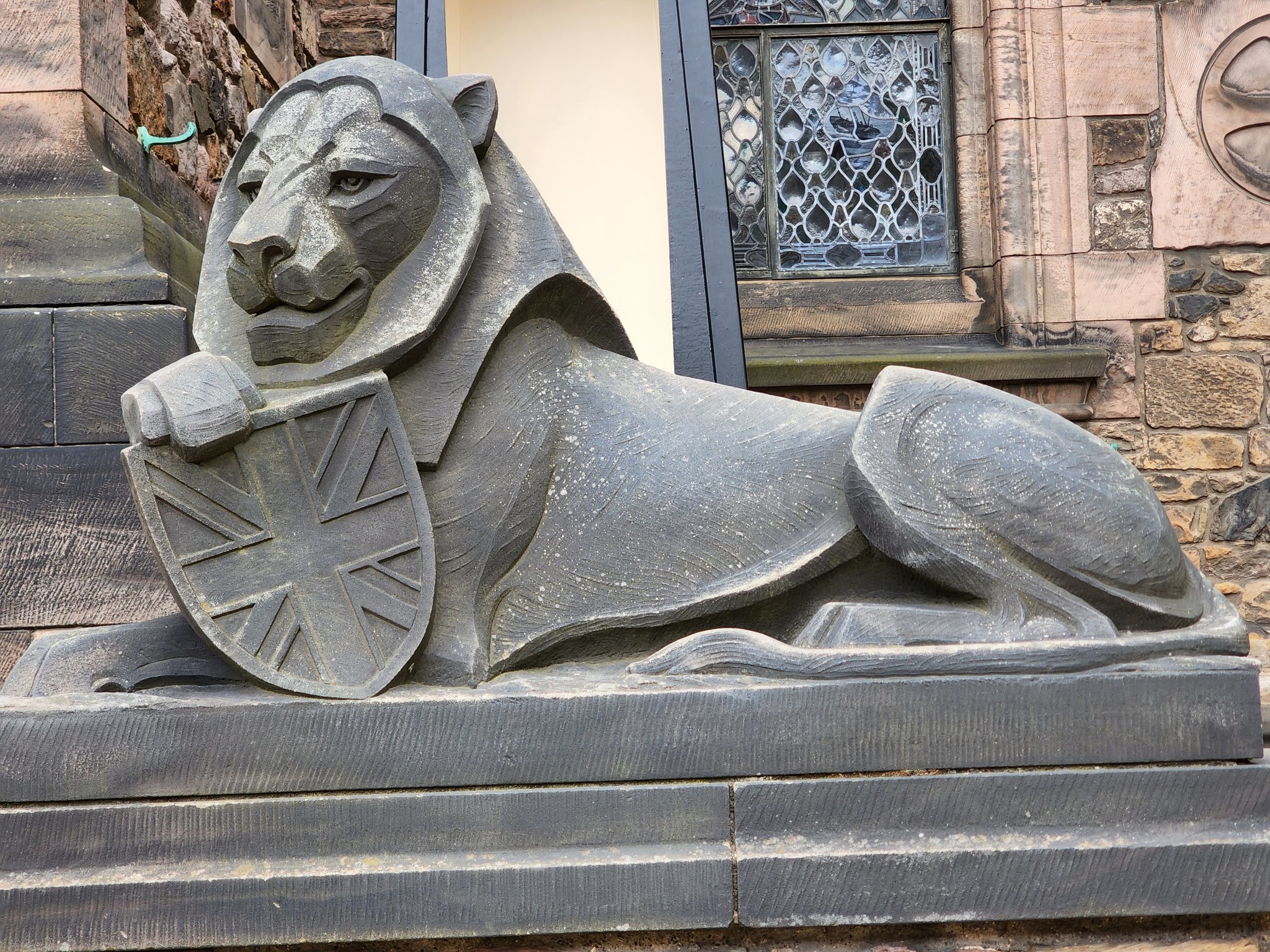
A handsome horse statue on the left side of the War Memorial

A debonair lion on the right side of the War Memorial

Ben Nevis, the highest point in Great Britain, with snow

The beautiful Highlands

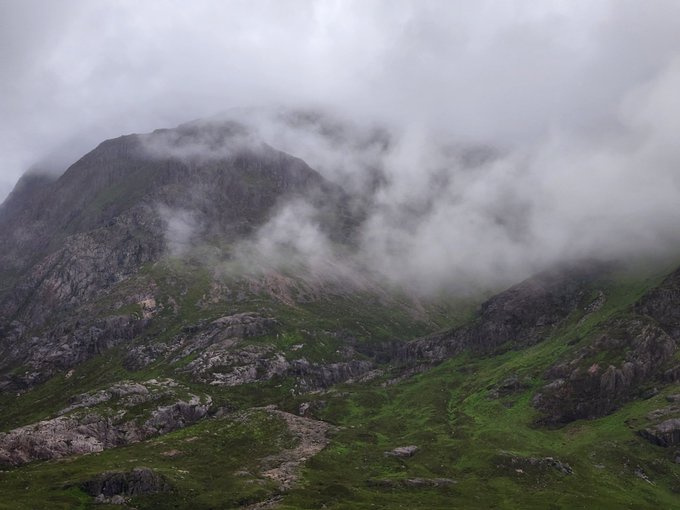
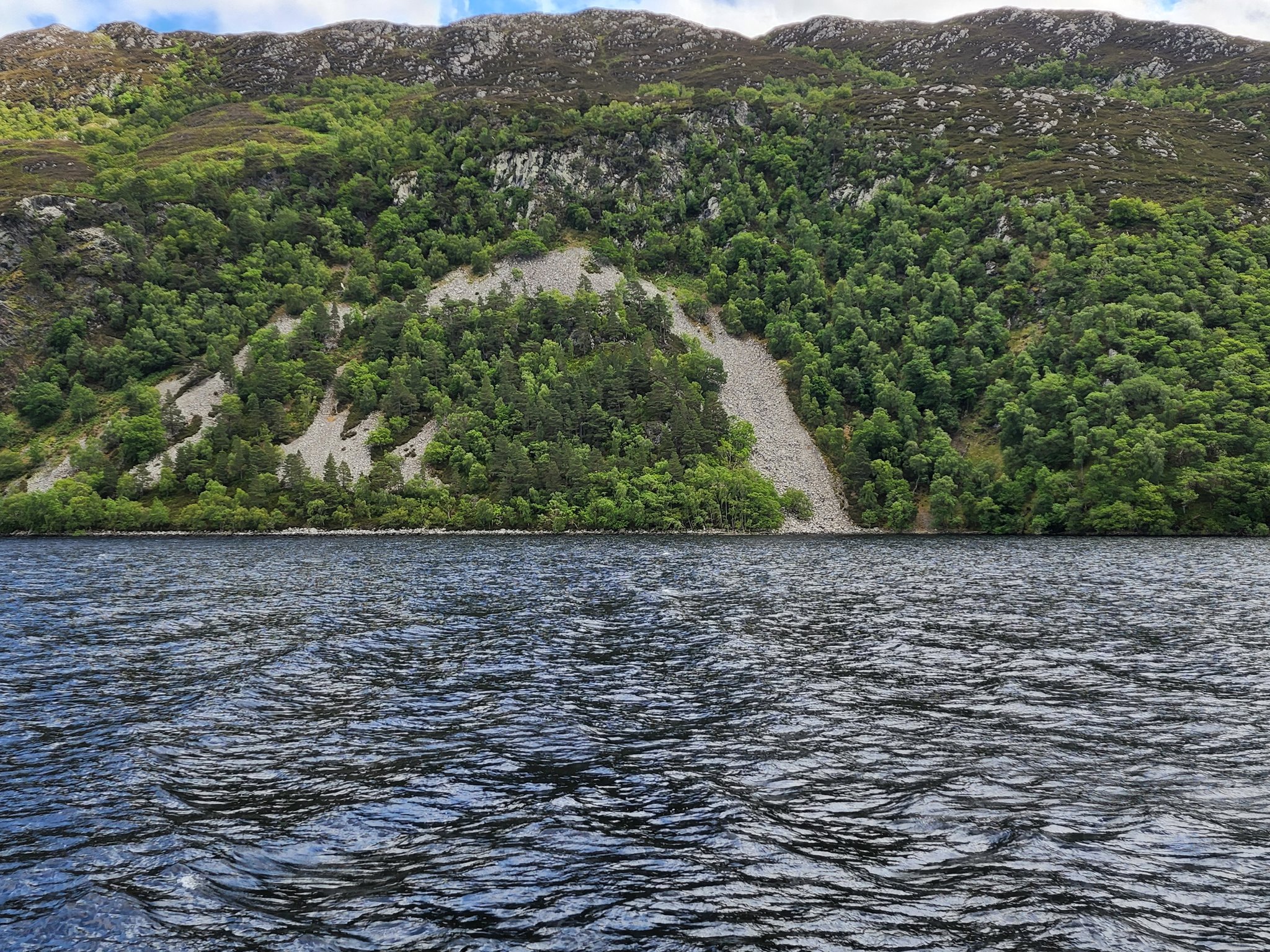
This scratched off part of the hill is where Nessie apparently tried to escape the Loch but unfortunatly slipped back into the water because the hill is so steep.

Loch Ness

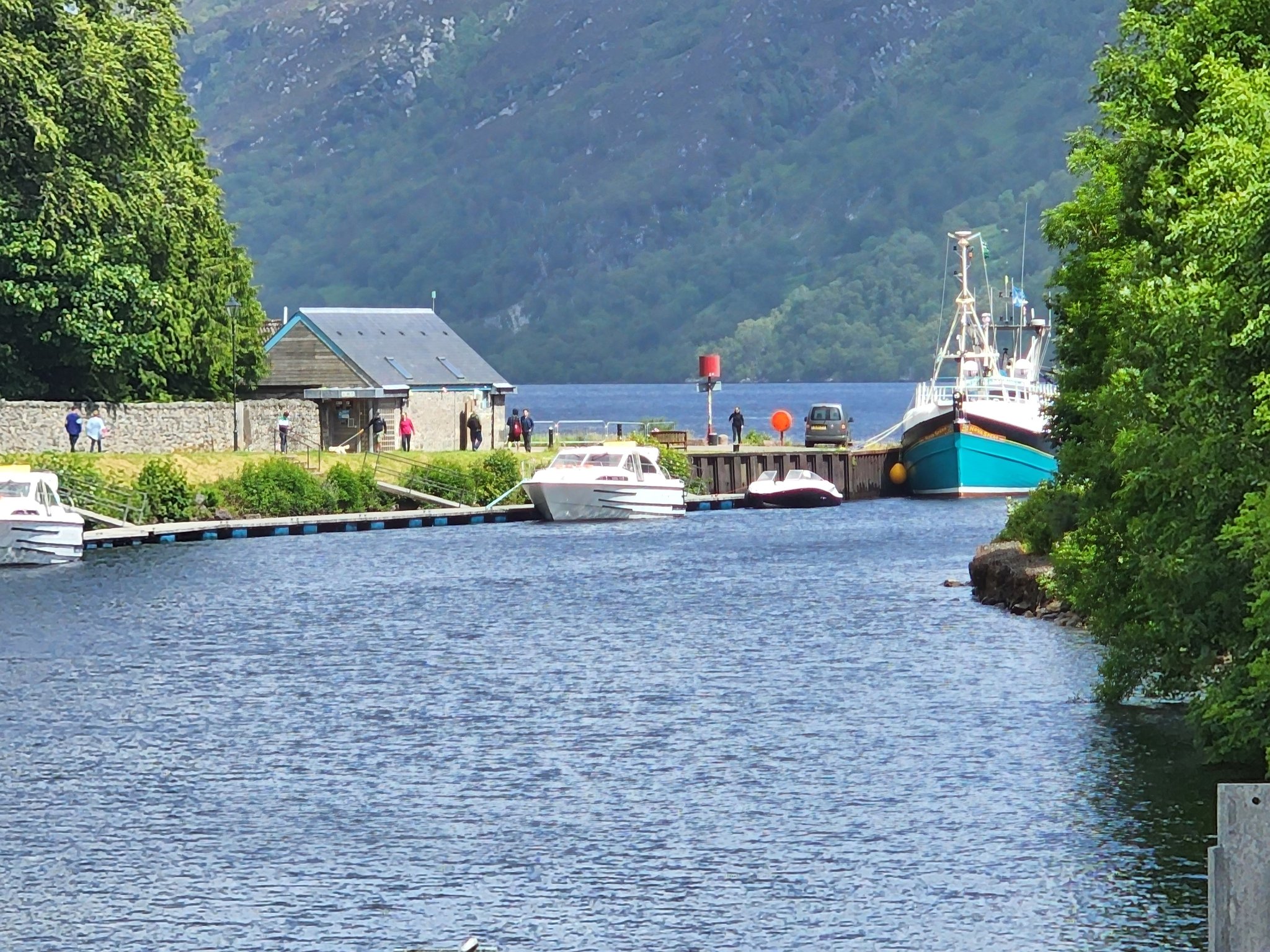
Loch Ness canal

Loch Ness (I think)

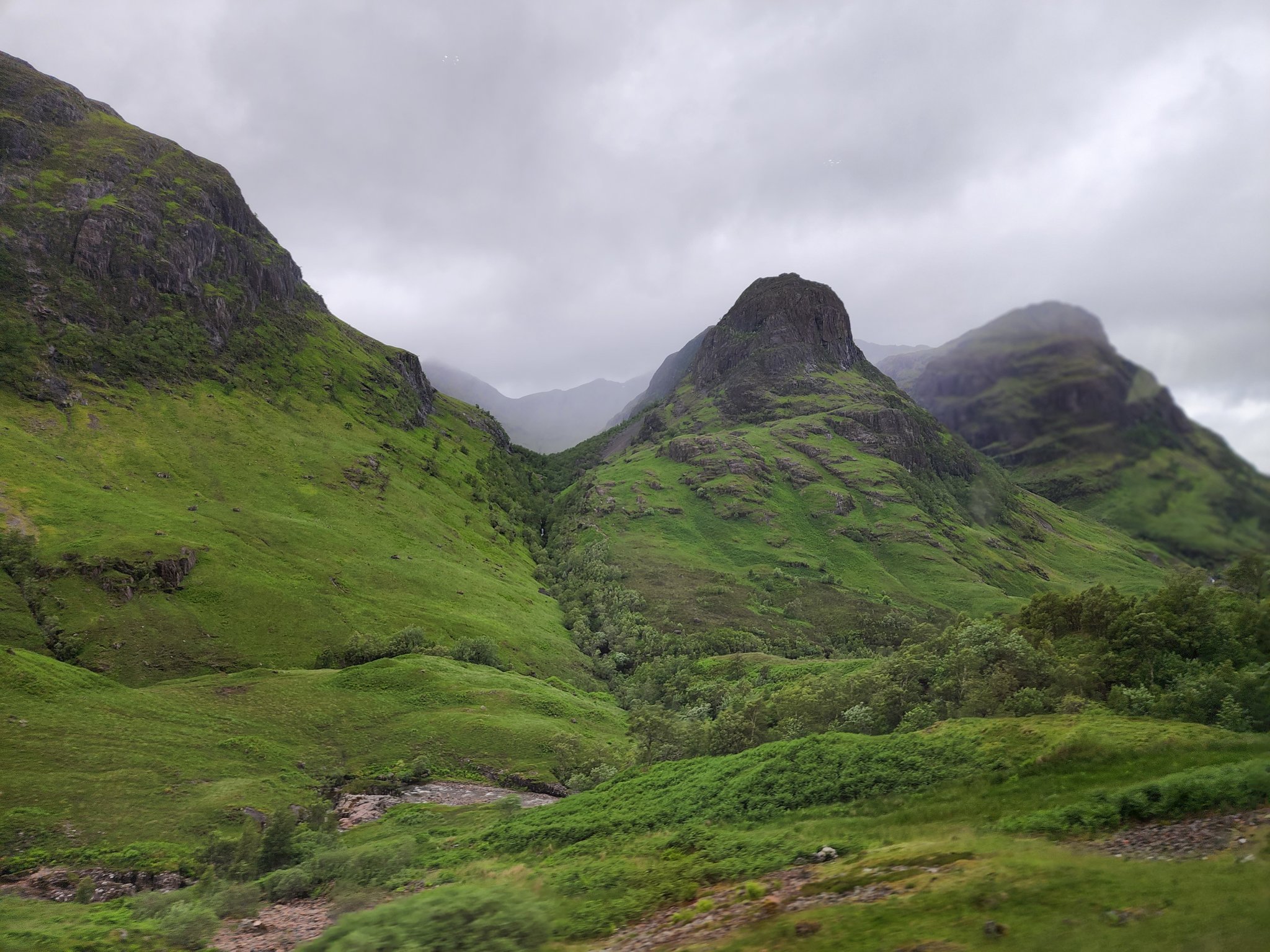
The Three Sisters, Glen Coe

Mountain in Glen Coe… the tour guide said “Geroff, and getcher Instagram pic.”

More Edinburgh Castle

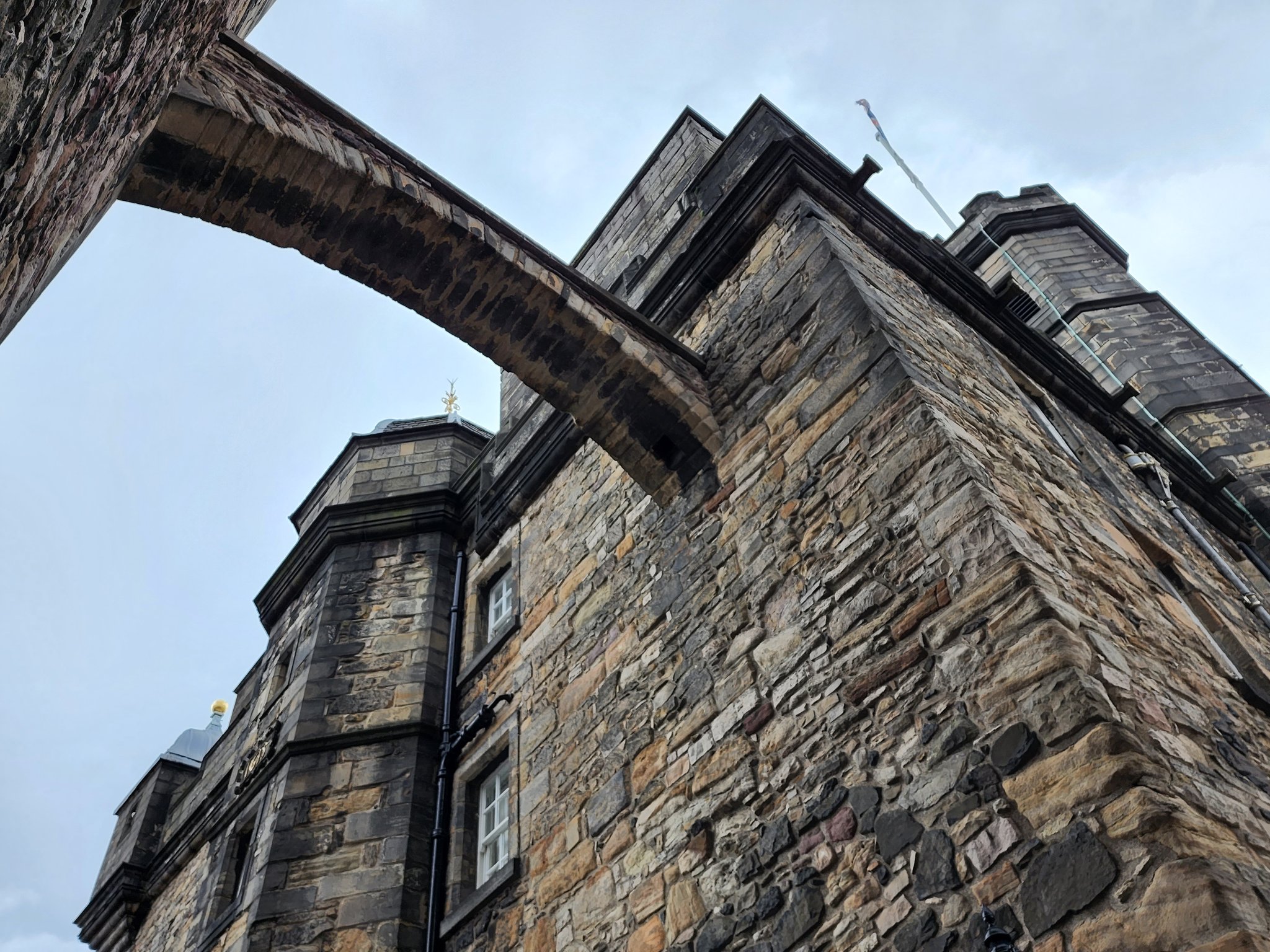
I like the angle I took this pic of the arch.

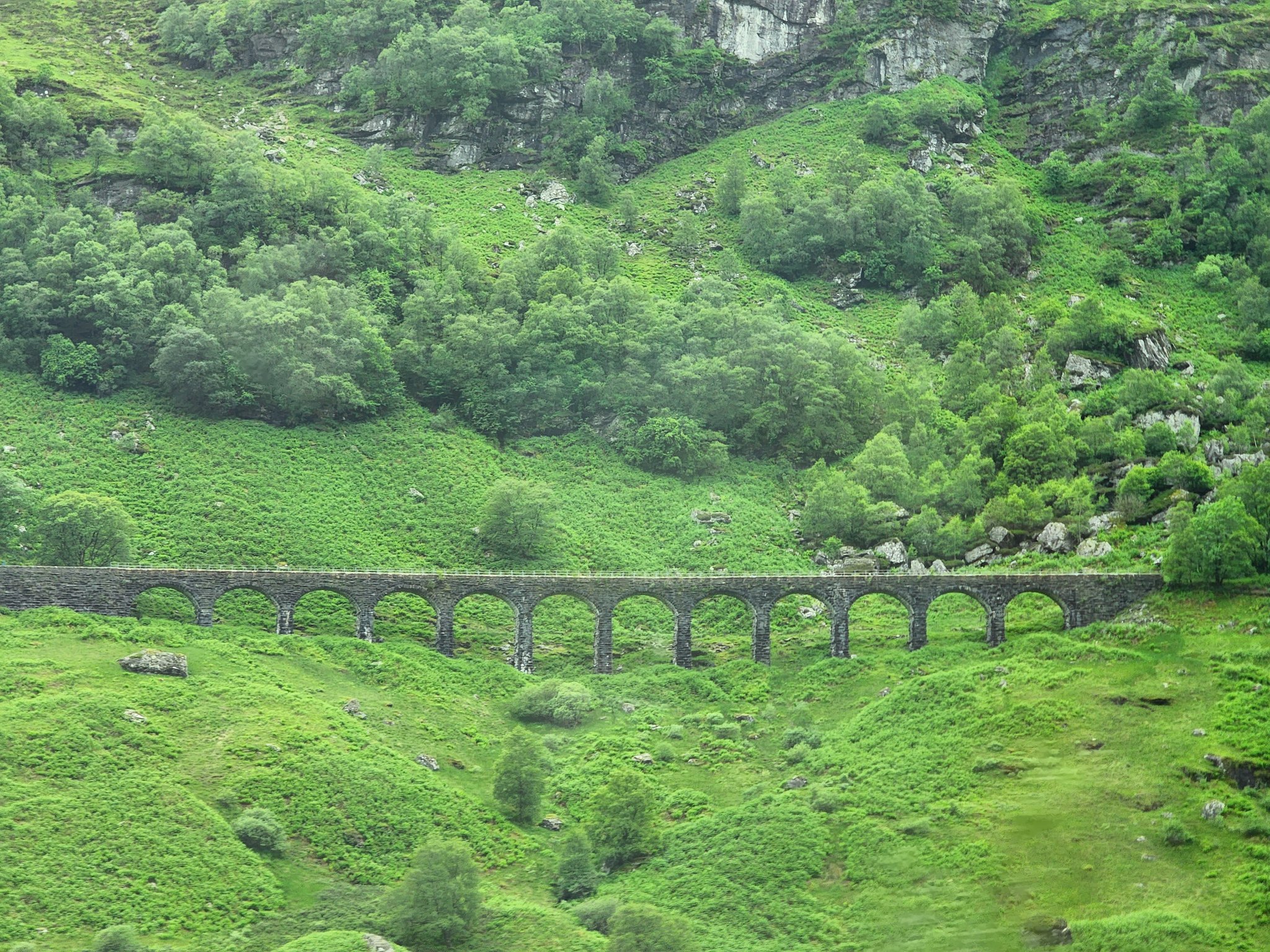
A Highland bridge, no longer used for trains

Edinburgh Castle

Edinburgh Castle

Loch Ness

Loch Ness

Loch Ness

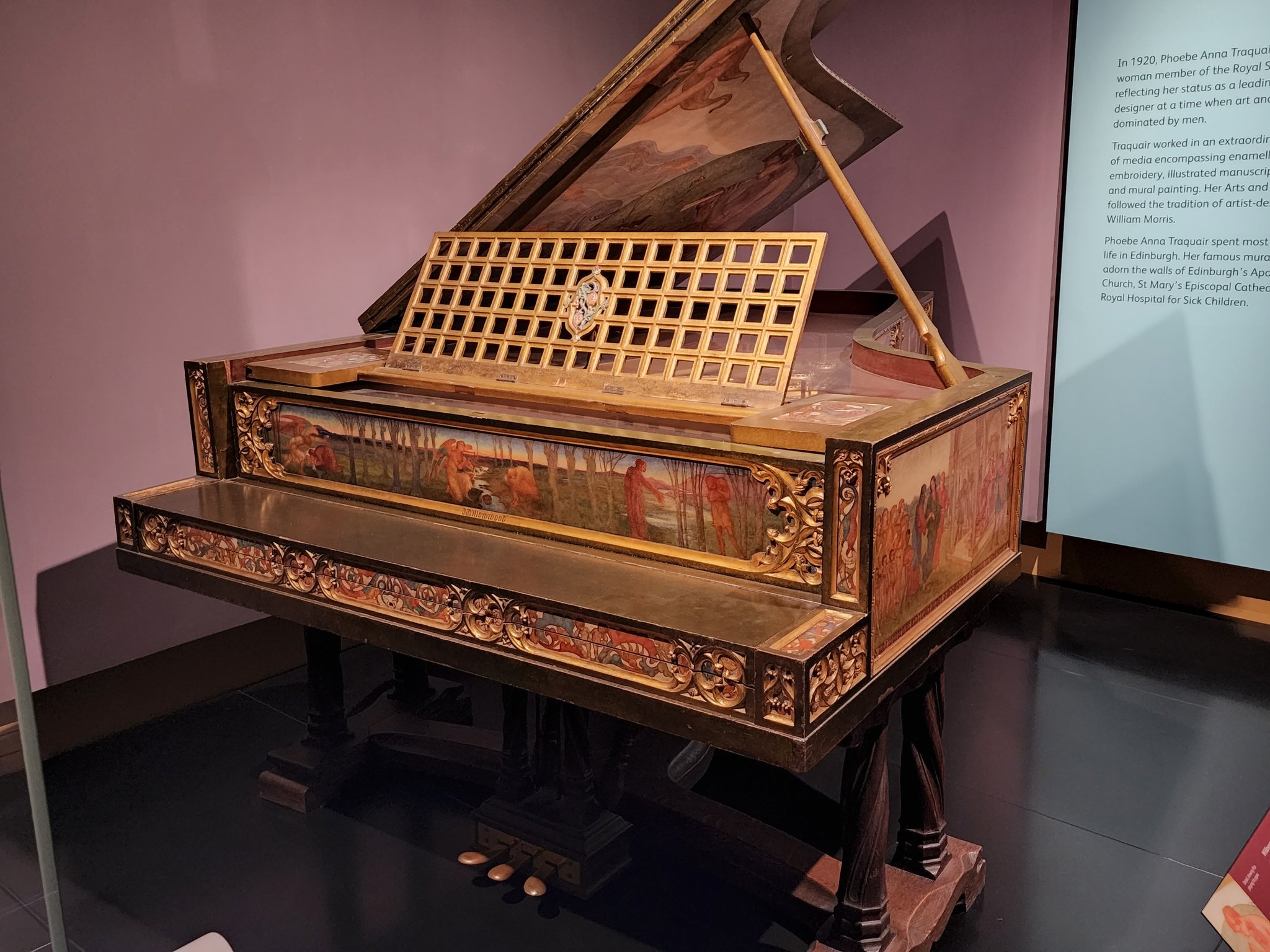
Piano painted by Phoebe Anna Traquair, National Museum of Scotland

Embroidered triptych by Phoebe Anna Traquair

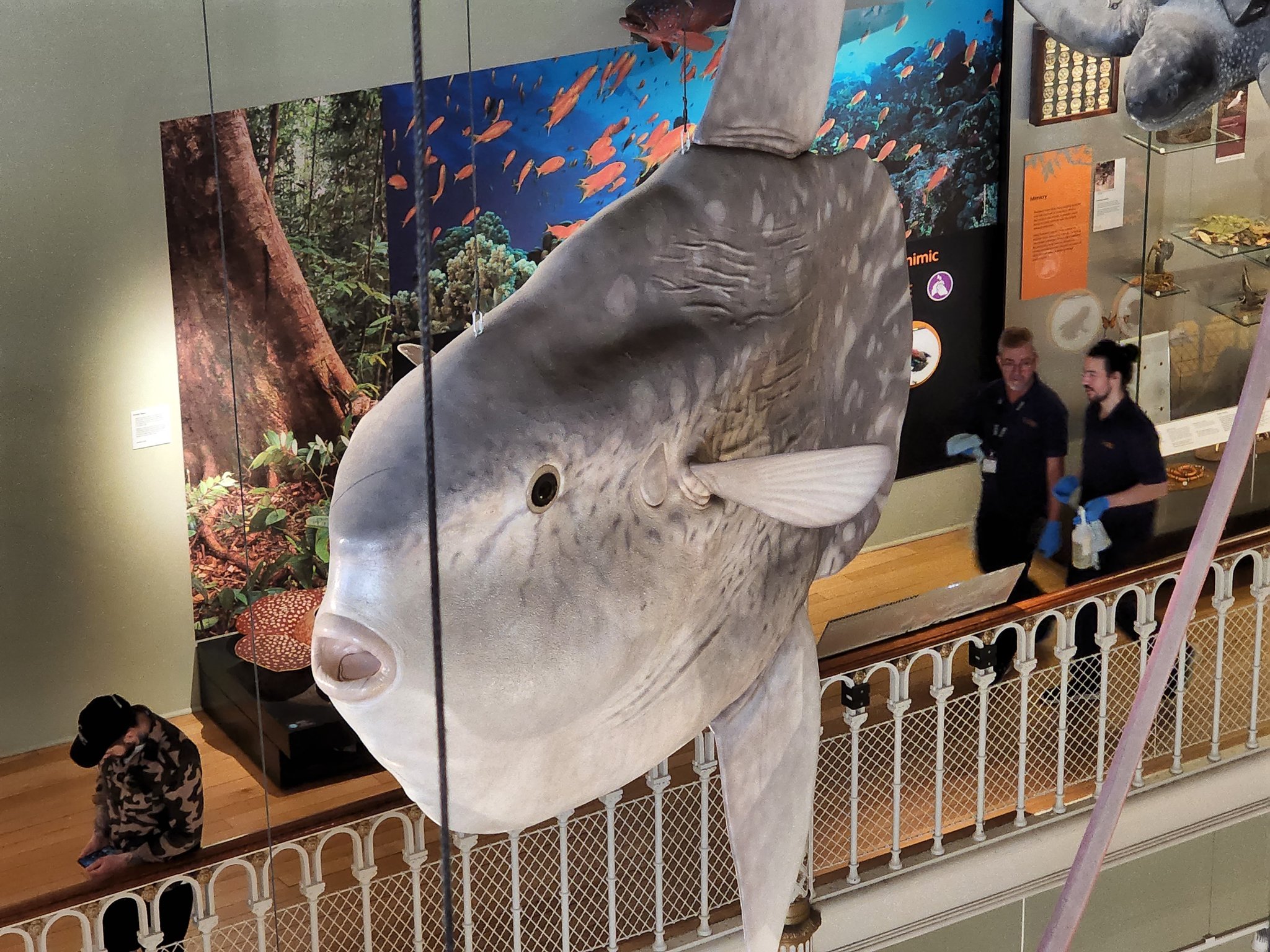
Big Ass Fish (Kirsten, it tried to bite me!), National Museum

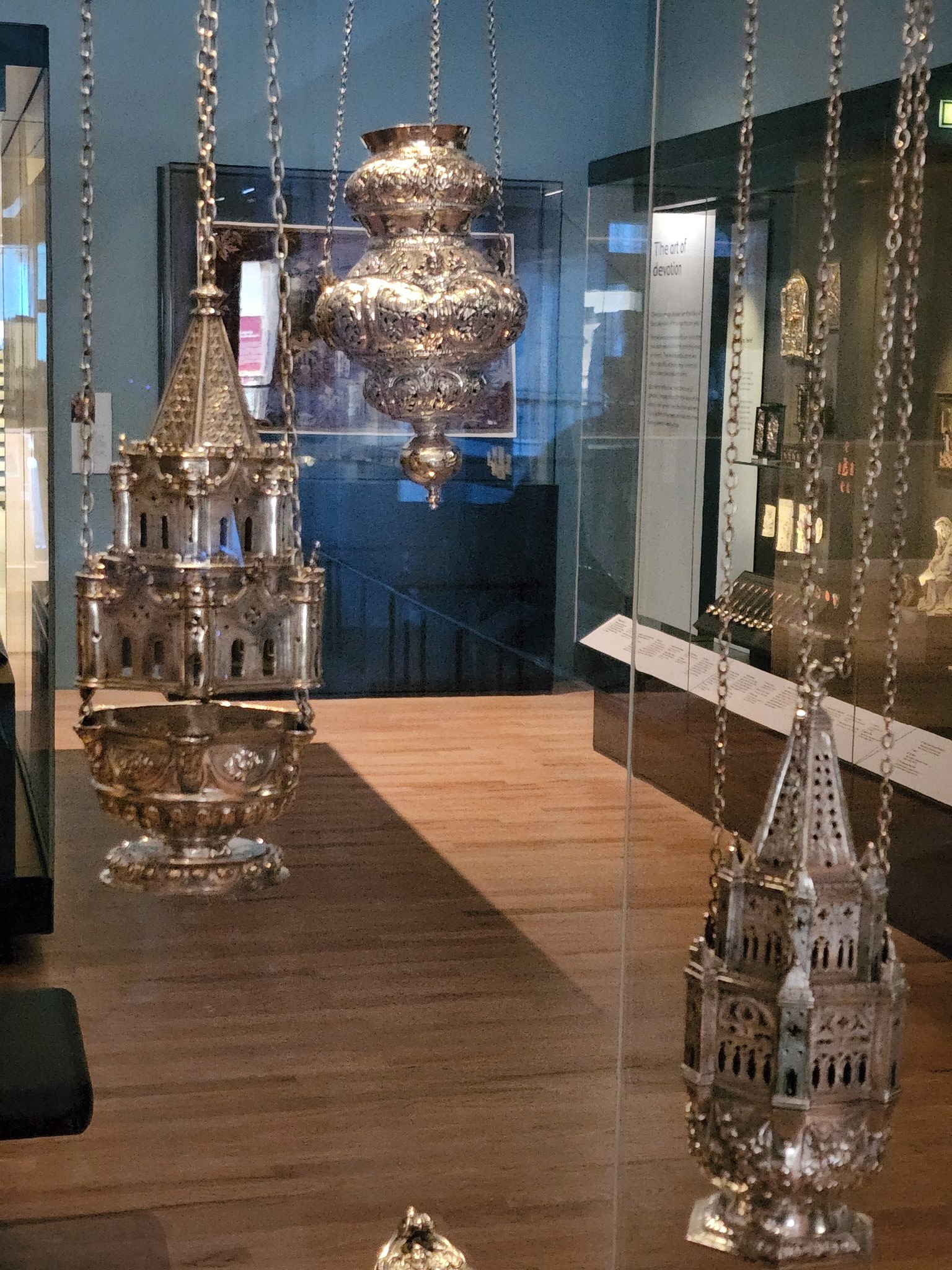
Mass censers, National Museum

Detail of Millennium Clocktower, with a tiny JC in the reflection, National Museum

Detail of the Millenium Clocktower, National Museum

Helen and Kate Storey dress, with X-ray of lung, 1997, National Museum

L: Plaque, the Virgin & Child, Italian,late 15th C., National Museum R: Plaque, the Virgin & Child, Italian, 17th C.

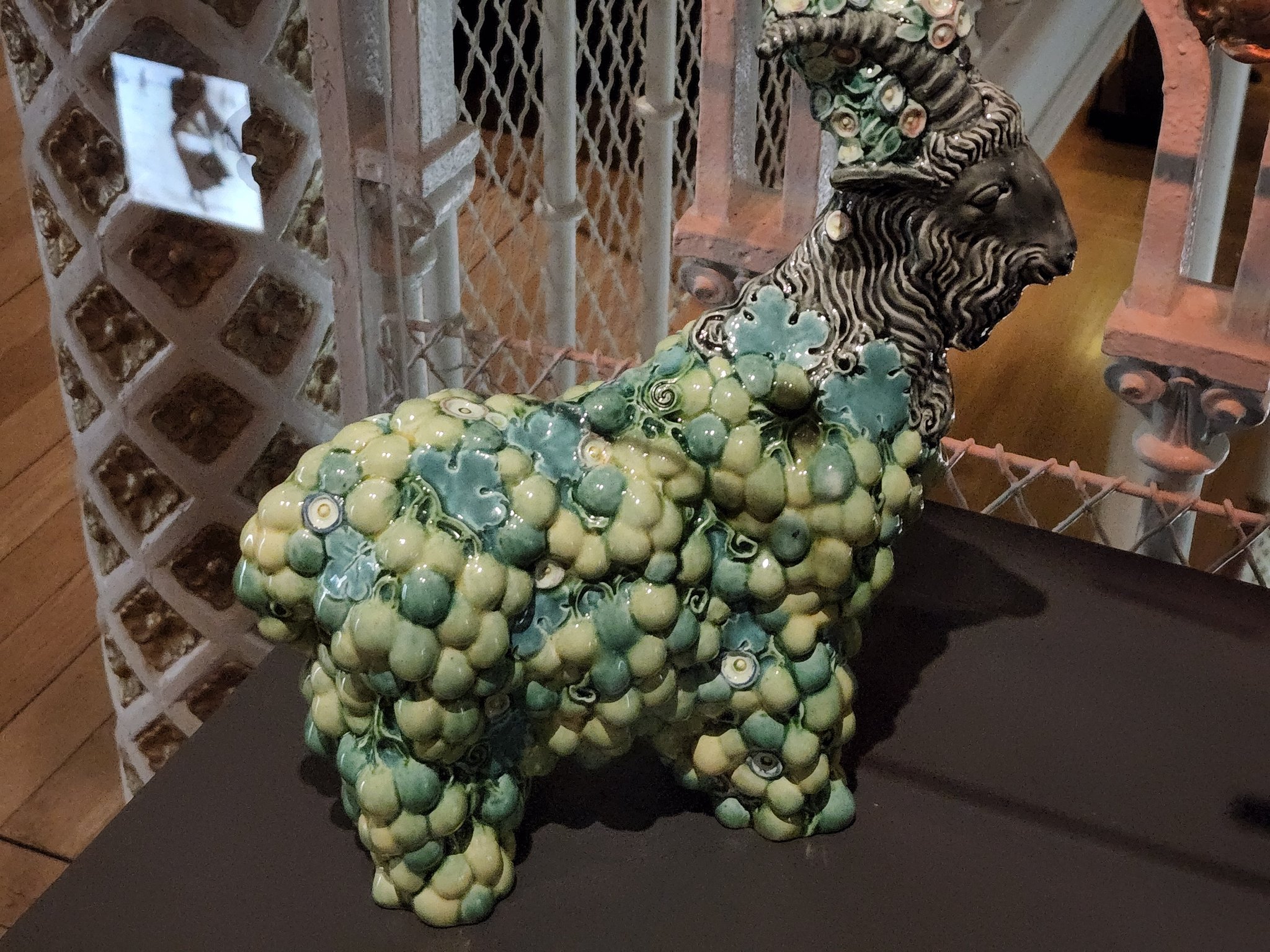
Grape goat, Michael Powolny, ca. 1907-1910, National Museum

The hall of animals, mostly extinct, National Museum

Giraffe head. I think he’s grinning.

Busts, National Museum. But I mostly like the atrium design apparent here.

Airplane in the Hall of Technology, National Museum

Another view of the atrium, National Museum

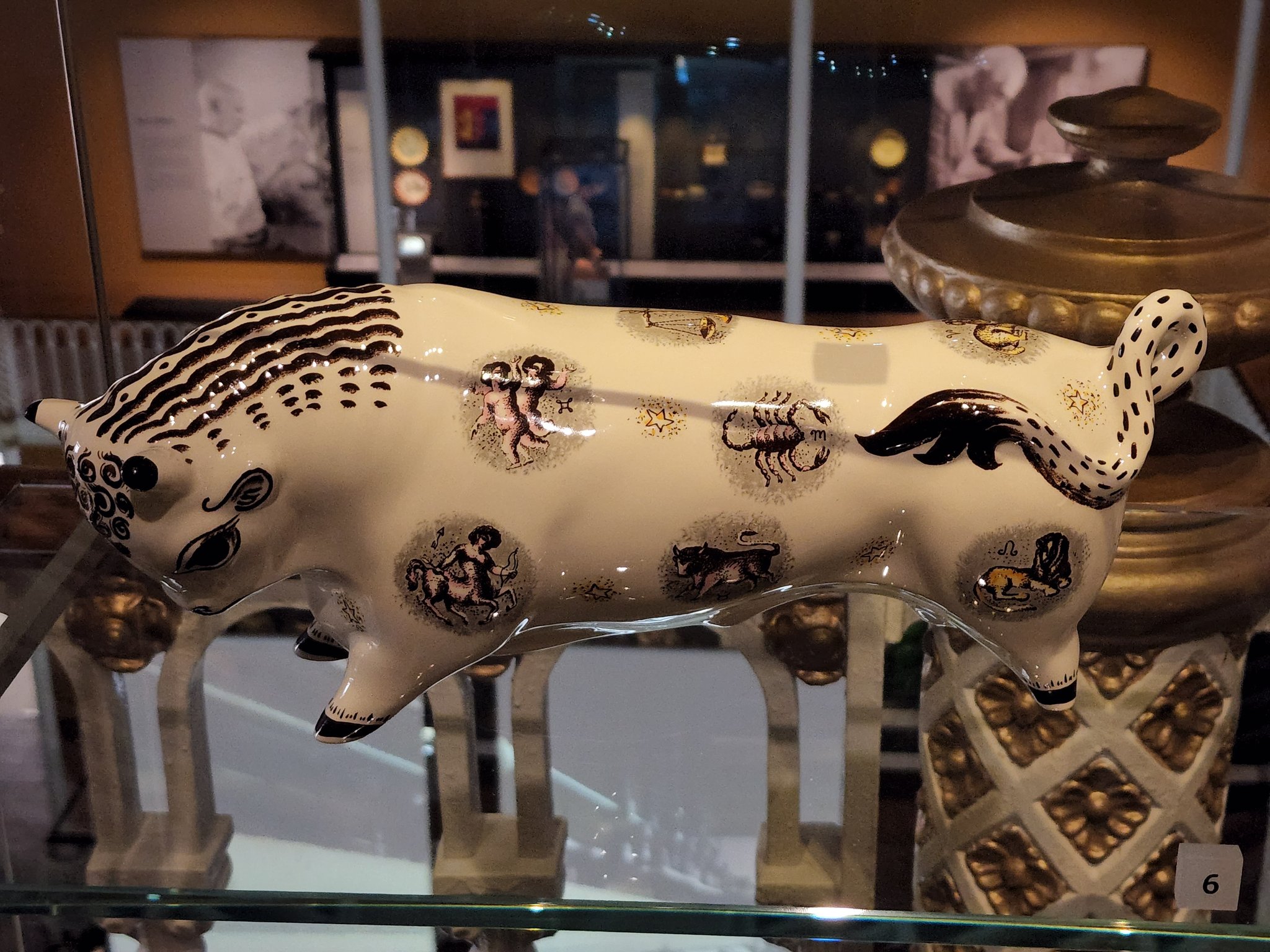
Bull figurine, National Museum

Cat figurine, National Museum


Morning Musing

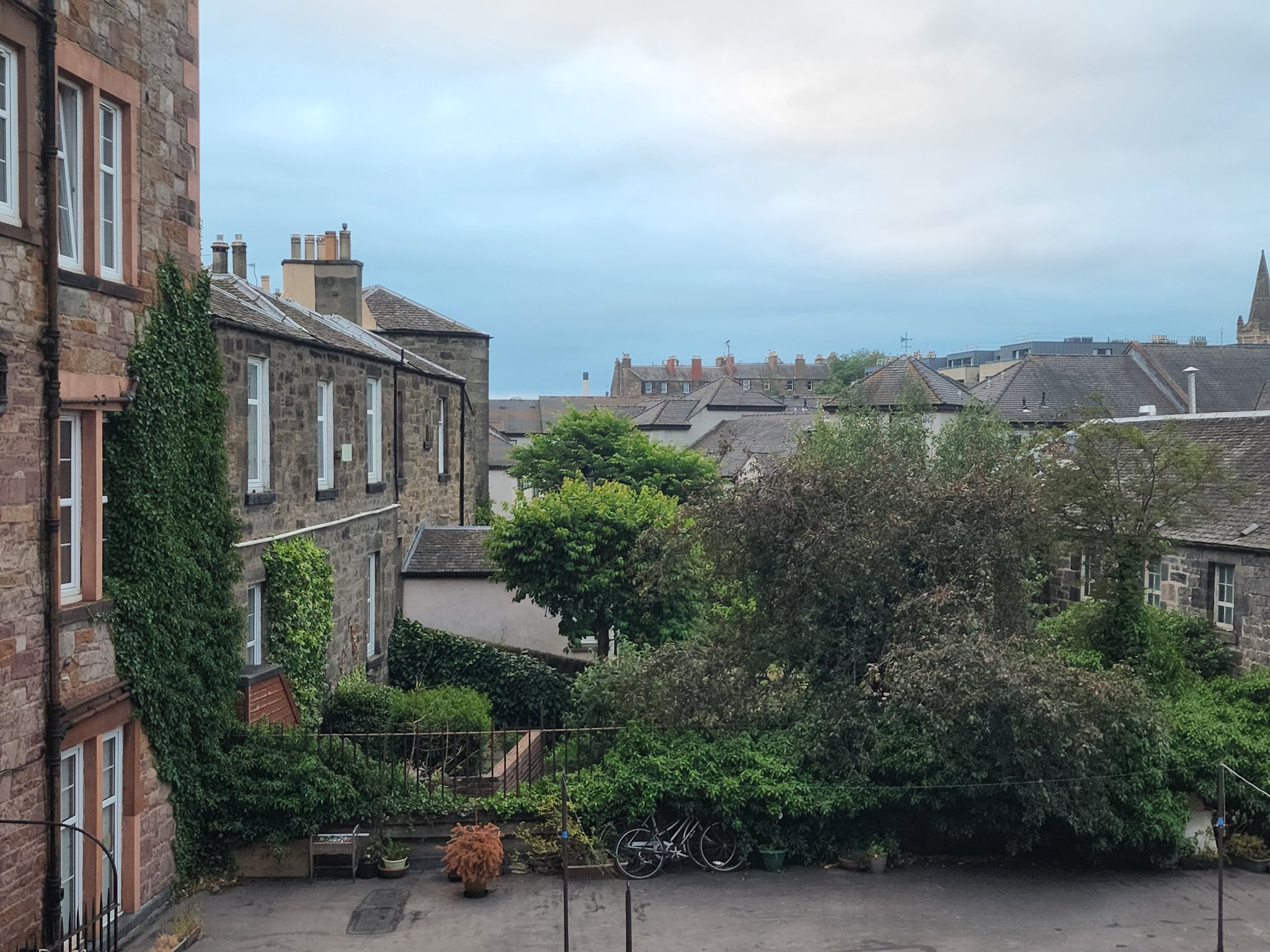
5 a.m. from my bedroom window. It ain’t what you call “dark.”

It’s 5 a.m.  I’ve been awake since 2:30, when the seagulls decided they wanted to hold a concert right outside my window. In case you haven’t heard a seagull lately, its cry falls somewhere between a half-cranked motor and a baby being stabbed to death.  Seagulls like to fly over the courtyard out back of my apartment, and I like to watch them…but not this early.

Since I’ve been in Edinburgh, my sleep patterns have been disrupted.  Partly that’s due to sleeping in a strange bed, one that lacks multiple blankets and too many pillows.  Partly it’s the light situation. I can tell you that around 3:30 the sky was definitely turning lighter, and I’m used to dark nights and black-out curtains back home, so that my bedroom is cave-like and no light enters in to bother me.  (Yes, yes, I could wear a sleepy mask here—and I have one—but I never can keep it on my face long enough to let it work.)  I also miss my cats, especially Jenny, who keeps me company at least for a little while as I sleep.  All of these things combined have contrived to keep me up later and to sleep less deeply when I finally go to bed.  Even my Fitbit has been giving me poor sleep marks since I’ve come to Scotland.

I’m not sure why I couldn’t just roll over at 2:30 and fall back asleep.  I guess I do have some weighty thoughts on my mind.  For one thing, I remembered I promised to write a blurb for a new poetry book, and I was suddenly panicked that I was late with it.  (Turns out I’m not; it’s due mid-July, not mid-June). For another I guess I’m worried about my class.  Discussion is going really well and what I’ve graded so far has been good, but teaching a new class is difficult and I worry my students may be disappointed with me.  (I’m so used to teaching creative writing these days, that teaching literature seems just so much harder than it used to be.)  And finally, as I mentioned before, I’m lonely, and also finding it hard to write.  My Dad asked me if I’d written a lot of poems since I’ve been here when we talked on Father’s Day, and I bashfully admitted I have not. (On the other hand, I didn’t write about Venice when I was in Venice, but when I did finally write about it, I came up with a book.  So perhaps a book of Scotland-related poems might be percolating in the back of my mind?)

I suppose I’ll wind up taking a nap at some point today—I suspect I’ll just crash.  (But hopefully not while I’m teaching. 😊)

Anyway, I just wanted to jot a quick blog for my five loyal readers, and to take a picture of 5 a.m. so you know what I’m dealing with.

Weekend Sightseeing (Is Exhausting)

Portobello Beach

This weekend was a busy one for me—I packed a lot of living into two days.  On Saturday, I took a bus out to the seaside, specifically the Portobello Beach Promenade.  It was cold and blustery, but there were plenty of people (and dogs!) playing in the sand and several people had their feet in the water.  There was even a couple of lunatics up to their waists in the North Sea.  The temperature wasn’t quite 60, so I can only imagine how cold the water was.  They didn’t stay in the sea long.  (Not surprising).

The truest ambrosia

While I was there, I stopped at the Shrimpwreck for lunch, and tried a fish finger sandwich, made of battered fish, French fries (on the sandwich!), tartar sauce, and mushy peas (also on the sandwich!).  It was good.  And those of you who know me IRL will understand how thrilled I was to drink a Lemon Fanta, the drink I fell in love with when I went to Italy several years ago (and one that is not available Stateside).  It was a perfect lunch, accompanied by entertainment: the Portobello volunteer clean-up crew dancing to the B-52’s “Rock Lobster.”  One of them wore a crawfish “fancy dress” costume, with a placard that read “No Fear! Be queer!” on the back.  Another one of them wore striped pants, and had a red-painted face and dreadlocks.  Not exactly the colorful characters of a Venice Beach scene, but they definitely had a boardwalk vibe going on.

Altar at St. Mary’s Cathedral

Afterwards, I came back to the apartment for a few hours and rested.  (I don’t know about you, but every time I go to the beach—in any capacity—I get tired.  I wonder if it has something to do with the sea air.)  Then I took another bus ride to the vigil Mass at St. Mary’s Cathedral (since I knew I would be out all day Sunday, and I didn’t want to miss church). It is lovely inside, but not what I think of when I think of a cathedral—it was certainly more elaborately decorated than St. Columba’s from last week, but it isn’t stately in the way cathedrals usually are.  It’s like, if a typical cathedral is a thoroughbred, then St. Mary’s is a workhorse.  It gets the job done, but isn’t magnificent to look at.  It’s just a nice, big church.

The Kelpies, by artist Andy Scott

Sunday I walked down to Waterloo Place (just over the bridge from the Royal Mile) to take a sightseeing tour outside of the city.  The first—and best—thing we saw was The Kelpies monument, outside of Falkirk.  You can’t imagine the scale of these horse heads—they are massive, about 100 feet high, and made from steel.  I would have liked to have longer than 25 minutes to visit them, though, because that was hardly enough time to go to the bathroom, see The Kelpies and then duck into the gift shop.  I loved them at first sight.  Of course, folktale kelpies are horrible creatures who lure unsuspecting people to get on their backs and ride them into the ocean where the horses drown them and feast on their bones.  But these kelpies were certainly wonderful to look at.

Loch Lomond marina

The next thing we did was visit Loch Lomond, of the eponymous famous folksong, and the surrounding farmland was green and lush and dotted with white sheep like confetti.  I could have wished that the tour drove around the perimeter of Loch Lomond, but we were confined to a little bit of shore where the boats were tied up.  There was a path around the marina, which I walked some. Mostly I watched the ducks who were sunning themselves on the banks.  The loch was as picturesque as you can imagine—the beginnings of the Highlands in the background, the sun glinting off the water in golden waves, the boats floating gently around their anchors.  And the air was so fresh!

A mama sheep. Very ewe-nique.

Our next stop was for lunch in a little hamlet called Aberfoyle. At the café I ordered a cheese toastie (kind of like a grilled cheese but not exactly) and a bowl of carrot and lentil soup, heavy on the carrots. I chose to sit outside and people watch, although the people weren’t all that interesting. Their dogs were, though.

There was a sweet shop next door, and I bought a package of homemade butter shortbread that literally, deliciously disintegrated on your tongue.  And then I headed over to the big wool shop, and figured there would be too many things I’d want to buy inside (like yarn, which I have no room in my suitcase to take home), so I skipped it, and went around back where they kept some sheep. Their pens stank (as you might expect), but the sheep themselves looked so cute.  They got into a bleating contest—it reminded me of a sheep opera (because you know, that’s a thing) (it’s not really) (but it should be), as they each tried to outdo the other in their “singing.”  I really wanted to put my hand out to pet them—which we were allowed to do—but the caveat that “These animals bite” kept my hands firmly on my side of the fence.

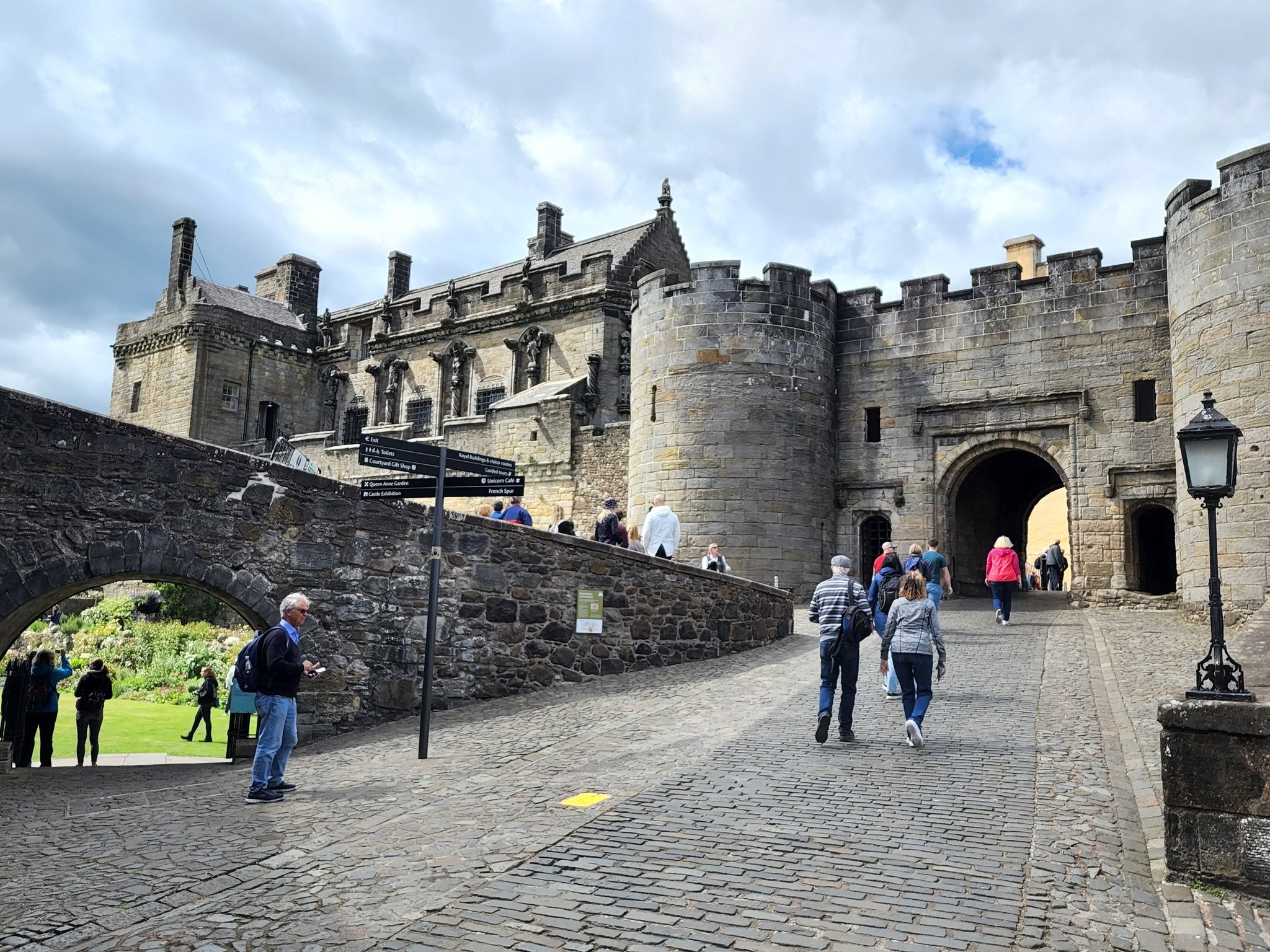
Stirling Castle

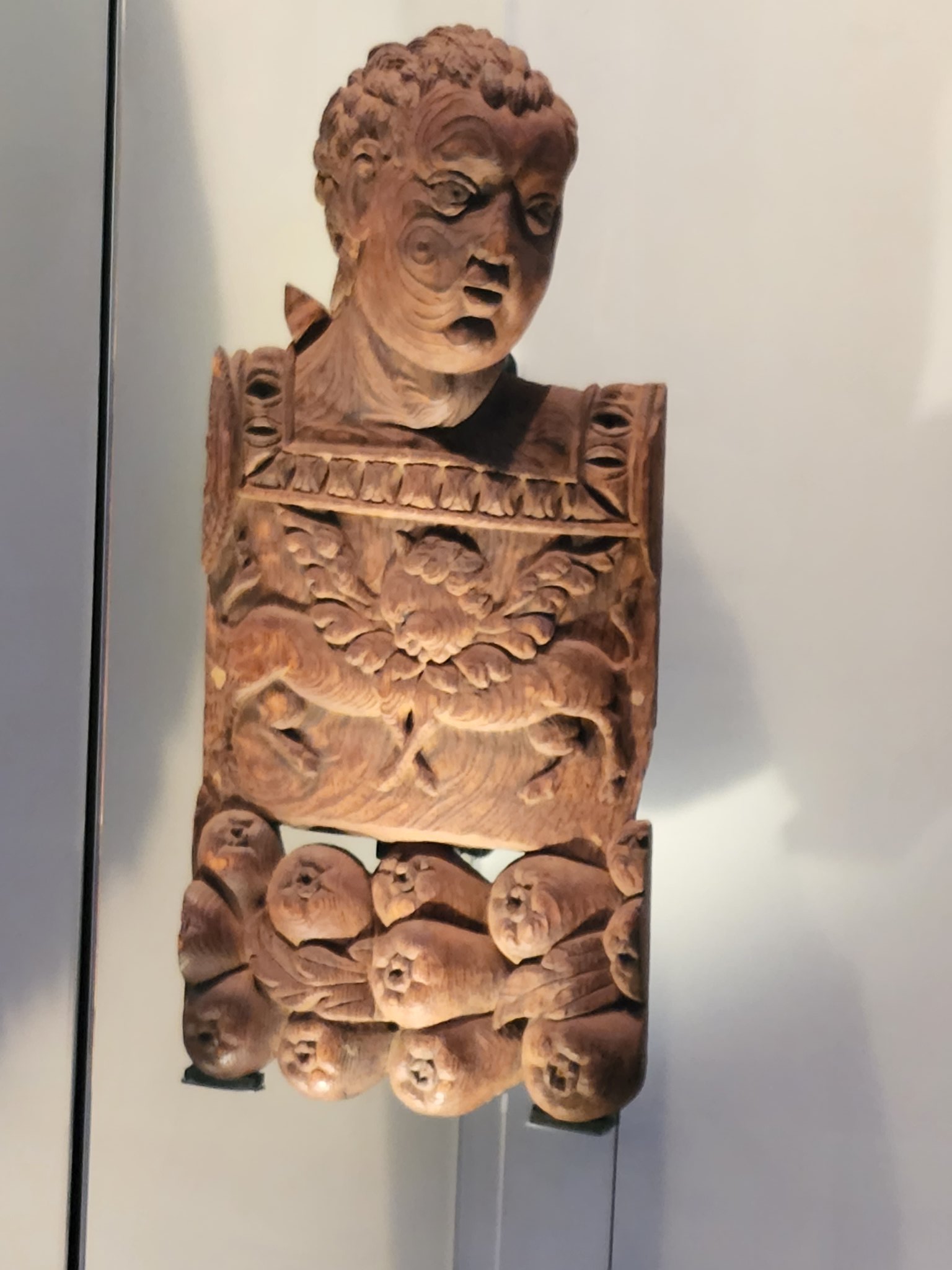
The awful Stirling Heads

Stirling Head art close up (yuck)

After lunch we headed to Stirling to visit Stirling Castle, the birthplace and home of King James VI.  I didn’t actually get to see the palace itself—I couldn’t figure out where it was—but I walked around the castle battlements, the dungeon, the chapel, the Great Hall, and the hall of the Stirling Heads, which are these large, wooden, medallion bust images of various people James wanted to commemorate.  And they were just horrible, creepy, weird pieces of décor, probably about 2-2.5 feet in diameter, and several inches thick. I know they served a purpose, but I really couldn’t get over how ugly they were.  I am probably revealing myself to be a philistine, but they were nothing like I was expecting. (They had really been talked up by a tour guide.) In my head I was imagining something magnificent; the reality was quite something else. But the castle itself was impressive with amazing views of the countryside from its sheer drops.  What was coolest about the castle was that Mary Queen of Scots was crowned there.  And, I think no matter who you are, Mary’s tragic life resonates.  At least, I always found her life story to be compelling, if sad. (I might actually have read her biography at some point, because I seem to remember a whole lot about her.)  Still, I didn’t need two hours at the castle, and wandered back to the garden to wait until it was time to get back on the bus and return to Edinburgh.

Castle gardens

I finally got home around 7 and I was exhausted.  The tour was longer than I was expecting.  I thought we’d be back by 5, but it was closer to 6:30; I should have taken a little nap on the bus (I usually take naps on Sunday), but I didn’t want to miss seeing any of the countryside. Just in case there was something amazing.  (I did get to see a glimpse of The Kelpies on the way back, so I count that as a win.)

I enjoyed the tour over all, but I was the only single traveler.  Everyone else had family or friends to visit things with, so I was kind of lonely.

Actually, if I were to complain about visiting Edinburgh at all, it would be because of how lonely I am.  Maybe I should pretend I am Mary Queen of Scotts in her prison cell; perhaps that would make the loneliness a little more bearable.  But even Mary had her little terrier dog for company.  I have no one.  (Weep, weep, sob, sob.)

Anyway, I hope you enjoyed all the pictures.

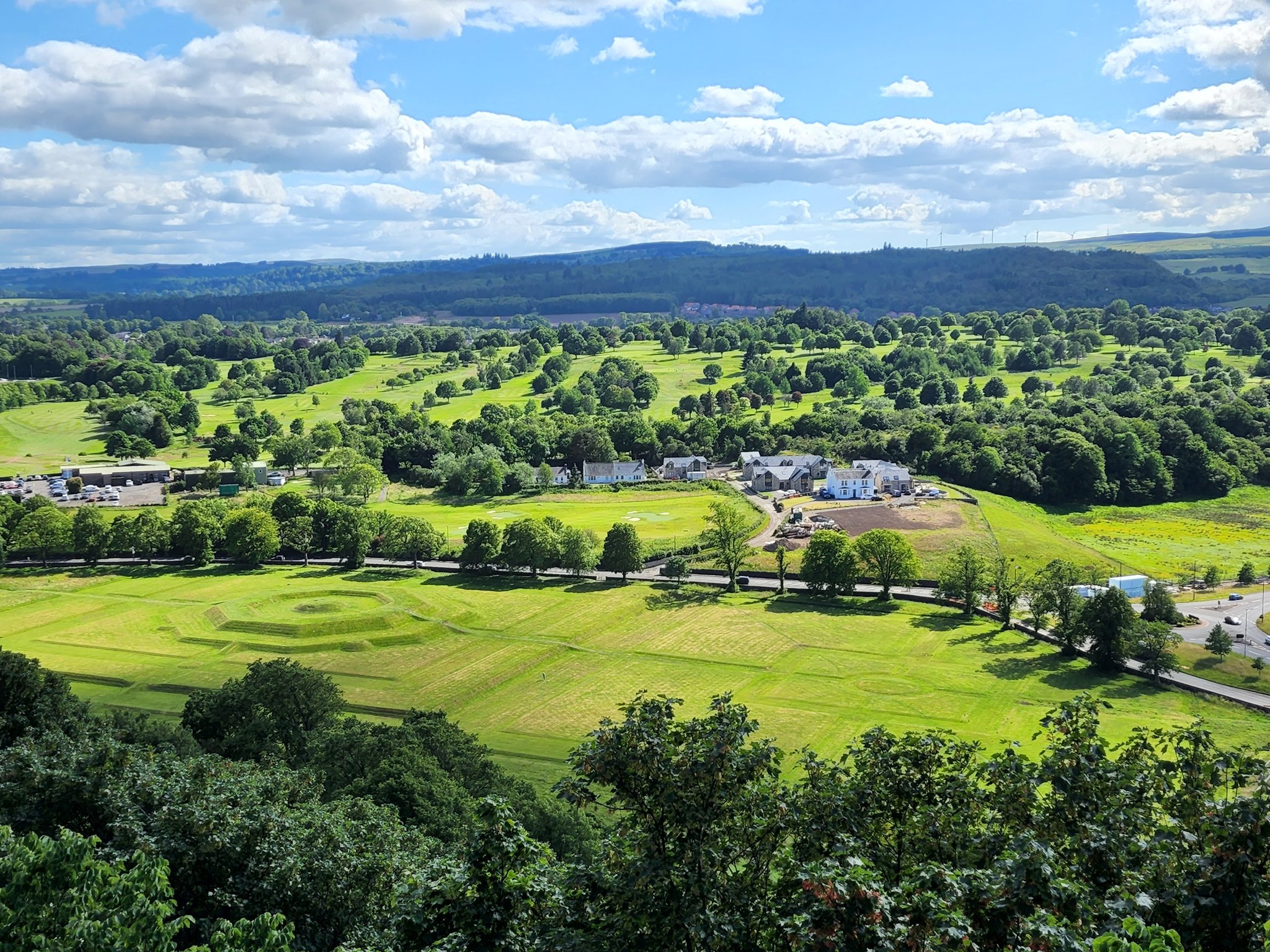
A view from Stirling Castle

Another view from the Castle

A Visit to the National Gallery

View of Old Town, with the National Gallery on the right.

Today after class I went to the National Gallery of Scotland.  It’s undergoing big-time renovation, so only a small amount of the collection was available for visitors to see.  Initially I was a little disappointed, because I was expecting to be blown away with breadth and volume, but then it occurred to me that it was kind of nice in its coziness.

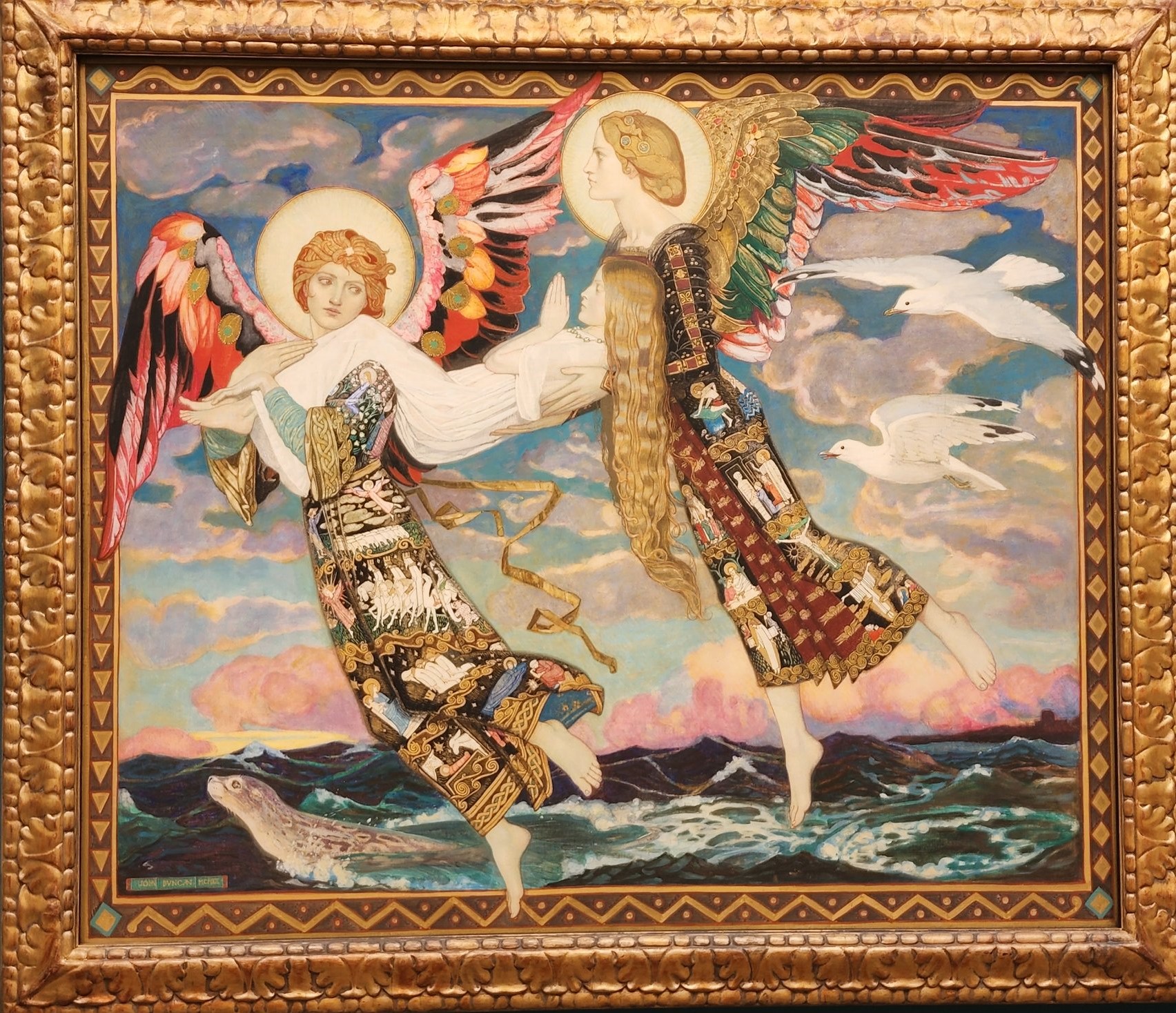
This was my favorite picture, John Duncan’s Saint Bride (1913)

There were maybe 14 or so individual galleries to peruse, starting with Medieval religious icons, some Titians and Canallettos and other Italians, a great Vermeer of Martha, Mary, and Jesus (I should have taken a photo—apparently, it’s the only religious picture in his 36 surviving works), some Dutch masters including a very small Rembrandt, Scottish pieces (portraits and landscapes), and then upstairs were the Impressionists and a few early 1900s works.

Because the space was so confined, big walls bore a picture high up as well as eye-level and that was a little annoying, because it seemed a little cluttered, but of course they want to showcase as much art as possible in the few rooms they had to show it.  I went through the exhibits twice, although I lingered on the Impressionists out of habit more than any other reason.

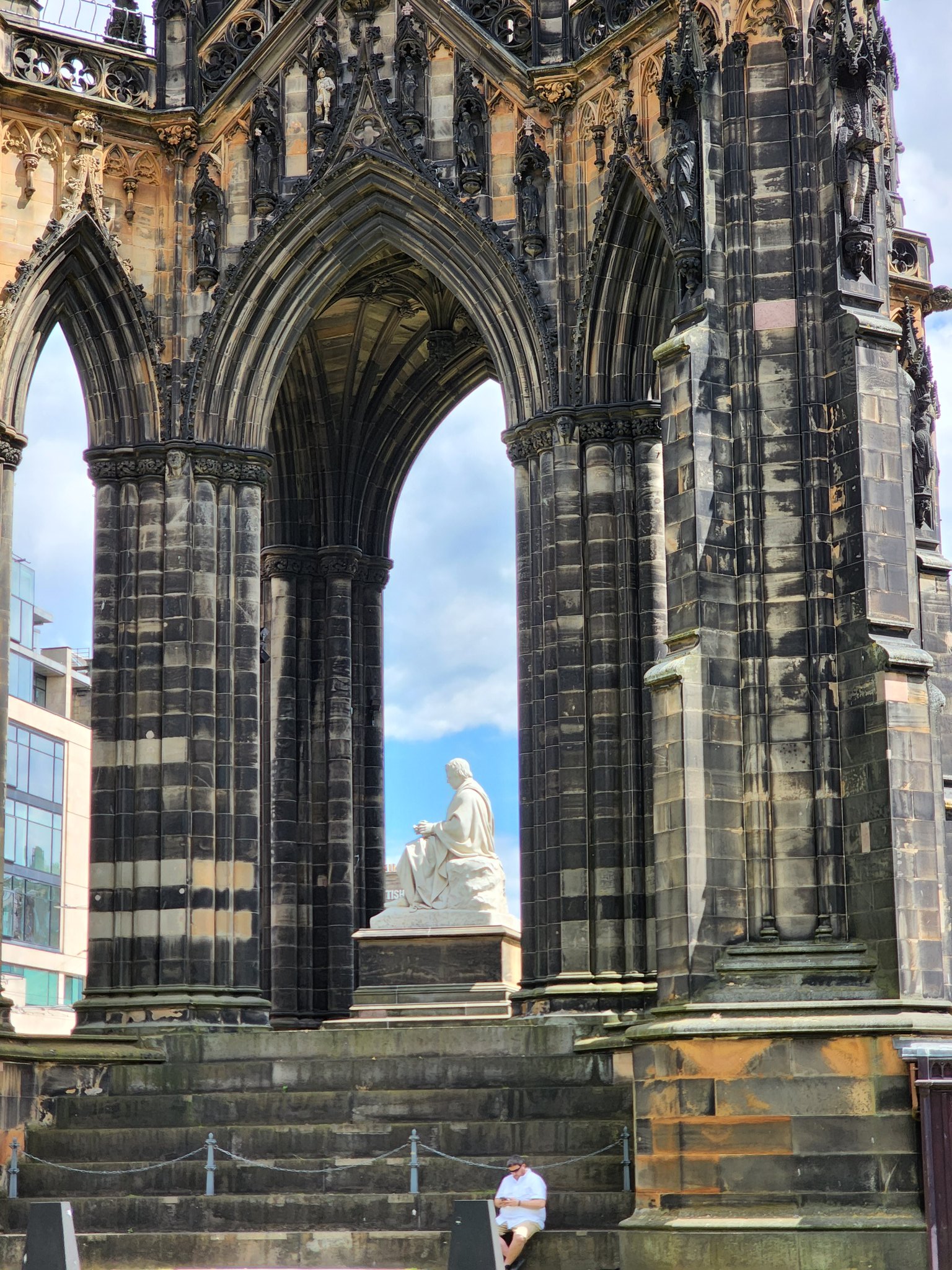
Walter Scott Memorial close up (see human for scale)

Afterwards I walked to the Walter Scott Memorial, which is huge—200 feet tall at least.  It wasn’t open for visiting, but you couldn’t miss it.  It sits right at the edge of a park on Princes Street.  I’m amazed that I missed seeing it when I rode in on the tram from the airport last week—although I was so zonked out from traveling that I guess I wasn’t paying attention.

I’m not sure where I’ll head to next.  Maybe Edinburgh Castle.  Maybe Holyrood Castle.  Looking forward to the weekend to get in more sightseeing.  (Where do you think I should go next?)

Walter Scott Memorial from a distance

My First Week in Edinburgh

I was reminded yesterday that when you’re in a new country, everything is interesting. Based on my experiences so far, I don’t know about that.  For me, I have mainly spent the first week in Edinburgh adjusting to the crazy amounts of daylight (4:30 a.m. to 10:30 p.m.) and the daily wind and rain.  (I’m so happy I brought a lined raincoat, and I Amazoned a new umbrella since I forgot to bring one.)  I have spent a good amount of time locked up in my flat, preparing for my class, but I’ve also taken some long walks, trying to get the lay of the land.  And I have drunk a metric butt ton of Scottish Breakfast Tea.  Which is like English Breakfast Tea, only it uses a really complicated dialect. 😊

Friday, I did a cursory visit to the National Museum of Scotland, which is a fantastic natural history museum with a huge atrium and tons of natural light.  I will go back and do a “deeper dive” in the exhibits, but I mainly looked at the science/technology hall, the hall of design, and the world cultures hall.  I visited the museum with the coordinator of the Scotland Study Abroad program, and we didn’t have a lot of time there because he also wanted to go to Clarinda’s Tea Room, on the Royal Mile, which was fussy and frilly (in the best way) and full of tea-related décor.  I had a scone with butter and preserves.  I was expecting more of a biscuit, but this scone was sweeter than that, but very crumbly.  Afterwards, we walked back past some bagpipers and drummers and Richard went his way, and I went mine…right into a freak storm.  Imagine a day where it’s bright and windy and gorgeous.  And then come the clouds like a galloping herd of gazelles.  That storm soaked me to the core, and of course I wasn’t wearing my raincoat.

In the rain, a man with a large backpack bumped into me (don’t worry, he wasn’t a pickpocket), and then as I passed the Museum again, he put his hand out for me to shake it and asked who I was.  I was so shocked, I told him.  He said his name was Sam and he was looking for a Tesco (a grocery store).  There was one right around the corner, and I thought he was going to go toward it but he went the opposite way.  It was a little strange.

Saturday, I tried doing laundry and found the washer to be beyond my intellect level.  Then I went for a walk in Holyrood Park.  There’s an entrance close bywhere I’m staying, so I walked over to it, and it turned out the entrance was a steep set of stairs down to the street (Queen’s Drive), and about 10 steps down it, I said to myself, “Self, if you go down these stairs you’ll have to come back up,” and while I was debating this shaggy sheep dog came out of nowhere.  He looked pretty good so I wasn’t worried he was lost, and then as if from mist, his owner appeared.

“Rolo,” he said, “quit botherin’ th’ lass.”

“Oh, he’s not bothering me,” I said, putting my hand out to pet Rolo.

“In tha’ case, quit botherin’ me dog.”

With that, the man and Rolo passed me going down the stairs, and after being flummoxed for a little bit at the surprising turn of events, I followed at a discreet distance.  I walked up the hill a ways (not the big hill, the one that puts you on top of Arthur’s Seat), and then down a grassy knoll.  I tried taking some selfies, but it was so windy my face was all scrunched up and my hair had its own postal code.  I sat on a convenient rock until I was ready to face the 400 steps back up to the park entrance.  I’ll have you know I died about 6 times on the hike back up the stairs.

Yesterday, I spent the day reading for class, but all day I wanted to go to church.  I just couldn’t get motivated for the 9:30 Mass.  Fortunately, St. Columba’s church had a service at 6:30, so I walked south till I got there.  It was definitely a no-frills service… no music and a homily that contrasted our relationship with God and the Trinity to this kid at his grammar school selling stick insects (don’t ask). It was a tenuous connection at best.  I was glad I went—it let me see a different part of town.  Next week I think I’ll try St. Patrick’s.

So, that kind of catches you up on my visit so far.  Not overly exciting, but I’ll have more exciting plans in my future I’m sure.

How I’m Coping with Social Distancing

It’s a funny thing about human nature that when you’re told you can’t do something (like go out and Mix with the Peoples), that’s pretty much all you want to do.  I’ve been thinking about how this “social distancing” we’re all supposed to practice is tedious as well as difficult.  True, it’s technically Spring Break and I’m working from home, so it’s not like I’m going anywhere during work hours—but if we weren’t in the midst of a pandemic, I could go somewhere, at least for lunch. But instead, I’m stuck at home, contemplating eating a very sad lunch of mixed veggies and rice.  And I miss people at work.

I wouldn’t miss them so much if, after Spring Break ends, we were all going back to campus.  But that’s not happening, as far as I can tell.  I miss Amanda popping in with her silly nonsense and her stern talkings-to to me when I stay late, or Karen standing in the door with some gossip that’s too good not to share.  I miss Carol asking me how things are going with the schedule or telling me about her crazy cat.  I miss hearing voices along the hall, students excitedly telling a professor they’re walking with about a project. All the interruptions from Monday to Thursday that makes my interruption-free Friday work-at-home days so very quiet and appreciated.  (I don’t miss meetings.  I would NEVER miss meetings.  But you get my point—it’s a little bit lonely.)

So far, I am virus-free, and I am very glad about that. As the numbers of cases grow exponentially, I wonder if I will remain virus-free.  So many people are sick—and it’s really hard to avoid people even when you’re socially distancing.  Invariably, you have to go to the grocery and you touch a variety of surfaces, even if you’re being careful.  (Even if you’re using sanitizer and washing your hands like you have OCD.)  And more to the point, if the person you live with still has to attend work, as Chris does, how isolated can you be?  I do worry about his catching something, too, since his job hasn’t shut down yet.  (Fortunately, he tells me that most people who can are working from home, so it’s very empty in the warehouse.)
You think social distancing would be an introvert’s dream.  You don’t have to see anybody, you don’t have to expend any of your limited powers of socializing.  You can just be content in yourself.  And the first couple of days, I think I was.  I mean, I love my house.  I love being here, listening to the bullfrogs and birdsong, seeing the buzzards behind the next door neighbor’s yard,  noticing what new green is appearing on the trees out back and what new flowers have popped up in front.  In every way, my house is a refuge for me, and I love that. But it becomes a little hard to appreciate those elements when you hear and see them full time.  Especially when you feel like you yourself may be becoming part of the furniture.  I suppose I need a little social interaction just so I don’t stagnate.
I’m sure I’ll grow more used to this situation as the weeks pass.  This is just what I’m feeling now.  I hope all of you are making the best of things, and that you’re staying well.