Unknown's avatar

About JC Reilly

JC Reilly writes across genre and has received Pushcart and Wigleaf nominations for her work. She is the Managing Editor of the Atlanta Review, and the author of What Magick May Not Alter (Madville Publishing), La Petite Mort (Finishing Line), Daughter of the Wheel and Moon (Red Mare) and Amo e Canto (Sow's Ear, forthcoming). Read her (sometimes updated) blog jcreilly.com, follow her @aishatonu, or follow her cats on Insta: @jc.reilly.

On Reading Ivy Alvarez’s Disturbance

Benjamin Dodds (an Australian poet I know here through WordPress and Twitter) and I once discussed how we never read poetry before going to bed.  Usually I adhere to that no-poetry-before-bed rule pretty religiously; as a person who suffers frequent insomnia, the last thing I need to be doing is riling up my mind when I should be winding down for sleep.  But last night I broke that rule and read Ivy Alvarez’s verse novel Disturbance (Seren Books, 2013), which had come in the mail earlier in the day, a book he had recommended to me (along with The Monkey’s Mask by another Australian poet, Dorothy Porter) when I was bemoaning the fact that nobody likes narrative poetry any more.

ivy alvarez book

Is Disturbance ever aptly named.  It is a deeply disturbing book, because it is so familiar:  abusers who keep upping the ante against their victims; a police force unwilling to intervene; victims who constantly adjust and modify their behavior to satisfy the whims of their abusers; neighbors who notice nothing.  This is the story, in spare, chilling, poetic detail of a man who, after abusing his wife for years and creating a household of terror for his wife and children, decides to kill her and the kids once she files for divorce.  And he succeeds (although, spoilers:  he dies too, though the daughter, who is elsewhere on the fateful night, survives).

What is interesting about this book, and I what I respond to, is the number of voices present here, many of them “after the fact.” It’s almost like noise—so many voices weighing in that Alvarez means us as readers to lose sight, temporarily, of the people at the heart of this tragedy. Once the wife, the son, and the husband are dead, they are just bodies, and all these other voices are giving testimony about their compartmentalized knowledge of the tragedy.  It’s a barrage at the reader from the very first poem, “Inquest,” and it’s devastatingly effective.

Jane, Tony, and Tom become figuratively “buried” under all of the other people brought together because of the crime.  And because this is a “tragedy,” a “crime,” we see how quickly dehumanized the murdered people become—they are just a “job” for others to deal with—the police, the coroner, the journalists, etc.  The poem “The estate agents” demonstrates, for example, this dehumanization, when they discuss the price for the sale of the house.  They explain that the house will be sold for $985,000, a $15,000 discount, because it’s “five thousand per dead body/ but we don’t look at it/ that way” (p. 14).  When of course that’s exactly what they’re doing.

Abusive relationships flourish in silence—we don’t even really hear anything from the wife Jane’s perspective until a 9 line poem, “Happy Sunday:  Jane” on page 47 (whereas we get a three-page poem from the Mistress on p. 29, “The Mistress Speaks”).  There is so much silence leading up to murders—then this interesting and horrible proliferation of people commenting on the unseemly details occurs.  Emergency operators, estate agents, journalists, neighbors, grandparents, police, coroners all relate their stories in individual poems—witnesses after the fact.  (Where were many of these people when Tony was terrorizing his family?)  We have to wade through all of their reports until Jane and Tom and Tony are “animated” again, through poems in their voices.

And speaking of Tony, he is a chilling character.  His eponymous poem, in twelve sections, lets us see how meticulous and really just disgusting he is.  In the fourth section, he describes Jane’s expression as “Her look of kick me/ bruise me/ hit me” (p. 64)—an expression, of course, that he’s made her wear.  Later in the eighth section, he says, “I’m only electric when she’s close to death.”  In other words, he feels “electric” (we can read this as “energized” or “aroused”) when he has cornered her like an animal and brought her to the brink of her life being extinguished.  Who gets aroused like that?  Tony’s just the proverbial sick bastard (or in psychological parlance, a narcissistic sociopath).  And he would be easy to write off, in some ways, except that the sixth section seems to want to complicate him.  I wonder if the poet wants us to evaluate his murderous rampage through the possibility that he’s insane—that it is his insanity that “…is the dark/ I know/ chasing me/ down the road” (66).

I don’t know if I believe this though.  I think as a society, we have a tendency to assume that people who do horrible things and exhibit extreme antisocial behavior are necessarily crazy.  But I think that’s too facile a reading of Tony.  It could be, rather, that’s he’s trying to justify his behavior–that this “darkness” is merely an excuse he uses to allow himself to be evil.  And sociopaths are masters of lying (“Sometimes I tell the truth/ but really crave the lie” he says on p. 63). But Alvarez shows us the real truth in the ninth section , and I want to quote half the poem so we can see how twisted Tony is (p. 69).  As she writes,

When I hunt, I am more myself
than ever.
No longer an unsuitable man.
I am my own best version then.
No longer an ordinary sort.
Ordinary sweat of an ordinary man.

Better to be a brute
than be far less.
I realise myself

when I hunt.

In other words, when he abuses his family, he is his “best” self.  He is “realized” which means, among other things, that he is his most “real,” that he “grasps” or “understands” himself with absolute clarity.  I don’t think he’s insane at all—Alvarez makes it very obvious that in Tony’s mind, he’s in his right mind.  Tony is the hunter; Jane is the prey.  That is the way of things.  “Better to be a brute/ than far less.”  In that line, we see Tony “realized” most fully. Because anything less than brutality (such as just being an ok guy and ok husband) he perceives as weakness, as untenable, as “ordinary.”  The lines are condemnatory and a watershed for the poem.  Insane?  Not a chance.

Of course, we can argue that insane people often don’t recognize their insanity, but I suggest that despite his blood-soaked dreams (p. 68), he is too clear-headed in his serial, ritualized abuse, too pragmatic in his approach to pre-meditation (“Notes to self, p. 72), and much too dedicated to hurting others as a way of life.  You don’t have to be “crazy” to flout the social contract and cultural script—you just have to choose to ignore it because you don’t see any direct benefit in it for you.  His narcissism and his sociopathy do not recognize that others don’t exist to please him; he believes in his heart that Jane, Tom, and Hannah are his property, and he can do with them as he will.

Reading about domestic violence, is, of course, excruciating (it brings up a lot of painful memories in my own past—though my experience was never to the extent that Jane’s is), but it’s more powerful when it’s written about with such economy of language.  To read about this marriage, these murders, these experts’ testimony in just the barest few words absolutely levels me as a reader.

Many of these poems don’t take up much space on the page at all—they are thin or short, or they show big breaks in the lines—many of them are written in fragments.  Which is, of course, a brilliant rhetorical and visual strategy that Alvarez employs, because it indicates the insignificance of family (if they only take up a few words) as well as highlights the constant disruptions that exist in such a dysfunctional relationship (when words are spread over the page with large gaps between them, we read the poems differently).

How do I say this?  It seems as if the white space in the book is a metaphor for a million dollar mansion that only houses four people.  Each page is a room.  The lack of verbiage on the pages reminds me of the way Tony wants his life to be—clean, orderly, tightly run without fanfare—like he doesn’t want his family to take up much space in his life—he wants nothing to detract from himself being the most important person—so the words on the pages don’t take up much space.  I could probably describe what I’m trying to say more articulately—but let me put it another way.  Alvarez’s choice to use so few words in her poetry partly demonstrates her poetic aesthetic, but it also refuses to allow the story to be obscured.  Poems with longer lines and more text on the page would serve only to conceal the horror.  In their nakedness, we see the truth.

A last note about Disturbance—I wish, somehow, Alvarez would have written more about Hannah, the daughter who escaped the violent end that the rest of her family suffered.  There are two poems about her, “Hannah’s statement” and “The surviving Daughter,” and while they give us some information about how it happened she wasn’t there (she is away at school: “So I left/ as soon as I could/ the black cloud/ of home” p. 84), I kind of wish we knew more about her.  Of course, perhaps there is a sequel to Disturbance somewhere in Ivy Alvarez’s future… perhaps Hannah’s story will be explored yet.

(In case all my rambling did not make things clear, this was an amazing book.  Please go buy it.  Support Ivy Alvarez and narrative poetry and verse novels…  It’s so worth it.  It’s painful but powerful.  Thank you, Ivy, for writing it, and thank you Benjamin for suggesting it!)
Eff You, Facebook

Facebook has taken my page, my photographs, my game accomplishments, and all my virtual friends hostage.  How did they do this?  They decided they didn’t like my name.  They decided that I needed to prove my identity, and have required me to send documents proving who I am—so that my friends can find me—they don’t want anyone to be “confused” about who I am.  Because everyone knows, my Facebook identity is what matters.  Everyone knows that to the outside world, my Facebook identity proves my existence.  As if.

I posted a few hot tweets earlier today, complaining about how I’ve been hijacked by Facebook.  We’ve looked it up—if they choose to reinstate me (after vetting my documents proving who I am)—it can take up to 12 days.  They think, I’m sure, that I will be so distraught without access to my account that I will do anything they say to get back to it.

True, I’m annoyed about my pictures.  Like really annoyed.  Because I have wedding pictures, and pictures of family, and cats and other things I like stored on their servers.  Like everyone else does—Facebook is, after all, a storage facility for such things.  And they know it.  They tell you, of course, that as soon as you upload anything onto their site, it becomes theirs.  Well, that is a risk we take when we decide to participate in the stupidity that is Facebook.  So I’m annoyed because they have all my pictures and I can’t get access to them.

And I’m annoyed because I will lose some progress in some of my games.  Every day I don’t log in, I lose a week of progress in some games.  Which sucks.

But truthfully, after 12 days of not logging into Facebook, will I even care?  Probably not.  Once I took a 6 week break from Facebook, and somehow my world didn’t collapse.  I think that will be the case this time too.  The longer I can’t log into Facebook, the easier it will become.  I won’t even think about it.

I hate, of course, that I won’t be able to keep up with all the things that my friends post—details about their lives, pictures of their pets, interesting things they’ve read that they want to share.

But… there is a plus side—all that time I spend on Facebook can be better spent writing poetry, revising my work, contributing to this blog.  Facebook is a stupid time suck, let’s be honest.  I said I needed to disconnect from the world—what could be better than being forced to by the cosmos in this way?

It won’t be easy to live without Facebook—after eight years, it has become a daily part of my life—but is it worthwhile?  If they don’t accept my documents, they will suspend my account indefinitely, and there won’t be anything I can do about it.  So I will have to train myself to use my time in more useful ways.

For a writer, that means writing.

Hey, Baby, What’s Your Writing Process?

Yes, yes, I know I said I would write every Wednesday—and here it is Thursday, the very first week, and I have failed.  In my defense, yesterday was a long day made longer because it was a freshmyn orientation day, and I was so exhausted that I came home and went almost straight to bed, good intentions be damned.  Alright, I’ll try harder next week to maintain the schedule.

Moving on.

The last few days, I’ve had a character floating in my head—or I should say, the mother of a minor character (Rodessa) I already wrote about in another piece.  I had intended to write about Rodessa’s early life, because in the other work, she was mostly a wizened old crone, but somehow, her mother’s story suddenly seemed compelling to me.  Perhaps I will get around to writing about Rodessa, but right now, Azucena wants to speak—through, ironically, it is Rodessa telling her mother’s story.

I’m not really sure what is happening yet.  I feel like I’m writing a lot of exposition. I tell my students that sometimes you have to “write for discovery.”  In other words—you’re writing, perhaps not with a very clear plan, but just to see what might happen.  Right now, I’m writing to find out about Azucena as a character—and since I’m doing character building, it makes sense that there is a lot of exposition—which I will probably trim later on—because exposition tells us who characters are and what the situation is in which they find themselves.  That is the purpose of discovery.  Using Rodessa as the narrator helps focus the discovery though, because, being her daughter, Rodessa should have a good sense of what her mother is like.  In other words, I’m trusting the narrator to reveal to me what needs to be revealed.  The plot can be worked out later.

What is surprising to me about the story is its form.  It seems to be emerging as something halfway between a memoir and an oral history or testimony one might find in a historical society journal.  I don’t know if the form is part of the discovery phase, or if, like a lot of the writing I do lately, it’s experimenting with form—or, more likely, it’s defying form altogether.  (Like poems I write are actually memoirs or stories that haven’t found their right form yet.)  I do know that if I complete this project, it will be yet another piece I don’t know what to do with in terms of submission—publishers don’t generally like writing that flounces conventional forms (or genres).  But I’m getting ahead of myself.  I need to write the thing first!

What I really want to talk about today is process.  Read any book on creative writing, and it will probably tell you a version of the following.  But this is my approach—these are my writing process phases, if you will (and I use them when I teach):

  • Unintentional writing:  This is an assignment I often give to my students.  I tell them, “Write for 15 minutes without stopping and see if anything emerges.”  Journaling, blogging, freewriting, brainstorming, all of that falls under this category.  I personally should do more unintentional writing.  I have found that when I practice it more frequently, interesting images and bits of ideas appear like mushrooms—and there’s so much you can do with mushrooms!  Once, an “unintentional writing” wound up being a prose poem (with revision, of course).  But if I hadn’t let my mind just wander where it will, that poem would never have appeared.
  • Invention exercises:  This is generative material, for when I know I want to flex my brain muscles—I’ll come up with some parameter that I have to meet in 10 unique ways.  Ideas come with a little more rapidity than they can do when I’m not writing with a purpose.  So, I might say, “Write 10 reasons someone might find a stray dog  in their  kitchen” or “List 10 things you might do in a bathtub besides bathe.”  Give yourself a weird little list, and be amazed with how quickly you can come up with the ideas.  I usually have my students choose one or more items from the list and then have them do some “guided” unintentional writing… that is, they freewrite with a topic.
  • Writing for Discovery:  Here, the writing is much more intentional in its direction (as I was mentioning previously)—there may be characters, image patterns, story ideas, metaphors, etc., etc., that are swarming around in my head and I have a direction in mind with a way to use them—it’s just not fully formed yet.  (To be fair, I think most writing falls into this category—I mean, who really plots in minute detail what is going to happen in a piece of writing?  Talk about zapping the creativity to slag when you overthink things, right?)
  • Writing with Purpose:  You’ve figured everything out more or less, and are cracking the whip on yourself and writing it all down, come hell or high water.  I think at some point I may choose to revisit the definition of this phase, to make it more elegant.  I will say that sometimes in tandem with Writing with a Purpose is its near and dear relation, Slogging Through the Muck (also known as Powering Through).  Writing with a Purpose is all about getting that shit done—even if it makes you so annoyed you’d rather clean your house than write, even if you’re so bored with every single word you’re writing, you’re only writing to meet a word count or a line count or a page number–some arbitrary stopping point that you’re not sure you’ll reach, but you’re going to die trying.  You’re doing it, and that’s what matters. Because after all, after you get it of your brain and onto your computer or paper, then you can work on the best part of all, which is Revision.
  • Revision, as anyone will tell you, is where the magic happens. There are a number of steps I could illuminate—and maybe I’ll save that for a future post.  But right now I’m just going to list the quick and dirty version. Revision is certainly often the most difficult part of the writing process, but it’s the most rewarding because here’s where you can do all the fancy work—where you look at all your verbs, and notice how you rely too frequently on “to be” (I notice I do this and I hate that about myself), and you get the chance to replace it with a more precise action verb instead.  Here is where you merciless attack all flabby nouns and replace them with more robust ones.  Here is where you can strengthen your image patterns, where you can work on the music and lyricism of your poetry, whether it’s increasing all the o-vowel sounds or repeating certain words to add resonance.  Revision is all about finding a piece’s most perfect form, most perfect voice.  All the “heavy lifting” is done—it’s just a matter of approaching perfection.  (Not attaining it of course, because perfection is a myth, but you get my drift.)
  • Editing:  This is the cosmetic job after the fact–last minute once-overs for spelling and grammar and any other little formatting things that somehow got overlooked before.  I’m not even sure it is its own category.  But it is an important part of the writing process, so I don’t want to leave it out, even if the topic bores me because I generally have perfect grammar. 😉

Anyway, I’m sure I haven’t written anything you haven’t thought about your own process.  But on that rare case I have, you’re welcome.  Use it for good or ill, but write something awesome tonight.  Or save the awesome for tomorrow, and just write anything at all tonight.

Some Thoughts on the Pecularities of Inspiration

Inspiration is a tricky, capricious thing.  Or is it?  There are those who’d argue that inspiration isn’t capricious at all–that it hovers “out there,” waiting to be actively courted, waiting for any of us as writers (or artists or musicians, etc.), to grab hold and begin to use it.  We just have to see that little sparkle that alerts us it’s there.

Sometimes, it eludes our notice.  Sometimes the sparkle hits us in the face like a baseball–though I can’t say I’ve taken too many baseballs to the face in my life, and certainly not lately.  (I’ve taken my share of tennis balls to the face–but that’s beside the point.  This is not a post about sports injuries.)

I’ve always said I’m not an ideas person.  I don’t see possibilities and connections the way I wish I did (the way geniuses seem to).  Inspiration might stare me in the face sometimes, and I’m off looking at a bird that’s soaring by, or a tree whose branches waver on the wind in some melody I can’t quite catch.  (Hello! Inspiration yells, why do you think I put that bird and tree in front of you? You dummy!) My point is, I’m not paying attention.

So inspiration, I think, is really about paying attention to your surroundings, getting caught in a rhythm, and adapting yourself to what that rhythm means.  How do we do that?  As poets and artists, we’re supposed to be hypersensitive to our surroundings anyway.  Aren’t we supposed to feel more deeply than the rest of society?  Aren’t we supposed to notice the certain play of light through the leaves on  the cherry tree outside our door and be moved to lyricism?  Well, maybe.

Maybe for some people, that actually works.  For myself, I think being in tune with that rhythm means to cut out a lot of extraneous noise from my life so I can actually hear that rhythm, see that sparkle.  Of course, everyone always says this.  And it’s hard.

For me, disconnecting with the world means disconnecting from the news, and Facebook, and stupid binge-a-thons on Netflix, and my Sudoku habit.  It means reading more–whether it’s new journals that have arrived in my mailbox, or reading the other authors’ works (fiction and nonfiction too, not just the poetry) in the journals that my own work appears in.  It means allowing myself the pleasure of reading a Phryne Fisher mystery (thank you, Kerry Greenwood, for giving us Phryne) so I can indulge in language used well, and fall in love with a place and characters who are real.

I know this is not new.  For heaven’s sakes, Wordsworth was saying the world was too much with us back in 1802.  But the world is hella more complicated in 2015, which makes it all the more essential to get away from it if we want to be true to our art.  (Or at least, if we want to recharge our flagging art.)

I’ve been thinking for a quite a while that I’ve needed to go to a writer’s residency somewhere.  I had actually even applied to one for the summer–and mistakenly believed I’d get in–and of course, everyone knows, throwing all your eggs into one basket is the surest way to making scrambled eggs.  But even if that didn’t work out, there are other residencies, other writers conferences that can help me to reconnect with writing.

I think a residency is one way to actively court inspiration.  Meeting with new writers, inhabiting a new space for a while, getting out of the routine of our daily existence–this is all about finding that new rhythm.  Certainly not everyone can afford the luxury of a writer’s residency (I mean, I can’t really either, but whatever)–but those rhythms are all around us.  We can hear them when we disconnect. We can hear them when we start reading one of our books from our never-ending “books to read” pile.  We can hear them when we sit on top of Stone Mountain, or if we’re taking a walk on a wooded path.  We can hear those rhythms everywhere if we give ourselves a chance.

Inspiration wants us to find it.  It does expect us to work a little, of course, to get outside ourselves a little, so we can see it, and benefit from what it has to show us.  Inspiration wants to include us.  It wants us to get into its rhythm.  We don’t have to be “ideas” people to get access–we just have to be a little more open-eared and flexible.

And maybe that seems harder than it really is because we’re too tied to our devices and routines.  But I for one am going to try to slip into that rhythm, because it’s calling me.

Brand, Shmand… and a Promise

Robert Lee Brewer has been doing an eight-part series on blogging and promotions with the effect of building your own personal brand.  It’s a pretty good series and it offers points worth considering, particularly in blogging “professionally” which is not something I do.  (Though it’s something I should do, probably.)

But somehow the notion of “corporatizing” my writing makes my stomach turn–oh, just a little bit.  Of course, I would like to have more than one reader for this blog.  (I am presuming, these days, that I am my only reader, which is clearly not ideal.)

After all, it seems kind of pointless to keep a blog (and pay for an Internet domain name) when only one person reads it.  It’s not as if I’m writing a personal-personal (all my deepest darkest secrets) kind of blog, the kind where I don’t actually want anyone to know I’m writing.  My goal, realistically, is to develop a true following—not just for this blog but for my poetry and nonfiction–my “real” writing.

The goal for my little-vain-voice-in-my-head is for people to say, “Hmm, what does that eminently awesome writer JC think about X?”  instead of “Who cares?  Who is she anyway?”  Clearly I need to make some adjustments in my thinking if I want to have a readership.

To be fair, much of what Brewer says is designed to sell Writer’s Market/ Writer’s Digest products.  I’m not trying to sell anything–but myself, in a manner of speaking.  “So, what is the JC Reilly brand?” she asks, scratching her head in confusion and dismay.

I have been described as “secretly hilarious” as well as a “diffident wise-ass.”  I don’t think I can make a brand out of either of those descriptions.  (Like if it were a logo, what would that even look like on a shirt?  The only thing coming to me is a little chubby butt wearing some eyeglasses and that’s just not a logo you can be proud of.)

Somehow the idea of a person having a brand is just so gross and capitalistic.  But then so much of publishing is marketing, so therein lies the conundrum.  I want to have a  brand so that others recognize me… and yet every fiber of my being rebels at that business-like approach to creating my public persona.  I have to give it some real thought.  I need to get past the “bleah” factor and embrace the notion of brand.

But in the meantime, I’m going to do what Robert Lee Brewer suggests, on a little scale, and decide on an Editorial Calendar.  This is my promise:  I will post at least every Wednesday for the next several weeks and see how it goes.  I’ll have to figure out a point for those blog posts (which is always a challenge for me), but if I blog at least regularly once a week, perhaps I’ll develop that readership I crave.  And, the best part is, I’ll develop the habit of writing a frequent blog so that people may indeed come to expect JC’s words of wisdom (or otherwise, let’s be honest), and actually look forward to reading what I have to say.

(And bonus—once I start getting readers, they might suggest things in their comments that will help me know what to write about.)

(The wheels are always turning.)

The Dilemma of a Personalized Rejection

Recently, I got a rejection on a flash story I had written, but it was personalized.  In fact, the editors explained that the reason they rejected it was that they thought the story missed a comic opportunity to explore the absurdity of the situation as presented in the story—that one of the main characters had much more life in her than just 500 words could show.

I really appreciate that they offered this bit of critique, because I wouldn’t have considered that maybe her life does need to be a short story.  In my mind, I was mainly thinking that the story was about her mother, and how she had to deal with a magical pregnancy.  But I could see that maybe the story is about the daughter—or maybe it should be.

I haven’t written a revision of the story yet.  I don’t know many fiction writers, and so I find I’m not sure what would be a good way to expand.   When I teach creative writing (like I am right now), it’s so easy to see the directions and possibilities that my student’s stories offer.  Easy? It’s generally obvious.

But of course we’re all blind when it comes to our own writing.  I find that, thinking about the daughter, I’m not sure what she should do.  Does she have dialogue?  What is her life like, when she’s abandoned her mother practically right after her birth, and she becomes a reality TV star?  What happens to her mother, who has to join a support group for mothers whose children have abandoned them?

There’s one person on campus whom I can ask what he thinks—he’s a fiction writer, and once, when I brought him a creative nonfiction story I had written, he gave it the most amazing reading and response I’ve ever received—like he lived with the story, and saw so many places for revision and connection that frankly I was embarrassed by the riches of his generosity and spirit and writerly insight.

I don’t know that anyone has looked at my writing the way he did.  I had the thought, that he must be an unbelievably fantastic teacher.  If he gives all student work the same attention that he gave my story, students must just be in awe of him.  Like I am.  (I would give a shout out to him here, but I don’t want him to be inundated with requests by hungry writers looking for critique gold.)

I am thinking of asking him for some suggestions on my flash piece… though I can’t help feeling a little greedy doing it… like I am taking something precious from him.  Which he freely offered, I know.  But still.  Perhaps, I can repay him in coffee and muffins…

Queen of Analog

I am a huge proponent of index cards.  I have been tracking my submissions to journals and contests on alphabetized index cards for years.  Some years, there are fewer cards in the box than others (though last year and this year, there are a ton).  I like that I can thumb through them, find what I’m looking for, and move on.  I like their tactile quality, that I can hold them and smell their papery-ness, that I have tangible proof at all times that I am working on publishing.

I keep my pack of cards with me in my purse or bag—I sometimes joke, à la Gollum, that the cards are “My Precious.”  They are precious to me, like a talisman or a charm, and I don’t like to be far from them.  It sounds a little wacky, but then, writers are by definition, wacky folk, so I don’t let my little partiality to (I won’t say “obsession with”) the cards bother me.

The red plastic case that holds them has the space for about 120 3x5s.  Inside, there’s a tab for Sent, Rejected, Accepted.  When I’m feeling like I need a boost, I just look through the cards and tell myself, “JC, you are working it.”  Seeing the Sent and Accepted piles is naturally pleasing (and self-affirming), but I even like the Rejected tab, because after I look for some new journals, I will mine the cards in there for submissions that I can send somewhere else.  And I don’t have to think about what pieces go with what, because the submission groupings have already been created—I’m just reusing the card with new journal title on the top.  Easy peasy.

But this is all by way of saying, that in February, I bit the bullet and got a Duotrope subscription, due in part to a young writer friend who mentioned that he was going to subscribe in order to take his writing more seriously, and that getting a subscription to Duotrope was one way he could feel “professional” about the work.  I thought about that and could see his point.  For myself, I wondered if I could justify the expense; after all, I already subscribed to Allison Joseph’s CRWROPPS list in Yahoo Groups, and got a weekly digest from the New Pages website.  So did I really need a Duotrope subscription?  It turns out, I did.

Now, let me be very clear, that I am in no way shilling for Duotrope—they haven’t promised me a free subscription for next year if I tout all their great qualities or anything.  But I like Duotrope for a number of reasons (and not just for the submission tracker element): I like to see the Response List—it’s quite illuminating about the journal process because people who subscribe are really serious about entering this data.  So you’ll see, for instance, one day, BOAAT will have accepted one person’s work, and there will be 15 rejections, or 32Poems will have accepted one or two pieces, and there’s a ton of rejections.  What it helps to do, in my mind, is to let me see the reality of the journal process—I’m not the only one getting rejections here.  It helps to see that other people’s work also is rejected—not from a “ha ha haha ha” schadenfreude perspective, but more like a “we’re all in this together” perspective.

The other thing about Duotrope that I like is that it is constantly updating when markets are open or closed as well as listing new markets that are available.  Having an academic background (and having worked as a reader on Prairie Schooner back in the day), you kind of have a sense that a lot of journals at university presses take the summer off.  But other journals have different submission cycles, so Duotrope is handy in that they let you know when these cycles are happening.

And finally, Duotrope offers metrics for lots of stuff—because people take a few minutes to record data about their submissions, I have an idea about how long it takes some markets to respond.  I’ll give you an example.  Last May (of 2014!!), I submitted poems to a journal and I just never heard from them–until I queried them in December and said, hey, what’s the deal?  I was told by a very harried editor that this was a Name Brand Journal, and they were Very Busy, and I just needed to wait.  And so I did.  Wait, wait, wait.  I finally got a rejection from them on June 10th—a 384 day wait, according to Duotrope.  The average response time for this market is 155 days; the longest reported was 401 days.  I wouldn’t know that, except that Duotrope offers that data.

Now, it’s probably obvious that I’ve become a fan of Duotrope.  I record my submissions and responses there; I look up new markets (and have had some acceptances directly because I found them on Duotrope)… but I still keep my cards.  Because they’re mine.  Because they’re easy to hold onto and easy to maintain, and I don’t need a computer to check on them.  I can keep My Precious with me at all times, and remind myself when I need to, that I’m doing what I can to get my writing out into the world.

Well, But One Acceptance Is Better than None at All, Right? So Quitcherbitchin.

I recently had the experience where I received an acceptance for two pieces of flash creative non-fiction.  To say I was delighted would be an understatement, particularly because the journal was one in which I’ve discovered many pieces that have moved me in one way or the other since I began reading it.  And I thought, hooray!  My writing will be archived among these paragons of the short form!  I was feeling pretty pleased with myself.

Then the other day, the journal contacted me about the galleys, asking me to look over the work and see if anything were amiss.  But they only sent me the link to one of the pieces they accepted.  So I inquired—what happened to the second piece?  Shouldn’t they have sent me the galley to it?

The CNF editor apologized, but said that clearly Submittable had made an error, and really, they only meant to take Piece A, not Piece A and Piece B.  They hoped I was ok with this, and they hoped Piece A was still available.

I’m not sure if the editor thought I might hold Piece A hostage—like, “You said you were going to publish both, and if you can’t publish both, you can’t publish either, nyah, nyah, nyah.”  I’m not so stupid that I would do that—an acceptance is an acceptance.  But it made me wonder if she had had that experience before, where she or one of the other editors had a Submittable “glitch” which accepted multiple pieces from an author only to have to break it to the author that there must have been some error with Submittable that day, and they only desired to publish one piece.  I could understand an author choosing to say, “To hell with that journal!  If they can’t even be clear about the works they want to publish, maybe I don’t want my work published there.”

I understand about computer errors, and software glitches, and even human mistakes—I get that.  Computers are machinery and bound to fail at some point, and editors have a lot on their plates and don’t always catch things.  But it’s hard, when you’re hungry to start racking up pubs in a different genre than you’re used to publishing in, to have an acceptance snatched away from you like that.  Part of me wishes that they would just have agreed to publish both works, since that’s what they said—and since I withdrew Piece B from all the journals I had sent it to, like a good little simultaneous submitter should do.  But then another part of me thinks I’d rather the work they didn’t want find a home in a journal that loves it for what it is—and not feel constrained to publish it under duress.

I’m trying really hard to see the multiple perspectives here.  I am grateful, of course, that they wanted to take any of my work at all.  That should be enough right?  Mistakes happen, blah blah—at least they wanted one piece—they could have told me the entire acceptance was a mistake.  But I’m stubborn and don’t want to be reasonable about this situation—particularly in light of some other recent (huge) writing rejections that have really demoralized me.  A little part of me feels like this “accidental” acceptance scenario is just too much to take.

I know, I know, this is the publishing biz.  I’m just having a little difficulty being rational while I wallow in my self-pity.

Today’s Zentangle… and a Thought

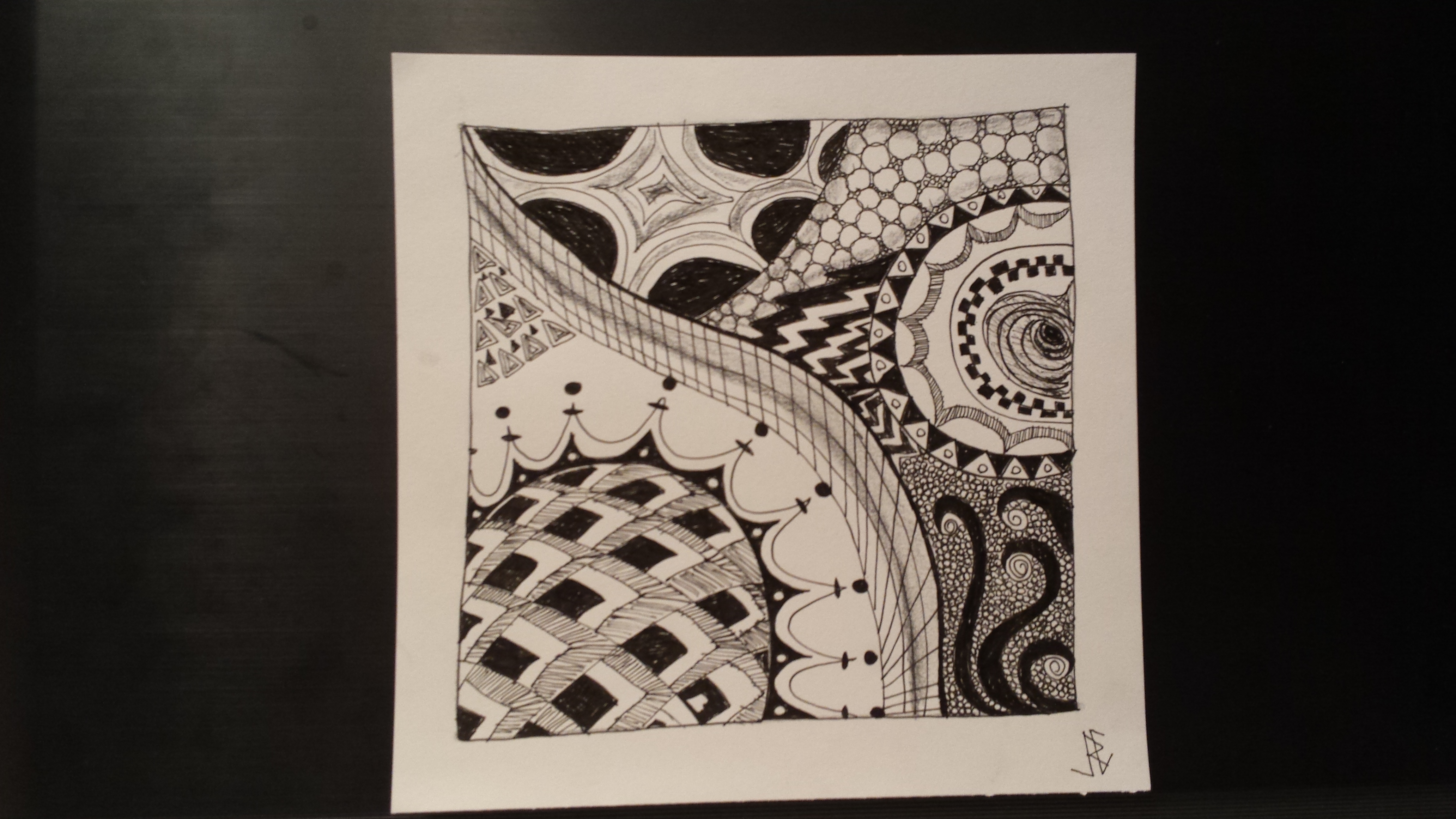
Zentangle 031815

Today I wasted over two good hours of my life that I’ll never get back dealing with people who didn’t want to be dealt with.  I got angsty and upset, and really, that just means they win.  So I came home and did this tangle to de-tangle my brain.  They call Zentangles meditative art, and they work.  If you haven’t tried doing them, you should. (You can get books about them at Amazon.)

Anyone can do them–I feel much calmer than I did earlier.  It doesn’t fix what still needs to be fixed, but I guess some things just happen in their own time.