In Which the Author of this Post Expresses Her Deep and Abiding Admiration for Alexander Hamilton and Broadway Musicals about Our First Secretary of the Treasury

A little more than a month has passed since my last blog.  I’d like to say I’ve been using the time in a worthwhile way—writing new work, perhaps, or reading a bunch of new books of poetry to shore me up in preparation for teaching creative writing this summer.  But the fact is, I’ve gone crazy for Hamilton (the Broadway musical that was just nominated for a record-breaking 162016-05-11 17.34.28 Tony Awards—for those of you living under a rock).

It’s all I think about.  I stay up late watching YouTube videos about anything about the musical—I recommend Leslie Odom, Jr.’s video where he responds to comments and questions on Facebook, and Lin-Manuel Miranda on Jimmy Fallon for the Wheel of Freestyle bit, or any of the #HamforHam videos— just coast from video to video to your heart’s content.  (While I’m at it, I also suggest watching the video of “My Shot,” which was performed at the White House.)  I listen to the soundtrack constantly—I haven’t listened to NPR in my car since the beginning of April—I don’t have time, because I want to get in as many songs as I can on the trip back and forth to work (also, I don’t care to hear anything about stupid Donald Trump [or warmongering imperialist oligarch Hilary Clinton, while I’m at it], and I assume anything election-related will mention those worthies).  If I wake up in the middle of the night, some lines from somewhere in the musical are floating in my head.  Or, if someone says something to me, I can think of a perfect line from Hamilton in response—and I desperately want to sing it to them.  (Really, try me… post a comment below, and I’ll respond with the perfect line.) I also can’t help myself from thinking about writing Hamilton fanfic.  Not that I would… but sometimes I imagine writing it.  Like, I totally want to write some Hamilton/Laurens slash—I don’t know why.  I comb websites (especially tumblr) for anything Ham-related.  It’s insane.  Or, if I read anything in the “Hamiltome” (The Hamilton Revolution), I can’t just read the lyrics on the lyrics pages, I hear the songs sung in my brain… breaking only to read the notes on individual lines.

It’s also all I dream about.  Last night, for instance, I dreamed two separate Hamilton dreams.  In the first one, I dreamed that Lin-Manuel Miranda invited me to audition, and I was supposed to sing/rap any song from the second act.  While it’s true that I don’t know the words to the second act as well as I do to the first one, I know enough that I could totally have aced the audition—I would have chosen “Cabinet Battle #1” for the audition, by the way—which I know 100%.  Except when they gave me the list of songs from the second act to choose from, they weren’t anything I recognized.  (A variation on a “failing the test” dream, I guess?)  In the second dream, I was drawing fan art of Daveed Diggs as Thomas Jefferson. (I want to include an image, but they’re all copyrighted—just Google “Daveed Diggs as Thomas Jefferson”… if you see a man in a purple velvet/velour suit, you’ll know who I’m talking about).  I have never drawn a fan art of anything in my entire life.  (Mainly because I don’t draw.)  But it kind of makes me want to sit down and try.

Additionally, 2016-05-11 17.30.31-1I’ve been reading Ron Chernow’s Hamilton biography; I’m on p. 580 (out of 738 pages + notes), and I go around reporting on what Hamilton has done “the night before”—i.e. what I read the night before in the biography, I report on.  “Did you know… blah blah Hamilton blah blah?”  (Did you know that Hamilton got Yellow Fever?  Did you know Hamilton was made a General under Washington, who came back from retirement at 66, when it seemed that the U.S. was going to go to war with France?  Did you know that everyone in President John Adams’ cabinet supported Hamilton, and John Adams had no idea?  Etc., etc.)  If I haven’t reported a “Hamilfact” to you, it’s probably because you and I haven’t crossed paths any time recently.  And, if you know me at all, you know two things:  1) I don’t read biographies; and 2) I don’t read anything longer than like 300 pages (Harry Potter notwithstanding).  But I’m making good progress in Chernow.  And one of these days soon, I plan to catch up with the Hamilcast, which is a podcast about the musical and Chernow’s biography.  It’s on my list.

So, maybe you wonder why I’ve become obsessed with Hamilton—besides that it’s just a great musical and there are so many great lines in it (and it’s great hiphop with so many great rhymes in it) (all written by Lin-Manuel Miranda)—it’s because Hamilton was a copious, obsessed writer.  These lines from “Non-Stop” describing Hamilton say it all:  “Why do you write like you’re running out of time/ Write day and night like you’re running out of time/ Every day you fight like you’re running out of time…”  One of the things that Chernow goes on and on about is how Hamilton just couldn’t stop writing—when he could write one essay, he’d write ten—or more.  The Federalist Papers (essays that defended the Constitution to the public) were supposed to be 25 essays, with him having written like eight.  But indeed, there were 85 essays, and Hamilton wrote 59 of them in six months.  (I can barely write 3 poems in six months, it seems.  Ok, I’m being disingenuous—I’m a little more dedicated than that, but you take my point.)

Even his essay, the Reynolds Pamphlet (a.k.a. Observations on Certain Documents Contained in No. V & VI of the “History of the United States for 1796,” in Which the Charge of Speculation Against Alexander Hamilton, Late Secretary of the Treasury, Is Fully Refuted.  Written by Himself.) where he falls on his sword to assure the public that he only slept around, he did NOT engage in illegal speculation with the banks (he was overly scrupulous with American money and wanted people to know he never abused his position as Secretary of the Treasury), was 95 pages long.  95 pages!  95 pages to basically explain that he’s very sorry that he was a sex addict who stepped out on his wife (while also responding to other things in the pamphlet History…for 1796 by James Thompson Callender, like American Jacobism—but still) (see Chernow p. 533).  It blows my mind.  He wrote poems, letters, reports, dispatches, plans, essays on everything—as well as created things like our banking system and the Treasury, and coming up with the idea for West Point and the Coast Guard and starting the New York Post…and, and, and…  Hamilton was a genius, and the musical celebrates that he was writer and that he wrote just as soon as breathe, and that is something I admire.  I wish I could be that prolific—or maybe even a quarter as prolific.  Or a tenth. (A hundredth?)

(I think Chernow mentioned that there are 27 volumes of collected works by Hamilton—and of course there’s probably more than that that didn’t survive.  The collection, The Complete Works of Alexander Hamilton: The Federalist, The Continentalist, A Full Vindication, The Adams Controversy, The Jefferson Controversy, Military … (26 Books With Active Table of Contents) is available for Kindle for $1.99.  I might have to get that.  Except I hate reading books of any quality on the Kindle—because I can’t take notes.) (Seems to me I remember that excerpts from The Federalist [a.k.a. The Federalist Papers] appeared in the Norton Anthology of American Literature—back then, when the Norton was practically surgically attached to my hand, the thought of reading any kind of writing from the Revolutionary era sounded about as dry as dirt.  Now I’m like, gimme gimme.  I’ll read it all.)

I liken my love for all things Hamilton to a kind of crush.  I sort of fall in love with things for a while—like anime, or manga, or zentangles, or TV shows like Murdoch Mysteries and Miss Fisher’s Murder Mysteries (remember when I burned through all of Kelly Greenwood’s Phryne books like I was in a race?), and then the interest doesn’t wane exactly, it just becomes more manageable.  I don’t see my Hamilton crush cooling any time soon, though.  I mean, I’m even considering watching the Tony Awards show… and I never watch Awards shows because they are full of bluster and balderdash…and commercials… but I will probably totally watch them on June 12th.  Anything for a glimpse of Hamilton… Since I won’t be going to New York any time soon.  (And even if I could, who can afford $756 for a shitty nosebleed seat?  Plus airfare and hotel and food for a weekend?  New York ain’t cheap.)

Anyway, join me in Hamilmania… Do not “throw away your shot” to download the soundtrack to the musical, watch some videos, and fall in love with Alexander Hamilton. (And then let’s hang out and we can wax effusive about Hamilton together!)

AWPost Mortems

It’s no secret I didn’t want to go to AWP.  In fact, when Karen Head announced to me that she had arranged it, fait accompli, that I was going to the conference, I pretty much decided to permanently take to my bed with the vapors.  My attitude wavered between considering how amputation of all my limbs or a lobotomy without anaesthesia would be preferable to flying out to Los Angeles (a city I was happy to be rid of the last time I left in 2002) and being thrust into a situation where I always have to be “on” and charming and cheerful, like a carnie, trying to tempt people to part with their cash.  (Although, of course, buying poetry is a better deal than any carnival game—and at least you don’t get snookered.)  But I’m always fine once I get to a place.  It’s the getting there, and the pre-anxiety (and the fact that I had a raging case of bronchitis—can I ever get through a Spring without it?  Geez!), that always cast a pall.

2016-03-31 08.53.04But I had a great time at AWP.  While I missed some interesting panels (being married to the booth for the entire time), I made up for it by being excellent at getting people to subscribe to the Atlanta Review.  Among the three of us—Dan Veach (now Editor Emeritus of AR), Karen (the new Editor), and me—we sold 42 or 43 subscriptions, sold out of all the journals that Dan brought with him (he brought 120 copies!), and met and encouraged lots of poets to send us their work.  I expect we’ll have quite the slush pile once Karen and I take over!  And that’s good because the more people who know about the Atlanta Review, the more we can spread our influence and get new readers and conquer the poetry world, Mwahahahah!  (Ah, sorry, I lost my head for a minute.  But you take my point.)  We want to continue Dan’s success with the journal, and between Karen and me, I think we waded into this new endeavor with aplomb.  And Collin Kelley was at the table off-and-on, and he is always one of my favorite people.
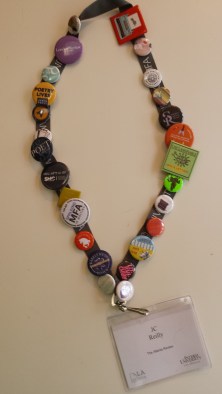
write buttonsOf course, what I always forget about AWP is how much fun the Book Fair is.  Especially when the swag is so good.  And it was pretty good this year.  The hot giveaway was buttons—everyone was giving away buttons, and so my AWP lanyard was bespangled with them from all manner of journals, the London Review of Books, PoetLore, Five Points, Sierra Nevada College’s “This Sh*t Is Lit,” “Poetry Changes Everything,” and nearly two dozen more. (I was all about the buttons—and even got several compliments from random peeps about my lanyard.  The best one sported a picture of a catalope (cat with antlers)—of course I can’t remember what journal I picked that one up at—I really wanted to buy a tee shirt from them, but they were out.)  (Also, we’re totally giving away buttons next year at the AR table—we totally need to swag it up.)
write poetry fresher


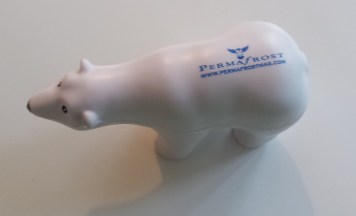
Other swag of note:  Poetry gave away car air fresheners.  I am totally mystified by this choice.  It smells vaguely piney, and also like antiseptic.  And ass.  Not really the smell your car longs for.  But on the back is the poem “Trees” by Joyce Kilmer, published in Poetry in August 1913, which is kind of nice.  Permafrost gave away a squishy stress-ball in the shape of a polar bear (awesome) as well as free copies of their journal.  There was one booth that as I was leaving the Book Fair for the day had some earbuds lying around.  I’m pretty sure they were giving them away…they had several pairs sitting on the table… but if not—if I accidentally liberated them—then I can add kleptomania to my list of skills, along with poetry and sarcasm.  (It’s good to diversify, you know.)

write bear


Then there was the booth with this one woman who apparently is a self-publishing machine. (I’m withholding her name in case my ridicule gets out of hand—but she shares a name with a famous early 20th century woman poet.)  I mean, she was probably 80, wizened like the Southwest—she looked like New Mexico—and draped in scarves and flowing skirts, and had stacks of her books in front of her like a fortress—all published through Amazon.  No matter how I tried to extricate myself from her clutches, she would not let me leave—she kept wanting me to purchase her books.

As soon as I’d inch away, she’d thrust another of her books into my hands, telling me how her life had been changed and how these poems represent her experience.  She gave me one book to take with me—which I totally thought was a catalogue describing her various books, with a few poems in between ads for her other books—and when I got back to the hotel, it turns out she was actually selling that book—there was a price of $18.95 stamped on the back.  (I was like, dafuq?  Really? Who would buy that??) Anyway, when she saw she could not entice me to purchase her whole corpus of books, she foisted her most recent one on me—which actually, from a graphic design standpoint, seems really kind of nice—the cover is lovely, and it looks like a real book of poetry, not something from a vanity press.  But I mean, how good can these poems be?  The first line of copy on the back cover states, “These new poems were all written during the first two months of 2016…” and the pub date is March 5.  I guess I am being a poetry snob.  I haven’t read the book yet—it could be wonderful.  But I’m not holding my breath.

Another book that was given to me for free was Jessie Carty’s Practicing Disaster (Kelsay Books/ Aldrich Press 2014).  I have a bit more faith in this book, although its title on the cover is written in shitty Comic Sans.  (Really?  Like who thought that was a good idea?)  The inside cover has the author’s name signed and the line “Not a joke—free poetry” with a smiley face.  And the acknowledgements list at the front of the book is quite impressive—among the places that Carty has published work include Eye Socket Journal, The Dead Mule, Blue Fifth Review, and Poet’s Market 2013.  So, I’ll try to read through it at some point.

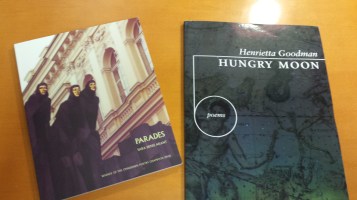
write booksAs far as purchased books, I bought Parades by Sara Deniz Akant (OmniDawn 2014), and Hungry Moon by Henrietta Goodman (Colorado State 2013) (which kind of got banged up on the flight home—c’est la vie).  And the stack of journals I picked up is impressive—Moon City Review, New South, Southern Indiana Review, Rock and Sling, Michigan Quarterly Review, Sugar House Review (which has a beautiful cover), the Laurel Review, and several others—all of which will be seeing submissions from me in the near future—hahah.

write journalsOf course one of the things people flock to AWP for is all the famous people, as well as catching up with old friends.  I didn’t meet any famousy-famous people, though I did get to meet Kelli Russel Agodon, of Two Sylvias Press (a press that makes lovely little books), who is one of my heroes (I love her as a poet and as an editor), and who tweets great material always (follow her if you don’t:  @KelliAgodon).  So meeting her at the Two Sylvias table was so nice—I was fulsome enough in talking to her, I think she felt like she had to hug me.  But we had a nice little convo.  And I did get to see some old Nebraska alums—Liz Ahl, who I always forget how divine she is (we had drinks with her at Tom’s Urban, in L.A. Live, across from the Convention Center), and Darryl Farmer, who was here at Georgia Tech too for a little while, before moving off to the wilds of Alaska.  But overall, not as many Nebraska folks as I expected to see.  (I went over to the Prairie Schooner table, thinking there might be someone from the old days, but I didn’t know any of those people.)  I would have liked to see a few more, at least.  (I did see another UNL alum, who, as always, looked right through me, the putz.  I refuse to mention him by name, but a pox on his head.)
2016-04-01 16.41.19

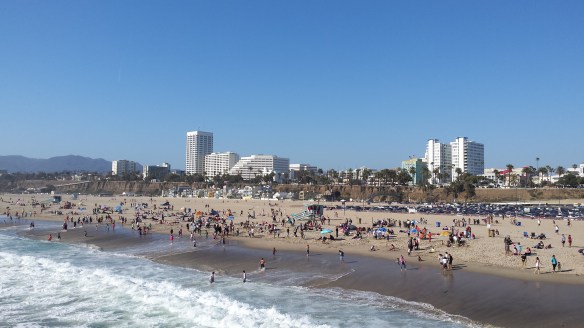
View from the Santa Monica Pier

Not at the conference, I met up with my old best friend/ enemy/ boyfriend-ish/ not boyfriend-ish/  “I’m gay” “No kidding” “Why didn’t you tell me?” “I thought you knew” / best friend again from back in my USC Trojan days.  We spent late Friday afternoon and Friday evening walking all over Santa Monica—we walked from Wilshire Blvd. to the Pier, and up and down the Pier, and along the beach for a long stretch (geezus, the water was cold as fuck), and then up and down the Third Street Promenade about three or four times, tried finding a movie to watch (we went to the movies all the time when I lived out there), went out to dinner, ate liquid nitrogen ice cream at Creams & Dreams, and then hung out at his place in Venice to watch Brooklyn—a great (if slow-paced slice-of-lifey movie… about 10 minutes into it, I thought, “This is so my Mom’s kind of movie”).  I didn’t get back to the hotel till well after midnight.  But it was so good to see him… and fun to tool around L.A. like we did when we were younger.

Anyway, I’m glad to be back, I won’t lie.  I need to recharge my introvert batteries which were sadly depleted while I was away.  And mostly I need to…

write like a mofo          …And so do you.

Oh,Venice, Mi Manchi

Underneath day’s azure eyes,
Ocean’s nursling, Venice, lies—
A peopled labyrinth of walls,
Amphitrite’s destined halls,
Which her hoary sire now paves
With his blue and beaming waves.

—from P.B. Shelley’s “View from the Euganean Hills”

I’ve been dreaming about Venice off and on for the last several weeks (in between dreams about houses missing an outside wall, pun-offs with Bob Wood—not as funny as it sounds, btw—or reading books with weird languages in them).  It’s almost strange how Venice has crystallized into this mythic place in my mind—and I want so much to go back there, and enjoy it in a way I didn’t enjoy it two years ago.  Like I really want to get lost there for maybe 3 weeks—but this time, I’d have my phone and a good map and I’d be on my own time table, and so it would be a controlled “lost”—I could explore at my will, and learn the city at my own pace, and see all the art (that I didn’t see before), and find interesting little alleys (that I didn’t have to map in my notebook so I could find my way back out of them), and visit the churches and the gardens and the other islands and the shopping districts (that I had to skip).  I just didn’t have that time before.

(To wit:  think about how the first day I was there was a complete wash, stranded as I was in the airport; the second day, I stayed in bed trying to recover from the emotional trauma of first day as well as from jet lag, and I was completely money-less except for maybe like €3 [which I spent on 2 cans of ambrosia of the gods Lemon Fanta] because I needed to find a bank—so that was 2 days out of 6 down.  And then of course I was there for work, and I was on someone else’s schedule.)

By the end of that week, I was finally getting a feel for the city, and could make my way around with some autonomy—and then, hello, I had to leave.  But it was in those last couple of days that I fell in love with Venice and realized that there’s a Venice book in me (right?  all the writers who’ve been to Venice—Shakespeare, Henry James, the Romantics, plus gobs of others—fall in love with the city and thinks there’s a book in them about it), but I really need to get back in that milieu and absorb the rhythms and sounds and textures of the place to be able to write it.  Or at least to write it with some authenticity, with the flavor of presence, and not just the hazy taste of memory.

I want to experience some of the touristy things—like take a gondola ride or visit the Peggy Guggenheim museum—and drink Aperol in every bar, and walk until I’m so tired all I can do is stumble upon little out-of-the way cafes and write for a couple of hours before I’m ready to walk back home.  That would be my dream:  to go back there (not in high summer—maybe, February, when it’s cold and rainy, the off-season for cruise ships—such weather would not deter my enthusiasm at all) and write and write and write and eat and drink and write.  There’s a reason that staying in Venice was an expected stop on the Grand Tour for like centuries—because it’s a capital of culture (yes, yes, dead, white, male, upper class, Eurocentric culture—spare me the lecture), and putting yourself in that space, away from your home space, gives you a different perspective on the world.  Maybe not a big difference in perspective—it’s still Western, it still has wi-fi—but it certainly influences your thought patterns.  It’s certainly also influenced my writing—and I keep coming back to writing those little prose poem/ memoir hybrid pieces (like the one I was nominated for a Pushcart for).  I have a number of them.  I think there are more inside me though.  Another trip to Venice would coax them out, I bet… (Haha.)

Speaking of things (roundabout) Venetian, I have to go to AWP’s annual chaos of a conference at the end of the month in Los Angeles as part of my new duties for The Atlanta Review.  I do not look forward to the conference; it’s gargantuan, spread out over multiple hotels, full of 50,000 writers (and that’s not my usual hyperbole) rushing to panels and readings (and apparently, I’m reading too—so great, now I have to figure out what the hell to read)—but I hope that I can get out to Venice Beach (or Santa Monica) for a little bit of time.  I need to see the ocean up close and personal, because it’s been a while (at least 14 years since I’ve seen the Pacific).  And Venice Beach, for all the times I’ve visited, always amuses me.  It’s quirky and endearing and strange, and I dig that.  Again, like so much of my time in L.A. in past, I will be sans auto, so not sure how I’ll get out there.  And a $60 taxi ride wouldn’t be my first choice for transportation, much as I’d like to go… But I’ll figure that out when I get there.  Who knows, maybe I’ll write a few Venice Beach poems.  That could be interesting.

As for Venice, Italy, I’ll get back there some day.  My book will still be waiting for me to write it.

grand canal image 06.24.14

A picture I took, maybe of the Grand Canal (I can’t remember), June 24, 2014.

Contests, & Waiting, & Rejections, Oh My

What does it take to get a book of poetry published in this country?  I wish I could write a blog where I list out all the steps a person needs to follow to help ensure success in this process.  These are the things I would mention:

  1. Write a book of poetry.
  2. Get friends to read it and make suggestions for revision.
  3. Edit and polish the hell out of it.
  4. Send it out to publishers.
  5. Get published.
  6. Become the latest darling of the poetry world.
  7. Repeat for Books 2, 3, 4…

Except, it hasn’t worked that way.  Well, I mean, I’ve got Steps 1-4 down pat.  I’ve sent out my manuscript (at this point) 42 times (which as you know is the answer to life, the universe, and everything), so you would think that perhaps the universe will come calling for me pretty soon.  (And to be fair, after a hiatus of several blues-ridden months where all I was getting was rejections, I’ve sent it out 10 places in the last month, 5 of which are contests. I guess you could say I’m feeling hopeful again—so technically speaking, it’s only received 32 rejections.)

And I get rejection is part of the gig.  Your manuscript has to find the right person who loves, loves, loves your writing, someone who will pass it along to the next reader, who also needs to love, love, love it.  And so on.  And contests aren’t the best way to ensure that your manuscript finds a loving audience, because readers simply don’t have the time to invest—particularly if your book is a little odd. (Which I fully admit mine is.)  Readers barely have time to invest even if the poetry they read is something they expect and understand. I know this.  On an intellectual level, I know this.  Everyone is getting rejected (well, except for one person).  Most contests report that they’ve had anywhere from 600-1000 entries.  Lots of people are getting told to take their manuscript and go bite the big wienie.  I get it.  I just wish that the process didn’t suck so hard.

I have a writer friend who told me that he knew someone for whom it took 70 times before her book won a contest and got published.  70 times.  Considering that most contests only award $1000 and run $25 a pop to submit, that times 70 contests comes out to $1750, meaning the contest cycle put her $750 into the hole.  (I don’t even want to think about how much into the hole I am.)  (Not that anyone goes into poetry to earn a living.)  (Honestly, what kind of business model is this, where the poet has to take it on the chin, nose, or other body part to get her work into the world?)

Of course, railing about it here is not going to change the status quo.  For whatever reason (because hardly anyone reads poetry anymore and contests are one of the only ways that publishers can make any money), this is how the process goes if one wants to be published by a reputable press and hopefully receive accolades for it.  And I buy into the system (literally and figuratively), which makes me complicit, and I have to be ok with that.   I am ok with that. Because, hey, who doesn’t want to win the Academy of American Poets Walt Whitman Award and spend 6 weeks lounging around and poeming in Italy plus get their book published and sent out to everyone who is on the rolls of the AAP?  If you won that, the $35 fee you invested (for me $70, since this is my second time around) when you submitted your manuscript would be hella worth it.

I could just wish I knew what the magic number of submission times for my book  to get published would be.  Because that would so alleviate my anxiety.  Like, let’s say the Goddess of Publication were to come down from On High and whisper one night when I’m asleep:  64 times, JC!   Then I would know that I only have 22 more rejections to go.  That would be great.  I could send them out all on one day and get it all done, knowing that soon I’d hear the good news.  Ah well.

Meanwhile, back at the ranch…

I haven’t been working on Hecate Applebough.  I was thinking about why this is, and it’s a combination of factors—the weirdo exhaustion, a preponderance of tennis matches in the evening when I would normally write, and a renewed vigor about writing poems.  But actually, those aren’t the biggest reasons.  I think the biggest reason is because I’m waiting to get notes back about the first book…and so I’m kind of feeling like I don’t want to write any more on the 3rd book in case there are repeated mistakes in the 1st one that I could prevent myself from writing in the 3rd book if I just knew to avoid them.

That’s certainly a true enough statement.  Avoiding mistakes if they’re preventable is always preferable to making a bunch more and having to go back and fix them.  But if I’m honest, another thing making writing the 3rd one a pain right now is I’ve dug myself into plot hole and I really don’t know how to get Cate out of it.  When I sit down at the computer and see that last chapter., I’m like, “Bleah” and then I get up and do something else.  It’s the first time since starting to write this series that I’ve just felt like I’ve lost control over the story and over Cate’s life.

And so in your endless wisdom, you might say, just throw out that chapter and start fresh.  And that’s really good, practical advice.  But the thing is, I don’t know what to replace it with.  I don’t know how I can make it better.  I have a blind spot right now.  So I kind of thought it might be ok to just set Hecate aside for a little while, and focus on writing poems and sending them out.  Maybe when I get the notes on the 1st book, it will help me see the 3rd one with a fresh eye too.  (There is no pressure on the person reading the book right now to hurry up and make those notes… I need some down time from Cate, so it’s totally ok.  Take as long as you need.  Srsly.)

And maybe this weekend, I’ll get a bee in my bonnet and suddenly figure out how to proceed with Hecate.  Or maybe I’ll write three more poems.  When it comes to my writing, it’s always just a mystery what will happen.  I kind of like it that way.

And, as a total non sequitur, please enjoy a photo of Jenny, who has been keeping me company:

2016-03-09 20.05.25

Time to Get Reading

In my push to work on Hecate Applebough 1, 2, & 3, my poetry has been getting somewhat short shrift.  True, Cate is a poet, so I include some of “her” poems in the text, but as for my own (“real”) poems, I’ve hit a dry patch, which tells me I need to begin a Reading Phase.  (Either that, or I need to win a trip back to Venice, but I don’t see that happening any time soon.)  Reading poetry is helpful on so many levels—among other things, it exposes you to new ways of looking at the world, it offers creative connections with language, and it reveals beauty and anguish and sudden bursts of weirdness.  But more importantly, it lets me escape the dolor of my own head.  I mean, honestly, that thing is like a coffin.  I need outside influence in the worst way.

But what to read?  I have plenty of books on my shelves that I’ve either never cracked, or I read long ago and forgot what it’s them.  (Also, as an aside, “long ago” could mean as recently as a year ago—I have a piss poor memory for poetry, which is kind of pathetic for someone who counts herself a poet.)  There are new books of poems out every day, some of them by acquaintances that I need to buy at some point—all of them equally good, I’m sure, but I think I’m going to choose some “free” ones—and by free, I mean, ones off my shelf.

(Closes eyes and chooses)…And here are the first three winners of my Random Poetry Picking Sweepstakes:

  • Mohja Kahf’s E-mails from Scheherazad (UP Florida, 2003)
  • Molly Peacock’s Original Love (Norton, 1995)
  • Evie Shockley’s A Half-Red Sea (Carolina Wren Press, 2006)

My goal, then, is to read these books in the next few days and be amazed by their words, and maybe after that I’ll read a few more, etc., etc., and maybe after that I’ll be ready to start a Writing Phase again.  I might even include some mini-reviews next week.

I do read journals off and on (especially when I’m in a Submitting Phase), but sometimes, I find what passes for poetry in them unintelligible.  Like, I just have no idea what the person is trying to communicate.  I don’t believe it’s because my brain has certainly turned into marshmallow—I think there’s just a real movement to putting words together for no damn reason other than to see if editors will be fooled into thinking that word-bag poems mean something.  Now, not every journal, and not every poem, obviously.  But it seems to happen more frequently than not.  Recently I read a few poems in a journal (that will remain nameless, but suffice it to say it’s Big and Impressive) that I was considering submitting to, and once I read the kind of poems they’ve published lately, I was very certain that what I write would fall directly into the round pile.

(I’m not talking about The New Yorker though, in case you’re curious what Big and Impressive Journal I mean.  For at least the last 20 years, they publish the shit poems of brand-name poets.  I’m saying it out loud, right here.  The New Yorker prints the absolute worst poems I’ve ever read.  And if this claim on my part means that they will never publish any of my poems, far far into the future, when I am myself finally a brand-name poet, then so be it.  Their poems are the pits, and honestly they should be ashamed of themselves that they can’t pick better ones.)

(Does that sound like sour, jealous grapes?  It’s not.  I know getting published in The New Yorker is a big benchmark for a poet, but I think I hold with Groucho Marx here:  I don’t care to belong to any club that will have me as a member.  So, sayonara New Yorker.)

Anyway, in my distaste for The New Yorker, I’ve meandered from my point (it happens, forgive me)… which is this:  it will be good to get back to reading quality writing (instead of what I have been reading, which is fun [manga], but not particularly conducive to inspiring my poetic side).

And if you have any poetry book suggestions that are current and wow, leave them in the comments.  I might go on a buying spree soon.  Goddess bless Amazon Prime.

Seriously, JC, They Make Pills for This

My novel went on a “first date” yesterday.  Metaphorically speaking.

What I mean is, it is in the process of being “courted” by a potential future editor, which is to say, my Brilliant Fiction Writer Friend™ (whom I’ve mentioned before in this blog), who, despite not being a fan of YA, has graciously, and generously, and kind of insanely agreed to read my NaNoWriMo novel Hecate Applebough because he believes in me as a serious writer (even a serious writer of fluff), and sight unseen is willing to work with me to revise it and maybe make it into something good (or good-ish).

I must admit I am in the absolute worst dither of insecurities about my writing ever.  Like I’m back in my first creative writing class when I’m 20 years old, and so shy about what I’ve written that I really fear—not just that what I wrote is crappy (because that is surely a given)—but that I will have a) inflicted my mental crappiness/ drivel on another person; b) wasted someone’s already limited amount of leisure reading by forcing them to read something appalling (and deeply flawed on all levels); c) imposed on someone’s friendship, even when they offered, even when they are doing their best to wear me down to make me agree to continuing this part of the writing process (and I am deathly afraid of imposing on people, like pathologically so); and d) allowed someone to discover proof  that I’m not nearly as hilarious and awesome as I think I am.  (Perhaps that last fear on the list sounds trivial or frivolous, but I assure you, it’s a deeply-seated fear.)

It’s really a weird place to be in—like I believe in my ability as a poet.  I might be having a shitty time convincing contest editors that my volume of poems is fantastic, the next best thing, blah blah, and they need to publish it already, goddammit, but I don’t doubt in any fiber of my being that I’m a poet.  When I think “JC,” I think “poet.”  These ideas fit in my head together, like synonyms.  And sure, it makes sense—you think about all this time that I’ve worked on writing poetry, that I earned that Ph.D. in poetry—I mean, if I didn’t see myself as a poet after the time I’ve invested in it, that would be a huge (and annoying) problem. (And would make having to pay back student loans even more of an insult.)

Except, I don’t want to be just a poet.  I have more words in my head than that.  I’m not saying I believe BFWF that I’m a “novelist” either (just by virtue of having written 1.99 “novels”), but limiting myself to one version of “who I am as a writer” doesn’t fit me any more either.  Of course, in terms of writing fiction—well, I still feel like I’m still 20 years old, with zero experience—but there’s an expansiveness that’s been coming the last few years, a real desire to try something new, and to tell stories that take more than a page.

That narrative bent in my writing and my voice is there—and let’s be honest, the poetry world does not appreciate narrative as a form.  So, I need to use forms that narrative work in… which is why I wrote Hecate Applebough, which is why I also write these memoir-y vignettes that seem to find homes in little journals too.  Hmm.

But getting back to the possibility of having a real reader/ editor:  I was asked if I want to be worn down.  That’s a hard question to answer.  Like, realistically, who wouldn’t want a person you admire who is brilliant and has critical and practical expertise and proclaims a genuine wish to help you succeed to be the one who reads your book and helps you edit and revise it—the two hardest parts of writing?  You’d have to be an idiot to turn that down—particularly when there is so little return in it for them.

(But to be fair, my idiocy is well-documented.)

As I’m thinking about this and talking myself in-and-out of this amazing opportunity that has shown up in my life like a late Christmas gift, I realize my fear isn’t anything like worry that I’m a “fraud” as writer.  I don’t question I’m a writer, per se.  Because there’s so much that goes into writing beyond the actual writing of whatever the piece is, you have to believe that you’re a writer deep down in your heart because if you don’t believe it, then what is the point of doing this really lonely, difficult  (and often barely rewarding) work?  Once a piece of writing is released into the world (and that’s after the writer has spent her time polishing her poem or story until it gleams) you can’t control the people who read it.  If your submission (or your “novel”) shows up on a day that the editors/ grad students working on a journal are on the rag, or hungover, or pissed off at their bosses, or they hate anything that smacks of genre or narrative poetry or they just read a great bird poem right before they picked your bird poem up from the pile and so can’t imagine any bird poem after the one they just read as measuring up (or whatever), your writing, no matter how good it is, won’t go beyond the first pass.  It might not even go beyond the first lines. (I say this as a person who has participated on the grad student side of the journal publication process.)

There’s so much luck involved in a person’s work entering the wider world by being published. And forget about the accolades.  You have to believe you’re a writer—because the odds are so stacked against you that your work will ever resonate with anyone and find a home in their journal or on their upcoming publications list.

So it’s not a matter of lacking faith in myself as a writer (in the generic sense) that is the stumbling block with my sharing Hecate Applebough—the fear emerges from the realization of just how drafty the first draft is—and sharing a piece of my writing with someone that is 98% imperfect terrifies the fuck out of me.

Because when I share my poems with people, they only see them after—typically—the poem has gone through 8-10 drafts already.  Like my writing group?  I show them poems that are, to my mind, already mostly good.  Poems after I meet with them may go through another 5-10 drafts, but when the writing group sees them initially, they don’t see the first draft.  They see something I’m not ashamed to show.

First drafts are unfit to be seen by anyone.  And Hecate Applebough is a first draft.  I mean, it’s prettier than a first draft, in that I’ve line-edited it, I’ve changed some words here and there, or added a few scenes to smooth over some plot holes.  But the aggregate is still first drafty.  (It’s so drafty, it needs to wear a coat.)  And sharing imperfection with someone, even someone as committed to helping me as BFWF is (someone who expects imperfection, moreover, so I’m not going to shock them), even someone who is my friend, is just one of my worst anxieties.  It just seems so wrong—so contrary to my process.  So naked.

And I guess I either need to get over myself and stop being so crippled by self-doubt and all this blather and take the opportunity because when the Universe wraps it in a bow, how stupid do you have to be to say no?  Or I just need to STFU about this book and move on to the next thing and be satisfied with sabotaging myself (again) and learn to enjoy obscurity and blown chances.

(Ugh.  When I put it like that, suddenly I think I must be pretty foolish to have spent 1400 words to realize I planned to say “Yes” all along.)

P.S.  I know BFWF will have read this post (being one of my Five Faithful Readers). And BFWF will think “I knew it.”  But I’m pretty sure, recognizing the kind of headcase I am, that I will change my mind at least 58 more times.  Possibly more. So certainty tonight may shift back over into uncertainty many more times before I actually hand a copy of the book over.  Fair warning.

P.S. #2  BFWF should in no way feel compelled to comment or to cheer me on. (This post is not a plea for more convincing.)  Sometimes I blog just to take the edge off my neuroses.

Report on NaNoWriMo, Week 2

At nearly 19,000 words, I feel like I am making great progress on my “novel,” and I’ve been thinking about what to do when I actually finish it.  Of course, we all have grand designs about writing the next Rainbow Rowell’s Fangirl (a book I loved when I read it a couple of years ago because it was funny and it was set at the University of Nebraska-Lincoln) and which I recently found out originated as a NaNoWriMo novel).  I know, deep down, however, that I won’t be writing the Next Big Thing.

What is more likely is this:  I plan to revise my book and get some feedback (I have a couple of people who have agreed to read it once it’s done–they must have a masochistic streak), and then, I think (unless they rave about it, and encourage me to MASSIVELY revise and think of publications, which also ain’t likely), I’m going to release on Amazon for 99 cents.

For 99 cents, I’ve read some pretty damn decent books.  I mean, I wouldn’t pay more than 99 cents for them, but for a couple of books (that had an interesting premise and characters who sounded reasonable), 99 cents was money well spent.  I have every confidence that my book is certainly worth 99 cents.

So… that’s what I’m thinking, at least this week.

Anyway, I’ll have more to say soon–but I was really busy with grading and with tennis tonight, I haven’t had a chance to write, and I’d like to get some words knocked away if I could.  (But first I really need a shower… I have some serious tennis funk going on.)

(I know you really needed to know that.) (xo)

Report on NaNoWriMo, Week 1

I’m just going to say it:  so far, NaNoWriMo is going great for me.  I’m doing everything wrong, everything I remind my students, ad nauseam, not to do—I’m telling more than showing, cheaping out on sensory description, failing to use character tags as effectively as I could, lollygagging (emphasis on gagging, I expect) with my dialogue, using adverbs a little more heavy-handedly than I ought.  And it’s FUCKING AMAZING  how much you can get written when you just don’t worry about MAKING ART.

I’m having a GREAT time.  I love every damn flawed word I write.  It’s so much fun to just focus on plot and vomit words down on the page—and to know that I can delay the revision process till much later, if I want.  Or not at all.  There’s a heady freedom knowing that there’s no stakes attached to this “novel.” I don’t agonize over the words the way I do when I’m writing poems, or even my “real” stories—here, I’m just racking up the word count.  If I can’t think of a more elegant word for when my character feels emotionally bankrupt and friendless and dorky, she just says she feels “crappy.”  And I’m totally ok with that.

Why?  Partly because she’s a teenager, and teenagers are not particularly known for their emotional depth and elegance in articulating the way they feel.  Partly because I know that this “novel” is an exercise in stamina and persistence.  And partly because I know that even if I write the lousiest, lamest, most derivative novel this November, that’s ok.  Because it’s practice writing.  It’s making me sit down every day and prioritize my writing over everything else.  And face it, that’s what we writers need to do.

And you know what else?  I would love my friends to read this novel when it’s done—because it’s cool in its way—and its aesthetic is so not me (at least I don’t think so) that it would be interesting to see what my friends think.  The way sharing writing with friends used to be—something you did for fun (instead of something you did because you’re concerned with publication)… Geez, when you have no expectations about publishing, you’re crazy free—like going to Kroger in a skimpy tank top and no bra when you’re a 46DD kind of free.

Something else I like about this novel is that it’s definitely not like most young adult fiction that seems determined to be depressing, dystopic, and dysfunctional.  This is about a girl at a new high school who likes to write poetry and who finds a guy at the school who like to write it too.  Sure, there’s bound to be heartbreak, but no one is going to be shooting people with arrows and trying to stay alive so your district can eat a little better the next year.  My characters are basically happy.  How’s that for innovative?

I think, honestly, overall, there are some good ideas in my story, and I actually kind of love my main character and her relationship with her Mom—they have an amazing rapport, and I like writing them together.  (Maybe I’m Mary-Sue-ing the hell out of them… somehow I have no problem with that. ) Actually I like all my characters.  None of them has disappointed me, and I don’t expect them to. They’re just cool people I’d love to hang out with… that’s what fiction should do, right?  Make you fall in love with the characters and want to Netflix and chill with them?

As I think about it, maybe there’s some real potential in this book that it could become something awesome at some point (with massive revision, let’s not kid ourselves—it desperately needs the artist’s/ critic’s eye leveled against it, and all of its blemishes to be smoothed away with the writer’s equivalent of Clearasil).  But again, if it doesn’t go anywhere, that’s ok too.

The main point is, it’s fun.  And I feel like there hasn’t been a lot of fun in my writing this past year.  I’ve definitely had some whimsy, but not out-and-out fun.

It’s fun to break the rules.  I possess such a serious attitude towards writing in general—I’m so concerned with making art, and creating something that will resonate with Important Readers (like editors and other academic creative writers and journal-reading types), that, frankly, it’s kind of constipating, artistically-speaking.

This novel, in contrast, is the Dulcolax approach to writing.  Anything can happen.  Characters can do stupid shit and say the unexpected thing—and I can worry about making it work later. I’m going to go on those writing tangents—I can be a little more plot driven and not obsess about creating these finely-wrought (overwrought?) characters who gnash their teeth in their sensitivity.  Sometimes my characters have whole paragraphs of dialogue that doesn’t seem to go anywhere.  OMG, the dialogue doesn’t drive the story forward!  Oh, the horror!  You know what I say to that?  So what.

And my characters laugh and smile a lot.  And they gaze at each other intently.  Yeah, I know:   I really need to expand their action repertoire.  They need to do more than laugh and smile and gaze intently at each other. They need to “inhabit their space.” (I tell my students that all the time about characters in their stories and plays—make them physical beings, block their movements, blah blah blah.) I know I need to move their asses around more effectively and get them from place to place with a bit more style.

But not right now I don’t.  And why is that?  Because it’s my novel, and I can.

Even with the “minor” setback of the exploding Coke Zero that decimated the motherboard in my desktop computer yesterday and the possible permanent loss of 1200 words (and potentially everything else I’ve ever written—though I’m really trying hard to have faith that my data is safe and not freak out and imagine the worst, as is my nature to do), hasn’t really fazed me.  In fact, it’s not even a real loss… it’s like I’ve “temporarily misplaced” 1200 words—sure, they comprised a few really good scenes with some funny dialogue—but hell, if the scenes are gone for good,  there’s more where that came from. Because I feel like the Mount Vesuvius of language—there’s just so much inside of me oozing out everywhere—even if I actually really have lost those 1200 words, that ain’t no big thing.

To have this experience in my writing life is remarkable and wonderful and really weird for me.  It makes me wonder what I could accomplish in other areas of my life if I just gave in to the fun and didn’t care about being proper and appropriate and sensible and practical—maybe I would be as grandiose and giddy as I feel now.

We’ll see how I feel next week—maybe by then NaNoWriMo will get harder, maybe I won’t feel so Mount Vesuvi-esque with my language… But as of today, I have logged 6899 official words so far—which technically counts the 1200 I lost, if I’m remembering correctly, but since there’s still a chance my data is safe, I’m counting them.

And if they’re really gone, like I said, it’s ok, I’ll just write more to catch up.

Oh, Fiction, How You Torment & Tantalize Me…

I’ve been doing this little online fiction class—it’s only for three weeks, and it is just about over.  The group is small—seven writers and a leader/ moderator and his friend/ assistant.  I don’t know much about the person leading the workshop (I know he has an MFA and a TT job and he’s published a great deal). But all of the things he’s shared about writing and about the individual stories that the group have submitted seem pretty on target to me, and (once I finally understood the interface—it took me several days) I’ve been enjoying it… but more from a teacherly perspective, than a writerly one.

Were I a fiction writer by vocation, I would probably find the prompts and writing discussions more applicable to my own writing process—I want to try them out, of course, I just haven’t… yet.  I’ve said before that I’m interested in writing fiction—I just really can’t seem to do it.  But perhaps like anything, it just takes practice.  And, a few of his prompts could very well apply to creative nonfiction, and I know that I’ll definitely try his “life through artifacts” prompt.

Anyway, as I said, the class interests me from a teacherly perspective.  I like to see good teachers in action.  He draws from a lot of different backgrounds in fiction, and, since the theme of the class is about genre bending/ blending, and being experimental (two things I’m especially poor at), he has a vast knowledge of texts that he uses as examples to illustrate his suggestions about individual pieces and in his discussion about writing in general.  Since I’m not that educated about fiction (from a writing it kind of standpoint), his commentary is especially useful and interesting.

While he seems to have a particular affinity for SFF (as do the rest of the students in the workshop), he doesn’t look down his nose at other genres of fiction, and I admire that, because many academics in general dismiss genre fiction as being aliterary at best and no damn good at worst.  This tension seems to pervade the aesthetics of many writing programs; I’ve seen a few genre-writing MFA programs advertised in Poets & Writers, but that’s in no way typical.  (I never took a fiction writing class at Nebraska, but my sense of the fiction writers they had on faculty back then was that they were literary fiction writers exclusively.)

I suppose writing programs still want to turn out John Steinbecks and Margaret Atwoods (though she’s a bit of a fence sitter) rather than Stephen Kings and J.K. Rowlings and Kerry Greenwoods… The argument always comes back to high art vs. popular culture, particularly in the hallowed grounds of the Ivory Tower, doesn’t it?  (I also suspect, though I can’t be sure, that academics have a deep-seated fear of debasing themselves to write for money.  Like writing popular fiction is the dark side or something.  I have no such fear.  If I had the talent to do it, you better believe I’d be turning out romance novels or mysteries or Game of Thrones clones or horror stories, or hell, even porn.  I’m not proud.  I’m just not talented that way–I have no attention span to write anything longer than six pages, tops.)

As a reader and lover of genre fiction (although my interest tends to run toward mysteries… and Christmas romance novels, when it’s Christmastime), I’m glad the  workshop leader doesn’t have an arbitrary bias against genre fiction.  Anyway, all this is by way of saying, I ordered three books from Amazon on his suggestion—two were by Kelly Link, a writer I didn’t know about at all, but whom I’m liking. (I’m reading stories from her Magic for Beginners in between more chapters of Greenwood’s Phryne Fisher novels and in between stories from Aimee Bender’s The Girl in the Flammable Skirt (which was a suggestion from BFWF**).  It’s important to have good material to aspire too… or to be motivated by.

Imitation being the highest form of flattery, I try putting absurdity like Bender’s or Link’s into my stories, but generally it just comes out wrong. Or pretentious.  Or just like I’m trying too hard to be too cool and winding up being that doofus in the corner.  So then I try writing a conventional story, which I gravitate towards naturally anyhow.  (I know, I know, they tell you to write the thing you’re frightened off… but mainly I’m frightened of writing things that suck, so that advice doesn’t work too well for me.) I worked on a story the other day—it was based on an upcoming theme from Duotrope’s upcoming theme list—a Christmas-ish story, to be submitted by Sept. 25th.  (So, not a lot of time to dick around with it.)  I don’t know if I will finish it, though.  It’s lacking something… maybe, more words.  It’s supposed to be flash though—ideally, the journal wants 700 words.  I’ve written 1000, and it’s not finished.

A real experience prompted the story, and so as I’ve written it, it lies somewhere between fiction and nonfiction. (Liminal spaces suck, by the way.) The problem is, it doesn’t work as fiction OR nonfiction.  I like the idea of it—it focuses on an interaction with a neighbor I had one time when I made a snowman in the front yard.  I could make it totally creative nonfiction, but then it will be considerably longer—and it already lacks that CNF aesthetic—that real attention to beautiful language that CNF is known for, that expectation of a transformative moment that we rely on in creative nonfiction to drive the story forward.  And yet, it is there, a flash of a moment where the woman building the snowman relents, at least a little bit, in her annoyance at her neighbor’s intervention.  So the draft has that going for it.

Still, the journal wants fiction.  If I make it shorter, and more fiction-y, I don’t know that its point will be clear.  Honestly, I’m not sure anyone would care either way.  If I made it more fiction-oriented, I wonder what I could do to “fix” the story?  I can’t make it about a snowman that comes to life because I believe we ALL have heard that one before.  What I’m really interested in is the relationship between the two neighbors.  But I just don’t know if it’s compelling enough.  Maybe the story just needs to be a little anecdote I share with friends—maybe it’s really not meant to be shared in a large sense (with a public audience, I mean).

But maybe I’ve just persuaded myself that I could try harder and make this story work.  It doesn’t hurt to try and a hundred other motivational platitudes, blah, blah, blah.  I can see what happens if I try.  At the very least, it will be practice, and all writing practice is good, even the failures.  I know it will wind up longer, so I guess I’ll go the CNF route and forget about sending it to that particular journal.  That’s ok.

But I’ve digressed…  Back to the writing workshop:  I have a story to read and respond to for the online group.  I printed it out and left it on the table and now it has cat vomit on it.  But the first page seems pretty good, despite the stain, so I think I’ll go read the rest now.  And then maybe another Kelly Link story.

**Brilliant Fiction Writer Friend™

My Philosophy on Writing, As Explained on My Creative Writing Class Syllabus

On my creative writing syllabus this term, I’ve included the following …well… essay explaining my philosophy on writing.  I thought it would be useful to my students to see what I think about the writing process going in.

Of course, everyone knows, the longer your syllabus is, the less students read it.  So I’m sharing this with you, my beloved five readers, because maybe you will appreciate it.  🙂

(P.S… I will make a Wednesday Post tomorrow… I just wanted to share this since I think it’s pretty good.)

*****

This class is as much about process as product—more so, actually.  What we end up with is important—but how we get there is more important.  It is extremely rare that the first draft we write is the final polished version—the person who can do that either is a literary genius or has made a deal with a devil.  If you’re a literary genius:  go home, you have no need for this class.  If you’ve made a deal with the devil:  congratulations on your masterpiece and future literary career, but too bad about your soul.

For the rest of us, we have to see a piece mature from a little clot of words and ideas to something that has possibilities to something that vaguely resembles a story or a play to something that becomes like a story or play to a revision and another revision to a detour to a revision of the detour to a rumination to a final polished version of a story or play.  Because experimentation is a key (and expected) part of the writing process, it’s not a linear process… it’s all ways at once, not a single path from start to finish.  (This may be scary to some  students, for whom linearity is a way of life.)  Creative writing is about approaching an idea from a lot of different ways, and sometimes that means we scrap what we started with.  Or we only save a line or two.  Or we change characters.  Or we change who’s telling the story.  Or we smash things together (or break them apart).  But the point is, you can’t be married to the first (or even second or third) version, because for most people, the first few versions are not fleshed out in terms of their vision and their form.

Drafting/ experimenting is NOT editing.  If you look at your first draft and “fix” a few comma errors or spelling mistakes, but generally keep the majority of the draft the same in terms of language and structure, that’s a cosmetic change (in other words, editing).  Drafting/ experimenting is an act of resistance… resisting the easy route, resisting the belief that the first try will be golden, resisting the status quo.  It’s about risk and about transformation.  It’s about making something new every time until the most perfect form reveals itself.  It’s about negative space.  About what’s not there—and about what could be there when we stumble on it.  But you won’t find out what could be there until you resist the urge to stick with your first attempt.  So, resist!  Resist mediocrity!  Resist the humdrum!  Because if you’re the kind of person who’s (even mildly) ambitious and curious and ready to aspire to something unique in writing, you’ll do just fine in this class.

Know this:  I’d rather see a flawed final draft that’s undergone some pretty substantial drafting/ experimenting as it emerged into its final polished form than a piece that hasn’t changed much at all because it was too satisfied with its original version or too fearful/ protective to let it become something more (in other words, a chrysalis that never becomes a butterfly).

I will help you realize the polished form and vision of your work through extensive comments on drafts and suggestions for revision.  I might not have the answer on how to “fix” your story or play, but I have a lot of experience in creative writing—it’s my field—so you can be sure that we’ll work together to make dynamic writing happen. Your classmates will also have ideas about your work.  This is a collaborative class—we learn from each other, and that’s as it’s meant to be.

A final word about this:  just because we experiment with our writing doesn’t mean that there aren’t “rules” that won’t need to be observed—we’ll talk about them in class, we’ll read about them in our text.  This is not an Outback restaurant.  It’s not “no rules, just right” (or “no rules, just write” as the case may be).  I do not believe in the idea of “anything goes because it’s creative!”  No.  There are real, aesthetic rules and conventions (practices or principles, if you prefer) that have emerged over the course of literary history that continue to be observed by contemporary writers for a reason—because they generally work.

When emerging writers understand these rules in writing and follow them, they acknowledge their forebears’ contributions to craft, and demonstrate that they, too, can be adept at using the conventions that have helped define (Western) literary and cultural tradition.  And then, through maturity, and only then, with deep, considered appreciation of aesthetics, may they consciously and judiciously break the rules and explore new territory.  Think of this in terms of an analogy:  Picasso, before he was a Cubist and could create something like Guernica, drew and painted realistic figures and scenes such as Portrait of the Artist’s Mother.  As he gained in experience and artistic power, Picasso threw over realism-as-convention and became a pioneer.

In works the same in writing:  demonstrate first that you can follow convention, that you can do it the “right” way (at least in terms of form and style), before you earn the right to defy it.  It’s absolutely important to create something new… but not at the expense of alienating your audience or making something that is incomprehensible and labeling it “art” just because you can.

A note about form, while we’re at it:  think of form as a lens.  The beauty of form is that it should be invisible; if we wear contacts or glasses, we don’t see the lens, because the lens itself is clear, and therefore we can see everything in front of us clearly, without blur.  The form of a piece of writing works the same way:  it should make the words and their meaning clear—it should not obscure words and meaning.  If you hand in a play that’s not in correct play script format, can you even call it a play?  No, and you’ll alienate your audience because they will be expecting to read a play, and instead will struggle to see your characters and understand their actions through the wrong lens.  Form and convention are important, and you should be mindful of them.

Of course, let me also include a quote from the famous fiction writer Flannery O’ Connor about just this subject:  “It’s always wrong of course to say that you can’t do this or you can’t do that in [creative writing].  You can do anything you can get away with, but nobody has ever gotten away with much.”