Leopard Aesthetics

I’ve been reading more poetry lately.  For a while it I read all Regencies, all the time, because I want to write more Regency novels, but the last one I read was really bad.  Like, I’ve been half-way through it for two months and am wondering if I—gasp—dare not finish.  Life is too short to read bad books, I believe, but I also hate to leave a book behind.  So instead of tossing it out altogether and starting a new one which will hopefully be more engaging, I’m reading poetry. It’s good to have a break anyway because even when poetry is “bad,” there’s always something to be learned from it—some new connections with language and thought and creativity to be made.

Last December I ran Atlanta Review’s first ever chapbook contest, and we received 115 chapbook submissions, all of which I read.  Some of the poems were wonderful, some were dreck, and some weren’t poems at all (at least, not what I’d call poems), but reading 115 chapbooks was quite the enterprise and it often entertained or moved me.  It certainly reinvigorated me as far as reading poetry goes—even though it was just part of my job.  And it reminded me that writing books of poetry really is something lots of people do—it’s not just the few of us living in our ivory towers, but it’s insurance salesmen, and accountants, machinists, nurses, software engineers, fast food workers, and teachers.  It’s not just MFA-ers trying to publish their theses, and that’s beautiful that the poetry community is so broad these days.

I don’t remember if I mentioned my friend Ed before, whom I met last year at the Tinker Mountain Writer’s Workshop, but he and I started a book club—Leopard Aesthetics Book Club to be exact—with the goal of reading contemporary books of poetry and spending 3 hours on a Saturday morning discussing it.  So far we’ve read We Contain Landscapes, by Patrycja Humienik, The Parachutist by Jose Hernandez Diaz, Happy Everything by Caitlyn Cowan, Nocturne in Joy by Tatiana Johnson-Boria, and Slaughterhouse for Old Wive’s Tales by Hannah V. Warren.  We may have read one or two others, but those are the ones that I’m remembering right offhand.  We meet at Marietta Coffee Company on Roswell Road and we just hang out and dish poetry. MCC has great iced caramel macchiatos which I syphon down in a snap as Ed and I go through the poems of the book, make incisive (or inane) comments about what we’ve read, and generally spend a lot of time laughing and talking. 

We get together about once a month and I become so energized by our discussion that it makes me hungry for the next time we visit.  I realize I don’t have a “poetry friend” group, not anymore, and so I feel really lucky to have met Ed and to have formed a great friendship with him.  He’s a neat person—generous, funny, and interesting—and we text  and share poems too.  It would be wonderful if Leopard Aesthetics would grow a community of poets and poetry readers around it, but so far neither Ed nor I have branched out like that. There’s still time, but for now, Leopard Aesthetics is just the two of us.

And if you’re wondering why “Leopard Aesthetics,” it has to do with a conversation we had where we were discussing different writing “schools” and the different aesthetics they espouse.  We couldn’t think what our aesthetic was, so we each came up with a list of names for our book club that somehow represented what we thought our aesthetic should be. Ed chose my top suggestion and we became Leopard Aesthetics.  We haven’t determined what that is exactly, but it’s becoming clearer the longer we hang out.

Anyway, our next book club selection is Real Phonies and Genuine Fakes by Nicky Beer. Dolly Parton graces the cover which I’m taking as a good sign.  I’m hoping Ed and I can meet soon.  I think this book is going to be great.

I know I took a year off from writing my blogs, but I promise it won’t be that long before I write again.  After all, I’m going to Scotland again this summer—and you know I’ll have plenty to say about that!
Writing and Summering at Home

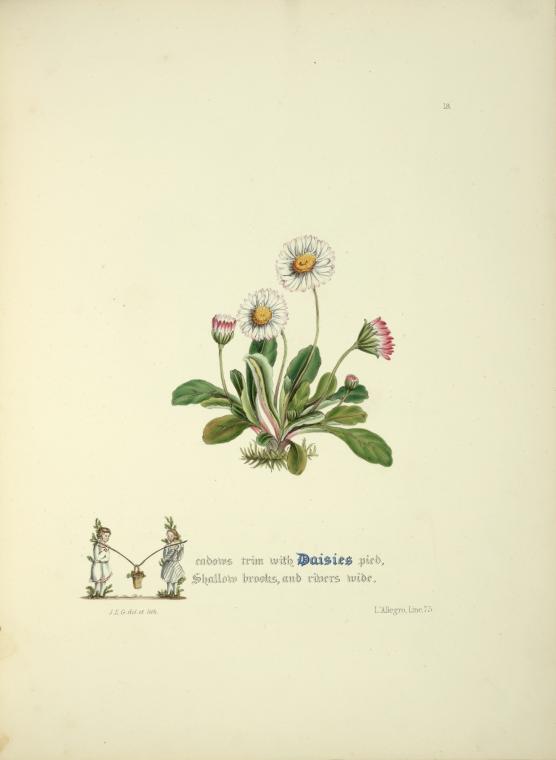
A water color picture of daisies

from the NY Public Library Digital Collections

I’m not in Scotland this summer for REASONS, and while I am sad about it, I’m dealing. Of course I think about Scotland all the time—last night I was dreaming of Outlander of all things, even though all I ever watched was the first season.  I really think it’s my spiritual homeland, like I am meant to live there some day.  I was even looking at real estate in Edinburgh and the rest of Scotland for a while, and found some places that didn’t look too expensive.  (Of course, they didn’t look too big either, but that is beside the point.)  Anyway, the point of telling you this is so you know not to expect a travelogue from me.  Of course, I haven’t written since last year, so you probably don’t expect anything from me!

Now for the update.  Writing and I had been at loggerheads for a while. I hadn’t really had a chance to write anything because of those same REASONS I mentioned a second ago.  (And I’m sorry to have to Vaguebook, but suffice it to say there are some real meanies out there who wish me ill.  But writing about that is for another day, if at all.) So of course, not writing poems was making it harder and harder for me to be ok. If I’m not writing, what am I even doing?

But the summer has been really productive for me, writing-wise.  I tasked myself with writing a villanelle every day for May (while I didn’t quite get 31, I got 26), so I worked on that project.  Some of the villanelles turned out better than others, but it felt really good to produce that work.  (Most still of course need to be revised, but there’s always time for that.) One of the ones that did turn out well got picked up by Midsummer Dream House, and you can read “Heart-bird” here.

And now I’m working on a Regency romance on Wattpad (currently #51 in Regency) called A Duke for Lady Ellen. I’ve published nine chapters so far, and am looking to publishing about 25.  This is my “gateway” novel—to see if I can start writing romance novels in earnest.  So I’m not worried about finding a “real” publisher or getting an agent or anything like that.  This book is an opportunity for me to try something new, to push myself in a new direction.  I’m enjoying it so far. Chris, for whatever reason, is really proud of me, although he has not read it so far.  (Well, I’d hardly expect him to read a romance novel, even if I wrote it!)  But it’s nice to have him cheering me on. I hope you’ll give A Duke for Lady Ellen a glance.  Even if you don’t like Regency romance novels, I’d appreciate any feedback you’d want to give it. I want to improve!  It will probably take the rest of summer to write it, but I will work on poems as well, so at least my writing “dance card” is full for the foreseeable future.

In other news, my friend Sarah Carey is coming out with her first full-length collection, The Grief Society Minutes, from St. Julian Press (sometime later this year, I believe) and I’ve got an ARC.  I’m so happy for her, and I’m looking forward to reading some quality poems!  I’m really surprised this collection has taken so long to find a publisher, especially because about 2/3 of the poems are published in quality journals—but finding a publisher is always a numbers game—you just gotta keep sending it out and sending it out.  I’m glad that she found a press for this book—now, onto the next one, Sarah! 😉

Other than all that, things in my life are ok. I’m glad it’s the summer, even if I don’t have Scotland.  At least I can write and feel happy about what I’m doing.

The Poetic Stylings of Chat-GPT

A newspaper drawing of a wild cat

Le Chat Sauvage, from NYPL Digital Collections

Goofing around with Chat-GPT (the chat sauvage?), I asked it to “Write a poem in the writing style of JC Reilly.” First, it didn’t know who I was (ugh), but when I gave it a link to one of my poems, this is what it came up with:

In this moment, I am but a flicker
A mere flame in the grander scheme
My life, a mere fragment in the picture
Of the endless and infinite dream

I am a creature of light and shadow
Walking the tightrope between day and night
With each step, I sow a seed to grow
Towards a future that’s ever so bright

I take comfort in the impermanence
Of all things that exist and persist
For I am but a brief remembrance
In the memory of what will persist

The sun rises and sets, the tide ebbs and flows
A rhythm of life that moves ever on
I embrace this dance, as the story goes
For in each moment, I am reborn

So let me be a spark in the darkness
A beacon of hope in a world of doubt
Let my light shine forth, with no less
Than the radiance that life is about

For in the end, all we can do
Is to live, to love, to dream, to be
And let our light shine, ever true
As a reminder of what it means to be free.

I think it goes without saying that I would never write such drivel. I might write some crap poems, but at least they are original crap. Among the things that bother me about this “poem” include the fact that it uses “persist” as a rhyme for…”persist.” Like, please try harder, Chat- GPT.  Also, the clear amount of cliches included strikes me as incredible.  You’d think a computer would have a lot more language to draw on, which could lessen the cliches.  That said, I do like the slant rhyme of “ever on” with “reborn.” I wouldn’t think to make that choice, and I kind of like it.  But the rest of the poem hurts my soul.

I also asked it to write a poem in the style of Ilya Kaminsky and honestly even if I had never read Deaf Republic or Dancing in Odessa, I can be sure it’s nothing like his writing.  Still, it’s a much better poem than what Chat-GPT wrote for me (and by “better” I mean “being incrementally not as bad”):

A poem in the style of Ilya Kaminsky:

The night sky is a canvas of stars
Each one a beacon, a guidepost
In this world of darkness and uncertainty
A reminder that there is light in the darkness

But what of those who cannot see the stars?
Whose eyes are shrouded by the fog of war
Or the darkness of the soul?
Do they too have a guidepost to follow?

Perhaps it is the sound of a loved one’s voice
Or the touch of a hand, warm and reassuring
Or the memory of a time when all was right
And hope burned bright, like a flame in the darkness

For even in the darkest of nights
There is a glimmer of hope, a spark of light
That can ignite a fire, a passion
And lead us out of the darkness, into the dawn

So let us hold onto that flame, that spark
And carry it with us, wherever we may go
For though the night may be long and cold
There is always the promise of a new day.

The second stanza is pretty decent (minus “the darkness of the soul”). Still, some achingly bad abstractions (“darkness and uncertainty”) and worse cliches (“the touch of a hand, warm and reassuring;” “lead us out of the darkness, into the dawn” “glimmer of hope”) doom this piece to the trash bin.

I’m not too worried that poetry is dead now that Chat GPT can write poems, because all it can write is really bad poems.  And I think most teachers are savvy enough to spot crap poetry when it’s presented to them.  Honestly I also think students wouldn’t want to turn poems like these in because they inherently know they’re bad as well.  If I were teaching poetry, and a student turned in some work like this, I wouldn’t get mad.  I’d just get really NITPICKY about their revision work, and they’d have to write a new poem because I’d mark all the places where the poem fails. (Which is about 95% of places.)

Here’s one more:

This one is supposed to be à la Billy Collins:

The world is full of mysteries, he said
As he looked out the window, lost in thought
Like the way a tree knows when to shed
Its leaves, or how a bird knows when to take flight

And there are secrets lurking in every corner
Like the way a cat curls up in a sunbeam
Or the way a flower turns to face the sun
Or the way the moon appears in the sky

And then there are the things we take for granted
The everyday wonders that we barely notice
Like the way a pen glides across paper
Or the sound of a kettle as it comes to a boil

But there are also the things we cannot explain
Like why some things are meant to be
Or why we find ourselves in certain places
Or why we feel a certain way at a certain time

And yet, even with all these mysteries
The world still manages to spin on its axis
And we still find moments of joy and wonder
As we journey through this ever-changing world.

This one at least has a few good images (“like the way a pen glides across paper/ or the sound of a kettle as it comes to boil”).  But it’s also not funny, and I think of humor as being a hallmark of Billy Collins.  Still, over all, the poem is kind of lifeless, and that last stanza is so leaden it may as well be made of concrete.

I think “lifeless” is the operating word here.  These are poems by something that clearly has no life of its own, and can only replicate what it thinks a poem is.  But it must have really bad models to produce examples such as these. This seems hard for me to believe when there are hundreds—maybe thousands—of years of poetry available online.

What is also surprising to me is that it doesn’t actually borrow lines from the poets—lines that must be floating around the internet.  That at least I could understand—a little plagiarism.  Maybe I’m even a little nostalgic for plagiarism—there is a certain art to doing it that is completely bereft in what Chat-GPT does.  Plagiarism at least requires the plagiarist to look things up to copy; Chat-GPT just makes it all up.

But I can’t be too hard on Chat-GPT.  It gave me this great recipe…which looks pretty legit:

Carrot cake is a delicious dessert that many people enjoy. Here’s a recipe for a classic carrot cake:

Ingredients:

      • 2 cups all-purpose flour
      • 2 teaspoons baking soda
      • 1 teaspoon baking powder
      • 1 teaspoon ground cinnamon
      • 1/2 teaspoon ground ginger
      • 1/2 teaspoon ground nutmeg
      • 1/2 teaspoon salt
      • 4 large eggs
      • 1 1/2 cups granulated sugar
      • 1 cup vegetable oil
      • 2 cups grated carrots
      • 1 cup chopped pecans
      • 1/2 cup raisins (optional)
      • Cream cheese frosting (recipe below)

Directions:

      1. Preheat the oven to 350°F. Grease and flour two 9-inch cake pans.
      2. In a medium bowl, whisk together the flour, baking soda, baking powder, cinnamon, ginger, nutmeg, and salt.
      3. In a large bowl, beat the eggs and sugar together until thick and pale yellow, about 2-3 minutes. Gradually add in the oil and mix until well combined.
      4. Add the dry ingredients to the wet mixture and stir until just combined. Stir in the grated carrots, pecans, and raisins (if using).
      5. Pour the batter into the prepared pans and smooth the tops with a spatula.
      6. Bake for 30-35 minutes, or until a toothpick inserted into the center of the cake comes out clean.
      7. Allow the cakes to cool completely in the pans before removing and frosting with cream cheese frosting.

Cream cheese frosting:

      • 8 oz cream cheese, softened
      • 1/4 cup unsalted butter, softened
      • 2 cups powdered sugar
      • 1 teaspoon vanilla extract
      1. In a medium bowl, beat the cream cheese and butter together until light and fluffy.
      2. Gradually add in the powdered sugar and vanilla, and beat until smooth and creamy.
      3. Use immediately to frost the carrot cake.

Enjoy your delicious homemade carrot cake!

Memoir, Poetry, and Why Can’t I Do Both?

Pastel image of a black woman wearing a blue dress and writing in a notebook.

from the NYPL Digital Collections

Yesterday I met up with a lovely colleague, Ida, to chitchat and catch up, and we spent a good amount of time discussing my writing.  I am in the middle of two projects right now, and one of them includes poems about my family or based on my family.  Ida and I had that age-old question about memoir and life writing:  what’s true, what’s what you remember, and do you dare to speak your truth?  I don’t think it’s any secret that the relationship I’ve had with my father has been fraught for most of my life, particularly late childhood and the teen years, and there are poems I want to write about certain times in my life with him, but I’m not sure I should/could.

Part of my concern about writing memoir in general (not just in relation to my father) is that I don’t feel like my life is particularly interesting (ergo, who would want to read about it?). Yes, I’ve dealt with trauma and abuse, but where most memoirists could find lots of fodder to write about on those subjects, I find that I have a very intellectualized perspective—which is not surprising, because as I’ve said other times in this blog, I live too much in my head—that resists doing the lyrical work that memoir is good at.  I also just don’t remember the feelings I had, beyond fear and anger, and even they have been dulled with time.  How can I reflect on memories I don’t really have anymore, except as brief snapshots from my life?  How can I delve into the specific details of a life which even to me are fuzzy at this point?  Where does that leave me?  Writing really banal poems, I guess.

(Hmm:  an aside. It just occurs to me that a few times I have written poems that didn’t work as poems, and I took out the line breaks and submitted them as flash memoir and they not only worked, they got published.  Hmm.  Need to think about that a bit more. I want to write poems, because poetry is where I live, but I wonder if my voice is too prosy for that—at least when it comes to writing about family.)

Back to Ida.  I was listening to her talk about her own creative writing, which focuses on Hawaii’s historic relationship with its Japanese settlers, and her own father’s participation in that system.  And I thought, she really gets how poetry collections can be about so much more than their individual lyrics—that they can tell a story that has panoramic scope.  And maybe it’s because she’s looking at a particular historic period as well as her relationship with family that the project comes across as so interesting to me.  Whereas my own life seems so whitebread and humdrum and disjointed that I can’t imagine anyone would find value in reading about it.  Hell, I’m pretty sure not even I would want to read about it.  (I’m only half-kidding.)

And yet, the desire to write poems about my life remains there, as a way to make sense of these experiences—and maybe not to lose them any further than I have.  I should have kept up with my journaling—then at least I’d have material to draw from.  But there was such darkness in my life in the terrible depression of my graduate school years that I just quit, because it was too painful to document. And then I had gotten out of the habit, even when times were better. The upshot? I’ve relinquished my past—which is a terrible thing, when you want to write about it, or need to write about it, or think you should.  And everyone knows a good journaler makes for a better writer.  But anyway.

Ida encouraged me to write a real article (like for a scholarly journal) about my process, and I can’t think of anything more gloomy and dull.  (And scary.) And to be fair, I wouldn’t know where to start.  It’s been so long since I had to do any writing that uses critical research, I’m not even sure I know how to do it—I think I’ve completely forgotten how to flex those critical muscles.  (I barely remember how to write poems, let’s be honest.). She says she would help me, but I hate to be a burden on someone who has her own important writing to do. But we’ll see.  Especially now that my job is in transition, it might make sense to try to write something real and get it published.  It could maybe help me down the line.

In other news, I’ve sent out a bunch of submissions lately… I hope I get lucky. I would love for you to read some of my new work (including this poem, How the Heart Works, which appeared recently in Third Wednesday.)

Thanks for reading this latest post, my lovies.  I hope your own writing is going well!

Love and Other Ironies

It’s February, and our attention turns naturally towards hearts and flowers.  At least, mine does.  Complain all you want about Valentine’s Day being a “Hallmark holiday,” but I have always been a fan—even when I didn’t have someone to dote upon or celebrate with.  This gets me to thinking about something I noticed when I sent off a submission today:  I write about love.  A lot.  (For instance, four of the six poems I sent out focus on love in a variety of ways. That poor first reader, when they open that submission.)

I find this surprising, because I wouldn’t consider myself a particularly achy heart stardusty lovey-dovey type person (although, I suppose I was once upon a time…late teens, early 20s, like everyone else).  And when I think of great love poems (“How do I love thee…” etc.), I for sure don’t think of my own work.  Yet I constantly write about the heart, and love, and the way these things interact with my very odd brain—it’s never truly “hearts and flowers”—there’s usually something rather off.

Here’s an example from my first book, La Petite Mort (arguably my favorite love poem that I’ve written):

Dystopic Love Poem
 

If I were to hand you my heart,
once you scraped away the fatty tissue,
arterial plaque, and congealing blood,
you’d find it’s really just a valentine
more Discovery Channel than Hallmark,
a bit ill-used, still serviceable,
and as full of love as it gets.  After
you got past the horror, you’d find
it has its uses:  keep it as a talisman
in your pocket, display it in a jelly jar
by the window—or add shallots and butter,
a hint of merlot.  Bon appetit.


It’s definitely heart-felt, but it’s also kind of gross.  Which, admittedly, is part of its charm. But also there’s a lot of irony there—and I think that’s what’s twisted my love poems.  They can never just be romantic—they have to be ironic.  And I wonder if that means that deep down, I’m just… damaged.  Or maybe it means my poetic voice won’t let me write something that’s too twee and sweet because I am, let’s face it, neither.

Here’s a more recent poem, still really drafty, this one about the end of love:

Paper Heart
 
On Valentine’s I cut a paper heart
and wrote the words I meant to share.
(In another year we’ll fall apart.)
 
Say what you will:  it was a start
on making amends. Don’t you care?
On Valentine’s I cut a paper heart
 
that I cut and cut and cut apart
until it fell like confetti in the air.
(In another year we’ll fall apart.)
 
So many strange days; I can chart
them all, caught as I was in your snare.
On Valentine’s I cut a paper heart:
 
a shabby thing, no piece of art,
it makes the abhorrent seem fair.
(In another year, we’ll fall apart.)
 
Where have we gone wrong, what part
of us shriveled, shed love so rare?
On Valentine’s I cut a paper heart.
Another year passed. We fell apart.


See what I mean?  Here the irony is in yo’ face:  (“what part/ of us shriveled, shed love so rare”)—that’s just… bald.  No subtlety, I guess, and that in itself is ironic (because poems should be subtle), especially if you know me (and my dear five readers, I know you do!).  My point is I can’t write love poems or out-of-love poems that don’t fundamentally out themselves as an exercise in “poetic praxis” (e.g. “Look at me, look at me, I’m a POEM!”)  This is not to say I wouldn’t like to write a real love poem (and by real, I mean “good”)—I would someday, but it might just not be in my nature/wheelhouse/skillset. I might just be doomed.

But as I was saying, love does figure prominently in my writing.  If I want to get psychological about things, I might say the reason I write about love is because I don’t really feel loved.  (I am not saying this for sympathy! Intellectually, I know I am loved.)  But writing about love is a way for me to try to connect with those feelings that I…er…don’t feel.  Maybe if I write about it enough, I can crack my ironic little heart wide open and begin to actually feel it.  (But I don’t know—years of therapy about this very issue has not cured it—I continue to live too much in my head and not in my heart.)

As I think about it…it’s kind of ironic to consider oneself very good at loving others (family and friends and all kind of creatures, especially kitties), but to feel a void when that love is returned. I don’t know…is that some kind of next level shit?  Probably.

Well, putting aside my very screwed up brain, let me say this:  I love you for reading my posts.  I love you for supporting me and cheering me on.  I love you for you.  I am hearts and flowers in love with (most of) the world.  And maybe that’s why I write love poems, flawed as they are.  Maybe that’s why we all write love poems now and then, to express the expansive love that resides in all of our collective hearts.

And on that note, I’ll leave you with this little haiku:

It’s Valentine’s Day
candy hearts speak sugar truths
Luv u 4 Ever

Help Ukraine–And Get My Book for Free!

As I mentioned several days ago, my new chapbook Amo e Canto was released. I posted about it on Twitter, Facebook, and Linked In, thinking that I could encourage some sales and share this book I’m so proud of with friends and peers.  (And I was going to pay the postage for anyone who purchased a copy.)  And like the last two “pandemic books” I published (What Magick May Not Alter and Daughter of the Wheel and Moon), nothing but crickets.  (That was my little pity party moment.)

Then I thought, I know what I’ll do:  I will give the proceeds from book sales to Ukrainian charities to help citizens fight the Russian invasion.  Surely that will drum up sales. (It didn’t.) Still when the world is burning, that’s when we need poetry the most—because it offers solace and empathy, and the world is sadly missing those things.

Right now Ukraine needs our empathy, and it needs our help.

So if you don’t want to buy my book, that’s fine!  I know there are more important things going on than my chapbook release at this moment.  But  please give all you can to these legitimate charities which you can read about on the USA Today website (along with several more charities than are listed here):

Please help.  And you know what?  If you give at least $20 to any of these charities and email a copy of your receipt and your address to aishatonu[at]gmail[dot]com, I’ll even send you a copy of Amo e Canto for free!

Amo e Canto is Out in the World!

Nearly two years after the announcement that it had won the 2020 Sow’s Ear Poetry Chapbook Prize, my collection Amo e Canto (Italian for I Love and I Sing) has been released.  Because it came out as Issue 30.1 of the Sow’s Ear Poetry Review (and was sent to all subscribers of the Review), it’s not conventionally available for purchase.  However, I am selling extra copies, postage paid, for $13.50 via my CashApp, $Aishatonu.  Hit me up if you would like to buy a copy.  (Put your address in the “For” line so I’ll know where to send your book!)

Amo e Canto is a collection of “poemoirs”—half poems, half memoirs about a trip I took to Venice in 2014. The poemoirs focus on typical Venetian sights, like churches, canals, pigeons, and art, and tangentially examine a relationship with a missing love.  It’s a really different kind of writing from what I normally do (which tends to be mostly narrative, women-centered writing), so if you’re interested in Italy and hybrid forms (or you just love me), this collection is for you.

I’m really proud of this work, and it’s a beautiful collection.  The cover includes an absolutely lovely painting by Alex Ghizea-Ciobanu called I Will Take Venice with Me that as soon as I saw it, I wanted it for the cover.  (Actually, I’d love to own the actual painting!)  The ecru paper is smooth and silky and not insubstantial.

It may have taken longer than I hoped for Amo e Canto to manifest, but it’s wonderful that it exists now. (Patience is a virtue, and all of that.)  I’m so grateful to Sarah Kohrs and Kristen Zimet at Sow’s Ear Poetry Review for all they’ve done to bring this collection into being, and I’m grateful to Sam Rasnake for choosing it as the winner.  I’m also thankful to the journals who originally published some of these poems, especially Rowan Glassworks, which nominated five of them for Pushcart Prize in 2015.

I have many to sell and would love to get one into your hands!

Writing the Red Flags

from dreamstime.com

This past weekend at Tybee Island was the first time I’ve set foot on the beach since I was caught in the rip current in Southampton, NY in 2018.  I thought I would feel fear, but when my sister and I went out last Friday night, it was low tide, the water warm, and the waves almost gentle.  In other words, the ocean felt safe to me.  It was a different story the following morning—the wind was crazy, the waves at high tide so rough that I just couldn’t make myself go in.  There was also a red flag warning—and can you get any more obvious than a red flag literally warning you there’s danger?  Three years ago I ignored the warning, and we all know how that turned out. I learned my lesson.

I think writing is the same way—there are times when writing feels easy and safe (and of course we love those times!), but there’s also those red flags that tell us that maybe we need to reconsider, or even back away.  That’s not to say we shouldn’t “write what we’re afraid to write”—we should, absolutely, write our lives, our stories, our poems that challenge us to be our most authentic selves.  Sometimes that means we write about difficult or painful memories.  Sometimes that means we share what we’re afraid will make us look ridiculous, or damaged, or imperfect.  Some danger is good.  Too much danger and we risk losing ourselves.

What do I mean?  I think there’s a chance that we can give too much of ourselves away when we write.  After all, we are “baring our souls” in one way or another—and when we write about unprocessed trauma that’s when the red flags go up.  We can unintentionally re-traumatize ourselves when we really mean to heal.  Of course, writing about the things that have shaped us is necessary, but I wonder how much good we accomplish if writing about an experience that was painful, terrifying, or devastating makes us revisit those dark places?

What boundaries do we have in place that will protect us?  Have we gone through counseling to process our trauma?  How do we know that what we write won’t revisit trauma on someone else?  If we don’t have boundaries, and we haven’t had the benefit of therapy, we are putting ourselves in danger of revealing too much and re-opening old wounds.

That’s always a danger with writing, I suppose, because to write and share something means you risk exposure—you invite the audience in, and once an audience is involved, you’re not entirely in charge of your work or the interpretation of experience anymore. There’s danger to the writer in the act of audience consumption of work.  How will the audience react?  Will they judge the person you were when you experienced what you experienced?  Will they discount your interpretation of events?  Will they harass you?  Will they reject you?

I think about my own experience trying to publish poems about past trauma in my life.  It never goes well.  I’m not afraid so much about sharing my life—I’ve had plenty of therapy, so I’m well and truly “processed.”  I just think I’m really bad at it.  (And honestly, does the world need more poems or a memoir about child abuse?  I doubt it.)

Not every experience that’s happened to us (or we were involved in) needs to be written about and shared.  Maybe that’s the difference.  Maybe, now that I think about it, we should always write the red flags—what scares us, what seems dangerous.  That’s what journaling is for—it’s a controlled environment:  we are both writer and audience, and there’s little chance of discovery and judgment.

But sharing traumatic experiences in published writing can be as dangerous as a rip current, where even the strongest swimmers can drown.  Are we prepared for the fall-out, to ourselves and to others?  If we’re not ready, then the work should probably stay private.  At least for now.  When the waves are less rough, we can always venture back out.

Redemption Sandwich

Today is my last full day at Rockvale.  It saddens me to be leaving—I’ve enjoyed unprecedented productivity in the last two weeks (22 different first drafts of poems), and it kind of shows me what my writing life would be like if I didn’t have a “day job” that takes up a lot of my creative energy and squanders it on quotidian crap.  Of course, that day job also pays the bills, so I can’t be too dismissive of it. I am grateful to have a job.  But I’ve been very grateful for these two weeks of “professional development” because I’ve really needed them.

Gerbera daisy in the garden

One of the best things that’s come from being here is meeting two new friends.  We were talking last night about how lonely being an adult is, and how difficult it is to make new friends.  But both Kelly and Rebecca have been a godsend.  We eat breakfast together and unwind at night with wine and tea, and becoming friends with them has been really remarkable—especially after the Year of Covid.  And sure, maybe friendship was born of proximity, but I feel like being around other writers, especially these two women—who are honest about themselves in a way that sometimes, surprisingly, writers are not—has been a real salve to my heart. Just this morning, Rebecca made me breakfast—a fried egg with cheese and kale on French bread—a “make-up” for the breakfast sandwich she made me the other day that was, to her mind, imperfect.  Today’s was delicious, for sure—it’s become a joke, her “Redemption Sandwich” (which she has been singing to Bob Marley’s “Redemption Song”).  But more delicious was her company!  I have felt too sequestered this past year (for good reason, to be sure), but I have missed human company.  Kelly and Rebecca, being writers—and kind, and funny, and goofy to boot—are my kind of people.

Mama (Little Mexico) in the mist

Another thing I’ve enjoyed about being here (besides the writing and my new friends) has been the wildlife.  I love the horses and the cows, and the flocks of goats on various farms.  But I love the other, unexpected, wildlife.  As I was driving a few days ago, I saw three wild turkeys, just hanging out in someone’s front yard, enjoying a colloquy.  I’ve seen deer everywhere.  When I was out at 6:30 a.m. one morning, I saw a whole herd of them, and the other night, when Kelly, Rebecca, and I drove to Publix at twilight, we saw families of deer along both sides of the road, eating dinner.  (So many deer!)

Gladiolus in the garden

Plus, I’ve seen hummingbirds, and butterflies, and even a turkey vulture, sitting on a post.  The rural life is really where I feel the most whole—it reminds me of Grandpa Reilly’s old farm in Pennsylvania, when we escaped the city and just could walk across his fields and take tractor rides and pet the animals in the barn.  That’s what being here has been like for me—a chance to reconnect with rural roots—and realize that in another life, I might have been a farmer poet, instead of an academic.  The trees and the hills and the fields feel like home.

I have always said I want to live in Tennessee, if the fates come together to permit it.  Every time I come to this state, something in my heart blooms. These last two weeks, my heart has blossomed from a year and a half of incubation, of being on hold.  I hope that I can keep blooming when I return to Atlanta—the idyll will be over, but the spirit of it doesn’t have to be.  That’s what imagination and poetry are for—to bring you back, to bring you back even when you only have memories to hold on to.

            Won’t you help to sing
            These songs of freedom?
            ‘Cause all I ever have
            Redemption songs
            Redemption songs
            Redemption songs

Daughter of the Wheel and Moon Released!

My second print chapbook, Daughter of the Wheel and Moon, has been released as part of the artisanal Red Mare Chapbook Series (#21).  I got copies in the mail yesterday!

The Red Mare Chapbook Series produces a limited print run of hand-numbered, handmade books, with fancy papers, ink-block-printed covers, and hand-stitching.  These are beautiful books that feel decadent in your hands, books that you appreciate for their ephemerality, quality, and uniqueness.  Poets who have been published in the series include Maxine Chernoff, Alfred Corn, Lorraine Caputo, and others.

The press specializes in works with an ecofeminist bent, and Daughter of the Wheel and Moon combines poetry about nature and the environment with a focus on the magickal Wheel of the Year to tell about the life of a solitary practitioner witch.  It may—or may not—be a companion piece to What Magick May Not Alter… you can decide for yourself.

Daughter of the Wheel and Moon is available for $15 + shipping. If you buy a copy, you are supporting a woman-owned, non-profit, small press.  And, of course, you’re supporting poetry—so it’s win-win!