Dispatch from Edinburgh #5–Afternoon Tea

The Georgian restaurant at Harrods

In the U.K., Afternoon Tea (don’t call it High Tea!) has been elevated to an art form.  It is not merely drinking a pot of tea and eating some cakes—but rather enjoying an experience of delicacies accompanied by tea and served on beautiful china with bright, shimmering silverwear. Loose tea wades in a silver teapot, just waiting to be poured through a silver sieve into a cup. A bowl of sugar cubes (white and brown) is overflowing, and on the side are tiny silver tongs with which to retrieve and drop sugar into the teacup. Then comes a tier of plates laden with sweets and sandwiches and scones just waiting for clotted cream and jam.  One leaves Afternoon Tea stuffed to the gills, but happy and satisfied, and feeling a little like a lady of the ton in a Regency novel.

This summer, I partook of Afternoon Tea three times for lunch—once at The Georgian restaurant at Harrods in London (it took me forever to find the place in the department store–that store is labyrinthine!), sparkling with crystal and soft light, once at The Willow Tea Rooms with a view of Edinburgh Castle, and once at Prestonfield House, also in Edinburgh.

Harrods was the most elaborate of the three, with an individually-assigned waiter who took care of my every need.  His name was Dennis, and he was born in Australia but raised in Italy. With every delivery of treats (all vegan), Dennis explained what each item was and encouraged me to try everything.  The tea he suggested was Harrods own special blend—a black tea combination of Sri Lankan, Assam, and Darjeeling with hints of spice like star anise. Combined with milk and sugar, the tea was smooth and bright and I drank two huge pots of it.
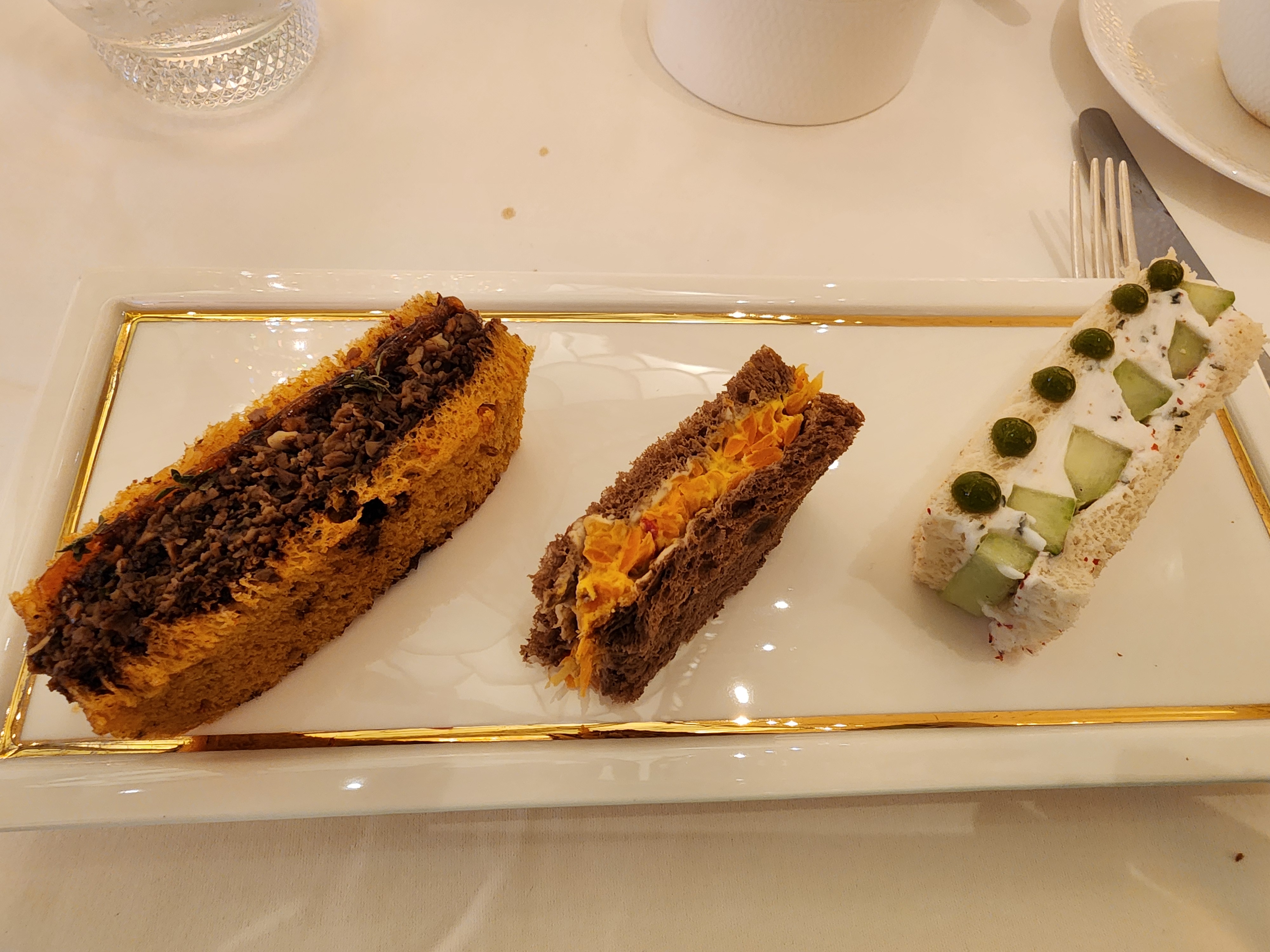
I took a bite out of the grape-and-carrot sandwich before I remembered to take a photo. Oopsie!

The first course was the finger sandwiches, which included a Grape and Carrot sandwich, a Cucumber sandwich, a Button Mushroom Savory Praline sandwich, and a Cheese and Caramelized Onion Tart. My favorite will always be the Cucumber and cream cheese, but the nutty, earthy taste of the Button Mushroom sandwich was very good as well. Dennis offered me a second plate of sandwiches (minus the tart; I could have gotten another for £5 but I didn’t want it that bad), which I heartily enjoyed.  Following that came the plain and fruit (sultanas or currents, not sure which) scones, with Madagascan Vanilla Oat Chantilly (vegan clotted cream) and a selection of four jams—apricot, strawberry, blackberry, and cherry, each in little ramekins with a silver spoon.  I worked my way through the jams, a different flavor for each bite, though the strawberry was particularly fine.  Apparently I did not eat enough of the blackberry, because Dennis seemed disappointed that there was so much of the jam left.

Desserts and scones

Next came four sweet treats:  a Chocolate Calisson, which was a chocolate cake with chocolate cream mousse, and a yuzu center, which is a kind of hot pepper; an English Strawberry and Elderflower Tart; a Matcha Sphere, which had matcha mousse and cake, with a bit of strawberry sauce and real gold leaf; and an Apricot and Thyme baba (a kind of soaked cake) with white chocolate.  Of course, things are brought out very slowly, so that presentation is front and center—at Harrods, one is overwhelmed with service and luxury, and given time to appreciate each bite.  When I left Harrods, I was quite full and delighted.  I only wished I had had someone with me to enjoy the meal with.
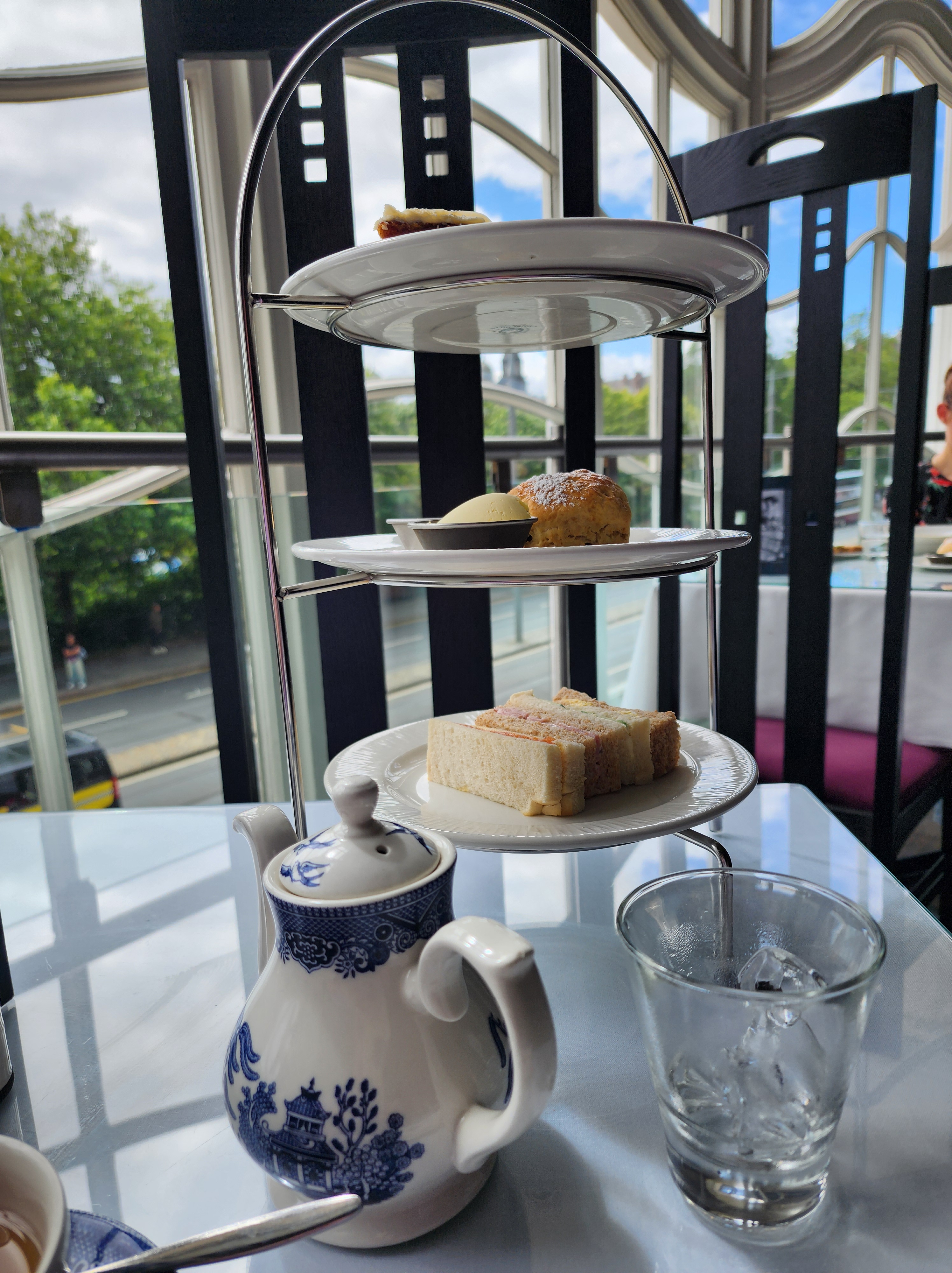
Willow Tea Rooms

I tried the Willow Tea Rooms across from the Castle on the recommendation of my students who went there to satisfy one of their “cultural experience” assignments for me. All four of the young ladies gushed over the presentation and the food, and I thought I would give it a try too.  It was about a quarter of the price of Harrods, but the tablecloths were a pristine white, and service was nice enough.  The large room accommodated many tables, but mine was tucked in a corner, across from a lady eating a bowl of soup and a cheese scone, and reading something heavy and Russian, maybe Anna Karenina. The design of the chairs was Art Deco, with black backs much taller than the person sitting in the chairs, and the logo printed on the napkins was like an Art Deco window with a rose on it and dark black lines mimicking the chairbacks.

I chose the classic Afternoon Tea, which came with four dainty sandwiches—Egg Mayo (otherwise known as Egg Salad), Scottish Salmon and cream cheese (I don’t think I’ll ever like cold salmon), Cucumber and cream cheese (again, my favorite), and Ham and butter (I did not eat the ham).  These arrived on a tier with a fruit scone with raspberry jam and clotted cream, and a nice slice of carrot cake with a vanilla buttercream frosting. I was not particularly adventurous with the tea—I just enjoyed a pot of peppermint, which was lighter on a hot day than a typical black tea would have been. The carrot cake was really the star of the show—while not as good as the kind I make, it had a lovely, spicy taste replete with carrots, and the sponge was soft but firm.

A sleepy Heilan coo!
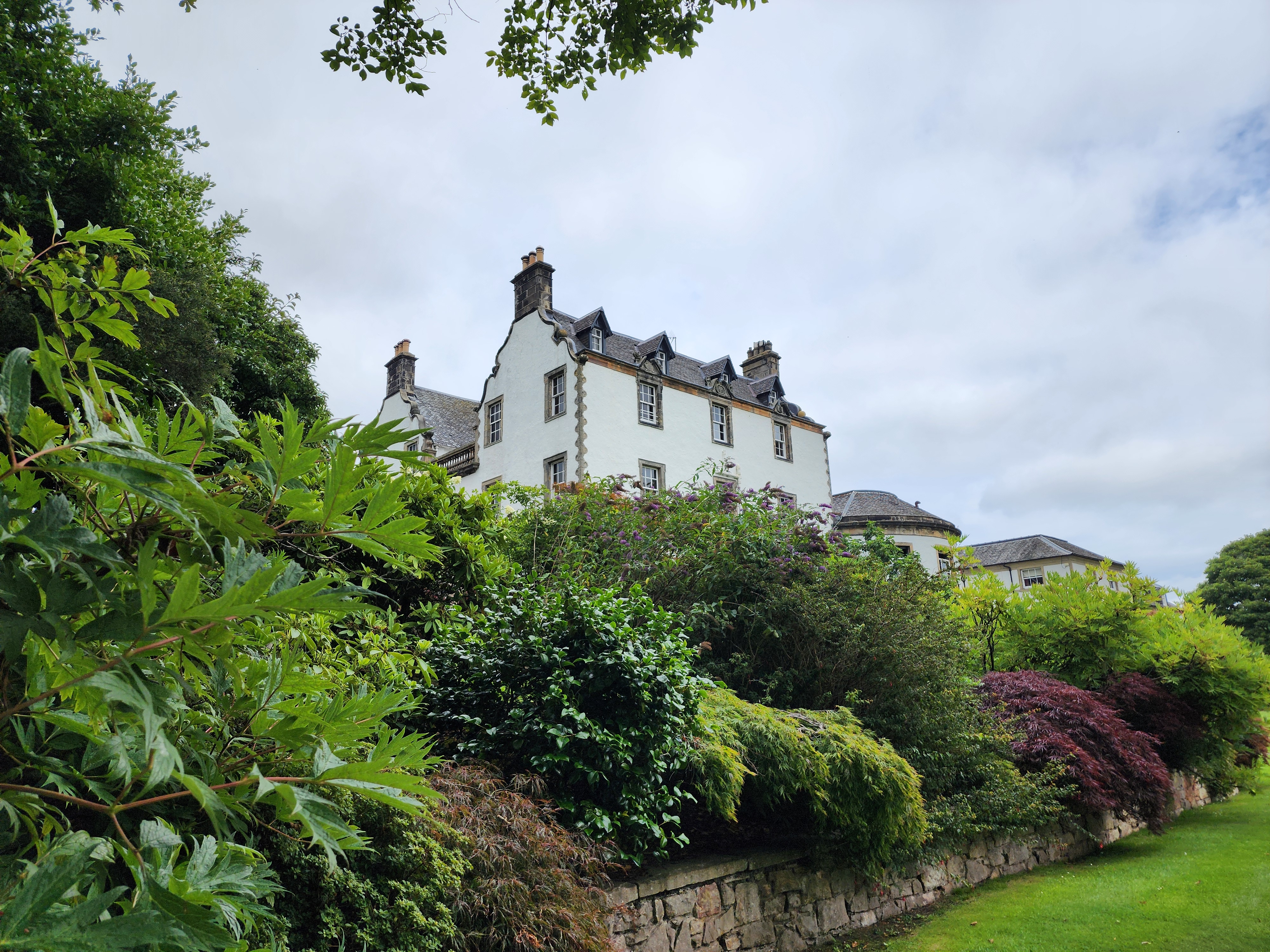
View of Prestonfield House from the gardens

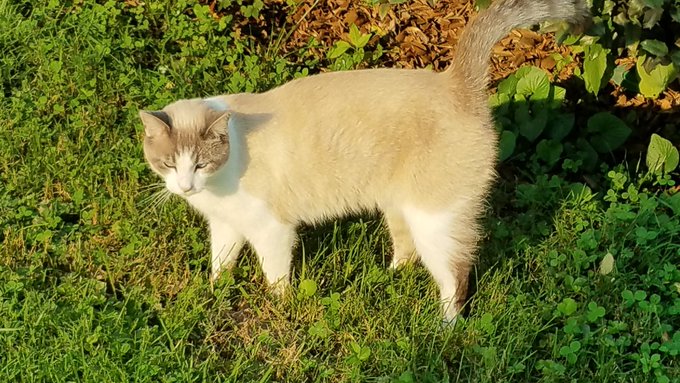
The final Afternoon Tea room I discovered by accident. One of my Facebook peeps mentioned they were in Edinburgh and had taken pictures of the tier of treats, and I was immediately drawn to it and the background of the room.  She told me about Prestonfield House, and I made my reservation for the last Friday before I left. I arrived about half an hour early, so I wandered the beautiful grounds on the lee side of Arthur’s Seat (the extinct volcano in the east side of Edinburgh), while I waited. The current Prestonfield House dates from the 1600s, but apparently way back in the 14th century it was an abbey. On the grounds live Heilan Coos, a peacock in a tree, and a rather scraggly black cat whom the major domo told me was “a bit of a hellion.”  The cat seemed perfectly nice to me, but as I was calling to it, the House’s flower arranger also called to it, and the cat, demonstrating utter disdain for me, zipped over to the flower arranger.  I don’t think that qualifies as hellion status, but it certainly betrays a bit of poor decision making, as I would have been happy to love on him.

As for the Afternoon Tea, how could it be anything but lovely? The room where I was led bore heavy, red and ochre damask wallpaper and velvet curtains, and paintings on the wall of previous owners of the house, plus two big bouquets of purple hydrangeas in the center of the room. Every table sparkled with multiple forks and knives, and more glasses than one person would actually need to drink with.

Prestonfield House prides itself on its exceptional service, and its service was, indeed, out of this world.  Not only did they seat me at a wonderful table (though, to be fair, all of them looked nice) with comfy bench seating, one of the servers actually put my napkin on my lap as she took my tea order.  I had thought about getting the Evening Chai, but then I noticed something called Black Fig Sencha, with aromas of forest fruits and fig. It was a green tea, or perhaps a white tea, which smelled like Christmas. Its delicate flavor was a little on the weak side for my taste, but it was plenty good with sugar in it.

A cool spach

The “water bearer” came out next and poured a glass of sparkling water into my water glass, and left the bottle.  So I had both water and tea to drink.  Then a third server brought out an espresso cup full of gazpacho for an amuse bouche, and believe me, my bouche was suitably amused to be drinking a cold tomato salsa. I sipped it slowly—it was very good—but had to smile when this Goth Girl at another table got hers.  She took one sip, wore a look on her face that was half horror and half disgust, and she put her espresso cup down with a thump. I did not see her girlfriend’s expression, and wondered if it had been the same.
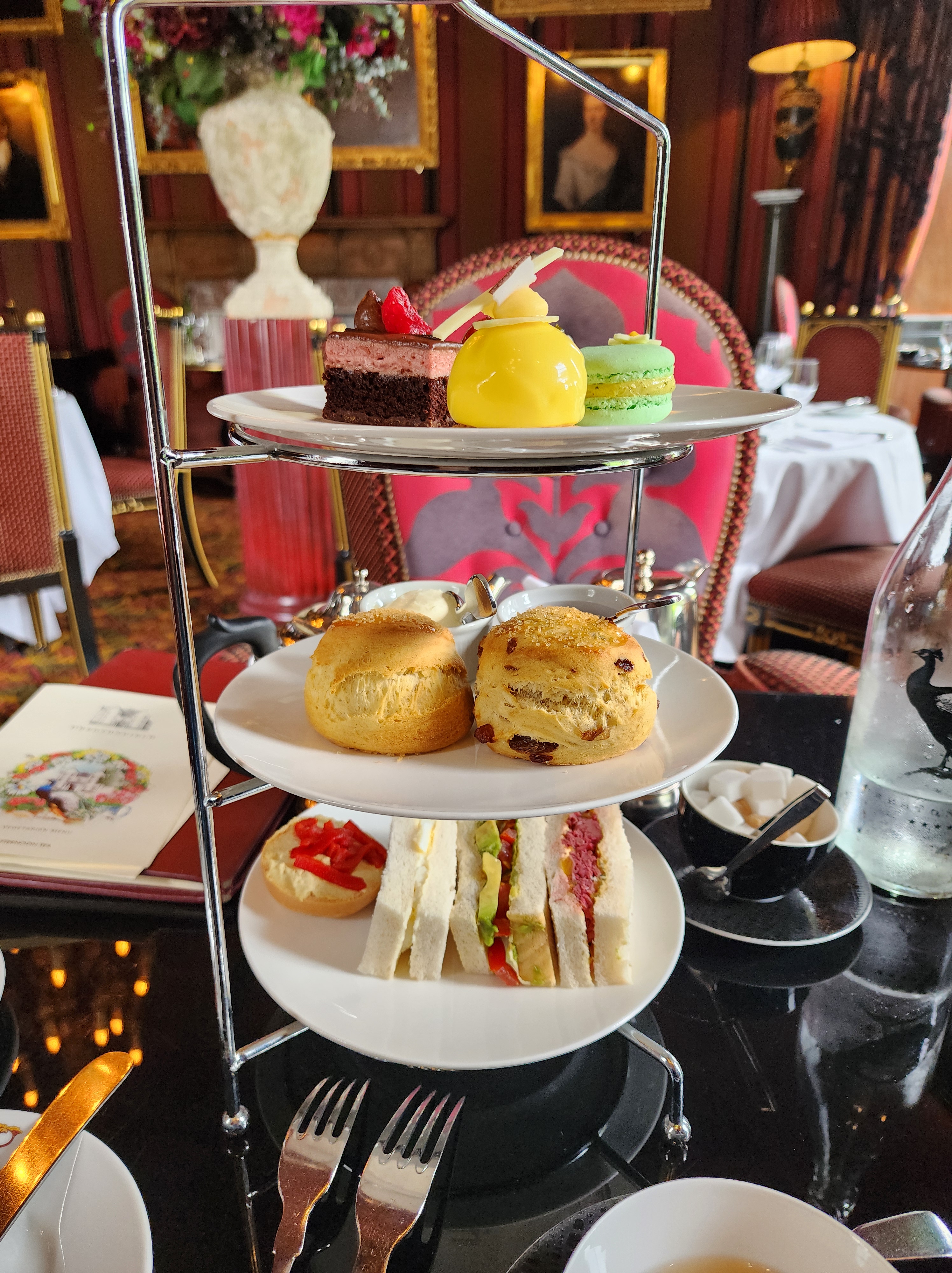
Prestonfield tower o’ treats

After a while, the tower of treats came out.  First was a plate of savory crackers, one with English pea, mint, and marigold (interesting, but not my favorite); one with cream cheese and tomato on a little oat cake; and the third a whipped applewood cheese on cranberry toast with a bit of apricot (the cheese part was whipped but didn’t taste very cheddary).  All were tiny, no bigger than half a thumb, but they were pleasant to eat.  On the bottom tier were four sandwiches:  Avocado and Tomato; Corned Jackfruit and Pineapple Chutney (I didn’t really taste the pineapple but the jackfruit was interesting); Egg with Caesar Mayonnaise; and a Roasted Red Pepper and Hummus on half-a-roll.

Prestonfield desserts

But wait, there’s more!  A fruit scone and a butter scone with raspberry jam and clotted cream awaited me.  Both were dusted with turbinado sugar, and the clotted cream was almost the consistency of butter. But by then I was starting to feel full, having drunk a wine bottle full of sparkling water, plus two silver pots of tea, plus eating the sandwiches and savories.  How, I wondered, could I possibly eat anything else?

Too much chocolate for me; it rather overpowered the rose.

I was afraid that asking for a to-go box would be déclassé, but when I asked for a box, the server didn’t bat an eye.  I did try two of the desserts—a raspberry and dark chocolate rose cake (which was almost too chocolatey), and an apricot and pistachio macaron.  That left a coconut, pineapple, and ginger mousse sphere and a strawberry tart with black pepper (!).  But I packed up the scones and the clotted cream and the jam, and the two desserts I couldn’t finish.

Once I was done eating, the manager came by to tell me the history of Prestonfield House and he also remarked on the box of sweets I was taking home.  I told him I couldn’t possibly eat another bite, but everything was divine.  He looked as pleased with this remark as if he had created the feast himself.  And everyone else I passed as I made my way to the front of the hotel was charming and pleasant, and made me feel like I was someone famous and important, the way they fell over themselves to wish me well.

Of the three Afternoon Teas, I think I liked Prestonfield House the best. It was elegant and cozy.  Harrods was perhaps a little finer on the food, but I just felt more comfortable at Prestonfield House. For one thing, I wasn’t ragged and sweating like I had been when I was walking in London and suffering a bum foot. Instead, I had taken an Uber to Prestonfield House, and I was perfectly put together (though still with a bum foot). The Willow Tea Rooms was nice, but not in the same class as Harrods or Prestonfield House—it was more of your “everyday” Afternoon Tea, whereas the other two promise special occasions. I think Prestonfield House felt like I could belong there, where The Georgian at Harrods seemed more like a place you would go to be seen.

The only thing that would have made all three of these Afternoon Teas better would have been if you were there with me.  Maybe next time!

Entrance into Prestonfield House

A brown Heilan Coo placidly getting rained on

Teapot at Prestonfield House
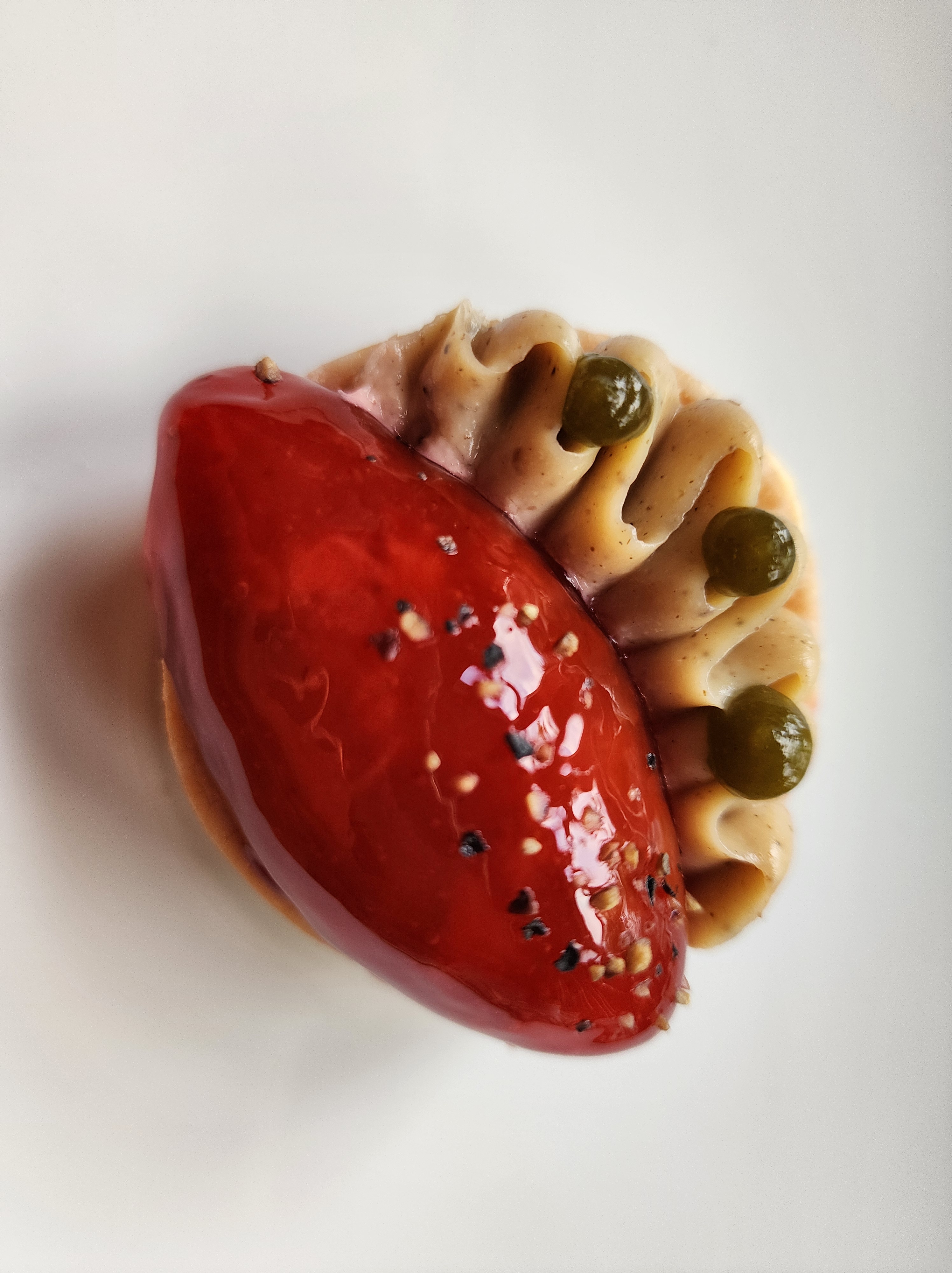
Strawberry-pepper tart

Prestonfield sandwiches, with the Pineapple Jackfruit one on the right.

Another view of the Rhubarb Room

So many glasses!
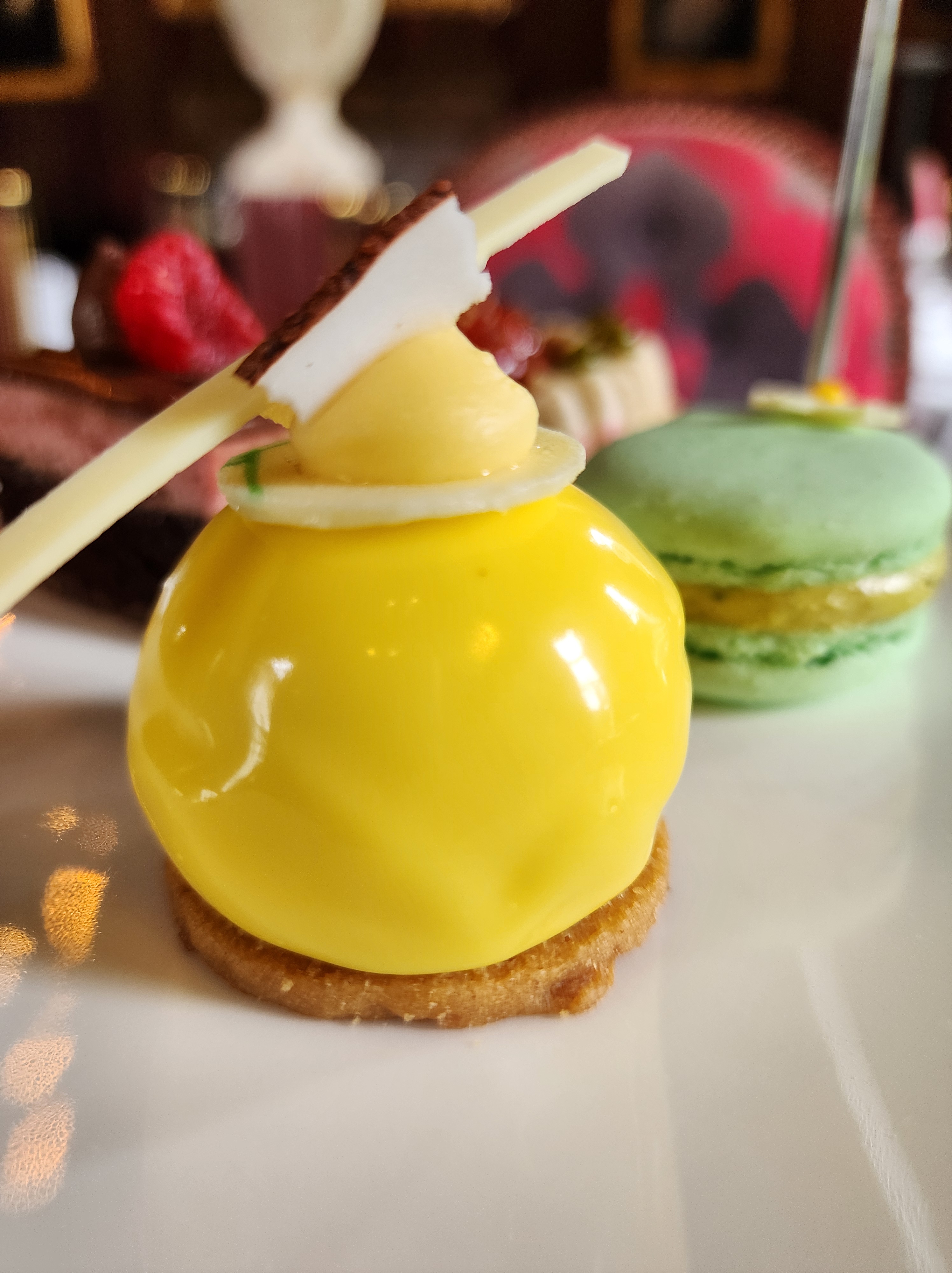
Pineapple-coconut-ginger mousse ball

Pistachio macaron

The Peacock in a tree!
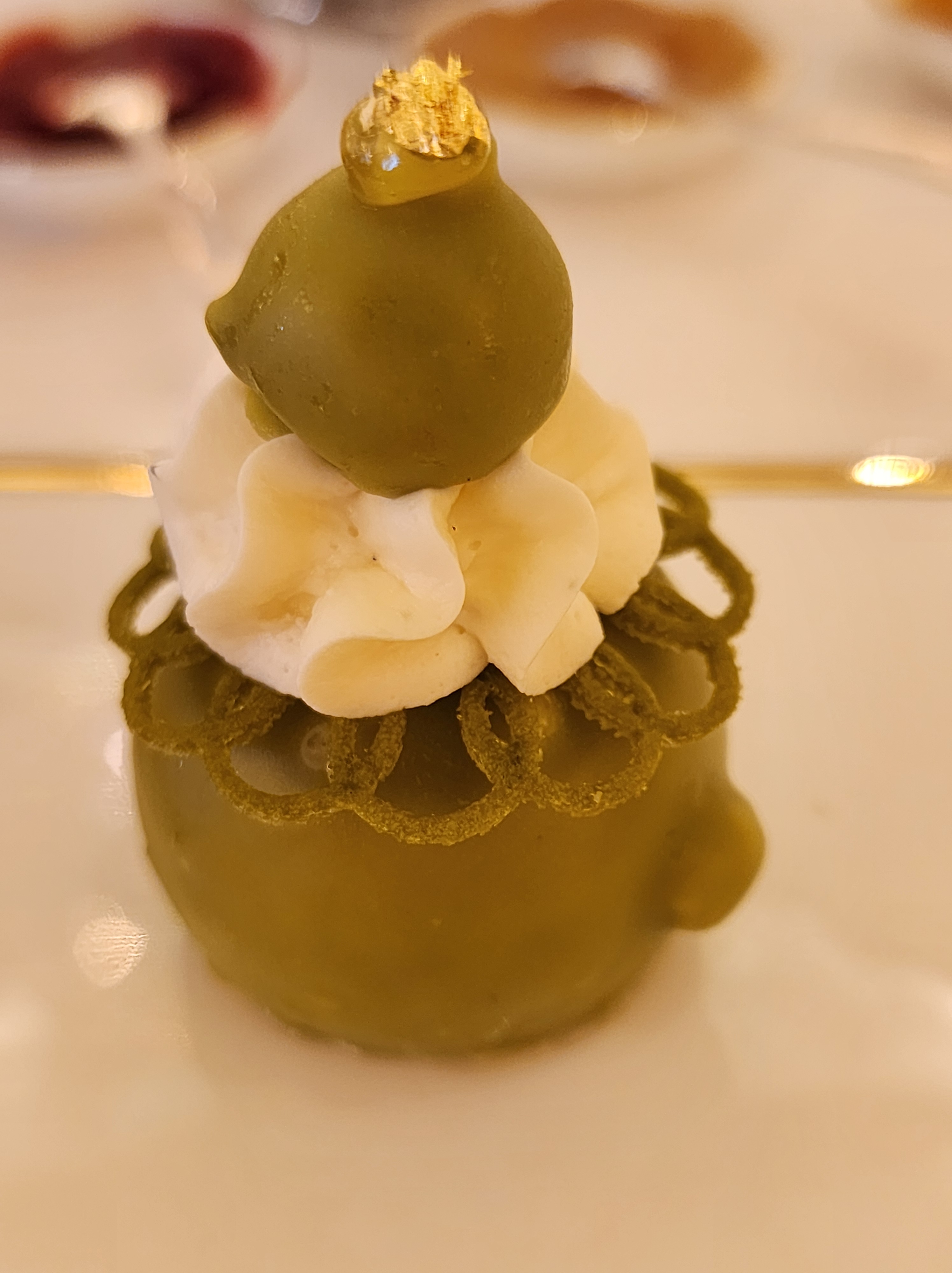
Harrods matcha ball

Harrods Apricot-Thyme tart

Harrods Chandelier
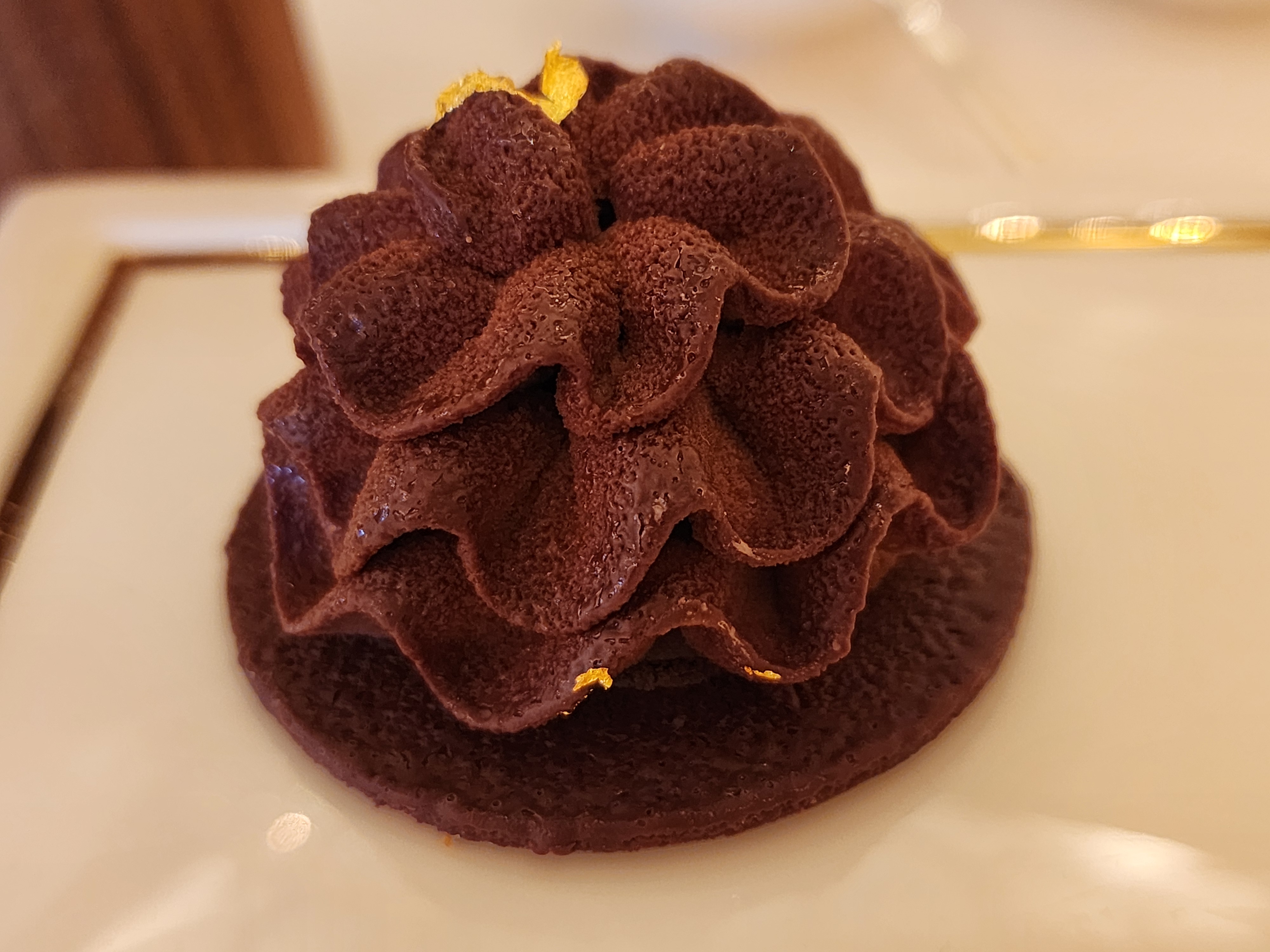
Harrods chocolate mousse cake
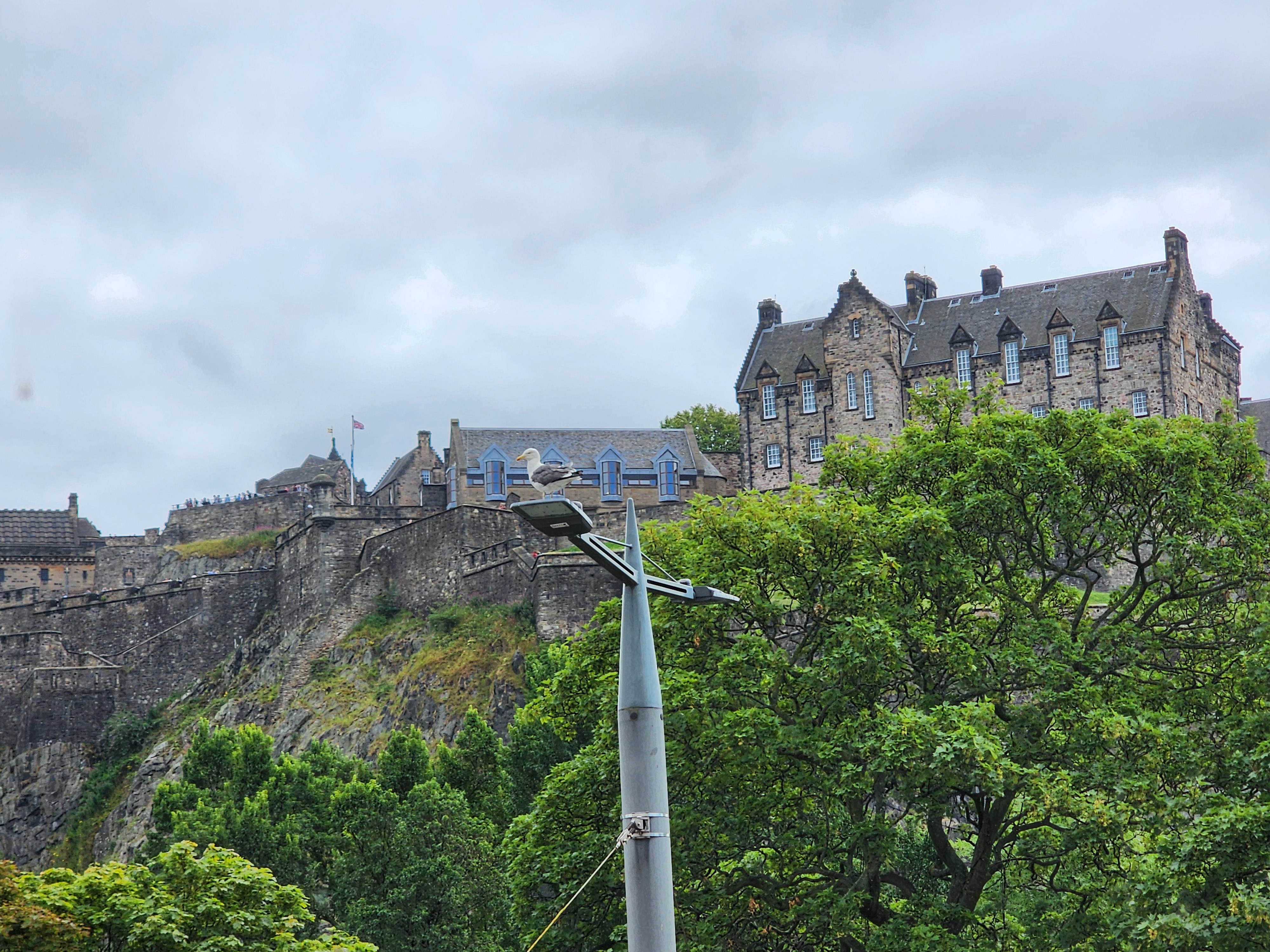
A view of Edinburgh Castle from Willow Tea Rooms, with an ugly lamp post with a seagull on it directly in front

Savory crackers at Prestonfield House


Love and Other Ironies

It’s February, and our attention turns naturally towards hearts and flowers.  At least, mine does.  Complain all you want about Valentine’s Day being a “Hallmark holiday,” but I have always been a fan—even when I didn’t have someone to dote upon or celebrate with.  This gets me to thinking about something I noticed when I sent off a submission today:  I write about love.  A lot.  (For instance, four of the six poems I sent out focus on love in a variety of ways. That poor first reader, when they open that submission.)

I find this surprising, because I wouldn’t consider myself a particularly achy heart stardusty lovey-dovey type person (although, I suppose I was once upon a time…late teens, early 20s, like everyone else).  And when I think of great love poems (“How do I love thee…” etc.), I for sure don’t think of my own work.  Yet I constantly write about the heart, and love, and the way these things interact with my very odd brain—it’s never truly “hearts and flowers”—there’s usually something rather off.

Here’s an example from my first book, La Petite Mort (arguably my favorite love poem that I’ve written):

Dystopic Love Poem
 

If I were to hand you my heart,
once you scraped away the fatty tissue,
arterial plaque, and congealing blood,
you’d find it’s really just a valentine
more Discovery Channel than Hallmark,
a bit ill-used, still serviceable,
and as full of love as it gets.  After
you got past the horror, you’d find
it has its uses:  keep it as a talisman
in your pocket, display it in a jelly jar
by the window—or add shallots and butter,
a hint of merlot.  Bon appetit.


It’s definitely heart-felt, but it’s also kind of gross.  Which, admittedly, is part of its charm. But also there’s a lot of irony there—and I think that’s what’s twisted my love poems.  They can never just be romantic—they have to be ironic.  And I wonder if that means that deep down, I’m just… damaged.  Or maybe it means my poetic voice won’t let me write something that’s too twee and sweet because I am, let’s face it, neither.

Here’s a more recent poem, still really drafty, this one about the end of love:

Paper Heart
 
On Valentine’s I cut a paper heart
and wrote the words I meant to share.
(In another year we’ll fall apart.)
 
Say what you will:  it was a start
on making amends. Don’t you care?
On Valentine’s I cut a paper heart
 
that I cut and cut and cut apart
until it fell like confetti in the air.
(In another year we’ll fall apart.)
 
So many strange days; I can chart
them all, caught as I was in your snare.
On Valentine’s I cut a paper heart:
 
a shabby thing, no piece of art,
it makes the abhorrent seem fair.
(In another year, we’ll fall apart.)
 
Where have we gone wrong, what part
of us shriveled, shed love so rare?
On Valentine’s I cut a paper heart.
Another year passed. We fell apart.


See what I mean?  Here the irony is in yo’ face:  (“what part/ of us shriveled, shed love so rare”)—that’s just… bald.  No subtlety, I guess, and that in itself is ironic (because poems should be subtle), especially if you know me (and my dear five readers, I know you do!).  My point is I can’t write love poems or out-of-love poems that don’t fundamentally out themselves as an exercise in “poetic praxis” (e.g. “Look at me, look at me, I’m a POEM!”)  This is not to say I wouldn’t like to write a real love poem (and by real, I mean “good”)—I would someday, but it might just not be in my nature/wheelhouse/skillset. I might just be doomed.

But as I was saying, love does figure prominently in my writing.  If I want to get psychological about things, I might say the reason I write about love is because I don’t really feel loved.  (I am not saying this for sympathy! Intellectually, I know I am loved.)  But writing about love is a way for me to try to connect with those feelings that I…er…don’t feel.  Maybe if I write about it enough, I can crack my ironic little heart wide open and begin to actually feel it.  (But I don’t know—years of therapy about this very issue has not cured it—I continue to live too much in my head and not in my heart.)

As I think about it…it’s kind of ironic to consider oneself very good at loving others (family and friends and all kind of creatures, especially kitties), but to feel a void when that love is returned. I don’t know…is that some kind of next level shit?  Probably.

Well, putting aside my very screwed up brain, let me say this:  I love you for reading my posts.  I love you for supporting me and cheering me on.  I love you for you.  I am hearts and flowers in love with (most of) the world.  And maybe that’s why I write love poems, flawed as they are.  Maybe that’s why we all write love poems now and then, to express the expansive love that resides in all of our collective hearts.

And on that note, I’ll leave you with this little haiku:

It’s Valentine’s Day
candy hearts speak sugar truths
Luv u 4 Ever

Struggling

CW:  Depression, navel-gazing

I’ve been thinking a lot lately about writer’s block.  It’s a subject I’ve addressed before in previous blog posts, but, as I’ve said numerous times (to myself anyway), writer’s block isn’t really a thing.  People either write, or they don’t. I mostly don’t these days.

I could blame my old BFF “Deppie” because depression is just a daily part of my life, and despite being managed, it doesn’t really get better.  But I’ve written through depression before.  I’m not sure what’s different this time.  Except I just feel like all my good ideas have dried up.  So it’s actually painful sitting in front of the computer (or in a notebook), trying to compose.

I should have a lot to write about—two months in Scotland for instance.  And I still have my Medea project and my Mary Magdalene project, both of which offer ample opportunities for expansion. They’re just not speaking to me.  In fact when I go back and read poems from those sequences (with a few exceptions), my response is invariably “bleah.”

So try writing something else you say.  Well, I’ve tried writing a little fiction, and writing letters, and writing a bit of prose, but I don’t know, my heart’s not in it. I feel like such a fraud too.  I always tell my students that the best way to avoid writer’s block is to just write something.  But when you hate everything you write, that’s kind of hard.

So do some reading you say.  That I am doing.  Just not poetry.  Talk about painful!  I know that writing is difficult for everyone, so when I see great poems in books, I just feel worse.  Very petty and jealous of me, I guess.  So I’m sticking to light novels, but that only puts off the inevitable.

What’s the solution?  I don’t know.  Not writing makes the depression worse, because if I’m not writing, what is my purpose in living?  I don’t mean to get existential, but it does feel that not writing is a threat to my existence.

Folks trying to be supportive have suggested that I just—for a while—not write and not stress over it.  How does that work?  Because the longer I don’t write a poem, the more it seems like I’m forgetting how to do it.  And I have been trying to engage different parts of my mind and body—I’m crocheting a shawl right now, and sewing, and playing tennis again after a Covid haitus.  I’ve even thought about getting out my paints and trying to be creative that way, with the thought that maybe I could “unlock the block.”  (But I haven’t done that yet.) Maybe I just need to try a different medium until writing wants to come back to me.  But that’s scary too… because what if writing doesn’t want to come back?

Oh well, I’m not really accomplishing anything with this blog post, except reiterating my basket case status.  So forgive me, my five dear readers, for my pity party.  I hope it doesn’t last too long.

Help Ukraine–And Get My Book for Free!

As I mentioned several days ago, my new chapbook Amo e Canto was released. I posted about it on Twitter, Facebook, and Linked In, thinking that I could encourage some sales and share this book I’m so proud of with friends and peers.  (And I was going to pay the postage for anyone who purchased a copy.)  And like the last two “pandemic books” I published (What Magick May Not Alter and Daughter of the Wheel and Moon), nothing but crickets.  (That was my little pity party moment.)

Then I thought, I know what I’ll do:  I will give the proceeds from book sales to Ukrainian charities to help citizens fight the Russian invasion.  Surely that will drum up sales. (It didn’t.) Still when the world is burning, that’s when we need poetry the most—because it offers solace and empathy, and the world is sadly missing those things.

Right now Ukraine needs our empathy, and it needs our help.

So if you don’t want to buy my book, that’s fine!  I know there are more important things going on than my chapbook release at this moment.  But  please give all you can to these legitimate charities which you can read about on the USA Today website (along with several more charities than are listed here):

Please help.  And you know what?  If you give at least $20 to any of these charities and email a copy of your receipt and your address to aishatonu[at]gmail[dot]com, I’ll even send you a copy of Amo e Canto for free!

Writing the Red Flags

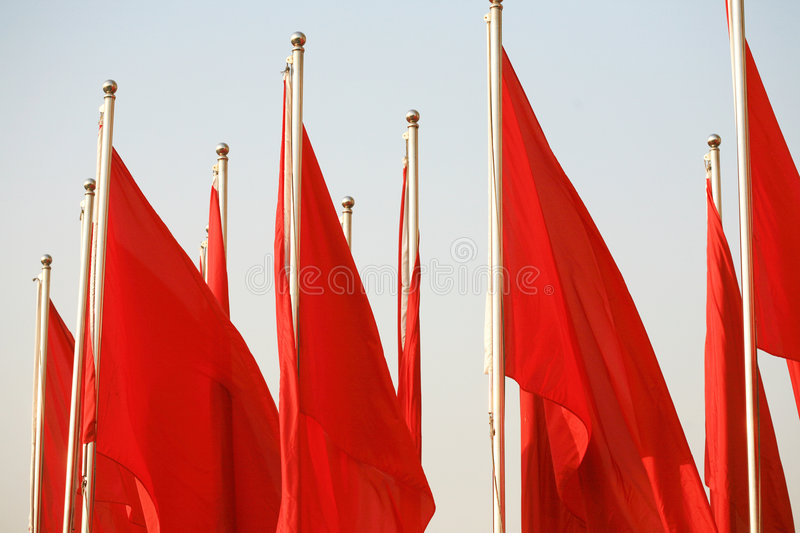
from dreamstime.com

This past weekend at Tybee Island was the first time I’ve set foot on the beach since I was caught in the rip current in Southampton, NY in 2018.  I thought I would feel fear, but when my sister and I went out last Friday night, it was low tide, the water warm, and the waves almost gentle.  In other words, the ocean felt safe to me.  It was a different story the following morning—the wind was crazy, the waves at high tide so rough that I just couldn’t make myself go in.  There was also a red flag warning—and can you get any more obvious than a red flag literally warning you there’s danger?  Three years ago I ignored the warning, and we all know how that turned out. I learned my lesson.

I think writing is the same way—there are times when writing feels easy and safe (and of course we love those times!), but there’s also those red flags that tell us that maybe we need to reconsider, or even back away.  That’s not to say we shouldn’t “write what we’re afraid to write”—we should, absolutely, write our lives, our stories, our poems that challenge us to be our most authentic selves.  Sometimes that means we write about difficult or painful memories.  Sometimes that means we share what we’re afraid will make us look ridiculous, or damaged, or imperfect.  Some danger is good.  Too much danger and we risk losing ourselves.

What do I mean?  I think there’s a chance that we can give too much of ourselves away when we write.  After all, we are “baring our souls” in one way or another—and when we write about unprocessed trauma that’s when the red flags go up.  We can unintentionally re-traumatize ourselves when we really mean to heal.  Of course, writing about the things that have shaped us is necessary, but I wonder how much good we accomplish if writing about an experience that was painful, terrifying, or devastating makes us revisit those dark places?

What boundaries do we have in place that will protect us?  Have we gone through counseling to process our trauma?  How do we know that what we write won’t revisit trauma on someone else?  If we don’t have boundaries, and we haven’t had the benefit of therapy, we are putting ourselves in danger of revealing too much and re-opening old wounds.

That’s always a danger with writing, I suppose, because to write and share something means you risk exposure—you invite the audience in, and once an audience is involved, you’re not entirely in charge of your work or the interpretation of experience anymore. There’s danger to the writer in the act of audience consumption of work.  How will the audience react?  Will they judge the person you were when you experienced what you experienced?  Will they discount your interpretation of events?  Will they harass you?  Will they reject you?

I think about my own experience trying to publish poems about past trauma in my life.  It never goes well.  I’m not afraid so much about sharing my life—I’ve had plenty of therapy, so I’m well and truly “processed.”  I just think I’m really bad at it.  (And honestly, does the world need more poems or a memoir about child abuse?  I doubt it.)

Not every experience that’s happened to us (or we were involved in) needs to be written about and shared.  Maybe that’s the difference.  Maybe, now that I think about it, we should always write the red flags—what scares us, what seems dangerous.  That’s what journaling is for—it’s a controlled environment:  we are both writer and audience, and there’s little chance of discovery and judgment.

But sharing traumatic experiences in published writing can be as dangerous as a rip current, where even the strongest swimmers can drown.  Are we prepared for the fall-out, to ourselves and to others?  If we’re not ready, then the work should probably stay private.  At least for now.  When the waves are less rough, we can always venture back out.

Yes, Virginia, I Do Need a Room of One’s Own

Ah, to be outside one’s typical milieu for the first time in 16 months!

I think about how it is when I am at home, trying to write—the cats are constantly jumping up on me, getting in the way of my computer, sitting on the books I’m using for research, whatever.  There are endless things to clean (not that I get up and clean them, but whatevs, they taunt me).  The phone rings constantly.  The emails and work fires intervene.  Someone in the cul-de-sac invariably manicures on his lawn, the incessant whine and growl of lawnmowers and weed-whackers destroying my concentration. It is hard to find a creative “zone” when too many things make demands on your attention.

Scout, with Sandy petting him

Since I have been here at Rockvale (in Tennessee, 35-ish miles south of Nashville as the crow flies) I have reveled in the almost uninterrupted quiet.  I read here in my “cell” (a beautifully appointed room with a cozy chair and desk and bed with a quilt on it from 1925) or in the fireplace room (which smells of a century of winter fires), and write in a little pool of sunlight on the enclosed porch.  It is almost like I alone have run of the place.  But there are other women here too, working on their own writing, finding their own paths.  Except for a little chitchat in the kitchen when preparing meals, the only noise is the AC turning on and off.  What must it be like to have this kind of quiet all the time?  I think I didn’t realize how exhausted and depleted I’ve been feeling until I rediscovered my own being here in this writer’s colony.  I am truly decompressing.

Mama… a.k.a. Little Mexico

From my window, I can see a paddock, and usually there’s a mama and her foal far out on the other side, nipping the grass.  Today they were over by the fence nearest me, so I went out there and got to pet Scout.  His mama (whose real name is Little Mexico (?)) didn’t come too close, but Scout seemed pretty interested in me, and in debonair Finn and chonky Ollie, the two cats who came running when they saw me.  (I can’t escape cats!)  Scout was so interested that he gave me a big chomp on my forearm—which hurts a bit, but didn’t break the skin.  Still, I’d pet him again if he came to this side of the fence.

Finn

Ollie (who is really Oliver)

I feel grateful to be here.  I think after a year and a half-ish of being shut in the house, I just needed…another house. 😊 I needed a place of clutter-free, basically cat-free peace.  (And wifi and cell service are spotty, so I’m even hard to reach, which actually, I love.) I am hoping to get some good writing done.  I’ve already brainstormed a number of ideas of where to go on my next project, I’ve organized a list of what I have, I’ve done some journaling (I know, what a shocker!) and I’ve read two whole books for research already.

Tomorrow, I’m writing two poems if it kills me.  And maybe I’ll go visit Scout again.

Enter a Giveaway for Leah Angstman’s New Novel!

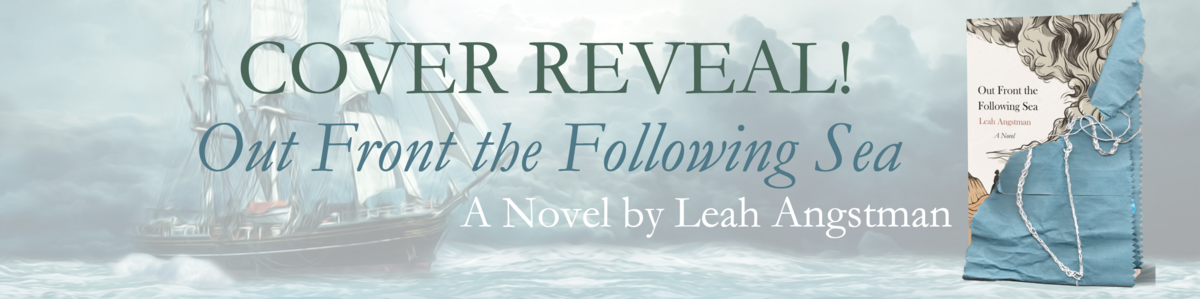
I’m am always happy to help out a fellow writer. So check out the cover reveal for
Leah Angstman’s debut novel, OUT FRONT THE FOLLOWING SEA, coming January 2022 from Regal House Publishing.


OUT FRONT THE FOLLOWING SEA:

A Novel of King William’s War in 17th-Century New England

BY LEAH ANGSTMAN

Publication Date: January 11, 2022

Regal House Publishing

Hardcover, Paperback, eBook, Audiobook; 334 pages

Genre: Historical / Literary / Epic

**Shortlisted for the Chaucer Book Award**


OUT FRONT THE FOLLOWING SEA is a historical epic of one woman’s survival in a
time when the wilderness is still wild, heresy is publicly punishable, and
being independent is worse than scorned—it is a death sentence.

At the onset of King William’s War between French and English settlers in 1689
New England, Ruth Miner is accused of witchcraft for the murder of her parents
and must flee the brutality of her town. She stows away on the ship of the
only other person who knows her innocence: an audacious sailor — Owen — bound
to her by years of attraction, friendship, and shared secrets. But when Owen’s
French ancestry finds him at odds with a violent English commander, the
turmoil becomes life-or-death for the sailor, the headstrong Ruth, and the
cast of Quakers, Pequot Indians, soldiers, highwaymen, and townsfolk dragged
into the fray. Now Ruth must choose between sending Owen to the gallows or
keeping her own neck from the noose.

Steeped in historical events and culminating in a little-known war on
pre-American soil, OUT FRONT THE FOLLOWING SEA is a story of early feminism,
misogyny, arbitrary rulings, persecution, and the treatment of outcasts, with
parallels still mirrored and echoed in today’s society. The debut novel will
appeal to readers of Paulette Jiles, Alexander Chee, Hilary Mantel, James
Clavell, Bernard Cornwell, TaraShea Nesbit, Geraldine Brooks, Stephanie Dray,
Patrick O’Brian, and E. L. Doctorow.

AVAILABLE FOR PREORDER

REGAL HOUSE PRINT
|
AMAZON KINDLE

AVAILABLE FOR ARC REQUEST

TNBBC PUBLICITY

Praise

“With OUT FRONT THE FOLLOWING SEA, Leah Angstman reveals herself as a brave
new voice in historical fiction. With staggering authenticity, Angstman gives
us a story of America before it was America — an era rife with witch hunts and
colonial intrigue and New World battles all but forgotten in our history books
and popular culture. This is historical fiction that speaks to the present,
recalling the bold spirits and cultural upheavals of a nation yet to be born.”

—Taylor Brown, author of PRIDE OF EDEN, GODS OF HOWL MOUNTAIN, and THE RIVER
OF KINGS

“Steeped in lush prose, authentic period detail, and edge-of-your-seat action,
OUT FRONT THE FOLLOWING SEA is a rollicking good read. Leah Angstman keeps the
story moving at a breathtaking pace, and she knows more 17th-century seafaring
language and items of everyday use than you can shake a stick at. The result
is a compelling work of romance, adventure, and historical illumination that
pulls the reader straight in.”

—Rilla Askew, author of FIRE IN BEULAH, THE MERCY SEAT, and KIND OF KIN

“Lapidary in its research and lively in its voice, OUT FRONT THE FOLLOWING SEA
by Leah Angstman is a rollicking story, racing along with wind in its sails.
Though her tale unfolds hundreds of years in America’s past, Ruth Miner is the
kind of high-spirited heroine whose high adventures haul you in and hold you
fast.”

—Kathleen Rooney, author of LILLIAN BOXFISH TAKES A WALK and CHER AMI AND
MAJOR WHITTLESEY

“Leah Angstman has written the historical novel that I didn’t know I needed to
read. OUT FRONT THE FOLLOWING SEA is set in an oft-forgotten time in the
brutal wilds of pre-America that is so vividly and authentically drawn, with
characters that are so alive and relevant, and a narrative so masterfully
paced and plotted, that Angstman has performed the miracle of layering the
tumultuous past over our troubled present to gift us a sparkling new reality.”

—Kevin Catalano, author of WHERE THE SUN SHINES OUT and DELETED SCENES AND
OTHER STORIES

“OUT FRONT THE FOLLOWING SEA is a fascinating book, the kind of historical
novel that evokes its time and place so vividly that the effect is just shy of
hallucinogenic. I enjoyed it immensely.”

—Scott Phillips, author of THE ICE HARVEST, THE WALKAWAY, COTTONWOOD, and HOP
ALLEY

“OUT FRONT THE FOLLOWING SEA is a meticulously researched novel that mixes
history, love story, and suspense. Watching Angstman’s willful protagonist,
Ruth Miner, openly challenge the brutal world of 17th-century New England,
with its limiting ideas about gender, race, and science, was a delight.”

—Aline Ohanesian, author of ORHAN’S INHERITANCE

“Leah Angstman is a gifted storyteller with a poet’s sense of both beauty and
darkness, and her stunning historical novel, OUT FRONT THE FOLLOWING SEA,
establishes her as one of the most exciting young novelists in the country.
Angstman plunges the reader into a brilliantly realized historical milieu
peopled by characters real enough to touch. And in Ruth Miner, we are
introduced to one of the most compelling protagonists in contemporary
literature, a penetratingly intelligent, headstrong woman who is trying to
survive on her wits alone in a Colonial America that you won’t find in the
history books. A compulsive, vivid read that will change the way you look at
the origins of our country, Leah Angstman’s OUT FRONT THE FOLLOWING SEA
announces the arrival of a preternatural talent.”

—Ashley Shelby, author of MURI and SOUTH POLE STATION

“Rich, lyrical, and atmospheric, with a poet’s hand and a historian’s
attention to detail. In OUT FRONT THE FOLLOWING SEA, Leah Angstman creates an
immersive world for readers to get lost in and a fascinating story to propel
them through it. A thoroughly engaging and compelling tale.”

—Steph Post, author of HOLDING SMOKE, MIRACULUM, and WALK IN THE FIRE

“It’s a rare story that makes you thankful for having read and experienced it.
It’s rarer still for a story to evoke so wholly, so powerfully, another place
and time as to make you thankful for the gifts that exist around you, which
you take for granted. OUT FRONT THE FOLLOWING SEA is a book rich with misery,
yet its characters are indefatigable; they yearn, despite their troubles, for
victories personal and societal. Leah Angstman’s eye is keen, and her ability
to transport you into America’s beginnings is powerful. With the raw
ingredients of history, she creates a story both dashing and pensive, robust
yet believable. From an unforgiving time, Angstman draws out a tale of all
things inhuman, but one that reminds us of that which is best in all of us.”

—Eric Shonkwiler, author of ABOVE ALL MEN and 8TH STREET POWER AND LIGHT

About the Author

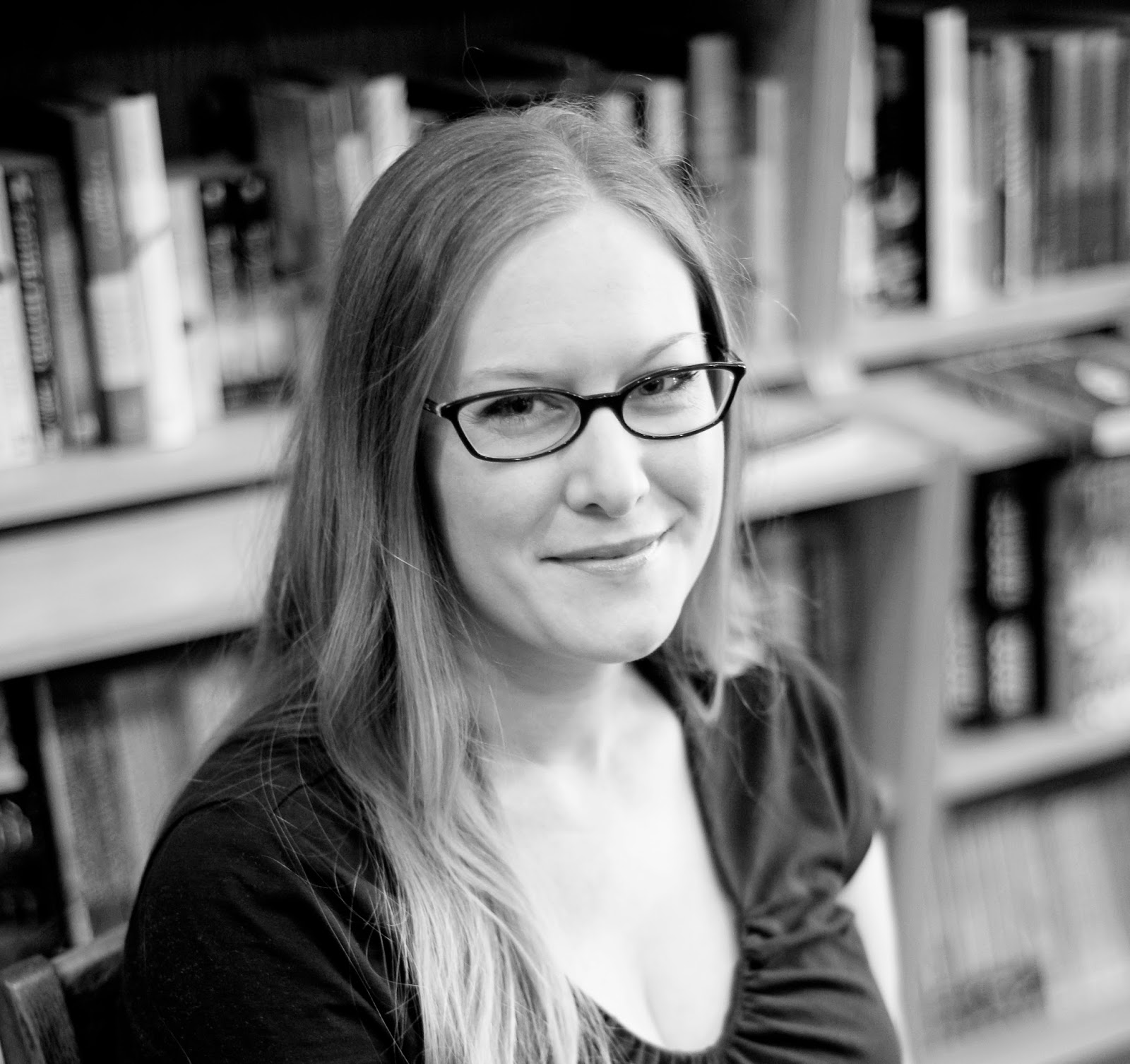
Leah Angstman author photo

Leah Angstman is a historian and transplanted Michigander living in Boulder.
OUT FRONT THE FOLLOWING SEA, her debut novel of King William’s War in
17th-century New England, is forthcoming from Regal House in January 2022. Her
writing has been a finalist for the Saluda River Prize, Cowles Book Prize,
Able Muse Book Award, Bevel Summers Fiction Prize, and Chaucer Book Award, and
has appeared in Publishers Weekly, L.A. Review of Books, Nashville Review,
Slice, and elsewhere. She serves as editor-in-chief for Alternating Current
and The Coil magazine and copyeditor for Underscore News, which has included
editing partnerships with ProPublica. She is an appointed vice chair of a
Colorado historical commission and liaison to a Colorado historic preservation
committee.

October and Greatness

from NYPL Public Domain Collection

The weather has changed, turning cool and windy, and that has infused a little life into this old carcass of mine.  I love October.  I love the sound of Canada geese flying overhead.  I love the way the sunlight deepens to sunflower yellow, and how the leaves fall in puffs, as if the trees have sneezed them away.  I love too when the year is coming to a close, and every month ends with a holiday. We need a holiday.  This year has been too burdensome, too excruciating for all of us—and for 208,000 of us in America (as of this writing) it has been our last year of life.

I can’t pretend, as much as October makes me happy, that I’m not cognizant of the real trauma people have experienced this year.  Of some friends getting cancer, and others seeing their depression worsen, and others catching Covid.  Of a country divided so intensely by fascist white supremacy and support for Black Lives Matter—and everything else that can divide us, especially this coming election.

I see more Trump signs than Biden around here where I live, and it makes me wonder about those people.  Has this country given them everything they wanted?  Are they content to watch their fellow citizens in less affluent zip codes struggle?  Or don’t the poorer among us even rate?  I think they must not—because if they did, we would all be doing a better job about caring for others—ending racism, ending the prison industrial complex, ending ICE, and uplifting the poor, ensuring equal civil rights for all, making health care free, relieving the shackles of student loan debt. (Not to beat a dead horse.)  There are so many things we could be doing—and expecting our “representatives” in Washington to be doing.  But many of us have become so afflicted with ennui and exhaustion that we feel helpless.

So the rallying cry is VOTE VOTE VOTE.  I see it everywhere on social media and in the news.  My phone is bombarded with texts asking me to send money to support Biden and other Democrats. And yet, I can’t say that voting has done much good so far. We have an Electoral College that exists to keep the oligarchs in power, even when they lose the popular vote.  And the people we’ve voted for bend over backwards to accommodate the Republicans, and move the Democrats to the right. 

I just don’t know what to think about Nancy Pelosi when she compliments the Republicans for doing so much for America or Joe Biden who refuses to consider Medicare for All.  These are the people who are supposed to have the best interests at heart for Americans who can’t obtain the American Dream (as well as those of us who have decent jobs that provide us with the means for housing, health care, and everyday comforts).  Yet these same Democrats who claim they champion the American worker support increases to the military and cut SNAP.  I don’t see how anyone can think they are on any side but their own.

Oh, but JC, you say, I thought you were going to be writing an homage to your favorite month?  Why are you being political?  I think it’s because my privilege weighs heavy on my heart sometimes.  As it should.  To those who have been given much, much is expected.  And maybe it’s just growing closer to the end of the year—especially such a contentious, traumatic year—that makes me feel a little thoughtful. 

I worry about the coming election. I fear it.  We have a month to go before America decides if it wants to be so “great” that it continues to screw over everyone in the 99% for another four years.  But if that’s “greatness,” I have to wonder how we moved so far right that the only people who matter anymore are the billionaires and corporations, when it was the workers and enslaved peoples who built the country the billionaires profit from.  That’s not greatness.  That’s theft, corruption, and exploitation.

I don’t know how to make America great for the majority of Americans. It was never great for a lot of people.  It works pretty well as is, for some of us—especially if you’re rich, white, able-bodied, educated, and male.  But I have some ideas about the changes we could make that would definitely improve life for everyone—here are 10:

  1. Redistributing some of those billions might help.
  2. Increasing the numbers of women, LGBTQ/nonbinary, and POC folks in positions of power would help.
  3. Getting rid of the rich septuagenarians in all levels of government would help.
  4. Dismantling the police and the prisons would help.
  5. Establishing term limits for Congressional, Senate, and SCOTUS seats would help.
  6. Medicare for all would help.
  7. Zeroing out student loan debt and making college free would help. 
  8. Increasing free lunch programs, SNAP benefits, and other unemployment benefits would help.
  9. Offering a universal basic income would help, of if not that, then…
  10. Giving $2,000 a month for the next 12 months to every resident of America to help offset the Covid disaster would help.

I think those ten ideas would help make America great for more people. We have a long way to go to even move the needle one point towards the left.  And no matter the outcome of the election next month, we all have to stay involved in making positive changes for all. This is especially true for Democrats, if Biden wins.  Liberals have a nasty habit of going to sleep about larger social justice issues when blue candidates are elected.  That’s not greatness either.

There’s a lot to do.  But hey, at least it’s October, my favorite month, beautiful and energizing and full of promise. A little gem on top of the turd of 2020.

Catfish Moon (poem reading)

from the NY Public Library Digital Collections

from the NY Public Library Digital Collections

Since all poetry readings are canceled for the foreseeable future, I thought I would take the opportunity to read a few poems over the next several days from my new book What Magick May Not Alter.

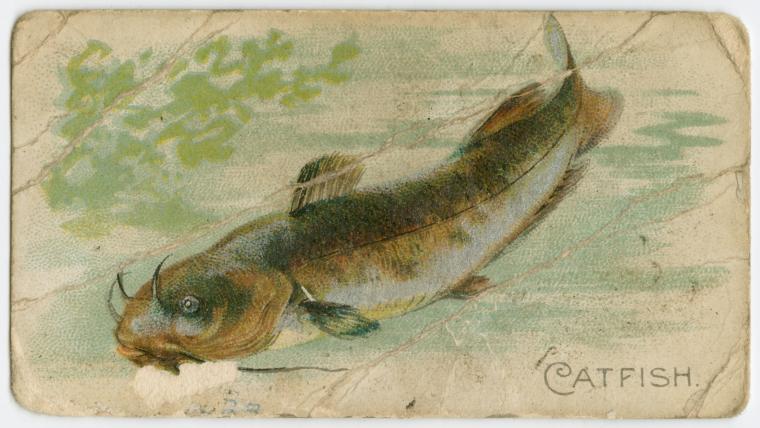
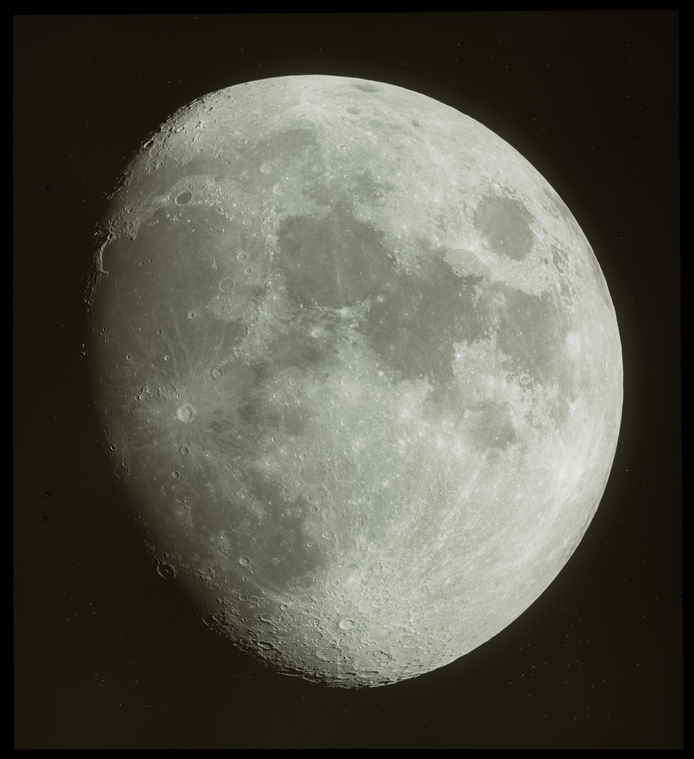
This poem called “Catfish Moon,” named after the full moon in August (which is technically the Sturgeon Moon, but this is poetry, and we take liberties).

(Also, the picture looked backwards when I was filming it, but it’s correct when you watch the video, so forget my little “backwards” comment.)

If you like the video, or this blog, please feel free to share it near and far!


Report from the Field: AWP & Portland

AR booth 2019

Our lonely booth, with Collin Kelley and Karen Head

This year marks the 25th anniversary of the Atlanta Review, and so we were thrilled to be in Portland to help celebrate this milestone with everyone and debut our 25th Anniversary Anthology.  Not only was Atlanta Review one of AWP’s sponsors this year, but Karen Head, our fearless Ed., had gotten us a primo spot at the entrance of the Book Fair, and we expected to blow through our swag.  Additionally we had a great 25th anniversary reading lined up with Ilya Kaminsky, Sholeh Wolpe, Marty Lammon, and former editor, Dan Veach, which we knew would be packed to the gills. We were expecting to take Portland by storm.  Reality was a little less impressive.

If you want to skip the details, suffice it to say that I’m glad I went, and that I love spending five days surrounded by writers and books in a city I’ve never been to.  If you want the low-down, read on…

Continue reading