Time to Get Reading

In my push to work on Hecate Applebough 1, 2, & 3, my poetry has been getting somewhat short shrift.  True, Cate is a poet, so I include some of “her” poems in the text, but as for my own (“real”) poems, I’ve hit a dry patch, which tells me I need to begin a Reading Phase.  (Either that, or I need to win a trip back to Venice, but I don’t see that happening any time soon.)  Reading poetry is helpful on so many levels—among other things, it exposes you to new ways of looking at the world, it offers creative connections with language, and it reveals beauty and anguish and sudden bursts of weirdness.  But more importantly, it lets me escape the dolor of my own head.  I mean, honestly, that thing is like a coffin.  I need outside influence in the worst way.

But what to read?  I have plenty of books on my shelves that I’ve either never cracked, or I read long ago and forgot what it’s them.  (Also, as an aside, “long ago” could mean as recently as a year ago—I have a piss poor memory for poetry, which is kind of pathetic for someone who counts herself a poet.)  There are new books of poems out every day, some of them by acquaintances that I need to buy at some point—all of them equally good, I’m sure, but I think I’m going to choose some “free” ones—and by free, I mean, ones off my shelf.

(Closes eyes and chooses)…And here are the first three winners of my Random Poetry Picking Sweepstakes:

  • Mohja Kahf’s E-mails from Scheherazad (UP Florida, 2003)
  • Molly Peacock’s Original Love (Norton, 1995)
  • Evie Shockley’s A Half-Red Sea (Carolina Wren Press, 2006)

My goal, then, is to read these books in the next few days and be amazed by their words, and maybe after that I’ll read a few more, etc., etc., and maybe after that I’ll be ready to start a Writing Phase again.  I might even include some mini-reviews next week.

I do read journals off and on (especially when I’m in a Submitting Phase), but sometimes, I find what passes for poetry in them unintelligible.  Like, I just have no idea what the person is trying to communicate.  I don’t believe it’s because my brain has certainly turned into marshmallow—I think there’s just a real movement to putting words together for no damn reason other than to see if editors will be fooled into thinking that word-bag poems mean something.  Now, not every journal, and not every poem, obviously.  But it seems to happen more frequently than not.  Recently I read a few poems in a journal (that will remain nameless, but suffice it to say it’s Big and Impressive) that I was considering submitting to, and once I read the kind of poems they’ve published lately, I was very certain that what I write would fall directly into the round pile.

(I’m not talking about The New Yorker though, in case you’re curious what Big and Impressive Journal I mean.  For at least the last 20 years, they publish the shit poems of brand-name poets.  I’m saying it out loud, right here.  The New Yorker prints the absolute worst poems I’ve ever read.  And if this claim on my part means that they will never publish any of my poems, far far into the future, when I am myself finally a brand-name poet, then so be it.  Their poems are the pits, and honestly they should be ashamed of themselves that they can’t pick better ones.)

(Does that sound like sour, jealous grapes?  It’s not.  I know getting published in The New Yorker is a big benchmark for a poet, but I think I hold with Groucho Marx here:  I don’t care to belong to any club that will have me as a member.  So, sayonara New Yorker.)

Anyway, in my distaste for The New Yorker, I’ve meandered from my point (it happens, forgive me)… which is this:  it will be good to get back to reading quality writing (instead of what I have been reading, which is fun [manga], but not particularly conducive to inspiring my poetic side).

And if you have any poetry book suggestions that are current and wow, leave them in the comments.  I might go on a buying spree soon.  Goddess bless Amazon Prime.

Seriously, JC, They Make Pills for This

My novel went on a “first date” yesterday.  Metaphorically speaking.

What I mean is, it is in the process of being “courted” by a potential future editor, which is to say, my Brilliant Fiction Writer Friend™ (whom I’ve mentioned before in this blog), who, despite not being a fan of YA, has graciously, and generously, and kind of insanely agreed to read my NaNoWriMo novel Hecate Applebough because he believes in me as a serious writer (even a serious writer of fluff), and sight unseen is willing to work with me to revise it and maybe make it into something good (or good-ish).

I must admit I am in the absolute worst dither of insecurities about my writing ever.  Like I’m back in my first creative writing class when I’m 20 years old, and so shy about what I’ve written that I really fear—not just that what I wrote is crappy (because that is surely a given)—but that I will have a) inflicted my mental crappiness/ drivel on another person; b) wasted someone’s already limited amount of leisure reading by forcing them to read something appalling (and deeply flawed on all levels); c) imposed on someone’s friendship, even when they offered, even when they are doing their best to wear me down to make me agree to continuing this part of the writing process (and I am deathly afraid of imposing on people, like pathologically so); and d) allowed someone to discover proof  that I’m not nearly as hilarious and awesome as I think I am.  (Perhaps that last fear on the list sounds trivial or frivolous, but I assure you, it’s a deeply-seated fear.)

It’s really a weird place to be in—like I believe in my ability as a poet.  I might be having a shitty time convincing contest editors that my volume of poems is fantastic, the next best thing, blah blah, and they need to publish it already, goddammit, but I don’t doubt in any fiber of my being that I’m a poet.  When I think “JC,” I think “poet.”  These ideas fit in my head together, like synonyms.  And sure, it makes sense—you think about all this time that I’ve worked on writing poetry, that I earned that Ph.D. in poetry—I mean, if I didn’t see myself as a poet after the time I’ve invested in it, that would be a huge (and annoying) problem. (And would make having to pay back student loans even more of an insult.)

Except, I don’t want to be just a poet.  I have more words in my head than that.  I’m not saying I believe BFWF that I’m a “novelist” either (just by virtue of having written 1.99 “novels”), but limiting myself to one version of “who I am as a writer” doesn’t fit me any more either.  Of course, in terms of writing fiction—well, I still feel like I’m still 20 years old, with zero experience—but there’s an expansiveness that’s been coming the last few years, a real desire to try something new, and to tell stories that take more than a page.

That narrative bent in my writing and my voice is there—and let’s be honest, the poetry world does not appreciate narrative as a form.  So, I need to use forms that narrative work in… which is why I wrote Hecate Applebough, which is why I also write these memoir-y vignettes that seem to find homes in little journals too.  Hmm.

But getting back to the possibility of having a real reader/ editor:  I was asked if I want to be worn down.  That’s a hard question to answer.  Like, realistically, who wouldn’t want a person you admire who is brilliant and has critical and practical expertise and proclaims a genuine wish to help you succeed to be the one who reads your book and helps you edit and revise it—the two hardest parts of writing?  You’d have to be an idiot to turn that down—particularly when there is so little return in it for them.

(But to be fair, my idiocy is well-documented.)

As I’m thinking about this and talking myself in-and-out of this amazing opportunity that has shown up in my life like a late Christmas gift, I realize my fear isn’t anything like worry that I’m a “fraud” as writer.  I don’t question I’m a writer, per se.  Because there’s so much that goes into writing beyond the actual writing of whatever the piece is, you have to believe that you’re a writer deep down in your heart because if you don’t believe it, then what is the point of doing this really lonely, difficult  (and often barely rewarding) work?  Once a piece of writing is released into the world (and that’s after the writer has spent her time polishing her poem or story until it gleams) you can’t control the people who read it.  If your submission (or your “novel”) shows up on a day that the editors/ grad students working on a journal are on the rag, or hungover, or pissed off at their bosses, or they hate anything that smacks of genre or narrative poetry or they just read a great bird poem right before they picked your bird poem up from the pile and so can’t imagine any bird poem after the one they just read as measuring up (or whatever), your writing, no matter how good it is, won’t go beyond the first pass.  It might not even go beyond the first lines. (I say this as a person who has participated on the grad student side of the journal publication process.)

There’s so much luck involved in a person’s work entering the wider world by being published. And forget about the accolades.  You have to believe you’re a writer—because the odds are so stacked against you that your work will ever resonate with anyone and find a home in their journal or on their upcoming publications list.

So it’s not a matter of lacking faith in myself as a writer (in the generic sense) that is the stumbling block with my sharing Hecate Applebough—the fear emerges from the realization of just how drafty the first draft is—and sharing a piece of my writing with someone that is 98% imperfect terrifies the fuck out of me.

Because when I share my poems with people, they only see them after—typically—the poem has gone through 8-10 drafts already.  Like my writing group?  I show them poems that are, to my mind, already mostly good.  Poems after I meet with them may go through another 5-10 drafts, but when the writing group sees them initially, they don’t see the first draft.  They see something I’m not ashamed to show.

First drafts are unfit to be seen by anyone.  And Hecate Applebough is a first draft.  I mean, it’s prettier than a first draft, in that I’ve line-edited it, I’ve changed some words here and there, or added a few scenes to smooth over some plot holes.  But the aggregate is still first drafty.  (It’s so drafty, it needs to wear a coat.)  And sharing imperfection with someone, even someone as committed to helping me as BFWF is (someone who expects imperfection, moreover, so I’m not going to shock them), even someone who is my friend, is just one of my worst anxieties.  It just seems so wrong—so contrary to my process.  So naked.

And I guess I either need to get over myself and stop being so crippled by self-doubt and all this blather and take the opportunity because when the Universe wraps it in a bow, how stupid do you have to be to say no?  Or I just need to STFU about this book and move on to the next thing and be satisfied with sabotaging myself (again) and learn to enjoy obscurity and blown chances.

(Ugh.  When I put it like that, suddenly I think I must be pretty foolish to have spent 1400 words to realize I planned to say “Yes” all along.)

P.S.  I know BFWF will have read this post (being one of my Five Faithful Readers). And BFWF will think “I knew it.”  But I’m pretty sure, recognizing the kind of headcase I am, that I will change my mind at least 58 more times.  Possibly more. So certainty tonight may shift back over into uncertainty many more times before I actually hand a copy of the book over.  Fair warning.

P.S. #2  BFWF should in no way feel compelled to comment or to cheer me on. (This post is not a plea for more convincing.)  Sometimes I blog just to take the edge off my neuroses.

Final Report on NaNoWriMo 2015

Have you missed me?

I got so engrossed with writing the NaNoWriMo novel in November and the sequel (still in progress) in December, and the of course the holidays intervened, that I took a break from my blog.   This was my thinking:  I can either write 1,000 words on my blog, or I can put that 1,000 words towards my novels’ daily word counts, and the novels won out.  But here, enjoy some metrics about the actual novel I wrote in November.

Novel Facts…

Title:  The Life & Times of Hecate Applebough, Teenage Poet
Words:  79,142
Page Count:  281 (double-spaced)
Certified NaNoWriMo Winner:  Yes
Genre:  YA high school romance-ish
Plotline:  Hecate (“Cate”) Applebough attends a school for wealthy, gifted students while developing her interests in writing and poetry.  She also attends events at an afternoon club and becomes friends with its members.
Timeframe of Plot:  August 22nd-December 25th
Setting:  Fictional town of Lytton, Maryland
My Favorite Character Besides Cate:  A toss-up between her Mom and Professor Khaniff
Character I’m in love with:  Alaunius

Novel Statistics:  Number of…

Times the Main Character (Cate) is Named: 184  (But this is somewhat disingenuous, as the book is written in first person.  I tried to do a search on the number of times “I” was mentioned, but it listed all the I’s in the book, to the tune of 23,744 times.)
Times other Salon characters are named:  Alaunius/Lonny:  472; Val/Malik:  463; Finian:  147; Felix:  133;  Arwyn:  93; Dhruv:  68
Times Mom/ Maggie is named:  369
Times Professor Khaniff is named:  30
Poems Cate “writes”: 4  (There are references to others, but I only include 4 poems in the actual text.)
Poems others “write”:  5
Times the words “Poetry” or “Poem” appear:  176
Texts from all characters:  111
Times the word “Text” appears:  96
Times the fictional manga title A Moon for Autumn appears: 10
Times the fictional character Takehiko from A Moon for Autumn is named:  23
People who have read this book besides me:  2 (1 for sure, 1 I’m not 100% about, but I gave it to her to read.)

The Sequel, You Ask?

The sequel is currently title-less… I really could just slap “Volume 2” on it, but I don’t love the original title so much that I want to repeat it (and frankly, the original title is subject to change, anyway).  On the other hand, I don’t want to adopt the format of Indiana Jones and the… or Harry Potter and the… either.

Or if I do follow that pattern, I guess the title will be something along the lines of Hecate Applebough and the Fucked Up Men in Her Life which I don’t think anyone would naturally gravitate towards if they saw the book for sale in Barnes & Noble.  (Despite it being an accurate title to describe Cate’s life as it appears in the sequel.  And let’s be real, that would probably be an apt title for the first one too… Hmm.)

Speaking of the sequel, it’s making me lose the will to live.  I’m really having to work to write it.  It’s like the first one wrote itself, like it was buried somewhere in my psyche, and just needed an excuse to be expressed on the page.  But LaToHATP ended on a cliffhanger so of course I had to write the sequel…which is going sooooo sloooowly.  I mean the first book covered four months; I’m only in February in the second book. (Still.) Granted, I’m at February 26th, but really, I’m 215 pages in (currently 66,702 words), and she’s only lived 2 months since the original book? Come on.  And somehow I have to resolve this story in the next 14,000 words?  Yeah, like that’s going to happen.

I don’t think it’s necessarily slow in terms of plot, I just think that there are so many characters making demands on me, that it’s really hard to progress.  Also, it’s really hard to write in first person.  Like, there are so many things going on in the background that Cate can’t know, and it’s really restrictive to me as a writer, and that annoys me.  (But to be fair, I’d probably complain if I wrote in third-person too.  But if I did write in third-person, at least I could let the audience know things that would be helpful to know in terms of backstory.  But alas, I cannot.)

2015 was a pretty good writing year for me over all.  Back when I decided to challenge myself with NaNoWriMo, I wasn’t even sure I could write 50,000 words in a month, and in 2 months plus a week, I’ve managed to write 145,844 words, which is amazing.  Add that onto all of the publications I had in 2015 (10, across genres, plus several more accepted, and a Pushcart Prize nomination), and I have to count it as my most successful year of writing yet, and I’m proud of that.

Of course, if I plan to do anything with LaToHATP, that will require a hella lot of work, and while I’m working on the sequel (and sadly, one assumes the sequel to the sequel, because I can’t fix Cate’s life in the remaining 14,000 words, there’s just no way in hell), I can’t think about revising.

Plus…revising fiction is really hard, and I’m not good at it.  Like revising a poem?  I got that down to a science.  But since fiction is basically a mysterious genre to me, I don’t know how to revise my own work.  I mean, I can tell other people how to revise (hence, why I teach fiction in my creative writing class), but I seem to have blinders on when it comes to my own work.  I just have no idea where to go.  And, frankly, no idea whom to ask for help.  Well, ok, I have an idea of whom to ask, but I feel like it would bleed him dry, and I couldn’t possibly ask him. Unless I had $100 lying around I could slip him for the pain and agita… Anyway.

Still, I’m not gonna worry about revision for a little while.  I need to worry about resolving Cate’s life and then I can get back to writing poems full time.

At least, that’s the plan.

Sharing Good News Doesn’t Make You a Braggart

I am a minimizer. That is to say: I don’t brag about myself or my accomplishments even when I should. In fact, sometimes I forget to tell people about them, or I mention good news in an offhand way, as if it’s of no consequence—and in this world where branding is a thing, you can’t be a minimizer.

I have writing friends who frankly tweet, post, Instagram, Snapchat, whatever, when they blow their fricken noses. That doesn’t appeal to me. I might make a quick tweet or a quick FB post, and it will get a few favorites or “likes,” and then it moves quickly out of the spotlight as I post more interesting things on my feeds, mainly pictures of my cats. And so, in choosing not to promote the hell out of myself—or even just the heck out of myself—I can’t really enjoy the accolades that I’m due because no one really takes notice.

Case in point. In my FB post about being named a finalist in the Hillary Gravendyk Poetry Prize, I should have been self-laudatory ad nauseam and really took time to savor that moment—I should have appreciated that it was a kind of milestone—that it meant that people outside of my little coterie of friends on FB and IRL recognized some worth in my manuscript. In my poetry—in the thing that is so central to my core self that it’s my identity. So what did I write on Sept. 19th about it? I quote:

“Just found out that my manuscript was a finalist in the Hillary Gravendyk Poetry Prize….but it didn’t win. Bummer.”

REALLY? That’s what I write? How about something like this?

“I just found out the great news that my poetry manuscript made it as far as finalist in the Hilary Gravendyk Poetry Prize!”

Look at the rhetorical differences between both of those posts—the lousy original and the one I should have written. Isn’t the second one a comment that deserves a lot of response? Of course it is—because it focuses on the positive, exciting aspect of even getting to the finalist stage. In my response, I minimized its significance right out of mattering to everyone… including myself.

How are people going to expect awesomeness from me if I don’t show off when something awesome happens? In my general (pathological?) desire to be wallflowery and invisible, this honor basically went unremarked. I mean, forgodsake, only one of my close writing friends even “liked” that post. It makes me wonder if the rest even know about it? And how would they know? I didn’t tell them. I should have let them take joy in my success—and it would have let me take some extra joy in it. But no.

Or what of the Pushcart Prize Nomination I received on Oct. 10th? This is an amazing recognition for me—yes, it’s a nomination, but just consider what it represents, that Glassworks thought mine was one of the best pieces they’d published all year. That is a Big Deal—or it should be. And here’s what I had to say about it on social media—talk about dinky—

“I would like to thank Glassworks Journal for nominating my piece ‘Camminare a Venezia: a Poemoir’ for a Pushcart Prize!”

This time not one of my close writing friends “liked” the post. Maybe they didn’t see it. Or maybe they don’t care about Pushcart Prizes; maybe they think writing prizes are bullshit, and nominations aren’t even noteworthy. But maybe they would have, if I had taken the time to tell them personally. (Or maybe not.)

This post is not to badmouth friends who weren’t more fulsome and forthcoming about praising me for my writing achievements. Whether something gets 9 “likes” or 90, that’s not how I should measure my worth. I know this.

This post is really designed more as a reminder to myself to be joyful in my writing successes, because they are fleeting and they don’t come often. By my not fully enjoying being a finalist in the manuscript contest or in learning about the Pushcart nomination (and preening or boasting even a little bit) I’ve robbed myself of some happy moments, and cheated my friends the opportunity to be happy for me too.  I need to do better about that.

P.S.: I took an unintentional hiatus from my Wednesday posts; October has been rife with disruption (bad and good), starting with the insanity that is semester scheduling for Spring; then my office flooded and I was office-homeless for more than a week; and my Mom came for a week, etc. So writing was a bit low-priority. I hope you, my Five Faithful, didn’t miss me too much.

DBF Post-Post Mortems

I mentioned a few blog posts ago that I decided to forego reading any poems from my manuscript at the Decatur Book Festival, because it’s really hard to excerpt pieces from a narrative–let’s be honest, the book is a verse novel, and so many of the poems are interdependent (except maybe the Moon Poems in it), that even reading sevearal in narrative-arc-order wouldn’t make much sense. How do you get invested in characters without hearing the WHOLE THING?  I don’t think it’s possible. (I suppose, if I ever get it published, I will really have to figure out how to present the poems in a way that makes sense for poetry readings.  But that’s just not an issue right now, so it’s clearly on the back burner.)

Anyway, at DBF, I read a handful of prose poems as I planned to.  I’ve been writing a number of them in the last year or so, along with the pieces of flash fiction and flash nonfiction.  (Actually, writing the prose poems might have been the catalyst for getting serious about fiction and nonfiction, now that I think about it.)

I’m not sure why prose poems are resonating with me so much–when I read them, I respond to their “quirky sensibility,” and the fact that they tend often towards absurdity and repetition (as well as the other things we expect in poetry, like sound and image and metaphor), and I like when I can write with a little bit of abandon, and try to tap into writing on the lighter (nuttier?) side.  Maybe that’s just my state of mind in the last year or so!  I’ve certainly gone out of my way to read a lot of prose poetry this past year, and I like what happens when I try writing it.

As promised…the Set List!  (You can find links to many of these on my Online Poems & Writing Page.)

  1. Nocturne
  2. This Is Not a Poem About a Blank Page
  3. Oceanic
  4. Weed ’em and Reap
  5. How to Mend a Broken Heart
  6. When the Wolf Bit Off the Fingers of My Left Hand
  7. Prosecco
  8. Piccioni
  9. Chiuso

Regarding readings, I was once described (by someone with excellent poetic delivery) as being a “diffident wise-ass,” and told that my performance tended to be sly and snarky between my poems, undercutting the presentation of the poems themselves.  I personally don’t mind being considered a diffident wise-ass–despite the fact that a body could argue that the definitions of both words would seem to cancel each other out–because it’s an accurate critique of my whole personality, and anyway, I’m nothing if not a contradiction.

But since he said that to me, I’ve tried to give  my poems the gravitas they deserve, and not be so snarky in my delivery.  I think I mostly succeeded this past Saturday at the DBF, but I’m sure I said a few snarky asides.  No one’s perfect…and anyway, I can’t help myself.  No one would recognize me if I was perfectly serious.

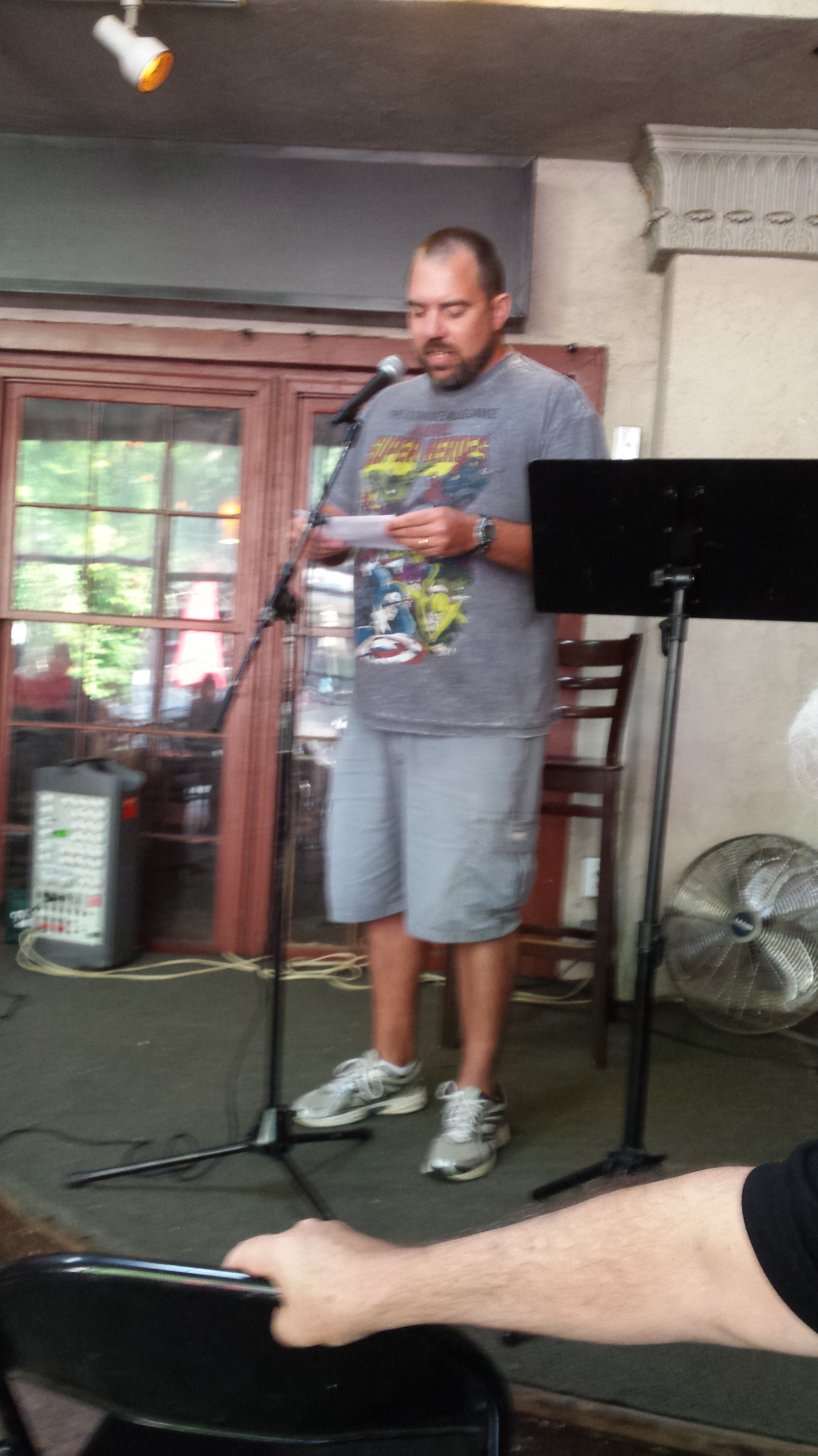
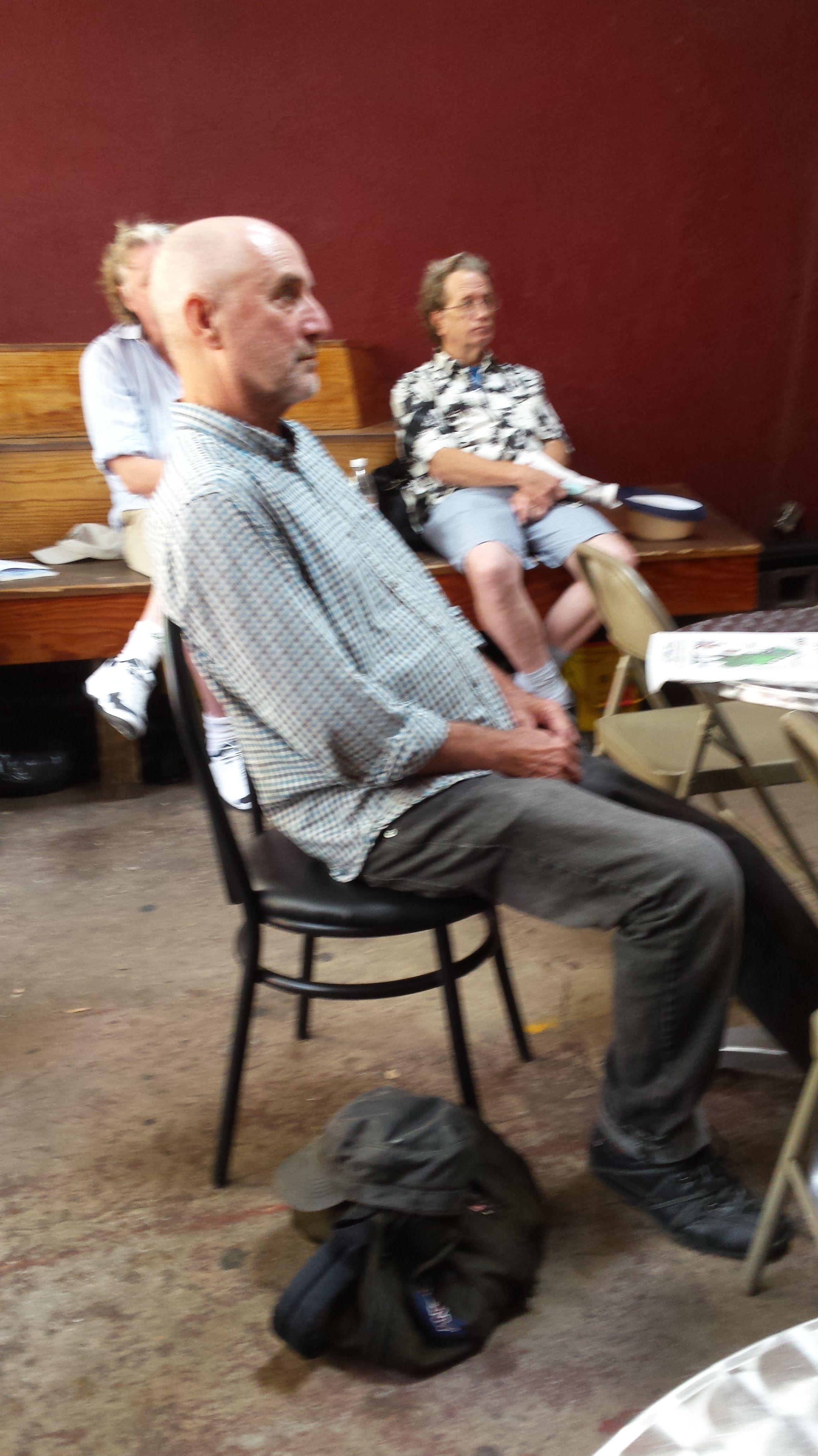
Finally…as for the photos… well, I forgot to bring my camera and had to settle with using the phone, and I often  get blurry pics on it.  I apologize to the photo subjects, who are all much more beautiful than they appear here!

Here are Tammy Foster Brewer, Robert Lee Brewer, and Andrea Jurjević (and Bob Wood in the foreground of Andrea’s photo).

Tammy Photo 1  Robert Photo 1  Andrea Photo 1

Here are Kodac Harrison, Dan Veach, and Rupert Fike (listening to Andrea’s poetry with rapt attention).

Kodac Photo 1  Dan Veach Photo 1  Rupert Fike Photo 1

Last, but not least, may I present “Still Life with Bob’s Hand.”  😉  Here he’s guarding his stack of copies of The Awkward Poses of Others, which, if you haven’t read, get thee to Amazon immediately and purchase a copy–especially if you like movies and art and ekphrastic poetry.

Bob's hand photo 1

And with that, I’ve no more to say about the Decatur Book Festival.  Until next September, that is.

DBF Post Mortems

I’m not sorry the Decatur Book Fest has been put to bed for another year.  There, I’ve said it—excoriate me all you will, but after nearly ten years of participating in the Local Poet’s Stage, there’s really nothing new and energizing about it.  It epitomizes the term de rigueur.  Been there, done that, got the poetry chapbook.

Don’t get me wrong—I truly like listening to my fellow poets—I thought Tammy Foster Brewer’s work was especially good this time—and I know I have her book around here someplace and I really need to re-read it.  Of course I enjoyed Robert Lee Brewer’s work too (I laughed out loud at the “Love Song of Lt. Commander Data”) and also Andrea Jurjević’s poetry—I like to hear them as writers and experience them as readers, which is why I always corral them for the 10 o’clock hour.  I find something new every time I listen to them—and that’s great.  And it’s amazing to listen to so many Atlanta poets just in general.  There’s a wealth of poetry here, and we can all thank Kodac Harrison’s work with the Local Poet’s Stage for bringing it to such a lively audience.

I always want to stick around for the entire day, but it’s complicated by an uncooperative body.  I did stay for the 11 o’clock hour, a medley of poets including Dan Veach and Karen Paul Holmes and Kodac (who, being a spoken-word/ performance poet recited both of his poems to the delight of the audience).  One poet who read with whom I wasn’t familiar at all was Christopher Martin, who seemed like a good ol’ Georgia boy, but he had a real narrative sense to writing, which I always respond to.  (I wish I had thought to buy one of his books.  For once I was carrying cash.)

I started to linger for the 12 o’clock hour (with the goal of staying through at least 2 p.m., so I could hear Karen and Bob)… except suddenly I was feeling anxious and light-headed, and that spoon-scooping-out-my-eye pain (indicating an oncoming migraine) hit me, and I knew I had to leave.

After all these years, the post-DBF reading-migraine makes me think it’s like some kind of psychosomatic response…I know for sure I’ve gotten one the last 4 years I’ve done this.  I don’t know what to attribute the migraine to—if it’s the venue, being outside on the patio, exposed to street noise (and let’s not forget Java Monkey has shitty coffee, though their frosted mint lemonade is terrific, I discovered), or if it’s the heat the longer the day gets (that’s always an issue, though the morning started cool enough), or if it’s just all the people who eventually fill in around me and I get antsy and hemmed in (actually, I’m almost sure that’s a main reason)—but SOMETHING kicks in, and makes me all Decatur Book Fest grrr-y/ angsty, and I have to GET OUT.

The problem with that DBF migraine is I missed a lot of local poets I’d have loved to hear.  Of course, Collin and Karen are giving a reading on Sept. 30th (which, assuming I don’t have a tennis match on that day, I plan to attend), so missing them this past Saturday is less egregious than missing, say, Christine Swint, whom I generally only see at DBF.  (And who I was so sorry to miss this time, because I’m sure she read poems that had to do with her Camino journey, and those I really wanted to hear.)

I suppose I should have taken a prophylactic Imitrex to head off the inevitable migraine (I get migraines ALOT, and I generally carry Imitrex with me just in case), but I didn’t think about it, and thus, just as all my friends were up to read, I had to go. But what can you do?

As far as my own reading went, I think it was fine.  About eight people were in the audience when I went on—mostly friends of Tammy’s—though my former supervisor and now dear friend Shannon Dobranski showed up just to hear me (I know it was just to hear me, because she left right after I left the stage), and I can’t tell you how touched I was.  It was so unexpected to see her in the audience, and it meant a lot that she showed up because at least I had someone to read to who wasn’t just there waiting in the queue to read after me.  And Bob showed up half-way through, too, when before, he emailed that he wouldn’t be coming, so that was a nice surprise.  I’m used to reading to an imaginary audience, so to have two friends there was two more than I’ve had before, and it was nice.

I’ll post the set list tomorrow, as well as some photos, as promised.  I feel a lie-down calling to me now.

Getting Ready for the Decatur Book Festival

This weekend is the Decatur Book Festival, the “largest independent book festival in the country,” going on ten years strong.  I have read at nearly all of them on the Local Poets Stage, which is located in the Java Monkey coffee house, and I am reading again this Saturday at 10 a.m.

That early there’s not much of a crowd.  I’ve heard that Maureen Seaton and Denise Duhamel are also reading at the same time (their program is Caprice:  Collected, Uncollected, and New Collaborations, being held in the First United Methodist Church), so I doubt that there will be anyone in the audience for me.  I don’t mind so much for myself—after all, I’ve heard my own poems often enough, but I’m sorry for the three people I’ve lined up for this time slot:  Tammy Foster Brewer, Robert Lee Brewer, and Andrea Jurjević, excellent poets, all, who deserve a good audience.

(It must be said, I wouldn’t mind hearing Denise Duhamel and Maureen Seaton either—but alas, I cannot.)

Because I am a tangential member of the group that puts the Local Poets Stage together, I have historically chosen the 10 a.m. slot to “get it over with.” Generally speaking, it’s disgustingly hot out, overcrowded, and crammed with people trying to persuade you to buy their books—and the most persistent of sales pitches seem to come from the self-published.  (I know, that’s terrible of me to say.) The height of summer is also not the best time to crowd 50,000 people into Decatur Square (about 3 city blocks or so), so usually I read my poems, M.C. my hour, and hightail it the hell out of Decatur.

This year, though, I’ll stay at the festival at least a few more hours, although I might go wandering, because Karen’s hour isn’t until 1 p.m., when Emily Schulten, Bob, and Karen’s friend (and mentor from University of Tennessee) Marilyn Kallet will be reading, and afterward, Karen is throwing a little soiree for Marilyn.  So, I’ll stick around for all of that.  Of course, a lot of good people are reading on the Local Poets stage—people I always like hearing, like Christine Swint, Collin Kelley, Julie Bloemeke, Lisa Annette Alexander, Cleo Creech, Megan Volpert, Rupert Fike, Kodac Harrison, and Theresa Davis—but they’re all reading in the afternoon, and I just can’t give up my entire Saturday for them, sad to say… not on Labor Day weekend, the last hurrah of Summer.

Anyway, I’ve picked out the poems I think I’ll read, and will make a set list afterward so you can see.  I could read poems from my manuscript, but honestly, it’s hard to pull out pieces from a narrative and have them make sense—and certainly, in 10-12 minutes of reading, it’s even harder to see a common thread—so instead, I’ll be reading a bunch of prose poems.  I’m looking forward to it—I’ve never read them to an audience (at least, I don’t think I have) though many of them have been published (or will be soon).  So that might be fun.

Well, I haven’t much more to say on this subject, though I will report back on Saturday (or Sunday).  There might even be pictures.

Now Trending in the Poetry World, the Poetry Project Book (Is It #PoetryProjectBook Yet?)

Coming up with an idea for a Wednesday Post has eluded me today.  I don’t feel well (a lurking migraine I think), and so consequently, my brain is a little foggy.  What gems can I impart on writing when I mostly just want to be in bed with the covers pulled over my head?  Maybe I need to forget gems and just be happy with bits of flint and granite.

Anyway, I read an article on the AWP website, Cynthia Marie Hoffman’s “The Poetry Project Book:  a Marriage of Heart and Mind” which discusses a trend she’s noticed in poetry books lately to be “obsessed” with an idea to the point that all of the poems within the book focus on a single guiding image or kind of form.  She argues that poets are writing these books because it offers the beauty of constraint while allowing a kind of “arc” to appear in a book of poetry that doesn’t normally appear in books where poems are about all manner of subjects—where the poems are true “collections” that demonstrate a breadth of a poet’s writing across time.

This trend appears more frequent in MFA theses, she notes, which are then (not surprisingly) flooding the contest market.  I think this approach to writing poetry changes the expectations of a poetry book. We want a book to be “about” something–not just be a collection of poems.  Of course, there are plenty of books that are more traditional in their collection-ness—these aren’t going anywhere—but I’ve even noticed just in reading some journal guidelines lately that ask for poems on related subjects.

So it’s no wonder, if journals are looking for related poems, that writers are writing entire books focused on a single issue.  I’m trying to think of books I’ve read lately—one was entirely focused on Persephone, one was focused on birds, another was illness and cancer—if you write 50+ poems on the same topic, it does make it easier to understand a book, to see where the author is going with her words.  Just this morning, Benjamin Dodds sent me a packet of poems to read from the verse novel he’s working on (I won’t give the topic away, don’t worry, Benjamin), and when the poems are all related it does lend a kind of urgency to them that might be missing when they’re all focused on different subject matter. The connection makes them more compelling—and I think that’s what Hoffman was arguing.

She also mentions that these poetry project books can fail spectacularly.  Can you just imagine if you read a collection and each poem centered on something tedious… like a motorcycle?  Sure, there’s cohesion, but who gives a fuck?

So I guess in that “marriage of heart and mind” that Hoffman discusses, an author has to balance her obsession with a topic that can reach a wider audience. I have to admit, when Hoffman referenced Nicky Beer’s The Octopus Game, which came out earlier this year from Carnegie Mellon, a book of poems that’s all about octopi, I thought, Oh, yeah, I would totally read that.  Who doesn’t like octopi? I like octopi.  I think they’re kind of cool.  I think a book full of octopus poems could totally work—Hoffman thinks Beer has plenty of relevant and urgent things to say in those poems.  I might actually buy that book from Amazon–in fact I’ve put it in my cart…  Whereas, if someone came out with a poetry project on motorcycles, I’d probably fall asleep before I could turn the first page.

This poetry project topic interests me in general because as I’ve said on a few occasions, I need a “hook” for my writing—something to get excited about.  Something to really go into detail with a kind of obsessive delight.  That focusing element that would at least help me get past that moment of inertia where I’m all, “I don’t know what to write about.  I have nothing to say.  Let me go look at cat pictures on tumblr.”

I feel as if I had a “obsession” like that, it might actually make writing easier.  It gives you something to rally around.  When I got back from Venice last year, I wrote seven poems about it.  I wish I could back to Venice because if ever a place was an inspiration, Venice is it.  I know I could write 50+ poems about Venice—but I need longer than a week to be there.  A month might do it.  Maybe two.  But that’s not happening any time soon.

So all of this is by way of saying that I like the poetry project approach to writing books.  It makes sense to me.  I’ve been thinking that it’s time I put together another chapbook.  But then I look at all my poems (particularly the published ones) and I don’t see any cohesive thread—I don’t see how they create an arc, how they work together.  And that is deadly when it comes to creating a collection—deadly because it’s hard to do, and deadly because potential publishers don’t know what to do with them lately, or so it seems.

Anyway, I know I’m a little all over the place today.  I’m sorry about that.  Go read Hoffman’s article–it’s interesting.  And if any of my five readers have a suggestion of topics for me to get excited about and write 50+ poems, please let me know.  That would be extremely cool of you.

On Reading Ivy Alvarez’s Disturbance

Benjamin Dodds (an Australian poet I know here through WordPress and Twitter) and I once discussed how we never read poetry before going to bed.  Usually I adhere to that no-poetry-before-bed rule pretty religiously; as a person who suffers frequent insomnia, the last thing I need to be doing is riling up my mind when I should be winding down for sleep.  But last night I broke that rule and read Ivy Alvarez’s verse novel Disturbance (Seren Books, 2013), which had come in the mail earlier in the day, a book he had recommended to me (along with The Monkey’s Mask by another Australian poet, Dorothy Porter) when I was bemoaning the fact that nobody likes narrative poetry any more.

ivy alvarez book

Is Disturbance ever aptly named.  It is a deeply disturbing book, because it is so familiar:  abusers who keep upping the ante against their victims; a police force unwilling to intervene; victims who constantly adjust and modify their behavior to satisfy the whims of their abusers; neighbors who notice nothing.  This is the story, in spare, chilling, poetic detail of a man who, after abusing his wife for years and creating a household of terror for his wife and children, decides to kill her and the kids once she files for divorce.  And he succeeds (although, spoilers:  he dies too, though the daughter, who is elsewhere on the fateful night, survives).

What is interesting about this book, and I what I respond to, is the number of voices present here, many of them “after the fact.” It’s almost like noise—so many voices weighing in that Alvarez means us as readers to lose sight, temporarily, of the people at the heart of this tragedy. Once the wife, the son, and the husband are dead, they are just bodies, and all these other voices are giving testimony about their compartmentalized knowledge of the tragedy.  It’s a barrage at the reader from the very first poem, “Inquest,” and it’s devastatingly effective.

Jane, Tony, and Tom become figuratively “buried” under all of the other people brought together because of the crime.  And because this is a “tragedy,” a “crime,” we see how quickly dehumanized the murdered people become—they are just a “job” for others to deal with—the police, the coroner, the journalists, etc.  The poem “The estate agents” demonstrates, for example, this dehumanization, when they discuss the price for the sale of the house.  They explain that the house will be sold for $985,000, a $15,000 discount, because it’s “five thousand per dead body/ but we don’t look at it/ that way” (p. 14).  When of course that’s exactly what they’re doing.

Abusive relationships flourish in silence—we don’t even really hear anything from the wife Jane’s perspective until a 9 line poem, “Happy Sunday:  Jane” on page 47 (whereas we get a three-page poem from the Mistress on p. 29, “The Mistress Speaks”).  There is so much silence leading up to murders—then this interesting and horrible proliferation of people commenting on the unseemly details occurs.  Emergency operators, estate agents, journalists, neighbors, grandparents, police, coroners all relate their stories in individual poems—witnesses after the fact.  (Where were many of these people when Tony was terrorizing his family?)  We have to wade through all of their reports until Jane and Tom and Tony are “animated” again, through poems in their voices.

And speaking of Tony, he is a chilling character.  His eponymous poem, in twelve sections, lets us see how meticulous and really just disgusting he is.  In the fourth section, he describes Jane’s expression as “Her look of kick me/ bruise me/ hit me” (p. 64)—an expression, of course, that he’s made her wear.  Later in the eighth section, he says, “I’m only electric when she’s close to death.”  In other words, he feels “electric” (we can read this as “energized” or “aroused”) when he has cornered her like an animal and brought her to the brink of her life being extinguished.  Who gets aroused like that?  Tony’s just the proverbial sick bastard (or in psychological parlance, a narcissistic sociopath).  And he would be easy to write off, in some ways, except that the sixth section seems to want to complicate him.  I wonder if the poet wants us to evaluate his murderous rampage through the possibility that he’s insane—that it is his insanity that “…is the dark/ I know/ chasing me/ down the road” (66).

I don’t know if I believe this though.  I think as a society, we have a tendency to assume that people who do horrible things and exhibit extreme antisocial behavior are necessarily crazy.  But I think that’s too facile a reading of Tony.  It could be, rather, that’s he’s trying to justify his behavior–that this “darkness” is merely an excuse he uses to allow himself to be evil.  And sociopaths are masters of lying (“Sometimes I tell the truth/ but really crave the lie” he says on p. 63). But Alvarez shows us the real truth in the ninth section , and I want to quote half the poem so we can see how twisted Tony is (p. 69).  As she writes,

When I hunt, I am more myself
than ever.
No longer an unsuitable man.
I am my own best version then.
No longer an ordinary sort.
Ordinary sweat of an ordinary man.

Better to be a brute
than be far less.
I realise myself

when I hunt.

In other words, when he abuses his family, he is his “best” self.  He is “realized” which means, among other things, that he is his most “real,” that he “grasps” or “understands” himself with absolute clarity.  I don’t think he’s insane at all—Alvarez makes it very obvious that in Tony’s mind, he’s in his right mind.  Tony is the hunter; Jane is the prey.  That is the way of things.  “Better to be a brute/ than far less.”  In that line, we see Tony “realized” most fully. Because anything less than brutality (such as just being an ok guy and ok husband) he perceives as weakness, as untenable, as “ordinary.”  The lines are condemnatory and a watershed for the poem.  Insane?  Not a chance.

Of course, we can argue that insane people often don’t recognize their insanity, but I suggest that despite his blood-soaked dreams (p. 68), he is too clear-headed in his serial, ritualized abuse, too pragmatic in his approach to pre-meditation (“Notes to self, p. 72), and much too dedicated to hurting others as a way of life.  You don’t have to be “crazy” to flout the social contract and cultural script—you just have to choose to ignore it because you don’t see any direct benefit in it for you.  His narcissism and his sociopathy do not recognize that others don’t exist to please him; he believes in his heart that Jane, Tom, and Hannah are his property, and he can do with them as he will.

Reading about domestic violence, is, of course, excruciating (it brings up a lot of painful memories in my own past—though my experience was never to the extent that Jane’s is), but it’s more powerful when it’s written about with such economy of language.  To read about this marriage, these murders, these experts’ testimony in just the barest few words absolutely levels me as a reader.

Many of these poems don’t take up much space on the page at all—they are thin or short, or they show big breaks in the lines—many of them are written in fragments.  Which is, of course, a brilliant rhetorical and visual strategy that Alvarez employs, because it indicates the insignificance of family (if they only take up a few words) as well as highlights the constant disruptions that exist in such a dysfunctional relationship (when words are spread over the page with large gaps between them, we read the poems differently).

How do I say this?  It seems as if the white space in the book is a metaphor for a million dollar mansion that only houses four people.  Each page is a room.  The lack of verbiage on the pages reminds me of the way Tony wants his life to be—clean, orderly, tightly run without fanfare—like he doesn’t want his family to take up much space in his life—he wants nothing to detract from himself being the most important person—so the words on the pages don’t take up much space.  I could probably describe what I’m trying to say more articulately—but let me put it another way.  Alvarez’s choice to use so few words in her poetry partly demonstrates her poetic aesthetic, but it also refuses to allow the story to be obscured.  Poems with longer lines and more text on the page would serve only to conceal the horror.  In their nakedness, we see the truth.

A last note about Disturbance—I wish, somehow, Alvarez would have written more about Hannah, the daughter who escaped the violent end that the rest of her family suffered.  There are two poems about her, “Hannah’s statement” and “The surviving Daughter,” and while they give us some information about how it happened she wasn’t there (she is away at school: “So I left/ as soon as I could/ the black cloud/ of home” p. 84), I kind of wish we knew more about her.  Of course, perhaps there is a sequel to Disturbance somewhere in Ivy Alvarez’s future… perhaps Hannah’s story will be explored yet.

(In case all my rambling did not make things clear, this was an amazing book.  Please go buy it.  Support Ivy Alvarez and narrative poetry and verse novels…  It’s so worth it.  It’s painful but powerful.  Thank you, Ivy, for writing it, and thank you Benjamin for suggesting it!)
Eff You, Facebook

Facebook has taken my page, my photographs, my game accomplishments, and all my virtual friends hostage.  How did they do this?  They decided they didn’t like my name.  They decided that I needed to prove my identity, and have required me to send documents proving who I am—so that my friends can find me—they don’t want anyone to be “confused” about who I am.  Because everyone knows, my Facebook identity is what matters.  Everyone knows that to the outside world, my Facebook identity proves my existence.  As if.

I posted a few hot tweets earlier today, complaining about how I’ve been hijacked by Facebook.  We’ve looked it up—if they choose to reinstate me (after vetting my documents proving who I am)—it can take up to 12 days.  They think, I’m sure, that I will be so distraught without access to my account that I will do anything they say to get back to it.

True, I’m annoyed about my pictures.  Like really annoyed.  Because I have wedding pictures, and pictures of family, and cats and other things I like stored on their servers.  Like everyone else does—Facebook is, after all, a storage facility for such things.  And they know it.  They tell you, of course, that as soon as you upload anything onto their site, it becomes theirs.  Well, that is a risk we take when we decide to participate in the stupidity that is Facebook.  So I’m annoyed because they have all my pictures and I can’t get access to them.

And I’m annoyed because I will lose some progress in some of my games.  Every day I don’t log in, I lose a week of progress in some games.  Which sucks.

But truthfully, after 12 days of not logging into Facebook, will I even care?  Probably not.  Once I took a 6 week break from Facebook, and somehow my world didn’t collapse.  I think that will be the case this time too.  The longer I can’t log into Facebook, the easier it will become.  I won’t even think about it.

I hate, of course, that I won’t be able to keep up with all the things that my friends post—details about their lives, pictures of their pets, interesting things they’ve read that they want to share.

But… there is a plus side—all that time I spend on Facebook can be better spent writing poetry, revising my work, contributing to this blog.  Facebook is a stupid time suck, let’s be honest.  I said I needed to disconnect from the world—what could be better than being forced to by the cosmos in this way?

It won’t be easy to live without Facebook—after eight years, it has become a daily part of my life—but is it worthwhile?  If they don’t accept my documents, they will suspend my account indefinitely, and there won’t be anything I can do about it.  So I will have to train myself to use my time in more useful ways.

For a writer, that means writing.